Patent Cost Calculator
Intellectual property tool • 2026 edition
Patent Cost Formula:
Show the calculator\( TC = (AF + PC + MF) \times (1 + R) \times (1 + S) \times (1 + I) \)
Where:
- \( TC \) = Total Cost
- \( AF \) = Application Fees (filing, search, examination)
- \( PC \) = Prosecution Costs (attorney fees, responses)
- \( MF \) = Maintenance Fees (periodic renewal fees)
- \( R \) = Regional Expansion Factor (additional countries)
- \( S \) = Complexity Scale Factor (technology complexity)
- \( I \) = International Filing Factor (PCT, EP applications)
This formula calculates total patent costs over the lifecycle, incorporating filing, prosecution, and maintenance expenses. Costs vary significantly based on technology area, filing strategy, and geographic coverage requirements.
Example: For a US utility patent application with \( AF = \$15,000 \), \( PC = \$20,000 \), \( MF = \$10,000 \), no regional expansion (\( R = 0 \)), medium complexity (\( S = 0.5 \)), and no international filing (\( I = 0 \)):
\( TC = (15,000 + 20,000 + 10,000) \times (1 + 0) \times (1 + 0.5) \times (1 + 0) = 45,000 \times 1.5 = \$67,500 \)
Thus, the total estimated cost would be $67,500.
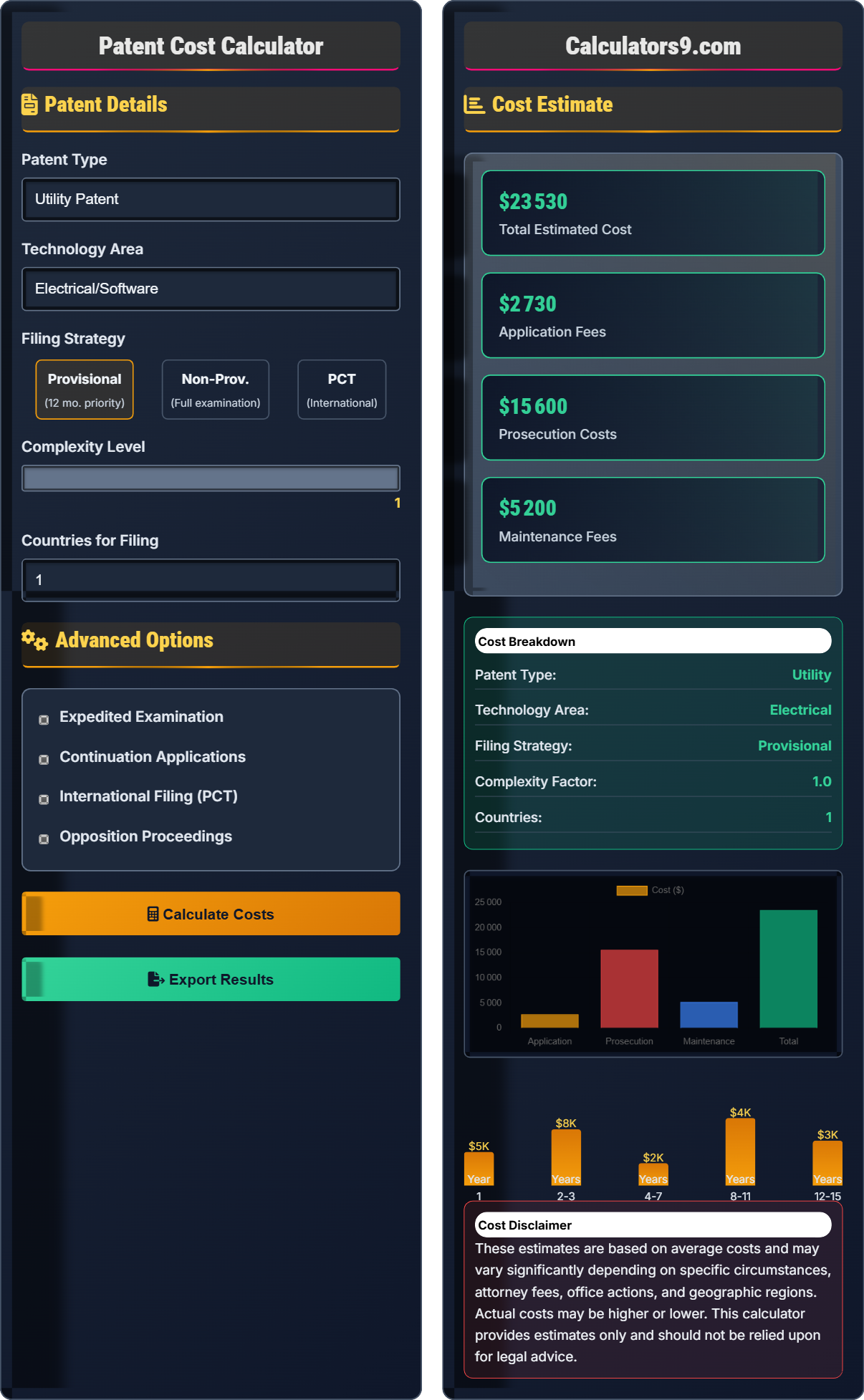
Patent Details
Advanced Options
Cost Estimate
These estimates are based on average costs and may vary significantly depending on specific circumstances, attorney fees, office actions, and geographic regions. Actual costs may be higher or lower. This calculator provides estimates only and should not be relied upon for legal advice.
Patent Cost Framework
Patent costs encompass multiple phases from filing to maintenance. The total cost includes filing fees, attorney fees, prosecution costs, and periodic maintenance fees. Understanding these components helps inventors budget appropriately and make strategic filing decisions.
The standard patent cost calculation uses the following formula:
Where:
- \(TC\) = Total Cost
- \(AF\) = Application Fees
- \(PC\) = Prosecution Costs
- \(MF\) = Maintenance Fees
- \(R\) = Regional Expansion Factor
- \(S\) = Complexity Scale Factor
- \(I\) = International Filing Factor
Several factors influence patent costs:
- Technology Complexity: Software patents often cost more due to prior art challenges
- Number of Claims: More claims increase prosecution costs
- Office Actions: Each rejection requires additional work
- Geographic Coverage: Each country adds filing and prosecution costs
- Attorney Experience: Specialized attorneys command higher fees
- Expedited Processing: Speed increases costs significantly
- Provisional Application: Secure priority date at lower cost ($100-$300)
- Micro Entity Status: Qualify for 75% fee reduction
- Streamlined Claims: Focus on key claims to reduce costs
- Phased Filing: File in key markets first, expand later
- Patent Prosecution Highway: Accelerate examination in other countries
- Regular Reviews: Abandon patents with limited commercial value
Patent Cost Framework
Three main phases: application, prosecution, and maintenance.
\(TC = (AF + PC + MF) \times (1 + R) \times (1 + S) \times (1 + I)\)
Where TC=total cost, AF=application fees, PC=prosecution costs, MF=maintenance fees, R=regional factor, S=complexity factor, I=international factor.
- Utility patents cost $15K-$40K in US
- Design patents cost $2K-$5K in US
- Maintenance fees due at 3.5, 7.5, 11.5 years
Cost Analysis
Pre-filing, filing, prosecution, and maintenance phases each incur distinct costs.
- Estimate base application costs
- Add prosecution cost projections
- Include maintenance fees
- Apply scaling factors
- Technology complexity affects costs
- Geographic expansion multiplies costs
- Office actions increase prosecution costs
Patent Cost Learning Quiz
Which of the following represents the correct sequence of major cost phases in a typical US utility patent application?
The answer is B) Application filing → Prosecution → Maintenance fees. The correct sequence is: 1) Initial application filing with fees, 2) Prosecution phase involving office actions and responses, 3) Maintenance fees paid periodically after grant to keep the patent in force.
Understanding the temporal sequence of patent costs is crucial for budgeting. The filing phase occurs first when submitting the application. The prosecution phase follows, where the patent office examines the application and may issue office actions requiring responses. Finally, maintenance fees are paid periodically after the patent is granted to keep it in force for its full term.
Application Filing: Initial submission with required fees to establish patent application
Prosecution: Process of responding to patent office actions and securing allowance
Maintenance Fees: Periodic payments to keep patent in force after grant
• Filing occurs before prosecution
• Prosecution happens during examination
• Maintenance fees occur after grant
• Remember the timeline: File → Examine → Maintain
• Budget for costs at each phase
• Confusing the order of cost phases
• Forgetting maintenance fees after grant
• Underestimating prosecution costs
Calculate the total cost for a US utility patent with application fees of $5,000, prosecution costs of $8,000, and maintenance fees of $2,000. The invention is in a complex electrical field (complexity factor 1.5), filed in 2 countries (regional factor 1.0), and without international filing (international factor 0). Show your work.
Using the patent cost formula: \(TC = (AF + PC + MF) \times (1 + R) \times (1 + S) \times (1 + I)\)
Given:
- AF = $5,000
- PC = $8,000
- MF = $2,000
- R = 1.0 (2 countries)
- S = 1.5 (complexity factor)
- I = 0 (no international filing)
Step 1: Calculate base cost = AF + PC + MF = $5,000 + $8,000 + $2,000 = $15,000
Step 2: Apply factors = $15,000 × (1 + 1.0) × (1 + 1.5) × (1 + 0) = $15,000 × 2.0 × 2.5 × 1.0 = $75,000
This calculation demonstrates how multiple factors compound to increase patent costs. The complexity factor of 1.5 means costs are 2.5 times the base (1 + 1.5 = 2.5). The regional factor of 1.0 means costs double for 2 countries (1 + 1.0 = 2.0). Together, these factors significantly increase the total cost.
Application Fees (AF): Costs for initial patent filing
Prosecution Costs (PC): Expenses for responding to office actions
Complexity Factor (S): Multiplier based on technical complexity
• Add all base costs before applying factors
• Each factor is added to 1 before multiplication
• Factors multiply together for total effect
• Calculate base cost first
• Apply factors sequentially
• Verify each step before final calculation
• Adding factors instead of multiplying
• Forgetting to add 1 to each factor
• Applying factors incorrectly
An inventor wants to file a PCT application for a mechanical invention ($10,000 base cost) and then enter national phase in 5 countries. The international filing adds a 1.0 factor, and each additional country beyond the first adds 0.2 to the regional factor. Calculate the total cost considering a complexity factor of 1.0 for mechanical inventions.
Step 1: Calculate base cost = $10,000
Step 2: Calculate regional factor
Base factor for first country = 0
Additional factor for 4 extra countries = 4 × 0.2 = 0.8
Total regional factor (R) = 0.8
Step 3: International filing factor (I) = 1.0
Step 4: Complexity factor (S) = 1.0
Step 5: Apply formula
TC = $10,000 × (1 + 0.8) × (1 + 1.0) × (1 + 1.0) = $10,000 × 1.8 × 2.0 × 2.0 = $72,000
Therefore, the total cost would be $72,000.
This example shows how international filing dramatically increases costs. The PCT filing adds a 100% increase (factor of 1.0), and multiple countries add another 80% (factor of 0.8). The complexity factor remains neutral at 1.0 for mechanical inventions, but the international and regional factors compound to quadruple the base cost.
PCT Application: International patent application under Patent Cooperation Treaty
National Phase: Entry into individual countries after PCT process
Regional Factor: Multiplier based on number of countries
• PCT filing precedes national phase entry
• Each country beyond first adds to regional factor
• International and regional factors compound
• Plan geographic strategy carefully
• Consider phased country entry
• Evaluate commercial value in each market
• Underestimating PCT-to-national-phase costs
• Not accounting for translation requirements
• Forgetting country-specific requirements
A university researcher qualifies for micro entity status, which provides 75% reduction in USPTO fees. Calculate the savings for a basic utility patent application with filing fees of $400 (normal) vs $100 (micro entity), search fees of $600 (normal) vs $150 (micro entity), and examination fees of $1,600 (normal) vs $400 (micro entity). What is the total savings percentage?
Step 1: Calculate normal fees = $400 + $600 + $1,600 = $2,600
Step 2: Calculate micro entity fees = $100 + $150 + $400 = $650
Step 3: Calculate savings = $2,600 - $650 = $1,950
Step 4: Calculate savings percentage = ($1,950 / $2,600) × 100% = 75%
Therefore, the inventor saves $1,950, representing a 75% reduction in official fees.
Micro entity status provides significant cost savings for qualifying applicants, particularly universities and independent inventors. The 75% reduction applies to most USPTO fees, substantially lowering the barrier to patent protection. This can make the difference between pursuing and forgoing patent protection.
Micro Entity: Reduced fee status for qualifying small inventors
Small Entity: 50% reduction status for qualifying entities
Official Fees: Fees charged by patent offices
• Micro entity requires specific qualifications
• Applies only to USPTO fees, not attorney fees
• Must meet income and filing history requirements
• Verify micro entity eligibility early
• Apply for status when filing
• Understand limitations and requirements
• Not verifying eligibility requirements
• Assuming all fees are reduced
• Missing application deadlines
When are maintenance fees due for a US utility patent to keep it in force?
The answer is C) At 3.5, 7.5, and 11.5 years after grant. US utility patents require maintenance fees at three specific intervals after the patent is granted: 3.5 years (surrounding 4 years), 7.5 years (surrounding 8 years), and 11.5 years (surrounding 12 years) from the grant date.
Maintenance fees are critical for keeping a patent in force. Unlike annual fees, they're due at specific intervals that increase in amount. Missing a maintenance fee deadline can result in patent expiration. The fees are approximately $1,000, $2,500, and $4,000 for small entities at the three intervals.
Maintenance Fees: Periodic payments to keep patent in force
Grant Date: When patent officially issues
Small Entity: 50% reduction status for qualifying entities
• Fees due after grant, not filing
• Specific intervals: 3.5, 7.5, 11.5 years
• Increasing amounts with each payment
• Mark calendar for maintenance fee dates
• Set up automatic reminders
• Consider value before paying fees
• Confusing filing date with grant date
• Thinking fees are annual
• Forgetting to pay maintenance fees
Patent Cost FAQ
Q: What's the difference between provisional and non-provisional patent applications in terms of costs and benefits?
A: Provisional applications provide a cost-effective way to secure a priority date while deferring full examination costs. Key differences:
Provisional: Lower upfront cost (~$100-$300 official fees), simpler requirements, 12-month pendency, no examination. Formula impact: \( TC_{provisional} = (AF_{provisional} + PC_{later} + MF) \times \text{factors} \) where \( AF_{provisional} \) is minimal.
Non-provisional: Full examination begins immediately, higher upfront costs (~$5,000-$15,000 total first-year costs), complete requirements. Formula: \( TC_{non-provisional} = (AF_{full} + PC_{immediate} + MF) \times \text{factors} \) where \( AF_{full} \) includes full filing, search, and examination fees.
Provisional applications allow inventors to defer ~$10,000-$20,000 in costs while testing market viability. However, the subsequent non-provisional filing still incurs full prosecution costs plus the complexity of incorporating improvements made during the 12-month period.
Q: How do I decide whether to file in multiple countries given the exponential cost increase?
A: The decision should be based on commercial value in each market versus cost. For a patent with base cost \( BC = \$15{,}000 \) and a regional factor of 0.2 per country beyond the first, the cost for \( n \) countries is:
\( TC = BC \times (1 + 0.2(n-1)) \times \text{other factors} \)
For 1 country: \( TC = 15{,}000 \times 1.0 = \$15{,}000 \)
For 3 countries: \( TC = 15{,}000 \times 1.4 = \$21{,}000 \)
For 5 countries: \( TC = 15{,}000 \times 1.8 = \$27{,}000 \)
Key considerations:
1. Market Size: Does the market justify the investment?
2. Competitive Landscape: Where do competitors operate?
3. Manufacturing Locations: Where is production occurring?
4. Enforcement Capability: Can you afford to litigate internationally?
A common strategy is to file in key markets first (US, EU, China) and expand based on commercial success.