Settlement Offer Calculator
Fast legal settlement calculator • 2026 laws
Settlement Offer Formula:
Show the calculator\( SO = (PV \times P) - LC \)
Where:
- \( SO \) = Settlement Offer amount
- \( PV \) = Potential verdict amount
- \( P \) = Probability of winning
- \( LC \) = Litigation costs
Alternative Expected Value Formula: \( EV = (W \times PW) - (L \times PL) \) where W=winning amount, PW=probability of winning, L=losing costs, PL=probability of losing.
Optimal settlement range: 70-80% of expected value for plaintiff, 20-30% for defendant.
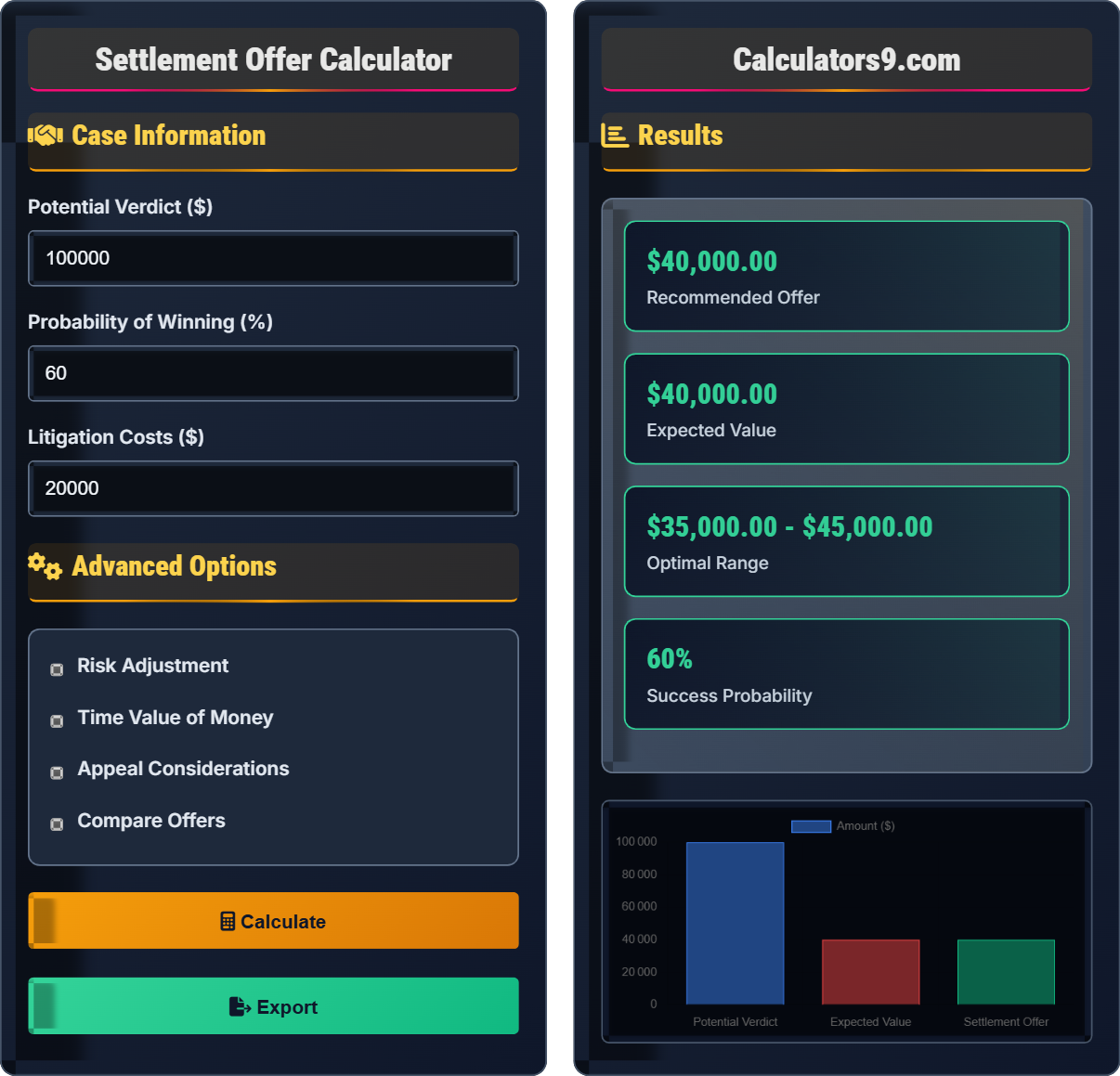
Example: For a case with $100,000 potential verdict, 60% chance of winning, and $20,000 litigation costs:
SO = ($100,000 × 0.60) - $20,000 = $60,000 - $20,000 = $40,000
Optimal offer range: $35,000-$45,000
Therefore, the settlement offer should be approximately $40,000.
Case Information
Advanced Options
Results
| Information | Value |
|---|
| Calculation | Details |
|---|
Comprehensive Legal Guide
Settlement is a negotiated resolution of a dispute without proceeding to trial. Parties agree to resolve their differences by accepting compensation or other consideration in lieu of pursuing litigation. Settlements offer certainty, save time and money, and preserve relationships. The decision to settle involves weighing the potential outcomes against the costs and risks of continued litigation.
Common calculation approaches include:
Where:
- \(SO\) = Settlement Offer
- \(PV\) = Potential Verdict
- \(P\) = Probability of winning
- \(LC\) = Litigation Costs
- \(EV\) = Expected Value
- \(W\) = Win amount
- \(PW\) = Probability of winning
- \(L\) = Loss amount
- \(PL\) = Probability of losing
These formulas provide analytical frameworks.
Key strategic elements in settlement negotiations:
- Opening Offers: Set tone for negotiations
- Concessions: Gradual movement toward agreement
- Alternatives: BATNA (Best Alternative to Negotiated Agreement)
- Timing: When to make offers and accept deals
- Information: Leverage and disclosure strategies
- Prepare thoroughly: Know your case strengths and weaknesses
- Set realistic goals: Establish target ranges and walk-away points
- Be patient: Allow time for productive negotiation
- Communicate clearly: Articulate positions and interests
- Consider interests: Look beyond positions to underlying needs
Legal Fundamentals
Negotiated resolution of legal disputes without trial.
\( SO = (PV \times P) - LC \)
Where SO=settlement offer, PV=potential verdict, P=probability, LC=litigation costs.
- Based on risk analysis
- Consider litigation costs
- Account for uncertainty
Application Guidelines
Case strength, financial resources, time/costs, reputation, risk tolerance
- Opening offers and positioning
- Gradual concessions
- Alternative options (BATNA)
- Negotiation timing
- Information strategy
- Each case is unique
- Strategic timing matters
- Information advantage helps
Settlement Calculation Learning Quiz
What is the primary advantage of settling a case rather than going to trial?
The answer is B) Certainty and reduced costs. Settlement provides certainty about the outcome and avoids the time, expense, and uncertainty of trial. While settlements may involve compromise, they eliminate the risk of losing entirely at trial and reduce legal fees. The certainty of a known outcome is often preferable to the uncertainty of trial results.
Students must understand that settlement is fundamentally about managing risk and cost. Rather than facing the uncertainty of jury decisions and trial outcomes, parties can agree on a guaranteed result. This risk management approach is central to settlement negotiations and legal practice.
Settlement: Resolution without trial
Certainty: Known outcome vs. trial risk
Risk Management: Controlling potential losses
• Settlement eliminates trial uncertainty
• Reduces litigation costs
• Provides guaranteed outcome
• Consider cost-benefit analysis
• Evaluate risk tolerance
• Assess case strength realistically
• Expecting guaranteed higher recovery
• Ignoring litigation costs
• Overvaluing public relations benefits
Calculate the settlement offer using the formula SO = (PV × P) - LC, where potential verdict is $80,000, probability of winning is 70%, and litigation costs are $15,000.
Step 1: Identify the formula: SO = (PV × P) - LC
Step 2: Identify values
Potential Verdict (PV) = $80,000
Probability of Winning (P) = 70% = 0.70
Litigation Costs (LC) = $15,000
Step 3: Apply formula: SO = ($80,000 × 0.70) - $15,000
SO = $56,000 - $15,000 = $41,000
Therefore, the settlement offer should be $41,000.
This problem demonstrates the basic settlement formula that balances potential recovery against litigation costs. Students learn to incorporate both the probability of success and the costs of continued litigation into their calculations. The formula reflects the risk-adjusted value of the case.
Expected Value: Probability-weighted outcome
Risk-Adjusted Value: Value considering uncertaintyLitigation Costs: Expenses of continued legal action
• Convert percentages to decimals
• Subtract litigation costs from expected value
• Consider probability in calculations
• Always convert % to decimal (70% = 0.70)
• Consider costs as reduction from expected value
• Probability affects expected value directly
• Forgetting to convert percentage to decimal
• Adding costs instead of subtracting
• Not considering probability in calculation
A case has a potential verdict of $120,000 with 55% chance of winning and $25,000 in litigation costs. If a 15% risk adjustment is applied to account for trial uncertainties, what is the adjusted settlement offer?
Step 1: Calculate basic settlement: ($120,000 × 0.55) - $25,000
Basic SO = $66,000 - $25,000 = $41,000
Step 2: Apply risk adjustment: $41,000 × (1 - 0.15)
Adjusted SO = $41,000 × 0.85 = $34,850
Therefore, the risk-adjusted settlement offer is $34,850.
This example demonstrates how to account for additional trial risks beyond the basic probability calculation. Risk adjustments account for factors like jury unpredictability, evidentiary challenges, and other trial-specific uncertainties that may not be captured in the initial probability assessment.
Risk Adjustment: Additional discount for trial uncertainties
Trial Risks: Uncertainties beyond case merits
Probability Assessment: Initial win probability
• Risk adjustment reduces settlement value
• Applied after basic calculation
• Accounts for trial-specific uncertainties
• Apply risk adjustment as multiplier
• Consider jury bias and prejudice
• Account for evidentiary challenges
• Adding risk adjustment instead of subtracting
• Not converting percentage to decimal
• Confusing risk adjustment with probability
Using expected value analysis, calculate the settlement range for a case where the plaintiff could win $150,000 (70% probability) but lose and owe $30,000 in costs (30% probability). What is the expected value and recommended settlement range?
Step 1: Apply expected value formula: EV = (W × PW) - (L × PL)
Step 2: Identify values
Win Amount (W) = $150,000
Probability of Winning (PW) = 70% = 0.70
Loss Amount (L) = $30,000
Probability of Losing (PL) = 30% = 0.30
Step 3: Calculate: EV = ($150,000 × 0.70) - ($30,000 × 0.30)
EV = $105,000 - $9,000 = $96,000
Recommended range: $86,400 - $105,600 (±10% of expected value)
This demonstrates the expected value approach that considers both winning and losing scenarios. Unlike the basic formula, this method accounts for the possibility of paying costs if the case is lost. This more comprehensive analysis is particularly useful for contingency fee arrangements or cases with high loser-pays risks.
Expected Value: Weighted average of all possible outcomes
Contingency Risk: Possibility of paying opponent's costs
Weighted Average: Outcome multiplied by probability
• Consider both winning and losing scenarios
• Account for loser-pays provisions
• Weight outcomes by probability
• Calculate both positive and negative outcomes
• Consider jurisdiction-specific rules
• Account for cost-shifting provisions
• Only considering winning scenario
• Forgetting to account for losing costs
• Not weighting by probability
What is the most important factor in determining a settlement offer?
The answer is B) Case strength and risk analysis. Effective settlement offers are based on objective evaluation of the case merits, probability of success, potential damages, and litigation costs. While other factors may influence negotiations, the core decision should be grounded in realistic assessment of the case's prospects and associated risks.
Students must understand that settlement negotiations should be based on rational, analytical assessment rather than emotion or external pressures. The foundation of any settlement discussion is the realistic evaluation of the case's merits and the associated risks and costs of continued litigation.
Case Strength: Quality of legal arguments and evidence
Risk Analysis: Evaluation of potential outcomes
Objective Assessment: Rational evaluation without bias
• Base on case merits and probability
• Consider litigation costs and risks
• Maintain objectivity in evaluation
• Conduct honest case evaluation
• Consider opposing party's perspective
• Evaluate alternatives to litigation
• Letting emotions drive decisions
• Overvaluing case strength
• Ignoring litigation costs
FAQ
Q: How do I determine the probability of winning a case?
A: Probability assessment involves:
1. Case Strength: Quality of evidence and legal precedents
2. Jury Appeal: Likelihood of favorable jury reception
3. Opposition Strength: Quality of opposing arguments
4. Expert Testimony: Reliability of expert witnesses
5. Legal Complexity: Difficulty of legal issues
Formula: \( P = \frac{\text{Favorable Factors}}{\text{Total Relevant Factors}} \)
Q: What's the difference between expected value and settlement value?
A: The main differences are:
- Expected Value: Mathematical calculation of probable outcome
- Settlement Value: Adjusted for negotiation strategy and risk
- Adjustments: Settlement value accounts for trial risks, costs, and negotiation dynamics
- Range: Settlement typically 70-80% of expected value for plaintiff
For example, with $100,000 expected value, settlement might be $70,000-$80,000 considering trial risks.