Statute of Limitations Calculator
Fast legal deadline calculator • 2026 laws
Statute of Limitations Formula:
Show the calculator\( \text{Deadline} = \text{Incident Date} + \text{Limitation Period} \)
Where:
- \( \text{Incident Date} \) = date when cause of action accrued
- \( \text{Limitation Period} \) = statutory time limit for filing suit
For discovery rule: \( \text{Deadline} = \text{Discovery Date} + \text{Limitation Period} \)
The statute of limitations varies by jurisdiction and type of claim. Civil claims typically range from 1-6 years, while criminal offenses have different timeframes (felonies often have no limitation). The discovery rule extends deadlines when injury isn't immediately apparent.
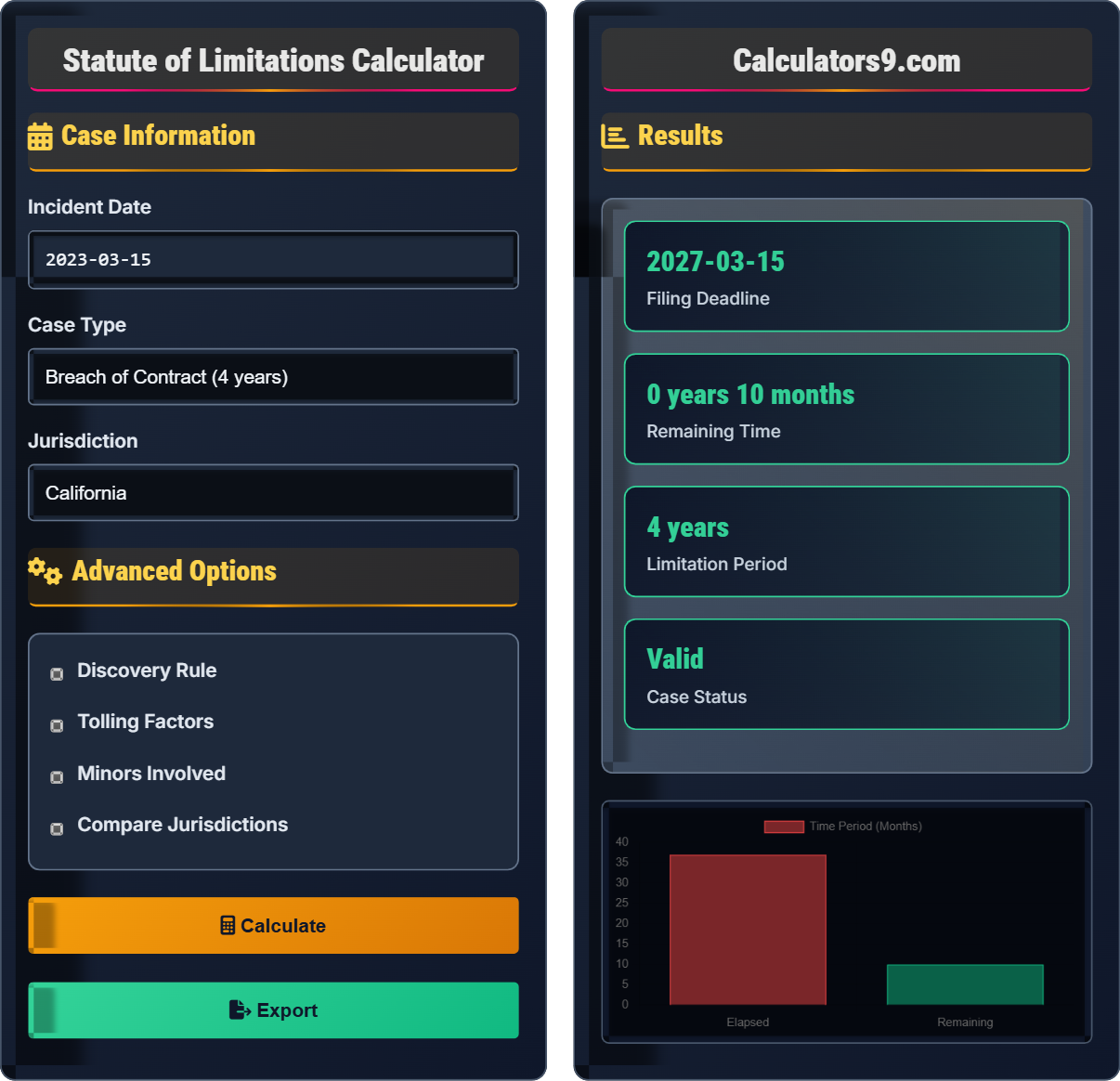
Example: For a breach of contract claim with 4-year statute starting March 15, 2023:
Deadline = March 15, 2023 + 4 years = March 15, 2027
Any lawsuit filed after March 15, 2027 would be time-barred.
Case Information
Advanced Options
Results
| Information | Value |
|---|
| Calculation | Details |
|---|
Comprehensive Legal Guide
A statute of limitations is a law that sets the maximum time after an event within which legal proceedings may be initiated. These statutes promote justice by ensuring that claims are brought while evidence is fresh and witnesses' memories are reliable. The limitation period varies by type of claim and jurisdiction. Once the period expires, the claim is time-barred and cannot proceed.
The basic calculation follows:
Where:
- \(\text{Accrual Date}\) = when cause of action arose
- \(\text{Limitation Period}\) = statutory timeframe
Special rules apply: Discovery rule, tolling, and minority exceptions.
Several factors can extend or pause the limitation period:
- Discovery Rule: Period starts when injury discovered
- Tolling: Suspension during defendant's absence
- Minority: Extended for minors until age 18
- Continuous Treatment: Extended for ongoing medical care
- Fraudulent Concealment: Extended when defendant hid facts
- Act promptly: Don't wait until deadline approaches
- Verify jurisdiction: State laws vary significantly
- Document everything: Keep detailed records
- Consult attorneys: Complex cases require legal advice
- Consider extensions: Evaluate all possible exceptions
Legal Fundamentals
Legal time limit to initiate legal proceedings after an event occurs.
\( \text{Deadline} = \text{Accrual Date} + \text{Limitation Period} \)
Where Deadline=last day to file suit, Accrual Date=when claim arose, Period=statutory time limit.
- Varies by claim type and jurisdiction
- Once expired, claim is time-barred
- Exceptions may extend deadlines
Application Guidelines
Breach of Contract: 4 years, Personal Injury: 3 years, Medical Malpractice: 2-3 years, Fraud: 3 years
- Discovery Rule: Starts when injury discovered
- Tolling: Suspends during certain circumstances
- Minority: Extended until age 18
- Fraud: Extended for concealed facts
- State laws differ significantly
- Federal law applies to federal crimes
- Legal advice recommended for complex cases
Statute of Limitations Learning Quiz
What is the primary purpose of statutes of limitations?
The answer is B) To ensure claims are brought while evidence is fresh. Statutes of limitations serve important public policy purposes: they promote justice by ensuring that trials are based on reliable evidence, prevent the prosecution of stale claims where memories have faded and evidence may be lost, and provide certainty and finality to potential defendants. This ensures fair trials where both parties can adequately prepare their cases.
Students must understand that statutes of limitations aren't meant to favor one party over another, but rather to promote fairness in the legal system. As time passes, witnesses' memories fade, documents may be lost, and physical evidence may deteriorate. The law recognizes that justice is best served when cases are heard while evidence is still reliable and accessible.
Statute of Limitations: Time limit to initiate legal proceedings
Time-Barred: Claim no longer legally actionable
Public Policy: Legal principles serving society's interests
• Evidence reliability decreases over time
• Fairness requires reasonable time limits
• Certainty benefits both parties
• Remember: fairness and evidence preservation
• Act promptly after discovering injury
• Consult lawyers early for complex cases
• Assuming all claims can be filed anytime
• Waiting too long to pursue legal remedies
• Not understanding jurisdictional differences
If a breach of contract occurred on January 15, 2022, and the applicable statute of limitations is 4 years, what is the last day to file a lawsuit?
Step 1: Start with incident date: January 15, 2022
Step 2: Add limitation period: 4 years
Step 3: Calculate deadline: January 15, 2022 + 4 years = January 15, 2026
Step 4: Last day to file is January 15, 2026 (inclusive counting)
Therefore, the lawsuit must be filed by January 15, 2026.
This problem demonstrates the basic calculation method. Students learn to add the statutory period to the accrual date. Courts typically count the full day of the anniversary date as the last day to file. This calculation is straightforward when no exceptions apply, but students must be aware that various factors can extend or modify this basic timeline.
Accrual Date: When cause of action arises
Limitation Period: Statutory time limitDeadline: Last day to file lawsuit
• Count full day of anniversary date
• Include leap years in calculations
• Check for jurisdictional variations
• Add years directly for simple calculations
• Verify with calendar when close to deadline
• Consider weekends and holidays for filing
• Not counting the anniversary date as final day
• Forgetting leap years in long periods
• Missing jurisdictional differences
A patient discovers medical malpractice on June 1, 2024, that occurred on March 15, 2022. If the jurisdiction has a 2-year statute of limitations from discovery, what is the deadline to file a lawsuit?
Step 1: Apply discovery rule - use discovery date as starting point
Step 2: Discovery date: June 1, 2024
Step 3: Add limitation period: 2 years
Step 4: Calculate deadline: June 1, 2024 + 2 years = June 1, 2026
Step 5: Last day to file is June 1, 2026
Therefore, the lawsuit must be filed by June 1, 2026.
This example illustrates the discovery rule, which modifies the basic calculation. The discovery rule applies when an injury isn't immediately apparent. Instead of using the incident date, the limitation period begins when the plaintiff discovers or reasonably should have discovered the injury. This prevents unfair results when injuries are latent.
Discovery Rule: Period starts when injury discovered
Latent Injury: Not immediately apparent
Reasonable Discovery: When person should have known
• Discovery rule applies to latent injuries
• Reasonable person standard used
• Some jurisdictions have separate limits
• Look for "should have discovered" dates
• Consider when symptoms appeared
• Document discovery date precisely
• Using incident date instead of discovery date
• Not understanding when discovery occurs
• Missing jurisdictional variations
A plaintiff files a lawsuit on February 15, 2024, for an incident that occurred on March 1, 2021. The applicable statute is 3 years, but the defendant was out of state from October 1, 2022, to March 1, 2023. Does the lawsuit fall within the limitation period?
Step 1: Calculate basic limitation period: March 1, 2021 + 3 years = March 1, 2024
Step 2: Identify tolling period: October 1, 2022 to March 1, 2023 = 5 months
Step 3: Extend deadline by tolling period: March 1, 2024 + 5 months = August 1, 2024
Step 4: Compare filing date: February 15, 2024 vs. August 1, 2024
Since February 15, 2024 is before August 1, 2024, the lawsuit is timely filed.
This demonstrates how tolling can extend limitation periods. Tolling temporarily suspends the running of the statute, typically during circumstances that make it unfair to expect the plaintiff to file suit (like defendant's absence from jurisdiction). The extension provides additional time beyond what would otherwise be the deadline.
Tolling: Temporary suspension of limitation period
Extension: Addition to original deadline
Jurisdictional Absence: Defendant not in state
• Tolling periods are added to original deadline
• Must meet specific legal criteria
• Varies by state and circumstance
• Identify when tolling begins and ends
• Calculate extension period separately
• Add extension to original deadline
• Not recognizing tolling circumstances
• Adding tolling to original period instead of deadline
• Assuming all absences qualify for tolling
Under most jurisdictions, when does the statute of limitations begin to run for a minor's injury?
The answer is C) From the minor's 18th birthday (age of majority). Most jurisdictions extend the statute of limitations for minors, beginning the limitation period only when the minor reaches the age of majority (typically 18). This recognizes that minors cannot legally file lawsuits and ensures they have a reasonable opportunity to pursue their claims once they become adults.
This exception reflects the legal principle that minors cannot act independently in legal matters. The extension provides minors with the same opportunity as adults to pursue their claims. However, there are usually maximum age limits (such as filing by age 20 or 21), preventing unlimited extensions. Students should understand this protection for vulnerable parties.
Minor: Person under age of majority (usually 18)
Age of Majority: Age when legal adulthood begins
Extension: Delayed start of limitation period
• Period begins at age of majority
• Usually maximum age limits apply
• Varies by jurisdiction and claim type
• Check for maximum age limits
• Verify by state and claim type
• Consider emancipation effects
• Not accounting for minority extensions
• Assuming automatic lifelong extension
• Forgetting maximum age limits
FAQ
Q: How do I determine the correct statute of limitations for a claim?
A: Determining the correct statute requires:
1. Identifying the type of claim: Contract, tort, etc.
2. Determining the applicable jurisdiction: Federal, state, county
3. Consulting the relevant statutes: Each jurisdiction has specific timeframes
4. Checking for exceptions: Discovery rule, tolling, minority, etc.
For example, California Civil Code §337(a) provides 4 years for written contracts, while §340 provides 2 years for personal injury. The calculation is:
\( \text{Deadline} = \text{Accrual Date} + \text{Statutory Period} \)
Q: What's the difference between the discovery rule and fraudulent concealment?
A: Both extend limitation periods but under different circumstances:
- Discovery Rule: Applies when injury wasn't immediately apparent. Period starts when plaintiff discovers or reasonably should have discovered the injury.
- Fraudulent Concealment: Applies when defendant actively hid facts. Extends period beyond discovery if concealment prevented reasonable discovery.
For example, in medical malpractice: Discovery rule starts when patient learns of injury, while fraudulent concealment might apply if doctor destroyed records to hide error.