Trademark Renewal Calculator
Brand protection tool • 2026 edition
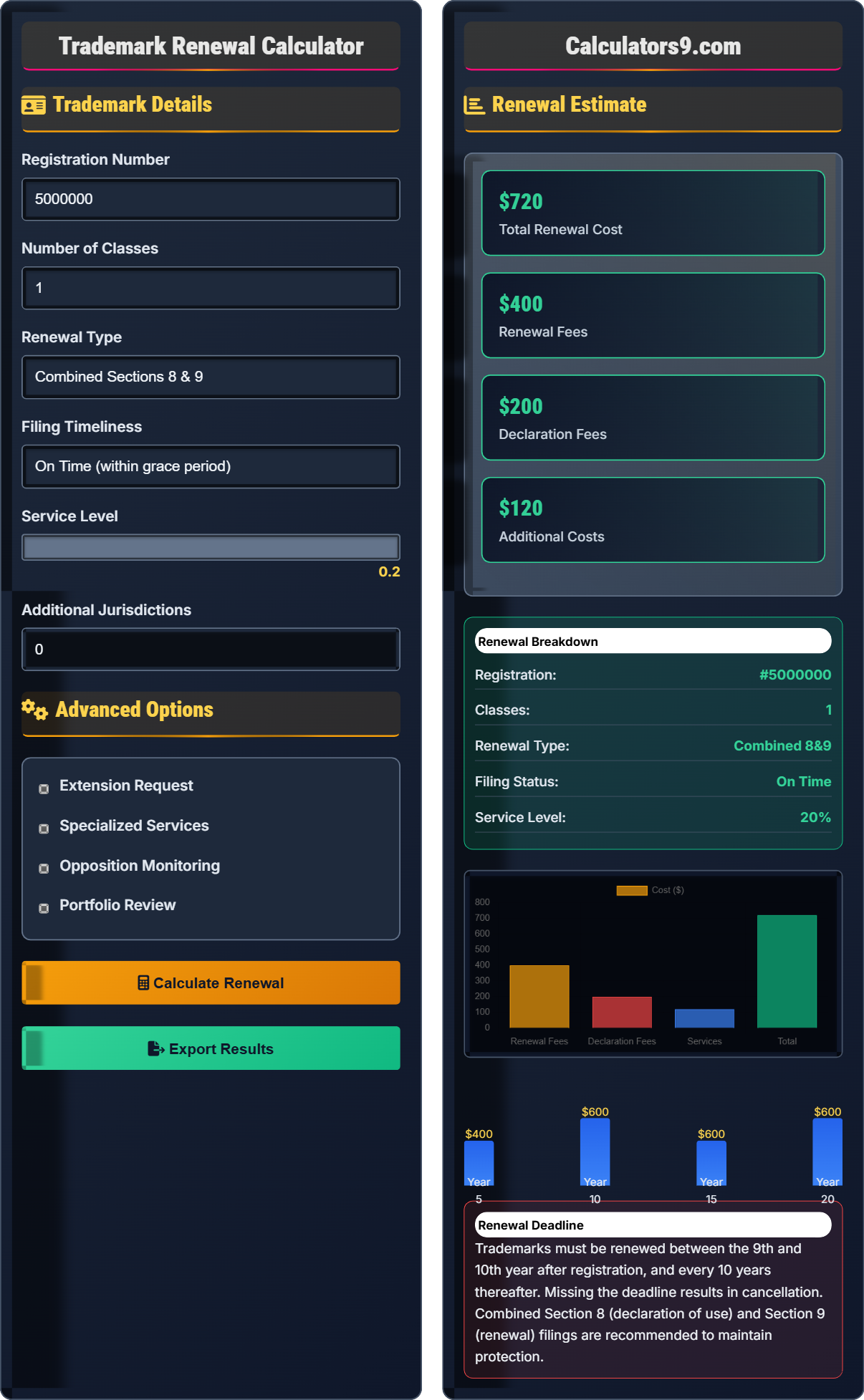
Trademark Renewal Formula:
Show the calculator\( TRC = (RF + DF) \times C \times (1 + L) \times (1 + S) \times (1 + E) \)
Where:
- \( TRC \) = Total Renewal Cost
- \( RF \) = Renewal Fee per Class (USPTO standard)
- \( DF \) = Declaration of Use Fee per Class
- \( C \) = Number of Classes
- \( L \) = Late Filing Surcharge (if applicable)
- \( S \) = Specialized Services Factor (legal assistance)
- \( E \) = Extension Request Factor (if needed)
This formula calculates total trademark renewal costs including official fees, declarations of use, and associated services. Costs vary based on number of classes, filing timeliness, and required services.
Example: For a trademark with \( RF = \$400 \), \( DF = \$200 \), \( C = 3 \) classes, filed on time (\( L = 0 \)), with standard legal services (\( S = 0.2 \)), and no extension (\( E = 0 \)):
\( TRC = (400 + 200) \times 3 \times (1 + 0) \times (1 + 0.2) \times (1 + 0) = 600 \times 3 \times 1.2 = \$2{,}160 \)
Thus, the total renewal cost would be $2,160.
Trademark Details
Advanced Options
Renewal Estimate
Trademarks must be renewed between the 9th and 10th year after registration, and every 10 years thereafter. Missing the deadline results in cancellation. Combined Section 8 (declaration of use) and Section 9 (renewal) filings are recommended to maintain protection.
Trademark Renewal Framework
Trademark renewals require filing specific forms with the USPTO at designated intervals. The primary renewal occurs between the 9th and 10th year after registration, with subsequent renewals every 10 years. Failure to renew results in cancellation of trademark rights.
The standard trademark renewal cost calculation uses the following formula:
Where:
- \(TRC\) = Total Renewal Cost
- \(RF\) = Renewal Fee per Class
- \(DF\) = Declaration of Use Fee per Class
- \(C\) = Number of Classes
- \(L\) = Late Filing Surcharge Factor
- \(S\) = Service Level Factor
- \(E\) = Extension Request Factor
Renewal filings require specific documentation:
- Section 8: Statement of continued use or excusable nonuse
- Section 9: Application for renewal
- Specimens: Current specimens showing mark in use
- Fee Payment: Required renewal and declaration fees
- Power of Attorney: If represented by attorney
- Address Updates: Current owner and correspondence information
- Combined Filing: File Sections 8 and 9 together to save costs
- Early Renewal: Renew up to 1 year before expiration
- Class Review: Remove unused classes to reduce fees
- Deadline Tracking: Set calendar reminders for renewal dates
- Professional Assistance: Use trademark attorney for complex portfolios
- Global Coordination: Align international renewals with US schedule
Renewal Framework
Trademarks must be renewed every 10 years with required declarations of use.
\(TRC = (RF + DF) \times C \times (1 + L) \times (1 + S) \times (1 + E)\)
Where TRC=total renewal cost, RF=renewal fee, DF=declaration fee, C=classes, L=late factor, S=service factor, E=extension factor.
- Renew between 9th and 10th year
- Renew every 10 years thereafter
- Combined Sections 8&9 recommended
Cost Analysis
Renewal fees, declaration fees, and service costs vary by class and timing.
- Identify number of classes
- Determine applicable fees
- Apply timing adjustments
- Add service costs
- Late filing incurs surcharges
- Multi-class renewals multiply costs
- Professional services add to total
Trademark Renewal Learning Quiz
When must a trademark be renewed for the first time after registration?
The answer is B) Between the 9th and 10th year after registration. The first mandatory renewal for a US trademark occurs between the 9th and 10th year after registration. After that, renewals are required every 10 years to maintain protection.
Understanding the trademark renewal timeline is critical for maintaining rights. The first renewal occurs between years 9-10, not year 10 exactly. There is a 6-month grace period available with additional fees if the deadline is missed, but missing the grace period results in cancellation of the trademark.
Renewal Deadline: Timeframe for filing renewal to maintain trademark protection
Grace Period: Extended timeframe available with surcharge
Cancellation: Loss of trademark rights due to non-renewal
• First renewal: Years 9-10 after registration
• Subsequent renewals: Every 10 years
• Grace period available with surcharge
• Mark calendar for year 9 deadline
• Set multiple reminders
• Consider early renewal to avoid rush
• Confusing renewal with maintenance filings
• Thinking annual renewals are required
• Missing the critical 9-10 year window
Calculate the renewal cost for a trademark with 3 classes, renewal fee of $400 per class, declaration fee of $200 per class, filed on time (no late surcharge), with a service level factor of 0.3 (30%), and no extensions. Show your work.
Using the renewal formula: \(TRC = (RF + DF) \times C \times (1 + L) \times (1 + S) \times (1 + E)\)
Given:
- RF = $400 per class
- DF = $200 per class
- C = 3 classes
- L = 0 (on time)
- S = 0.3 (service level)
- E = 0 (no extension)
Step 1: Calculate base fees per class = RF + DF = $400 + $200 = $600
Step 2: Apply to all classes = $600 × 3 = $1,800
Step 3: Apply service factor = $1,800 × (1 + 0.3) = $1,800 × 1.3 = $2,340
Step 4: Apply other factors = $2,340 × (1 + 0) × (1 + 0) = $2,340
This calculation demonstrates how the number of classes directly multiplies renewal costs. The service level factor of 0.3 means additional costs equal 30% of the base renewal amount. All factors compound to determine the final cost, emphasizing the importance of planning for renewal expenses.
Renewal Fee (RF): Official fee for trademark renewal
Declaration Fee (DF): Fee for Section 8 declaration
Service Level Factor (S): Multiplier for professional services
• Fees apply per class
• Multiply before applying factors
• Add 1 to each factor before multiplication
• Calculate per-class costs first
• Apply class multiplication before other factors
• Verify each calculation step
• Forgetting to multiply by number of classes
• Adding factors instead of multiplying
• Misapplying the order of operations
A trademark owner misses the 9-10 year renewal deadline and files during the 6-month grace period. The renewal fee is $400 per class for 2 classes, declaration fee is $200 per class, and the grace period surcharge is 50% of the total official fees. Calculate the total renewal cost including the late surcharge.
Step 1: Calculate base official fees
Per class: $400 (renewal) + $200 (declaration) = $600
For 2 classes: $600 × 2 = $1,200
Step 2: Calculate grace period surcharge
Surcharge = 50% of official fees = $1,200 × 0.5 = $600
Step 3: Calculate total cost
Total = Base fees + Surcharge = $1,200 + $600 = $1,800
Therefore, the total renewal cost with late surcharge is $1,800.
This example illustrates the significant cost impact of late filing. The grace period surcharge equals 50% of the original fees, effectively increasing the renewal cost by 50%. For trademarks with multiple classes, this penalty can be substantial, emphasizing the importance of meeting renewal deadlines.
Grace Period: Extended filing window with surcharge
Official Fees: Fees charged by the trademark office
Surcharge: Additional fee for late filing
• Grace period is 6 months after deadline
• Surcharge is 50% of official fees
• No further extensions after grace period
• Set calendar alerts well before deadline
• Consider early renewal to avoid penalties
• Plan for grace period if needed
• Assuming unlimited time for renewal
• Underestimating grace period costs
• Confusing grace period with extensions
A company has a trademark registered in 5 classes with renewal fees of $400 per class and declaration fees of $200 per class. During portfolio review, they determine they only use the mark in 3 of the 5 classes. Calculate the savings by dropping 2 unused classes for renewal. Also calculate the renewal cost if they had kept all 5 classes but filed late during the grace period.
Scenario 1: Renew only 3 classes (on time)
Per class: $400 + $200 = $600
For 3 classes: $600 × 3 = $1,800
Scenario 2: Renew all 5 classes (on time)
For 5 classes: $600 × 5 = $3,000
Savings by dropping 2 classes: $3,000 - $1,800 = $1,200
Scenario 3: Renew all 5 classes (late with grace period)
Base fees: $600 × 5 = $3,000
Grace period surcharge: $3,000 × 0.5 = $1,500
Total late cost: $3,000 + $1,500 = $4,500
The savings from dropping 2 classes is $1,200, while the penalty for late filing of all 5 classes adds $1,500 in surcharges.
This demonstrates the dual benefit of portfolio optimization: reducing costs by eliminating unused classes and avoiding penalties by meeting deadlines. The combination of both strategies maximizes cost efficiency. Regular portfolio reviews help identify opportunities to reduce renewal costs while maintaining necessary protection.
Portfolio Optimization: Strategic management of trademark portfolio
Unused Classes: Trademark registrations not in commercial use
Cost Efficiency: Minimizing expenses while maintaining protection
• Only renew classes in actual use
• Unused classes increase renewal costs
• Portfolio reviews should be periodic
• Conduct annual portfolio reviews
• Document use in each class
• Plan renewals well in advance
• Renewing unused classes unnecessarily
• Not tracking use across all classes
• Failing to plan for renewal costs
What must be included with a Section 8 declaration of continued use?
The answer is B) Specimens showing current use of the mark. Section 8 declarations must include specimens that show the trademark is currently in use in commerce. These specimens must demonstrate use of the mark in connection with the goods/services identified in the registration.
The specimen requirement is crucial for maintaining trademark rights. The specimens must show the mark as actually used in commerce, not just as registered. For goods, this is typically product packaging or labels. For services, it's advertising materials or displays showing the mark in connection with the services.
Specimen: Actual example of trademark use in commerce
Section 8: Declaration of continued use requirement
Use in Commerce: Actual commercial use of the trademark
• Specimens must show actual use
• Must match goods/services in registration
• Required for Section 8 declarations
• Keep current specimens ready
• Ensure specimens match registration
• Document use regularly
• Submitting specimens that don't match registration
• Not having specimens ready for renewal
• Confusing specimens with other documents
Trademark Renewal FAQ
Q: What's the difference between Section 8 and Section 9 filings in trademark renewal?
A: Section 8 and Section 9 serve different purposes in trademark maintenance:
Section 8: Declaration of continued use. Required to prove the mark is still in use between years 5-6 (optional) and years 9-10 (mandatory). Formula impact: \( DF \times C \) where \( DF \) is the declaration fee.
Section 9: Application for renewal. Required to extend the registration term. Due between years 9-10 and every 10 years thereafter. Formula impact: \( RF \times C \) where \( RF \) is the renewal fee.
For a trademark with \( RF = \$400 \) and \( DF = \$200 \) per class, combined filing for \( C = 3 \) classes costs: \( (400 + 200) \times 3 = \$1{,}800 \), which is more efficient than filing separately.
Combined Section 8 and 9 filings are recommended to fulfill both requirements simultaneously and avoid missing renewal deadlines.
Q: How do I decide whether to renew all trademark classes or just the ones I'm using?
A: The decision should balance protection needs with cost efficiency. For a trademark with base renewal cost \( BRC = (RF + DF) \times C \), where \( C \) is the number of classes:
Keep All Classes: \( BRC = (400 + 200) \times 5 = \$3{,}000 \)
Reduce to Active Classes: \( BRC = (400 + 200) \times 3 = \$1{,}800 \)
Savings: \$3{,}000 - \$1{,}800 = \$1{,}200
Key considerations:
1. Current Use: Only renew classes where the mark is actively used
2. Future Plans: Consider expansion within the next renewal cycle
3. Competitor Activity: Monitor potential infringers in unused classes
4. Re-registration Costs: New applications cost more than renewals
A balanced approach is to keep active classes and monitor others for potential future use.