Closing Cost Calculator
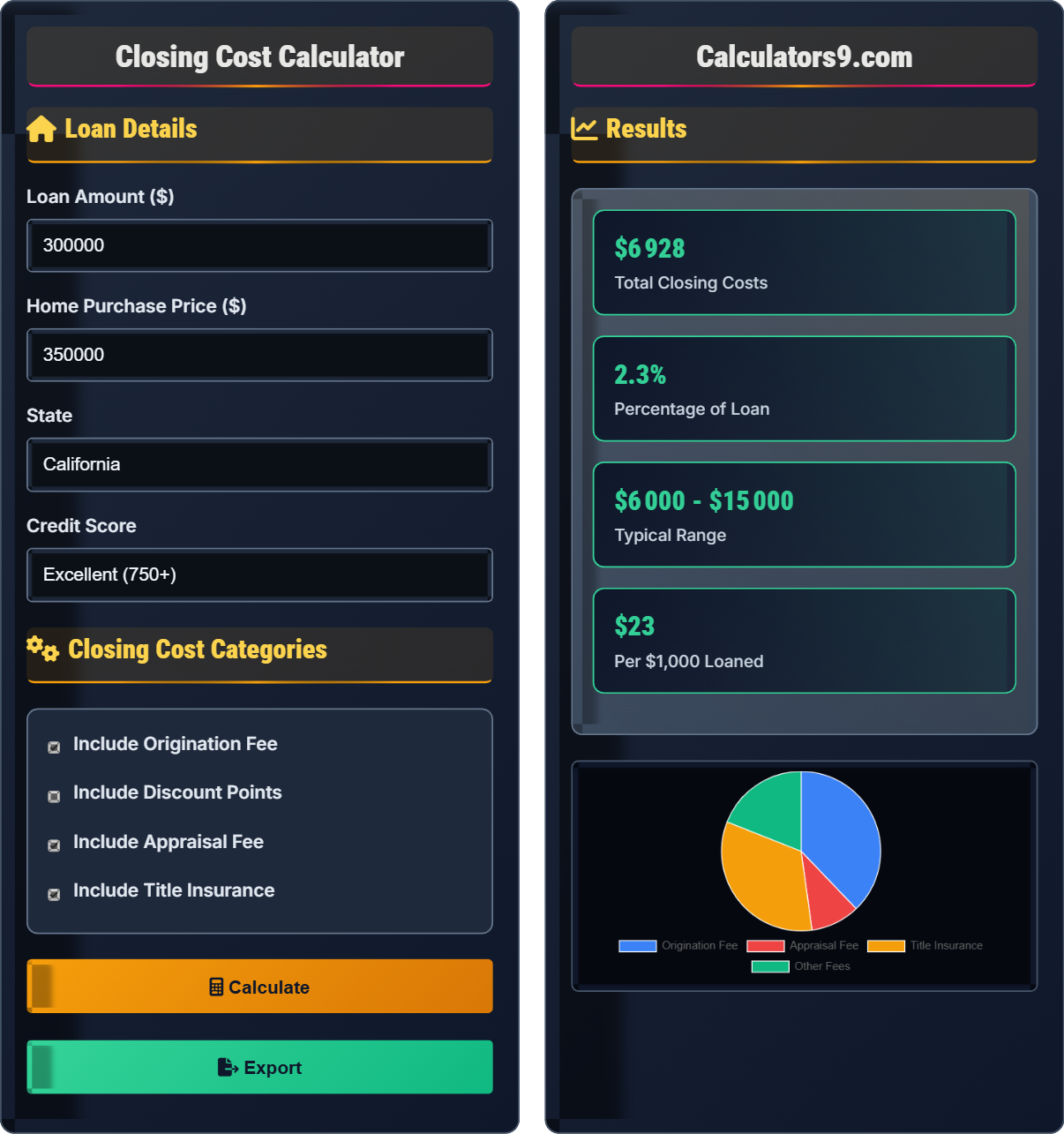
Estimate your mortgage closing costs • 2026 rates
Closing Cost Formula:
Show the calculator\( Closing\_Costs = (Origination\_Fee + Points + Appraisal + Title\_Insurance + Escrow + Prepaid\_Items) + Other\_Fees \)
Where:
- \( Origination\_Fee \) = Lender's processing fee (typically 0.5-1% of loan amount)
- \( Points \) = Discount points paid to reduce interest rate (1 point = 1% of loan amount)
- \( Appraisal \) = Property valuation fee ($400-$800)
- \( Title\_Insurance \) = Protection against title issues ($1,000-$3,000)
- \( Escrow \) = Attorney/trust company fees ($300-$800)
- \( Prepaid\_Items \) = Property taxes, insurance, interest ($1,000-$3,000)
This formula calculates the total closing costs by adding all mandatory and optional fees associated with obtaining a mortgage. Closing costs typically range from 2-5% of the loan amount.
Example: For a loan of \( \$300{,}000 \), typical closing costs might include:
Origination fee: \( \$300{,}000 \times 1\% = \$3{,}000 \)
Appraisal: \( \$500 \), Title insurance: \( \$2{,}000 \), Prepaid items: \( \$2{,}000 \)
Total estimated closing costs: \( \$3{,}000 + \$500 + \$2{,}000 + \$2{,}000 = \$7{,}500 \)
Thus, the borrower would need approximately $7,500 for closing costs.
Loan Details
Closing Cost Categories
Results
| Fee Type | Description | Amount | % of Total |
|---|
| State | Avg. Closing Costs | Range |
|---|
Comprehensive Closing Cost Guide
Closing costs are the fees and expenses paid when completing a real estate transaction. These costs are separate from the down payment and typically range from 2% to 5% of the loan amount. They include fees paid to the lender, third-party service providers, and government agencies.
The closing cost calculation uses the following formula:
Where:
- \(Fee_i\) = Individual closing cost fee
- \(n\) = Total number of fees
Key factors that influence closing costs:
- Location: State and local regulations vary significantly
- Loan Amount: Higher loan amounts typically mean higher fees
- Credit Score: Lower scores may result in higher fees
- Property Type: Condos, manufactured homes may have additional fees
- Lender: Different lenders charge different fees
- Shop Around: Compare fees from multiple lenders
- Negotiate: Some fees are negotiable
- Timing: Close at the end of the month to minimize prepaid interest
- Gift Funds: Use gift funds for closing costs when allowed
- Rate vs. Points: Evaluate whether buying points makes sense
Closing Costs Basics
Fees paid at real estate transaction completion.
\(Closing\_Costs = \sum_{i=1}^{n} Fee_i\)
Where Closing_Costs=total costs, Fee_i=individual fees, n=number of fees.
- Typically 2-5% of loan amount
- Separate from down payment
- Varies by location and lender
Strategies
Compare lenders and negotiate fees.
- Compare lender fees
- Negotiate non-regulatory fees
- Time closing strategically
- Use gift funds when possible
- Don't focus solely on lowest costs
- Consider loan terms and quality
- Understand all fees
- Factor in future rate benefits
Closing Cost Learning Quiz
What percentage of the loan amount do closing costs typically represent?
The answer is B) 2-5%. Closing costs typically range from 2% to 5% of the loan amount. For a $300,000 loan, this would mean closing costs of $6,000 to $15,000. The exact percentage can vary based on location, loan type, and lender.
This is a fundamental concept in mortgage financing that borrowers need to understand. The 2-5% range is important because it helps borrowers budget appropriately for closing costs. Many first-time buyers underestimate these costs, which can lead to financial stress at closing. The variation depends on multiple factors including state regulations, lender fees, and property location.
Closing Costs: Fees and expenses paid when completing a real estate transaction
Loan Amount: The principal amount being borrowed
Percentage of Loan: How closing costs relate to the loan amount
• Closing costs typically range from 2-5% of loan amount
• Costs vary by location and lender
• Separate from down payment requirements
• Budget 2-5% of loan amount for closing costs
• Get estimates from multiple lenders
• Ask for itemized breakdown of all fees
• Underestimating closing costs
• Not budgeting separately from down payment
• Assuming all lenders charge the same fees
Calculate the approximate closing costs for a $400,000 loan using the 3% rule. Show your work.
Using the typical range of 2-5% for closing costs:
Calculation: $400,000 × 3% = $400,000 × 0.03 = $12,000
Therefore, the approximate closing costs would be $12,000.
This simple calculation helps borrowers quickly estimate their closing costs. Using 3% as a middle estimate is a good rule of thumb for planning purposes. However, borrowers should get actual estimates from lenders for accurate budgeting, as the actual costs can vary significantly based on numerous factors.
Rule of Thumb: A general guideline for estimation
Percentage Calculation: Converting percentage to decimal and multiplying
Planning Purpose: Estimating for budget preparation
• Multiply loan amount by percentage (as decimal)
• 3% is a good middle estimate
• Actual costs may vary significantly
• Quick estimate: Loan amount × 0.03
• Verify with actual lender estimates
• Consider range of 2-5% for planning
• Using percentage as whole number instead of decimal
• Assuming estimate equals actual costs
• Not accounting for location variations
Sarah is getting a $350,000 mortgage. She's considering buying 2 discount points to lower her interest rate. How much would this add to her closing costs, and what would be the immediate cost?
Step 1: Calculate cost of discount points
One point = 1% of loan amount
Cost of 2 points = $350,000 × 2% = $350,000 × 0.02 = $7,000
Step 2: Determine immediate cost
The immediate cost of buying 2 discount points would be $7,000 added to closing costs.
Therefore, Sarah would pay an additional $7,000 at closing to buy the discount points.
Discount points are a way to prepay interest to secure a lower rate. Each point costs 1% of the loan amount and typically reduces the interest rate by about 0.25%. This is an upfront cost that can save money over the life of the loan, but borrowers need to calculate whether the savings justify the initial expense.
Discount Points: Fees paid to reduce interest rate
Prepaid Interest: Interest paid in advance
Rate Reduction: Lower interest rate obtained by paying points
• One point = 1% of loan amount
• Typically reduces rate by 0.25%
• Points are paid at closing
• Calculate break-even point for points
• Consider how long you'll keep the loan
• Compare total cost vs. monthly savings
• Confusing points with percentage points
• Not calculating break-even period
• Assuming points always make sense
Closing costs vary significantly by state. In California, average closing costs might be 3.5% of the loan amount, while in Texas they might be 2.5%. For a $300,000 loan, what is the difference in closing costs between these two states?
Step 1: Calculate California closing costs
$300,000 × 3.5% = $300,000 × 0.035 = $10,500
Step 2: Calculate Texas closing costs
$300,000 × 2.5% = $300,000 × 0.025 = $7,500
Step 3: Calculate difference
$10,500 - $7,500 = $3,000
Therefore, closing costs in California would be $3,000 higher than in Texas for the same loan amount.
This demonstrates the significant impact that location has on closing costs. State regulations, local practices, and required services vary widely. California tends to have higher closing costs due to various factors including transfer taxes and required services. Borrowers should research local customs and regulations when moving to a new state.
State Variation: Differences in costs by location
Transfer Taxes: Taxes on property transfers
Local Practices: Regional requirements for transactions
• Closing costs vary significantly by state
• Research local requirements
• Factor location into budget planning
• Research state-specific requirements
• Consult local real estate professionals
• Account for regional variations in estimates
• Assuming costs are the same everywhere
• Not researching local requirements
• Using national averages for local planning
Which of the following closing cost fees is MOST likely to be negotiable?
The answer is C) Lender origination fee. The origination fee is charged by the lender and is often negotiable. Government fees, taxes, and regulatory charges are typically fixed, while the origination fee is a business decision by the lender that can sometimes be reduced or waived.
It's important to distinguish between regulatory fees that cannot be changed and lender fees that may be negotiable. Fees charged by government agencies, tax collectors, and regulatory bodies are typically fixed. However, lender fees such as origination fees, processing fees, and administrative charges may be negotiable, especially when shopping between lenders.
Regulatory Fees: Government-mandated charges that cannot be negotiated
Business Fees: Charges set by service providers that may be negotiable
Origination Fee: Lender's processing fee for originating the loan
• Government fees are typically non-negotiable
• Lender fees may be negotiable
• Shop around for competitive pricing
• Negotiate lender-specific fees
• Compare total costs between lenders
• Ask for fee waivers or reductions
• Trying to negotiate fixed government fees
• Not negotiating negotiable lender fees
• Accepting first quote without comparison
FAQ
Q: Can I roll closing costs into my mortgage?
A: Generally, closing costs must be paid in cash at closing, but there are some exceptions:
- Gift Funds: Closing costs can be paid with gift funds from family members
- Seller Credits: Sellers may agree to pay some or all of your closing costs
- Trade-Offs: You might accept a slightly higher interest rate in exchange for lender credits toward closing costs
However, you typically cannot simply add closing costs to your loan balance. Doing so would require a higher loan-to-value ratio, which may trigger additional requirements like private mortgage insurance.
Q: When do I need to have closing costs ready?
A: Closing costs must be paid at the actual closing of your mortgage. You'll need to have these funds available in the form of a cashier's check or wire transfer when you sign your mortgage documents.
Most lenders will provide a Closing Disclosure at least 3 business days before closing, which details all final costs. This gives you time to arrange for the funds. Typically, you'll need to bring the funds to the closing meeting, though some lenders may accept wire transfers.
It's important to budget for closing costs well in advance, as they're due at the same time as your down payment.