Mortgage Affordability Calculator
How much house can I afford? • 2026 rates
Mortgage Affordability Formula:
Show the calculator\( Max\_Loan = \frac{Monthly\_Payment \times [(1+r)^n - 1]}{r \times (1+r)^n} \)
Where:
- \( Max\_Loan \) = Maximum loan amount you can afford
- \( Monthly\_Payment \) = Maximum monthly payment you can afford
- \( r \) = Monthly interest rate (annual rate ÷ 12)
- \( n \) = Total number of monthly payments (loan term in years × 12)
This formula calculates the maximum loan amount based on your available monthly payment, taking into account the interest rate and loan term.
Example: If you can afford a monthly payment of \( \$2{,}000 \), with a 4.5% annual interest rate over 30 years:
Monthly rate: \( r = \frac{4.5\%}{12} = 0.00375 \)
Number of payments: \( n = 30 \times 12 = 360 \)
Maximum loan:
\( Max\_Loan = \frac{2{,}000 \times [(1.00375)^{360} - 1]}{0.00375 \times (1.00375)^{360}} \approx \$416{,}529 \)
Thus, you could afford a loan of approximately $416,529.
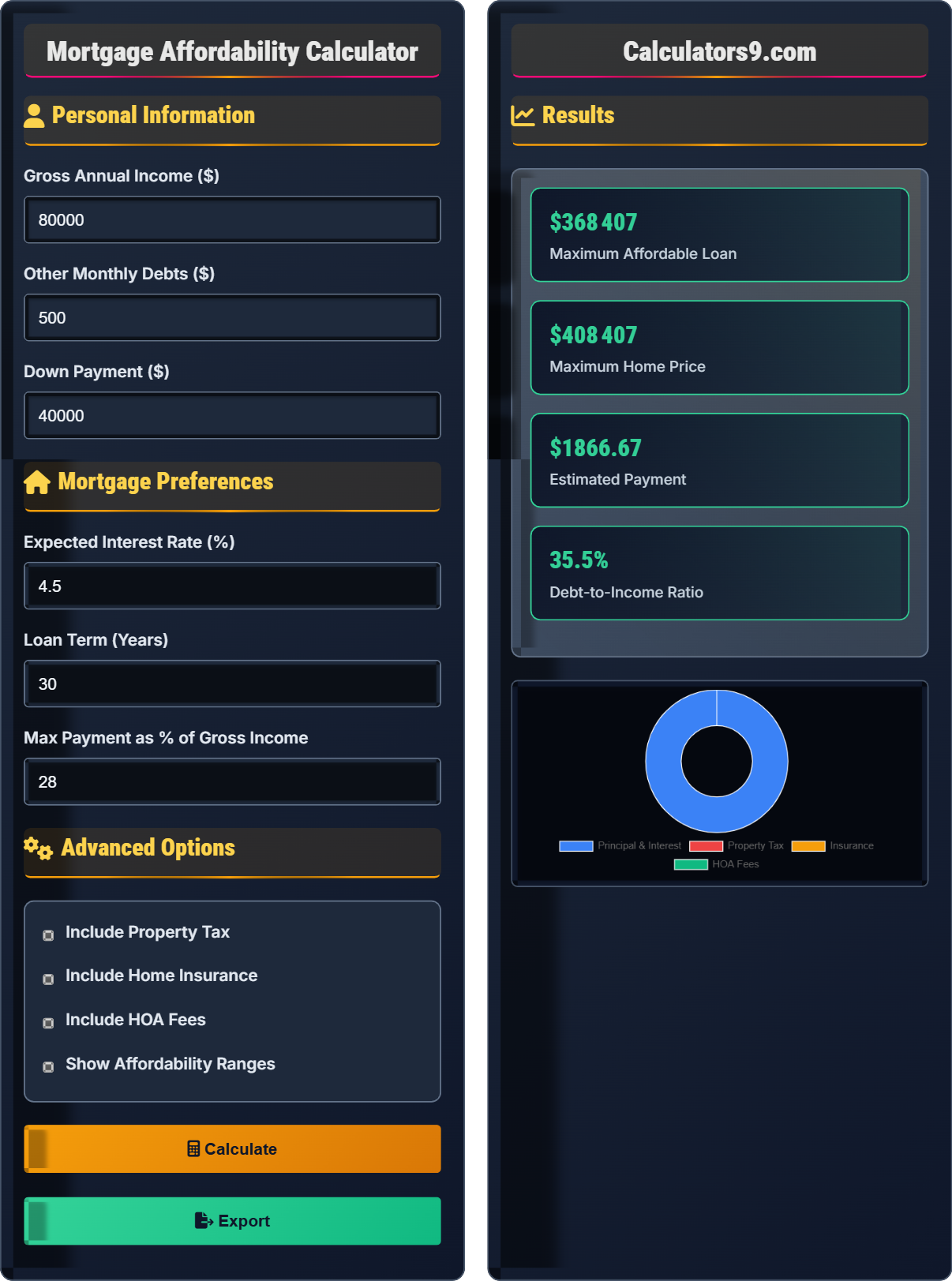
Personal Information
Mortgage Preferences
Advanced Options
Results
| Component | Amount | % of Payment |
|---|
| Income Range | Down Payment | Max Home Price |
|---|
Comprehensive Mortgage Affordability Guide
Mortgage affordability is determined by several key factors: your income, debts, credit score, down payment, and prevailing interest rates. Lenders typically use your debt-to-income (DTI) ratio to assess how much you can borrow. A good rule of thumb is that your total monthly debt payments shouldn't exceed 36% of your gross monthly income.
The mortgage affordability calculation uses the following formula:
Where:
- \(Max\_Loan\) = Maximum loan amount you can afford
- \(Monthly\_Payment\) = Maximum monthly payment you can afford
- \(r\) = Monthly interest rate (annual rate ÷ 12)
- \(n\) = Total number of monthly payments (loan term in years × 12)
Key factors that influence how much house you can afford:
- Down Payment: Larger down payments reduce loan amount and monthly payments
- Credit Score: Higher scores qualify for better interest rates
- Debt-to-Income Ratio: Lower DTI ratios allow for larger loans
- Interest Rates: Lower rates increase affordability
- Increase Down Payment: Save more to reduce loan amount and monthly payments
- Reduce Debt: Pay off existing debts to improve DTI ratio
- Improve Credit Score: Qualify for better interest rates
- Consider Shorter Terms: May qualify for larger loans despite higher payments
- Shop Around: Compare lenders for the best rates and terms
Affordability Basics
Income, debts, down payment, and interest rates.
\(Max\_Loan = \frac{Monthly\_Payment \times [(1+r)^n - 1]}{r \times (1+r)^n}\)
Where Max_Loan=affordable loan amount, Monthly_Payment=available payment, r=monthly rate, n=payments.
- 28% rule for housing expenses
- 36% rule for total debt
- Higher down payments increase affordability
Strategies
28% housing expenses, 36% total debt of gross income.
- Save for larger down payment
- Reduce existing debts
- Improve credit score
- Shop for better rates
- Consider future income changes
- Account for maintenance costs
- Factor in emergency funds
- Plan for property taxes
Mortgage Affordability Learning Quiz
Which of the following has the greatest impact on how much house you can afford?
The answer is C) Gross annual income. Your income is the primary factor that determines your borrowing capacity. Lenders typically allow your total monthly debt payments to be no more than 36% of your gross monthly income, with housing expenses limited to 28% of gross monthly income. While other factors are important, income sets the upper limit for what you can afford.
Lenders use your income as the foundation for determining affordability because it represents your ability to make monthly payments. The 28/36 rule (housing expenses at 28% of income, total debt at 36%) is the standard benchmark. Other factors like credit score, down payment, and interest rates affect the terms but income determines the baseline borrowing capacity.
Debt-to-Income Ratio (DTI): Percentage of gross monthly income used for debt payments
28/36 Rule: Housing expenses ≤ 28% of income, total debt ≤ 36% of income
Gross Income: Total income before taxes and deductions
• Housing expenses should not exceed 28% of gross income
• Total debt should not exceed 36% of gross income
• Income is the primary factor in affordability calculations
• Remember: 28/36 rule for housing/total debt
• Calculate your DTI before house hunting
• Income is the primary affordability driver
• Focusing only on down payment without considering income
• Not accounting for other debts in DTI calculation
• Overestimating affordability based on maximum allowed ratios
Calculate the maximum home price someone with a $75,000 annual income can afford if they follow the 28% rule for housing expenses, expect a 4.5% interest rate, and plan for a 30-year loan. Assume a 20% down payment. Show your work.
Step 1: Calculate gross monthly income = $75,000 ÷ 12 = $6,250
Step 2: Calculate maximum housing payment = $6,250 × 28% = $1,750
Step 3: Calculate maximum loan amount using mortgage formula:
Monthly rate = 4.5% ÷ 12 = 0.375% = 0.00375
Number of payments = 30 × 12 = 360
Max loan = $1,750 × [(1.00375)^360 - 1] ÷ [0.00375 × (1.00375)^360]
Max loan ≈ $364,463
Step 4: Calculate maximum home price
Since 20% down payment is made, loan = 80% of home price
Home price = $364,463 ÷ 0.80 = $455,579
This calculation demonstrates how the 28% rule translates into actual affordability. The process involves: 1) determining available housing payment based on income, 2) calculating the loan amount that corresponds to that payment, and 3) converting loan amount to home price based on down payment percentage. This systematic approach ensures you don't overextend financially.
28% Rule: Housing expenses should not exceed 28% of gross monthly income
Down Payment: Initial payment made toward home purchase
Loan-to-Value Ratio: Percentage of home price financed by loan
• Housing payment = Gross income × 28%
• Loan amount depends on payment, rate, and term
• Home price = Loan amount ÷ (1 - down payment %)
• Calculate housing payment first: Income × 28%
• Use mortgage formula to find loan amount
• Convert loan amount to home price using down payment %
• Forgetting to convert annual to monthly income
• Not accounting for down payment in final price
• Using incorrect formula for loan calculation
Sarah earns $90,000 annually and has $300 in monthly credit card payments and $200 in car loan payments. If she follows the 36% total debt-to-income ratio rule, what is the maximum monthly mortgage payment she can afford?
Step 1: Calculate gross monthly income = $90,000 ÷ 12 = $7,500
Step 2: Calculate maximum total monthly debt = $7,500 × 36% = $2,700
Step 3: Calculate maximum mortgage payment = Total debt - Other debts
Maximum mortgage payment = $2,700 - $300 - $200 = $2,200
Therefore, Sarah can afford a maximum monthly mortgage payment of $2,200.
This example illustrates how existing debts affect mortgage affordability. The 36% DTI rule applies to total debt, including mortgage, credit cards, car loans, and other obligations. Existing debts reduce the available amount for mortgage payments. This is why paying down debts before buying a home can significantly increase affordability.
Debt-to-Income Ratio (DTI): Percentage of gross monthly income used for debt payments
Total Debt: All monthly debt obligations combined
Available for Mortgage: Total debt allowance minus other debts
• Total debt = Gross income × 36%
• Mortgage payment = Total debt - Other monthly debts
• Existing debts reduce mortgage affordability
• Calculate total debt allowance first: Income × 36%
• Subtract other debts to find mortgage capacity
• Pay down debts before house hunting to increase affordability
• Forgetting to account for existing debts
• Using housing payment instead of total debt calculation
• Not converting annual income to monthly
Compare the maximum home prices for two buyers with the same $80,000 income and $400 in other monthly debts: Buyer A makes a 10% down payment, Buyer B makes a 20% down payment. Both qualify for a 4.5% interest rate on a 30-year loan. How much more house can Buyer B afford?
Step 1: Calculate maximum mortgage payment for both buyers
Gross monthly income = $80,000 ÷ 12 = $6,667
Maximum total debt = $6,667 × 36% = $2,400
Maximum mortgage payment = $2,400 - $400 = $2,000
Step 2: Calculate maximum loan amount (same for both)
Monthly rate = 0.375%, Number of payments = 360
Max loan ≈ $416,529
Step 3: Calculate maximum home price for each buyer
Buyer A (10% down): Loan = 90% of home price
Home price = $416,529 ÷ 0.90 = $462,810
Buyer B (20% down): Loan = 80% of home price
Home price = $416,529 ÷ 0.80 = $520,661
Step 4: Calculate difference
Difference = $520,661 - $462,810 = $57,851
Therefore, Buyer B can afford $57,851 more house than Buyer A.
This demonstrates the significant impact of down payment on purchasing power. A larger down payment means you need to borrow less to buy the same home, which allows you to afford a more expensive home with the same loan amount. Additionally, a 20% down payment avoids private mortgage insurance (PMI), further improving affordability.
Loan-to-Value Ratio (LTV): Percentage of home price financed by loan
Private Mortgage Insurance (PMI): Insurance required for loans with <20% down
Purchasing Power: Ability to buy a more expensive home
• Larger down payments increase affordability
• 20% down avoids PMI requirement
• Higher down payment = higher home price for same loan
• Save for 20% down to avoid PMI
• Larger down payment increases purchasing power
• Consider gift funds for down payment assistance
• Not understanding the relationship between down payment and loan amount
• Forgetting that down payment affects maximum home price
• Not considering PMI impact on affordability
Which of the following strategies would have the LEAST impact on increasing mortgage affordability?
The answer is D) Extending loan term from 15 to 30 years. While extending the loan term does lower monthly payments (allowing qualification for a larger loan), it has the least impact on overall affordability because it significantly increases total interest paid over the life of the loan. The other options (larger down payment, lower debt, better credit) all improve your financial profile more comprehensively.
While extending the loan term does lower monthly payments, allowing qualification for a larger loan, it's not necessarily the best strategy for long-term financial health. A longer term means more interest paid over time. The other strategies improve your financial position: larger down payment reduces borrowing needs, lower debt improves DTI ratio, and better credit scores lead to better interest rates.
Loan Term: Length of time to repay the loan
Interest Savings: Money saved by securing better terms
Financial Health: Overall stability of finances
• Down payment has significant impact on affordability
• Debt reduction improves DTI ratio
• Better credit leads to better rates
• Focus on improving financial fundamentals
• Pay down debts before house hunting
• Work on credit score improvement
• Thinking longer terms are always better
• Not considering total interest costs
• Focusing only on monthly payments
FAQ
Q: How do I calculate my debt-to-income ratio?
A: Your debt-to-income (DTI) ratio is calculated by dividing your total monthly debt payments by your gross monthly income.
\( DTI = \frac{Total\_Monthly\_Debt}{Gross\_Monthly\_Income} \times 100 \)
For example, if your gross monthly income is \( \$6{,}000 \) and your total monthly debts (mortgage, car loans, credit cards, etc.) are \( \$1{,}800 \), your DTI ratio would be:
\( DTI = \frac{1{,}800}{6{,}000} \times 100 = 30\% \)
Lenders typically prefer DTI ratios of 36% or lower, with no more than 28% going toward housing expenses.
Q: How much should I put down as a down payment?
A: The traditional recommendation is a 20% down payment, which offers several advantages:
- No Private Mortgage Insurance (PMI): Required for loans with less than 20% down
- Better Interest Rates: Lenders often offer better rates for larger down payments
- Lower Monthly Payments: Smaller loan amount means lower payments
- Immediate Equity: You start with 20% equity in your home
However, there are programs available for lower down payments (3-5%), and sometimes it may be better to put down less and keep cash reserves for emergencies and home repairs.