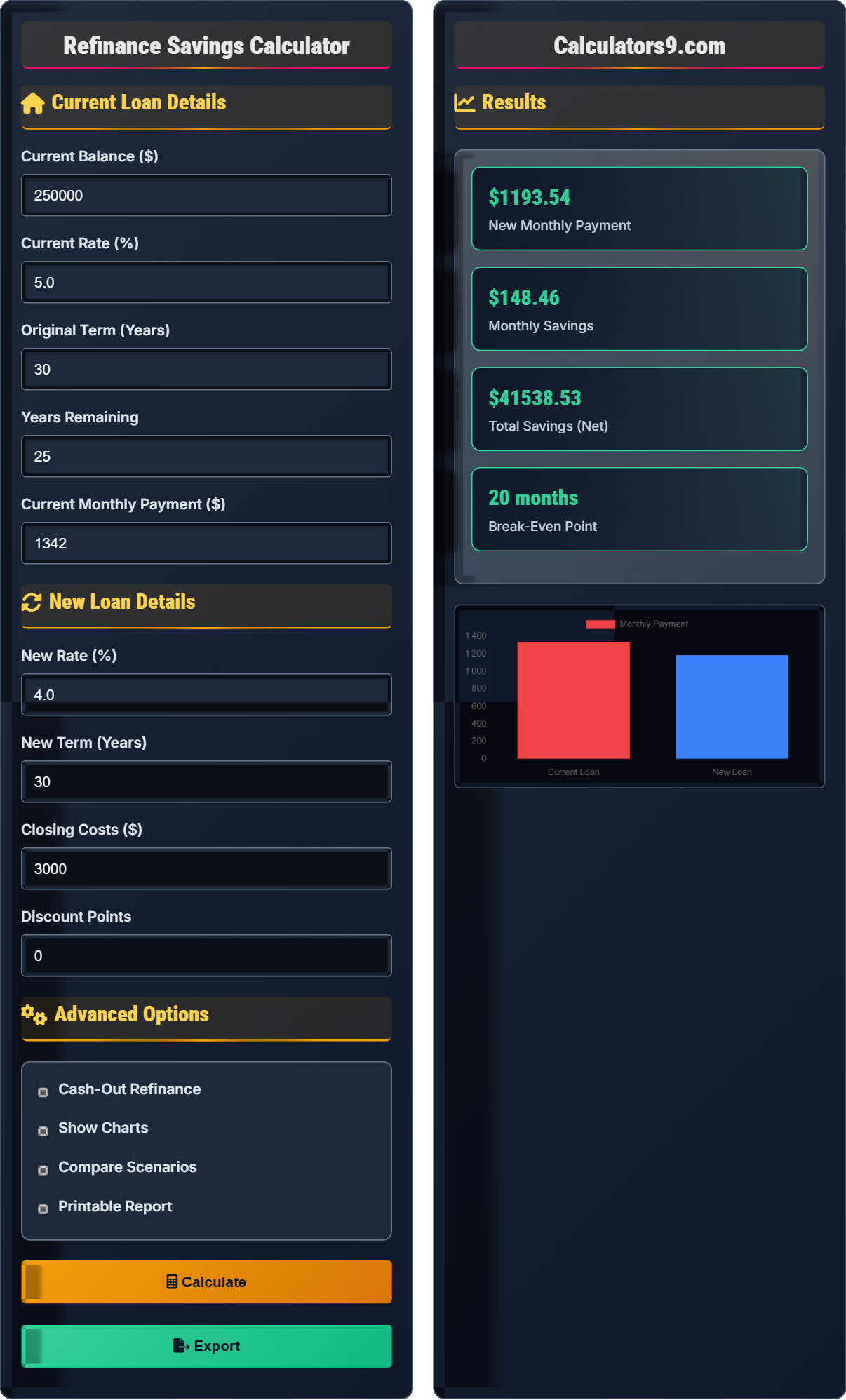
Refinance Savings Calculator
Calculate refinance benefits • 2026 rates
Refinance Savings Formula:
Show the calculator\( Savings = (Old\_Payment - New\_Payment) \times Remaining\_Months - Closing\_Costs \)
Where:
- \( Old\_Payment \) = Current monthly payment
- \( New\_Payment \) = Proposed monthly payment after refinance
- \( Remaining\_Months \) = Months left on current loan
- \( Closing\_Costs \) = Total costs to refinance
This formula calculates the net savings from refinancing by comparing monthly payment differences over the remaining loan term, minus upfront closing costs.
Example: Current loan: $300,000 at 5% (payment: $1,610), 25 years remaining. New loan: same balance at 4% (payment: $1,520). Closing costs: $3,000.
Monthly savings: $1,610 - $1,520 = $90
Total savings over 300 months: $90 × 300 = $27,000
Net savings: $27,000 - $3,000 = $24,000
Thus, the borrower would save approximately $24,000 by refinancing.
Current Loan Details
New Loan Details
Advanced Options
Results
| Metric | Current Loan | New Loan | Difference |
|---|
| Category | Amount | Percentage |
|---|
Comprehensive Refinance Guide
Refinancing is the process of replacing an existing loan with a new loan that has different terms. The most common reason for refinancing is to secure a lower interest rate, which can reduce monthly payments and total interest paid over the life of the loan. Refinancing can also change the loan term, switch from an adjustable-rate to a fixed-rate mortgage, or access equity in your home.
The standard refinance savings calculation uses the following formula:
Where:
- \(Savings\) = Net savings from refinancing
- \(Old\_Payment\) = Current monthly payment
- \(New\_Payment\) = Proposed monthly payment after refinance
- \(Remaining\_Months\) = Months left on current loan
- \(Closing\_Costs\) = Total costs to refinance
Before refinancing, consider these important factors:
- Closing Costs: Typically 2-5% of the loan amount. Include origination fees, appraisal fees, and title insurance.
- Break-Even Point: Calculate how long it takes for monthly savings to offset closing costs.
- Loan Term: Extending the term may lower payments but increase total interest.
- Credit Score: Higher scores qualify for better rates and terms.
- Rate shopping: Compare quotes from multiple lenders to get the best deal
- Improve credit score: Boost your score before applying to qualify for better rates
- Consider points: Pay discount points to lower your rate if you plan to stay long-term
- Lock in rates: Secure your interest rate to protect against market fluctuations
- Calculate break-even: Ensure you'll save more than closing costs
Refinance Basics
Replacing existing loan with new loan having different terms.
\(Savings = (Old\_Payment - New\_Payment) \times Remaining\_Months - Closing\_Costs\)
Where Savings=net savings, Old/New=monthly payments, Remaining=months left, Costs=closing costs.
- Closing costs typically 2-5% of loan
- Break-even should be within planned ownership
- Lower rate usually means savings
Strategies
Time when savings equal closing costs.
- Calculate break-even point
- Compare total costs
- Shop multiple lenders
- Check credit score
- Plan to stay beyond break-even
- Consider loan term extension
- Factor in tax implications
- Check prepayment penalties
Refinance Learning Quiz
What is the primary benefit of refinancing a mortgage?
The answer is B) To potentially lower monthly payments and save money. The primary reason for refinancing is to take advantage of better loan terms, typically a lower interest rate, which can reduce monthly payments and total interest paid over the life of the loan.
Refinancing is fundamentally about optimizing loan terms to save money or achieve other financial goals. When interest rates drop or your credit score improves, you may qualify for better terms than your original loan. This can result in lower monthly payments, reduced total interest, or both.
Refinancing: Replacing an existing loan with a new loan having different terms
Interest Rate: The percentage charged for borrowing money
Closing Costs: Fees paid when finalizing a loan transaction
• Lower rates typically mean lower payments and interest
• Closing costs must be considered in savings calculation
• Break-even point determines if refinance is worthwhile
• Calculate break-even point before refinancing
• Shop around for best rates and terms
• Consider how long you plan to stay in the home
• Ignoring closing costs in savings calculation
• Refinancing too close to selling the home
Calculate the refinance savings for a loan with current payment of $1,500, new payment of $1,350, 20 years remaining, and $4,000 in closing costs. Show your work.
Using the refinance savings formula: \(Savings = (Old\_Payment - New\_Payment) \times Remaining\_Months - Closing\_Costs\)
Given:
- Old Payment = $1,500
- New Payment = $1,350
- Remaining Years = 20
- Closing Costs = $4,000
Step 1: Calculate remaining months = 20 × 12 = 240 months
Step 2: Calculate monthly savings = $1,500 - $1,350 = $150
Step 3: Calculate total savings over remaining term = $150 × 240 = $36,000
Step 4: Calculate net savings = $36,000 - $4,000 = $32,000
This calculation shows the importance of considering both the ongoing savings and the upfront costs when evaluating a refinance. The monthly savings multiply over the remaining loan term, but closing costs must be recovered for the refinance to be beneficial.
Net Savings: Total savings minus all costs
Break-Even Point: When savings equal closing costs
Remaining Term: Time left on the current loan
• Always subtract closing costs from total savings
• Convert years to months for accurate calculations
• The longer you stay, the more you save
• Remember: Savings = Monthly Difference × Remaining Months - Closing Costs
• Calculate break-even: Closing Costs ÷ Monthly Savings
• Plan to stay beyond break-even point
• Forgetting to subtract closing costs
• Using years instead of months in calculation
• Not considering the time factor
Sarah's current mortgage payment is $1,800 per month. She's considering refinancing to a new loan with a payment of $1,600 per month. The closing costs for the refinance are $3,600. What is the break-even point for this refinance?
Step 1: Calculate monthly savings = $1,800 - $1,600 = $200
Step 2: Calculate break-even point = Closing Costs ÷ Monthly Savings
Step 3: Break-even = $3,600 ÷ $200 = 18 months
Therefore, Sarah would break even on the refinance after 18 months.
The break-even point is critical in refinance decisions. It tells you how long you need to keep the new loan to recoup the closing costs. If Sarah plans to sell her house in 12 months, refinancing wouldn't make sense since she'd only save $2,400 ($200 × 12) but pay $3,600 in closing costs.
Break-Even Point: Time when savings equal closing costs
Monthly Savings: Difference between old and new payments
Closing Costs: Upfront fees for refinancing
• Break-even = Closing Costs ÷ Monthly Savings
• Must stay beyond break-even to realize savings
• Shorter ownership = less benefit from refinance
• Calculate break-even before refinancing
• Consider your planned ownership period
• Lower break-even = better for short-term plans
• Not calculating break-even point
• Forgetting to factor in planned move date
• Assuming all refinances are beneficial
Mark has a mortgage with a balance of $200,000 at 5% interest with 25 years remaining and a payment of $1,167. He's considering a cash-out refinance to a new loan of $230,000 at 4.25% for 30 years. The closing costs are $4,500 and he'll receive $25,000 in cash. What would be his new monthly payment and total interest savings (considering he now has 30 years instead of 25)?
Step 1: Calculate new payment for $230,000 at 4.25% for 30 years
Monthly rate = 4.25% ÷ 12 = 0.3542%
Number of payments = 30 × 12 = 360
New payment = $230,000 × [0.003542(1.003542)^360] / [(1.003542)^360 - 1] = $1,131
Step 2: Calculate monthly savings = $1,167 - $1,131 = $36
Step 3: Calculate total payments for original loan (remaining 25 years) = $1,167 × 300 = $350,100
Step 4: Calculate total payments for new loan (full 30 years) = $1,131 × 360 = $407,160
Step 5: Interest savings is actually negative due to extended term: New total interest is higher despite lower rate
This example shows why cash-out refinances can be tricky. While Mark gets a lower rate and lower payment initially, extending the term from 25 to 30 years means he'll pay more total interest over time. The benefit comes from the cash received and the lower monthly payment, but the total cost increases.
Cash-Out Refinance: Taking a new loan larger than current balance to receive cash
Term Extension: Increasing loan duration which affects total interest
Total Interest: Sum of all interest paid over loan life
• Cash-out refinances may extend loan term
• Lower rate doesn't always mean lower total cost
• Consider purpose of cash-out before refinancing
• Consider purpose: debt consolidation vs. home improvement
• Compare total costs, not just monthly payments
• Evaluate whether extended term is acceptable
• Focusing only on monthly payment reduction
• Not considering total interest impact
• Misunderstanding the purpose of cash-out
When is refinancing typically most beneficial?
The answer is C) When rates are falling and you plan to stay long-term. Refinancing is most beneficial when you can secure a significantly lower interest rate and plan to keep the new loan long enough to recoup closing costs. The longer you stay in the home, the more you benefit from the lower monthly payments.
Refinancing benefits depend on three key factors: the rate differential, closing costs, and how long you plan to stay. When rates fall, you can potentially lock in a lower rate. But if you're only staying for a few years, you may not recoup the closing costs. The optimal scenario combines a meaningful rate reduction with a long enough ownership period to realize the savings.
Rate Differential: Difference between old and new interest rates
Ownership Period: How long you plan to keep the loan
Cost-Benefit Analysis: Evaluating whether benefits exceed costs
• Lower rates create opportunity for savings
• Longer ownership = more savings realized
• Closing costs must be recovered
• Monitor rate trends before refinancing
• Calculate break-even point carefully
• Consider your housing plans for next 5+ years
• Refinancing too frequently with high closing costs
• Not considering planned move timeline
• Ignoring the impact of rate changes on savings
FAQ
Q: How much should interest rates drop before refinancing makes sense?
A: Traditionally, a 1% drop in interest rate was considered the threshold for refinancing. However, with today's lower rates, even a 0.5% to 0.75% drop can provide meaningful savings, especially for larger loans.
For example, on a loan of \( \$250{,}000 \) with 25 years remaining, a rate drop from 5% to 4.25% (0.75%) would save approximately \( \$110 \) per month, or \( \$33{,}000 \) over the remaining term. After subtracting \( \$3{,}000 \) in closing costs, the net savings would be \( \$30{,}000 \).
The key is to calculate your specific break-even point: \( Break-even = \frac{Closing\_Costs}{Monthly\_Savings} \). If you plan to stay in your home beyond this point, refinancing likely makes sense.
Q: Should I pay discount points to get a lower rate?
A: Whether to pay discount points depends on your break-even calculation and planned ownership period.
Each point costs 1% of the loan amount and typically reduces your rate by 0.25%. For example, on a \( \$300{,}000 \) loan, one point costs \( \$3{,}000 \) and might reduce your rate from 4.5% to 4.25%.
To evaluate: If this saves \( \$50 \) per month, the break-even point is \( \$3{,}000 ÷ \$50 = 60 \) months (5 years). If you plan to keep the loan longer than 5 years, paying points makes sense. If you plan to sell sooner, it's better to skip the points.