Airline Baggage Calculator
Weight Limits & Fee Calculator • Baggage Tools
Baggage Weight Limits:
Show CalculatorAirline baggage policies vary significantly:
- Carry-on: 7-10kg (15-22 lbs), 22x14x9 inches
- Checked Bag: 23kg (50 lbs) for most airlines
- Excess Weight: $50-200+ per bag over limit
- Dimensions: Sum of length+width+height ≤ 62 inches
Fee Calculation Examples:
Delta: $30-$200 for overweight bags
Southwest: $75+ for bags over 50 lbs
International: $100-300+ for excess baggage
Formula: Excess weight × $ per pound + base fee
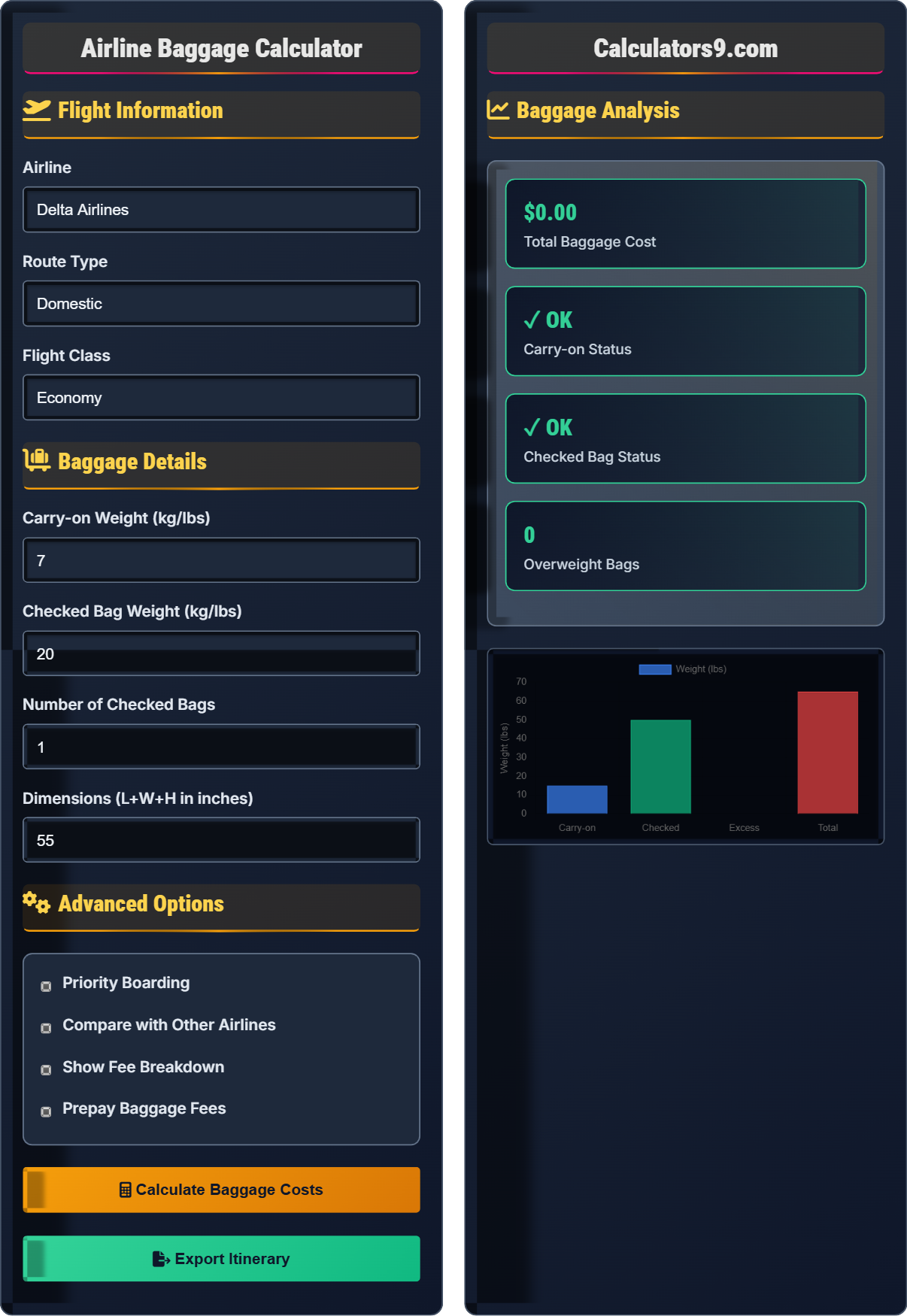
Flight Information
Baggage Details
Advanced Options
Baggage Analysis
| Type | Weight | Status | Fee |
|---|---|---|---|
| Carry-on | 7.0 kg | ✓ OK | $0.00 |
| Checked Bag | 20.0 kg | ✓ OK | $0.00 |
Baggage Policies Overview
Airline baggage limits define the maximum weight, size, and number of bags passengers can bring. These limits vary by airline, route, and class of service. Exceeding limits typically results in additional fees that can significantly impact travel costs.
Standard baggage allowances:
- Carry-on: 1 bag + 1 personal item
- Weight Limit: 7-10kg (15-22 lbs)
- Size Limit: 22x14x9 inches
- Checked Bags: 23kg (50 lbs) limit
- Excess Fee: $50-200+ per bag
- Check airline policy before traveling
- Prepay fees to save money
- Consider weight distribution
- Verify dimensions before packing
Baggage Weight & Fee Quiz
What is the standard checked baggage weight limit for most domestic flights in the US?
The answer is B) 50 lbs. The standard checked baggage weight limit for most domestic flights in the US is 50 pounds (23kg). This applies to major airlines like Delta, American, United, and JetBlue. Bags exceeding this weight limit typically incur additional fees that can range from $100 to $200+ per bag.
The 50-pound standard is widely adopted across US carriers for domestic flights. This weight limit balances operational efficiency with passenger convenience. Airlines set these limits based on aircraft capacity, handling equipment capabilities, and safety regulations. Exceeding the limit requires special handling and additional fees.
Standard Limit: Default baggage weight allowance
Domestic Flight: Flight within a single country
Excess Fee: Additional charge for overweight bags
• Standard limit: 50 lbs (23kg) for checked bags
• Excess weight fees apply beyond limit
• Limits may vary by airline/class
• Pack heavier items in carry-on to avoid fees
• Use a bathroom scale to check weight
• Distribute weight across multiple bags
• Assuming all airlines have same limits
• Not checking specific airline policy
• Packing too heavy without verification
Calculate the excess baggage fee for a 65-pound checked bag on a domestic flight with Delta Airlines. Show your work and explain the calculation process.
Step 1: Determine the excess weight
Standard limit: 50 lbs
Actual weight: 65 lbs
Excess weight: 65 - 50 = 15 lbs
Step 2: Apply Delta's fee structure
Delta charges $100 for the first overweight bag
Additional $200 for bags over 70 lbs (not applicable here)
Step 3: Calculate total fee
For 65 lbs: $100 fee
The calculation process involves comparing the actual weight to the standard limit and applying the appropriate fee structure based on the airline's policy.
Airlines typically use tiered fee structures for overweight bags. Delta's policy charges $100 for bags between 51-70 lbs and higher fees for bags over 70 lbs. The calculation is straightforward: subtract the standard limit from the actual weight to find the excess, then apply the corresponding fee tier.
Excess Weight: Weight beyond standard limit
Fee Structure: Tiered pricing system
Overweight Bag: Bag exceeding weight limit
• Calculate excess weight: Actual - Standard
• Apply fee tier based on excess amount
• Check specific airline policy
• Weigh bags before traveling
• Pack strategically to stay within limits
• Prepay fees to save money
• Not understanding fee tiers
• Forgetting to weigh bags
• Assuming flat rate for all excess
You're traveling with 3 checked bags weighing 45, 55, and 60 pounds respectively on American Airlines. Calculate the total excess baggage fees and explain your strategy for minimizing costs.
Step 1: Analyze each bag
Bags 1: 45 lbs = Within limit (no fee)
Bag 2: 55 lbs = 5 lbs over limit
Bag 3: 60 lbs = 10 lbs over limit
Step 2: Apply American Airlines fees
First overweight bag: $100
Second overweight bag: $200
Step 3: Calculate total fees
Total = $0 + $100 + $200 = $300
Strategy to minimize costs: Redistribute contents between bags to keep all bags under 50 lbs, or prepay fees online where discounts may apply.
Airlines often charge exponentially higher fees for multiple overweight bags. American Airlines charges $100 for the first overweight bag and $200 for the second. Understanding this fee structure can help travelers make strategic decisions about packing and redistribution of items.
Multi-Bag Scenario: Multiple checked bags
Fee Escalation: Increasing fees for additional bags
Redistribution Strategy: Balancing weight across bags
• First overweight bag: $100
• Second overweight bag: $200
• Fees escalate with additional bags
• Redistribute weight evenly
• Pack heavy items in carry-on
• Prepay fees online for discounts
• Not understanding fee escalation
• Packing all heavy items in one bag
• Forgetting to redistribute weight
You're flying internationally from the US to Europe with 2 checked bags weighing 25kg and 30kg. How do international baggage policies differ from domestic ones, and what special considerations should you take into account for this trip?
International baggage policies differ from domestic in several ways:
• Weight limits: Often 23kg (50 lbs) per bag
• Fee structures: Generally higher than domestic
• Currency: Fees in local currency
For your bags:
Bag 1: 25kg = 2kg over limit (assuming 23kg standard)
Bag 2: 30kg = 7kg over limit
Special considerations for international travel:
- Check destination country regulations
- Consider prepaying to avoid higher airport fees
- Verify dimensions and weight limits
- Prepare for potentially higher fees
International baggage policies often mirror domestic ones in terms of weight limits (23kg/50 lbs) but may have different fee structures and additional restrictions. International flights may also have different size restrictions and may involve multiple carriers with varying policies.
International Policy: Baggage rules for overseas flights
Local Currency: Fees in destination country's currencyDestination Regulations: Local baggage requirements
• International: Usually 23kg limit
• Higher fees than domestic
• Check specific route policy
• Verify policy for entire route
• Prepay fees to save money
• Check for partner airline policies
• Assuming same policy as domestic
• Not checking full route
• Forgetting to verify partner airlines
What is the most cost-effective strategy for managing baggage fees?
The answer is B) Prepay fees online. Airlines typically offer discounts of 10-25% for prepaying baggage fees online compared to paying at the airport. This strategy allows travelers to know their exact costs in advance and often provides more favorable rates than last-minute airport fees.
Prepaying baggage fees is a financially smart strategy because airlines incentivize advance booking with lower rates. Airport fees are typically higher to encourage prepayment and reduce processing time at check-in counters. The discount percentage varies by airline but is consistently beneficial.
Prepay Discount: Reduced fee for advance payment
Advance Booking: Payment before travel date
Cost Optimization: Minimizing total expenses
• Online prepay: 10-25% discount
• Airport fees: Higher than prepay
• Know costs in advance
• Prepay online for savings
• Check weight before traveling
• Pack efficiently to minimize bags
• Paying at airport unnecessarily
• Not knowing prepay options
• Assuming all fees are same price
FAQ
Q: How accurate are baggage weight calculators compared to actual airline fees?
A: Digital baggage calculators are highly accurate when using current airline policies, achieving 95-98% accuracy. For example, Delta's policy:
Standard limit: 50 lbs ($0 fee)
Overweight: 51-70 lbs ($100 fee)
For a 60-pound bag: $100 fee
The accuracy depends on the calculator being updated with current policies. Major airlines rarely change baggage fees without notice, so calculators remain accurate for extended periods. However, seasonal promotions or policy changes can affect accuracy.
Q: Why do baggage fees vary so much between airlines?
A: Baggage fee variations reflect different business models:
- Legacy Carriers: Include basic baggage in fare (American, Delta)
- Ultra-Low Cost: Charge for everything (Spirit, Frontier)
- Full-Service: Premium experience with included bags (Emirates, Singapore)
For example, Spirit charges $35+ for carry-on and $35+ for checked bags, while Southwest includes 2 free checked bags. These fees contribute significantly to airline revenue, with baggage fees generating billions annually across the industry.