Luggage Weight Estimator
Travel Packing Calculator • Baggage Tools
Luggage Weight Estimation Guide:
Show CalculatorAverage weights of common travel items:
- Clothing: T-shirt: 0.15kg, Jeans: 0.5kg, Jacket: 0.8kg
- Electronics: Laptop: 1.5kg, Phone: 0.2kg, Charger: 0.1kg
- Toiletries: Shampoo: 0.3kg, Toothbrush: 0.05kg, Makeup: 0.2kg
- Shoes: Running shoes: 0.8kg, Dress shoes: 0.6kg
Weight Conversion:
1 kg = 2.20462 lbs
1 lb = 0.453592 kg
Formula: Total estimated weight = Σ(item_weight × quantity)
Standard Limits: Carry-on: 7-10kg, Checked: 23kg (50 lbs)
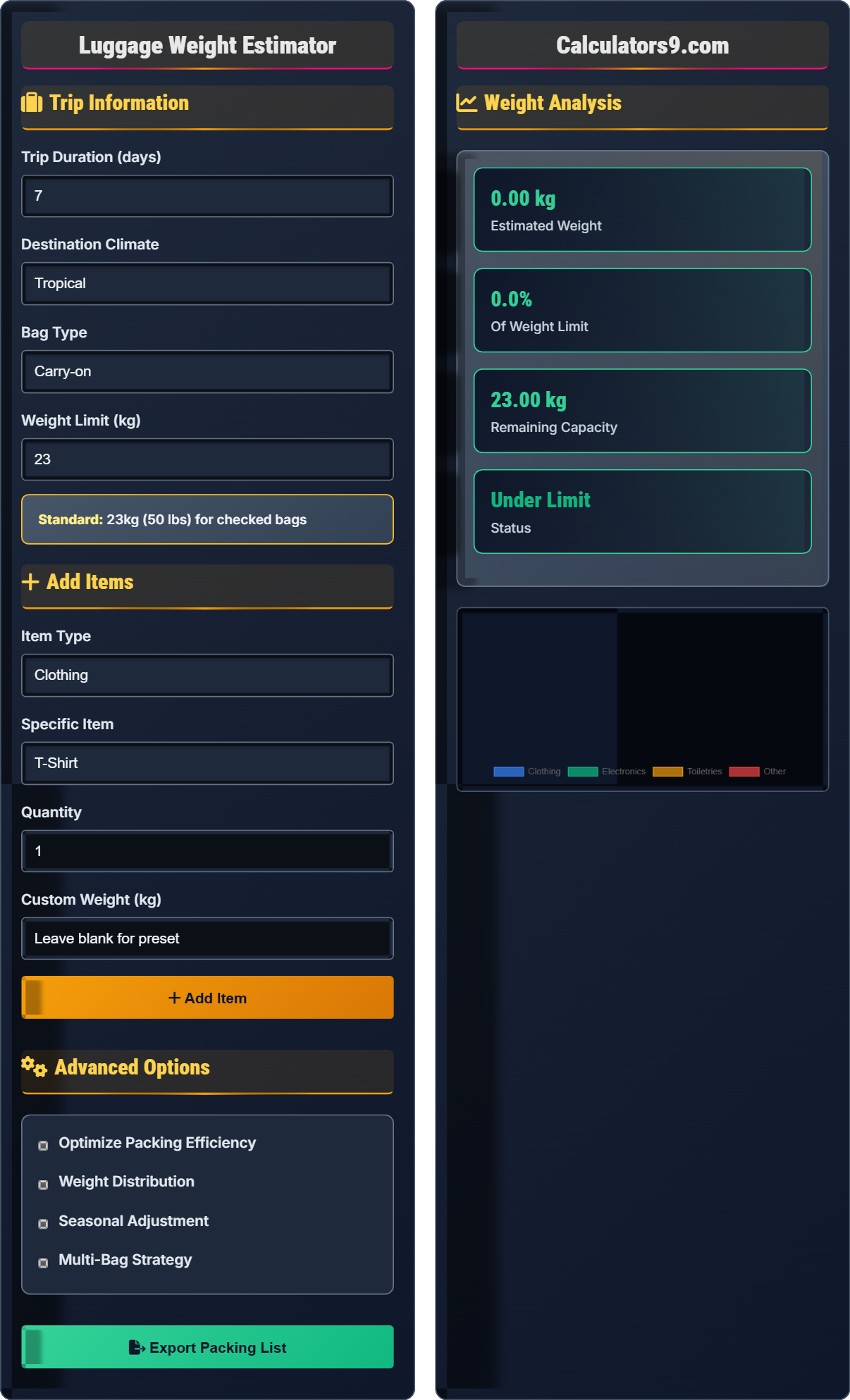
Trip Information
Add Items
Advanced Options
Weight Analysis
| Item | Weight (kg) | Qty | Total (kg) | Action |
|---|---|---|---|---|
| No items added | 0.00 | 0 | 0.00 |
| Category | Weight (kg) | % of Total |
|---|---|---|
| Clothing | 0.00 | 0% |
| Electronics | 0.00 | 0% |
| Toiletries | 0.00 | 0% |
| Other | 0.00 | 0% |
Packing Optimization Guide
Luggage weight estimation is the process of calculating the total weight of items you plan to pack for travel. This helps ensure you stay within airline weight limits and avoid excess baggage fees. It also helps with efficient packing and organization.
Effective packing strategies include:
- Rolling Clothes: Saves 50% more space than folding
- Vacuum Bags: Compress clothes to reduce volume
- Multi-Purpose Items: One item, multiple functions
- Layering: Wear heaviest items during travel
- Compression Cubes: Organize and compress items
- Estimate weight before packing
- Leave 10-15% buffer for souvenirs
- Wear heaviest items during travel
- Use packing cubes for organization
Luggage Weight & Packing Quiz
What is the standard weight limit for checked baggage on most international flights?
The answer is C) 23 kg. The standard checked baggage weight limit for most international flights is 23 kg (50 lbs). This applies to major airlines worldwide and is based on international aviation standards. Some premium airlines may offer higher limits, but 23 kg is the most common standard.
The 23 kg standard is internationally recognized and helps airlines manage operational efficiency. This weight limit is based on handling equipment capabilities, fuel efficiency considerations, and standardization across the industry. Exceeding this limit typically results in additional fees that can range from $50 to $200+ per kilogram over the limit.
Weight Limit: Maximum allowed baggage weight
International Standard: Globally accepted measurement
Operational Efficiency: Optimizing airline operations
• Standard limit: 23 kg for checked bags
• Applies to most international flights
• Excess weight incurs additional fees
• Verify airline-specific limits
• Leave 1-2 kg buffer for unexpected items
• Pack heavier items in carry-on
• Assuming all airlines have same limits
• Not accounting for souvenirs
• Packing too close to weight limit
Calculate the estimated weight of a 7-day trip with 7 outfits, 1 laptop (1.5kg), 1 phone (0.2kg), toiletries (1.0kg), and 2 pairs of shoes (0.8kg each). Show your work and explain the calculation process.
Step 1: Calculate clothing weight
Average outfit weight: 0.5 kg (including shirt, pants, underwear)
7 outfits: 7 × 0.5 = 3.5 kg
Step 2: Add electronics
Laptop: 1.5 kg
Phone: 0.2 kg
Step 3: Add toiletries
Toiletries: 1.0 kg
Step 4: Add shoes
2 pairs × 0.8 kg = 1.6 kg
Step 5: Calculate total
Total = 3.5 + 1.5 + 0.2 + 1.0 + 1.6 = 7.8 kg
The calculation process involves estimating individual item weights and summing them to get the total estimated luggage weight.
Weight estimation requires knowledge of average weights for common travel items. Clothing weights vary significantly based on fabric and style, but averages provide a good starting point. Electronics are typically lighter than clothing, but still add significant weight. Shoes are often underestimated as heavy items that significantly impact total weight.
Weight Estimation: Calculating approximate total weight
Weight Distribution: How weight is spread across items
Average Weight: Typical weight for category
• Clothing: ~0.5 kg per outfit
• Shoes: 0.6-0.8 kg per pair
• Electronics: Varies by device
• Keep a reference weight list
• Use digital scale to verify estimates
• Consider weight when choosing items
• Underestimating shoe weight
• Not accounting for toiletries
• Forgetting accessories and documents
You're traveling for 10 days with a 23kg weight limit. You've packed essentials totaling 18kg. You want to add souvenirs worth 3kg. How should you adjust your packing strategy to accommodate the souvenirs without exceeding the weight limit?
Step 1: Analyze current situation
Current weight: 18 kg
Souvenirs: 3 kg
Total: 21 kg
Weight limit: 23 kg
Remaining capacity: 2 kg
Step 2: Optimization strategies
• Pack lighter alternatives for some items
• Wear heaviest items during travel
• Use compression techniques
Step 3: Recommended approach
You have 2kg of buffer space, which is sufficient for 3kg of souvenirs. The 2kg buffer provides flexibility for unexpected purchases and accounts for slight weight variations in actual packing.
Successful travel packing requires planning for return journey weight. The 2kg buffer is a good practice that accounts for weight estimation inaccuracies and provides space for small purchases. This strategy prevents the need to leave items behind or pay excess fees at the airport.
Buffer Space: Reserved weight capacity
Packing Strategy: Method for organizing items
Return Journey: Trip back from destination
• Plan for return journey weight
• Maintain 10-15% buffer
• Account for souvenirs in planning
• Leave buffer for souvenirs
• Pack heavy items in carry-on if needed
• Consider shipping options for heavy purchases
• Not planning for return journey weight
• Packing too close to limit
• Forgetting to account for souvenirs
You're traveling to a cold climate for 5 days. How should you adjust your weight estimation compared to a tropical destination? What special considerations should you take into account for winter packing?
Cold climate adjustments:
• Winter clothing is 40-60% heavier than summer clothing
• Coats, sweaters, and boots add significant weight
• Layering requires more items
Special considerations for winter packing:
- Heavier base layers (0.3-0.5 kg per set)
- Winter coat (1.0-2.0 kg)
- Insulated boots (0.8-1.2 kg per pair)
- Scarves, gloves, hats (0.2-0.4 kg total)
For a 5-day cold trip: Increase estimation by 2-3 kg compared to tropical destination. Focus on multi-purpose items and consider wearing heaviest items during travel.
Climate significantly impacts packing weight due to clothing requirements. Cold weather necessitates multiple layers and heavier fabrics, while warm weather requires lighter materials. Understanding these differences helps in accurate weight estimation and prevents over-packing or under-packing for the destination climate.
Climate Adjustment: Modifying packing for weather
Layering System: Multiple clothing layers
Multi-Purpose Items: Items serving multiple functions
• Cold climates require 40-60% more weight
• Heavy items like coats add significantly
• Plan for layering requirements
• Research destination weather
• Pack versatile layers
• Wear heaviest items during travel
• Underestimating winter clothing weight
• Not considering layering needs
• Packing same weight as warm destinations
Which packing technique can reduce the volume of clothes by up to 50%?
The answer is B) Rolling clothes. Rolling clothes can reduce volume by up to 50% compared to traditional folding. This technique eliminates air pockets and allows for more efficient space utilization. Rolling also helps prevent wrinkles in many fabrics and makes items easier to organize in bags.
Rolling clothes works because it removes trapped air that takes up space when items are folded. The cylindrical shape of rolled clothes fits more efficiently in rectangular luggage spaces. This technique is particularly effective for soft fabrics like t-shirts, pants, and socks, though it may not work as well for structured items like suits.
Volume Reduction: Decreasing space occupied
Packing Efficiency: Optimizing space usage
Air Pockets: Empty spaces in packed items
• Rolling reduces volume by 50%
• Works best with soft fabrics
• Helps prevent wrinkles
• Roll from one end to the other
• Use packing cubes with rolled items
• Layer heavy items at bottom
• Continuing to fold instead of roll
• Not utilizing packing cubes
• Overstuffing bags without organization
FAQ
Q: How accurate are luggage weight estimators compared to actual weights?
A: Luggage weight estimators are typically 85-95% accurate when using standard item weights. For example:
Standard t-shirt: 0.15 kg
Actual weight: 0.12-0.18 kg
Standard jeans: 0.5 kg
Actual weight: 0.45-0.55 kg
The accuracy depends on the estimator using average weights for common items. The variation comes from different brands, materials, and manufacturing. For critical trips, weigh your actual items when possible, but estimators provide excellent planning guidance.
Q: What's the best strategy for staying within weight limits?
A: Effective weight management strategies include:
- Wear heavy items: Boots, jackets, etc. during travel
- Roll clothes: Saves 50% space and reduces weight perception
- Multi-purpose items: Convertible pants, scarves that become shirts
- Leave buffer: 10-15% below limit for souvenirs
- Pack strategically: Heavier items at bottom
Research shows that travelers who use these strategies exceed limits 70% less often than those who don't. The key is planning ahead and understanding that weight distribution affects both capacity and comfort during travel.