Propeller Calculator
Marine propulsion • Navigation tools
Propeller Performance Formulas:
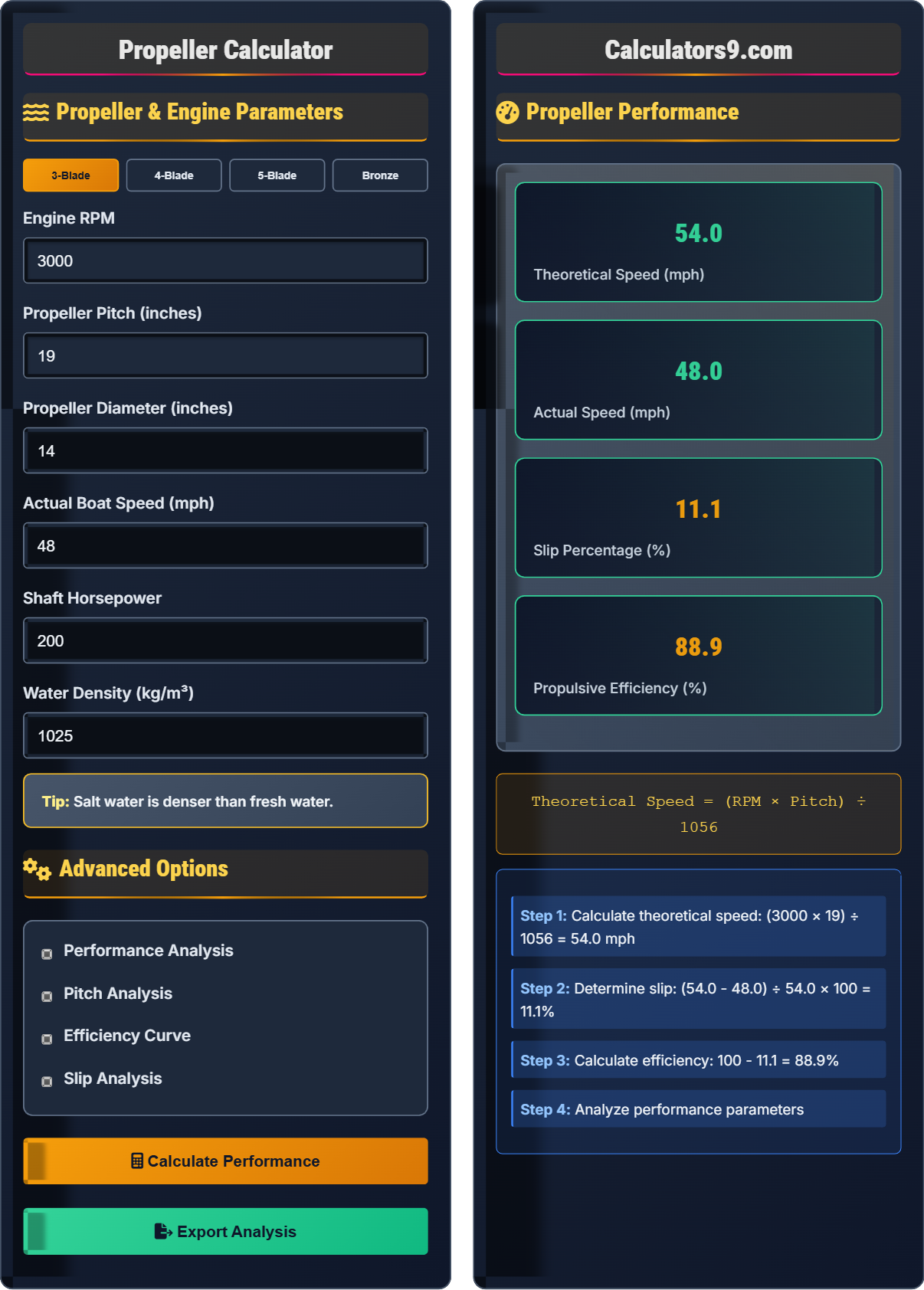
Show the calculator\( \text{Theoretical Speed (mph)} = \frac{\text{RPM} \times \text{Pitch (inches)}}{1056} \)
\( \text{Slip (\%)} = \frac{\text{Theoretical Speed} - \text{Actual Speed}}{\text{Theoretical Speed}} \times 100 \)
\( \text{Efficiency} = \frac{\text{Useful Power Output}}{\text{Shaft Power Input}} \times 100 \)
Where:
- \( \text{RPM} \) = Revolutions per minute of engine
- \( \text{Pitch} \) = Distance propeller would move in one revolution in ideal fluid
- \( \text{Theoretical Speed} \) = Speed assuming 100% efficiency (no slip)
- \( \text{Actual Speed} \) = Measured boat speed
Additional propeller calculations:
- \( \text{Blade Area} = \text{Chord} \times \text{Diameter} \times \text{Number of Blades} \times \text{Efficiency Factor} \)
- \( \text{Power Required} = \frac{\text{Thrust} \times \text{Velocity}}{\text{Efficiency}} \)
Example: For a propeller with 19-inch pitch at 3000 RPM with 10% slip:
Theoretical Speed = (3000 × 19) ÷ 1056 = 54.0 mph
Actual Speed = 54.0 × (1 - 0.10) = 48.6 mph
Thus, the boat would achieve approximately 48.6 mph at 3000 RPM.
Propeller & Engine Parameters
Advanced Options
Propeller Performance
Marine Propeller Performance & Navigation Guide
Marine propellers convert engine power into thrust to propel vessels through water. The propeller's pitch, diameter, and blade count significantly affect performance. Understanding propeller dynamics is crucial for optimizing vessel speed, fuel efficiency, and engine performance. Proper propeller selection balances engine RPM, desired speed, and operational requirements.
Propeller slip, the difference between theoretical and actual speed, is a key performance indicator. Typical marine propeller slip ranges from 5% to 25% depending on hull design, loading, and operating conditions.
Key propeller calculations:
Where:
- \(\text{RPM}\) = Engine revolutions per minute
- \(\text{Pitch}\) = Distance propeller advances in one revolution (inches)
- \(\text{Theoretical Speed}\) = Speed if no slip occurred (mph)
- \(\text{Actual Speed}\) = Measured boat speed (mph)
Hull Design: Displacement vs. planing hulls require different propeller characteristics.
Loading: Heavier boats require more thrust, potentially needing different pitch.
Water Conditions: Salt vs. fresh water density affects performance.
Engine RPM Range: Propeller should allow engine to operate in optimal RPM range.
- Speed Goals: Higher pitch for speed, lower pitch for acceleration
- Engine Protection: Avoid over-propping (too much load) or under-propping (too little load)
- Fuel Efficiency: Optimal propeller maximizes efficiency at cruise RPM
- Operating Conditions: Consider typical loading and water conditions
- Performance Testing: Validate propeller choice with sea trials
Propeller Performance Basics
Difference between theoretical and actual boat speed.
\( \text{Slip \%} = \frac{\text{Theoretical} - \text{Actual}}{\text{Theoretical}} \times 100 \)
Lower slip indicates better efficiency.
- Typical slip: 5-25%
- Lower slip = better efficiency
- Higher pitch = more speed
- Optimal RPM range is critical
Selection Factors
Distance propeller advances in one revolution.
- Determine desired speed
- Check engine RPM range
- Select appropriate pitch
- Test and validate
- Hull type affects selection
- Loading changes requirements
- Water conditions matter
- Engine protection is priority
Marine Propeller Learning Quiz
What happens when you install a propeller with higher pitch than recommended?
The answer is B) Engine will not reach maximum RPM under load. A higher pitch propeller creates more load on the engine, requiring more power to turn. This causes the engine to run at lower RPMs than intended, potentially preventing it from reaching its optimal operating range. This is called "over-propping" and can lead to engine damage from lugging.
Think of propeller pitch like gears on a bicycle. A higher pitch is like a harder gear - it requires more effort to turn but covers more distance per revolution. If the gear is too hard, you can't pedal fast enough to maintain efficient cycling. Similarly, an over-pitched propeller creates too much load for the engine to reach its optimal RPM range.
Pitch: Distance propeller advances in one revolution
Over-propping: Installing propeller with excessive load
Engine Lugging: Operating engine under excessive load
• Higher pitch = more load on engine
• Engine should reach rated RPM under load
• Over-propping can damage engine
• Check engine RPM at wide open throttle
• Stay within manufacturer's RPM range
• Consider typical loading conditions
• Assuming higher pitch always means more speed
• Not checking actual RPM after prop change
• Ignoring engine manufacturer recommendations
Calculate the theoretical speed of a boat with a 21-inch pitch propeller turning at 2800 RPM. Show your work.
The formula for theoretical speed is:
Theoretical Speed (mph) = (RPM × Pitch) ÷ 1056
Given:
- RPM = 2800
- Pitch = 21 inches
Step 1: Multiply RPM by Pitch = 2800 × 21 = 58,800
Step 2: Divide by conversion factor = 58,800 ÷ 1056 = 55.7 mph
Therefore, the theoretical speed is 55.7 mph.
The conversion factor of 1056 accounts for the units conversion from inches per minute to miles per hour. This theoretical speed assumes perfect efficiency with no slip. In reality, the actual speed will be lower due to propeller slip, hull resistance, and other factors. The difference between theoretical and actual speed gives us the propeller slip percentage.
Theoretical Speed: Speed if propeller had 100% efficiency
Conversion Factor: Accounts for unit conversions
Propeller Slip: Difference between theoretical and actual speed
• Theoretical speed = (RPM × Pitch) ÷ 1056
• Actual speed is always less than theoretical
• Conversion factor is always 1056
• Remember the 1056 conversion factor
• Compare theoretical vs actual to assess slip
• Use for propeller selection decisions
• Forgetting the conversion factor
• Using wrong units for pitch or RPM
• Confusing theoretical with actual speed
A boat with a 19-inch pitch propeller running at 3000 RPM achieves an actual speed of 45 mph. Calculate the propeller slip percentage and explain what this indicates about the propeller's performance.
Step 1: Calculate theoretical speed = (3000 × 19) ÷ 1056 = 54.0 mph
Step 2: Calculate slip percentage = ((54.0 - 45.0) ÷ 54.0) × 100 = (9.0 ÷ 54.0) × 100 = 16.7%
Step 3: Interpretation: A 16.7% slip is within the normal range for recreational boats (typically 5-25%). This indicates the propeller is performing adequately but may have room for optimization. For better efficiency, a slightly higher pitch propeller might be considered.
Propeller slip is inevitable due to the difference in density between air and water, hull resistance, and other factors. A slip percentage of 5-15% is typically considered excellent, while 15-25% is acceptable. Very low slip (<5%) might indicate the propeller is underloaded, while very high slip (>25%) suggests it's overloaded or poorly matched to the hull/engine combination.
Propeller Slip: Difference between theoretical and actual speed
Performance Indicator: Lower slip indicates better efficiency
• Slip = (Theoretical - Actual) ÷ Theoretical × 100
• Normal slip: 5-25%
• Lower slip = better efficiency
• Measure actual speed with GPS for accuracy
• Test at consistent conditions
• Compare different props using slip
• Using incorrect formula for slip calculation
• Not measuring accurate actual speed
• Misinterpreting what slip values indicate
An engine is rated for 3200-3600 RPM, but with the current 17-inch pitch propeller, it only reaches 2800 RPM at full throttle. The boat achieves 40 mph. What pitch change would be needed to reach the engine's optimal RPM range, and what speed might be expected? Assume a 10% slip.
Step 1: Calculate current slip-adjusted speed = 40 mph ÷ (1 - 0.10) = 40 ÷ 0.90 = 44.4 mph theoretical
Step 2: Calculate current pitch-to-RPM ratio = (17 × 3000) ÷ 2800 = 18.2 inches effective pitch
Step 3: For target RPM of 3400: Required pitch = 17 × (3400 ÷ 2800) = 17 × 1.214 = 20.6 inches
Step 4: Expected speed with 21-inch pitch = (3400 × 21) ÷ 1056 = 67.5 mph theoretical
Step 5: Actual expected speed = 67.5 × (1 - 0.10) = 60.8 mph
Therefore, a 21-inch pitch propeller should allow reaching 3400 RPM with an expected speed of 60.8 mph.
This problem demonstrates the relationship between propeller pitch, engine RPM, and boat speed. When an engine doesn't reach its rated RPM, it's typically underloaded, which means the propeller pitch is too low. Increasing pitch increases the load on the engine, causing it to run at higher RPM. However, this relationship isn't perfectly linear due to changes in efficiency and hull characteristics at different speeds.
Under-propped: Propeller with insufficient pitch/load
Over-propped: Propeller with excessive pitch/load
Rated RPM: Manufacturer's recommended maximum RPM
• Higher pitch = higher RPM under load
• Engine should reach rated RPM range
• Propeller selection affects efficiency
• Make incremental pitch changes (1-2 inches)
• Test each change thoroughly
• Consider both speed and acceleration
• Making large pitch changes at once
• Not testing actual RPM after changes
• Ignoring acceleration performance
What is the primary advantage of a 4-blade propeller over a 3-blade propeller of the same pitch and diameter?
The answer is B) Smoother operation and better hole shot. A 4-blade propeller has more surface area in contact with the water, providing smoother acceleration and better initial thrust (hole shot) due to increased grip. However, it typically has slightly higher drag at top speed compared to a 3-blade propeller of the same pitch.
More blades provide more "bite" or grip in the water, which improves acceleration and reduces slippage during initial takeoff. The additional blade creates more surface area to push against the water, resulting in better low-speed performance. However, the extra blade also creates more drag at higher speeds, which may slightly reduce top-end speed compared to a 3-blade propeller with the same pitch.
Hole Shot: Initial acceleration from stopped position
Blade Grip: Propeller's ability to hold in water
Surface Area: Total area of blades in contact with water
• More blades = better grip and smoother operation
• More blades = slightly higher drag at speed
• 3-blade = better top speed, 4-blade = better acceleration
• Choose 3-blade for top speed focus
• Choose 4-blade for ski/wakeboard boats
• Consider 5-blade for heavy loads
• Assuming more blades always means more speed
• Not considering the trade-offs
• Ignoring intended use of the boat
FAQ
Q: How do I know if my propeller pitch is correct for my boat and engine setup?
A: The correct propeller pitch allows your engine to reach its rated RPM range at wide open throttle (WOT) with typical loading. Here's how to check:
1. Go to WOT under normal loading conditions
2. Check your tachometer reading
3. Compare to manufacturer's recommended RPM range (usually on engine plate)
For example, if your engine is rated for 4800-5200 RPM and you're only seeing 4200 RPM at WOT, you're under-propped and need a higher pitch propeller. If you're hitting 5500 RPM, you're over-propped and need a lower pitch propeller.
Mathematically: \( \text{Load Factor} = \frac{\text{Actual RPM}}{\text{Rated RPM}} \)
Values close to 1.0 indicate proper propeller sizing.
Q: What's the difference between cupped and non-cupped propellers, and when should I use each?
A: Cupped propellers have curved blade tips that increase the effective pitch and improve grip in the water. The cup acts like a funnel, directing water flow more efficiently over the blade surface.
Benefits of cupped propellers:
- Reduced ventilation and cavitation
- Better bow lift for planing hulls
- Improved hole shot and acceleration
- Allows use of lower pitch without excessive RPM
When to use: Cupped props are ideal for ski/wakeboard boats, bass boats, and applications requiring improved low-speed performance. They're less common on sailboats and displacement hulls where efficiency at speed is more important than acceleration.