Algebra Solver
Quadratic Equations & Polynomial Calculator • 2026
Quadratic Formula:
Show the calculator\( x = \frac{-b \pm \sqrt{b^2 - 4ac}}{2a} \)
Where:
- \( ax^2 + bx + c = 0 \) is the standard form of a quadratic equation
- \( a, b, c \) are coefficients with \( a \neq 0 \)
- \( x \) represents the variable we're solving for
This formula solves any quadratic equation by finding the values of x that satisfy the equation. The discriminant (\( b^2 - 4ac \)) determines the nature of the roots: positive for two real roots, zero for one real root, and negative for complex roots.
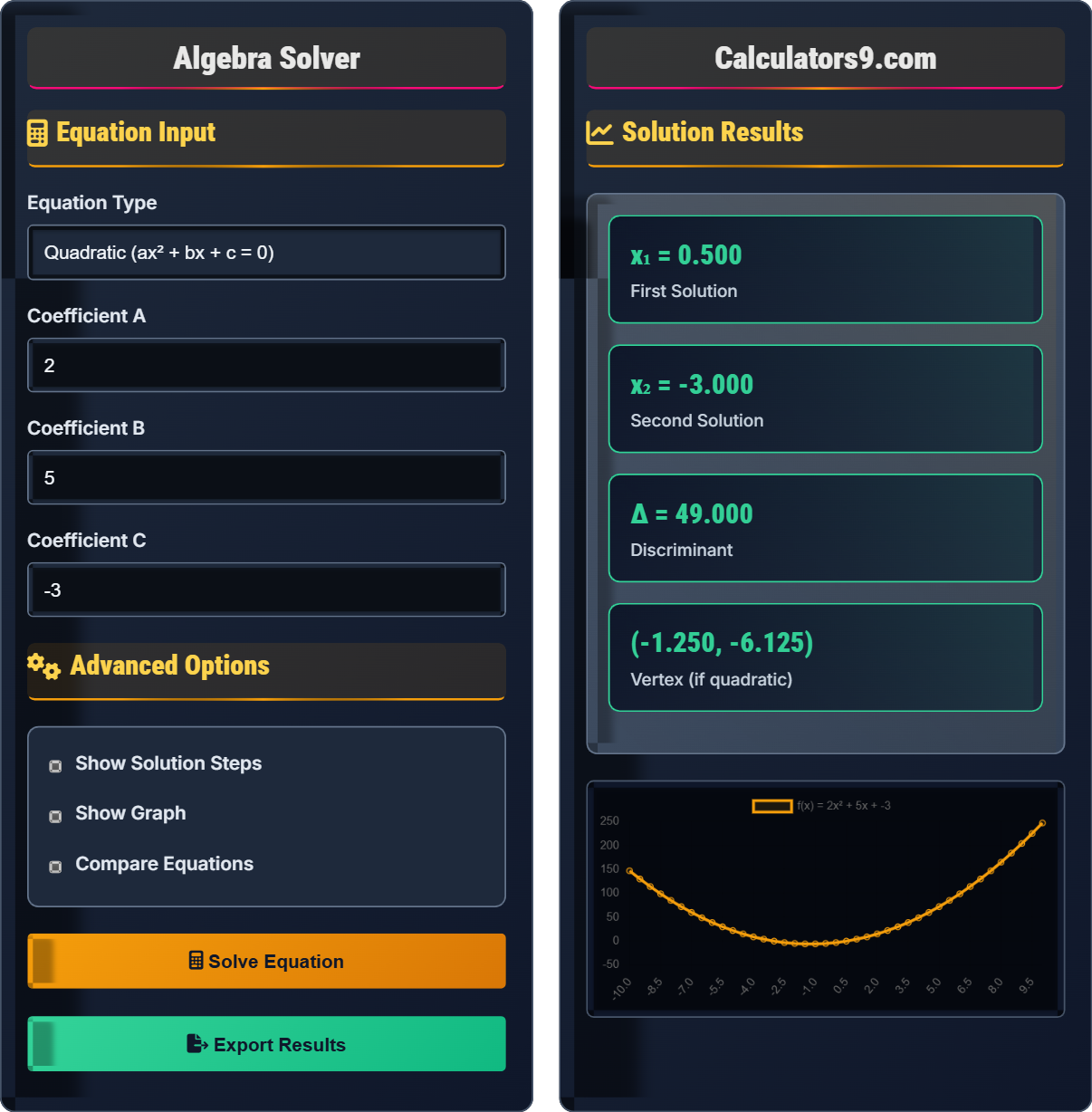
Example: For the equation \( 2x^2 + 5x - 3 = 0 \):
\( a = 2, b = 5, c = -3 \)
\( x = \frac{-5 \pm \sqrt{5^2 - 4(2)(-3)}}{2(2)} = \frac{-5 \pm \sqrt{25 + 24}}{4} = \frac{-5 \pm \sqrt{49}}{4} = \frac{-5 \pm 7}{4} \)
Therefore: \( x_1 = \frac{2}{4} = 0.5 \) and \( x_2 = \frac{-12}{4} = -3 \)
Equation Input
Advanced Options
Solution Results
| Step | Action | Expression |
|---|---|---|
| 1 | Identify coefficients | a=2, b=5, c=-3 |
| 2 | Calculate discriminant | Δ = b² - 4ac = 49 |
| 3 | Apply quadratic formula | x = (-b ± √Δ) / (2a) |
| 4 | Calculate solutions | x₁ = 0.5, x₂ = -3 |
| 5 | Verify solutions | 2(0.5)² + 5(0.5) - 3 = 0 |
| Solution | Verification | Status |
|---|---|---|
| x₁ = 0.5 | 2(0.5)² + 5(0.5) - 3 = 0 | ✓ Correct |
| x₂ = -3 | 2(-3)² + 5(-3) - 3 = 0 | ✓ Correct |
Comprehensive Algebra Guide
Algebra is a branch of mathematics that deals with symbols and the rules for manipulating those symbols. These symbols represent quantities without fixed values, known as variables. It allows us to solve equations, model real-world situations, and generalize mathematical relationships. Algebra is fundamental to higher mathematics and essential for solving problems in science, engineering, and economics.
Quadratic equations are polynomial equations of degree 2, written in the standard form:
Where:
- a, b, c are constants (coefficients)
- a ≠ 0 (otherwise it's not quadratic)
- x is the variable we're solving for
The discriminant (Δ = b² - 4ac) reveals the nature of the roots:
- Δ > 0: Two distinct real roots
- Δ = 0: One repeated real root (perfect square)
- Δ < 0: Two complex conjugate roots
- Factoring: When the quadratic can be expressed as a product of binomials
- Completing the Square: Transform to vertex form (x - h)² = k
- Graphing: Find x-intercepts of the parabola
- Special Cases: Difference of squares, perfect square trinomials
Algebra Learning Quiz
What is the discriminant of the equation x² + 4x + 4 = 0, and what does it tell us about the roots?
The answer is B) Δ = 0, one repeated real root. For the equation x² + 4x + 4 = 0, we have a=1, b=4, c=4. The discriminant is Δ = b² - 4ac = 4² - 4(1)(4) = 16 - 16 = 0. When Δ = 0, there is exactly one real root (which is repeated).
This example demonstrates a perfect square trinomial (x² + 4x + 4 = (x + 2)²). When the discriminant equals zero, the quadratic touches the x-axis at exactly one point, creating a repeated root. This occurs when the quadratic can be factored as a perfect square, meaning the parabola has its vertex on the x-axis.
Discriminant: b² - 4ac, determines nature of roots
Repeated Root: Root that appears twice in solution
Perfect Square Trinomial: Quadratic that factors to (x + a)²
• Δ > 0: Two distinct real roots
• Δ = 0: One repeated real root
• Δ < 0: Two complex roots
• Remember: Δ = b² - 4ac
• Perfect squares always have Δ = 0
• Check by factoring when possible
• Confusing Δ = 0 with no real roots
• Forgetting to multiply by 4 in discriminant
• Misidentifying coefficients
Solve the equation 3x² - 2x - 1 = 0 using the quadratic formula. Show your work.
For 3x² - 2x - 1 = 0, we have a=3, b=-2, c=-1.
Step 1: Calculate discriminant: Δ = (-2)² - 4(3)(-1) = 4 + 12 = 16
Step 2: Apply quadratic formula: x = (2 ± √16) / (2×3) = (2 ± 4) / 6
Step 3: Calculate solutions: x₁ = (2 + 4) / 6 = 1, x₂ = (2 - 4) / 6 = -1/3
Therefore, the solutions are x = 1 and x = -1/3.
This problem demonstrates the systematic approach to using the quadratic formula. Pay special attention to the signs of coefficients when substituting into the formula. The discriminant (16) is positive, confirming we have two distinct real roots. Always verify solutions by substituting back into the original equation.
Quadratic Formula: x = (-b ± √(b² - 4ac)) / (2a)
Coefficients: Values a, b, c in standard form
Real Roots: Solutions that are real numbers
• Always identify a, b, c correctly
• Substitute with correct signs
• Calculate discriminant first
• Write coefficients clearly: a=3, b=-2, c=-1
• Calculate discriminant separately
• Check both solutions in original equation
• Sign errors when substituting negative coefficients
• Arithmetic errors in discriminant calculation
• Forgetting to divide by 2a
A ball is thrown upward from a height of 5 feet with an initial velocity of 32 ft/s. Its height is modeled by h(t) = -16t² + 32t + 5, where t is time in seconds. When does the ball hit the ground?
The ball hits the ground when h(t) = 0, so we solve: -16t² + 32t + 5 = 0
For the equation -16t² + 32t + 5 = 0, we have a=-16, b=32, c=5.
Step 1: Calculate discriminant: Δ = 32² - 4(-16)(5) = 1024 + 320 = 1344
Step 2: Apply quadratic formula: t = (-32 ± √1344) / (2×-16) = (-32 ± 36.66) / -32
Step 3: Calculate solutions: t₁ = (-32 + 36.66) / -32 ≈ -0.15 (negative, discard)
t₂ = (-32 - 36.66) / -32 ≈ 2.15 seconds
Therefore, the ball hits the ground after approximately 2.15 seconds.
This physics application demonstrates how quadratic equations model real-world phenomena. The negative solution represents a time before the ball was thrown, which is not physically meaningful in this context. Always consider the practical meaning of mathematical solutions in word problems.
Projectile Motion: Object moving under gravity
Initial Conditions: Starting height and velocity
Physical Constraints: Time must be positive
• Physical problems require realistic solutions
• Discard non-physical answers
• Check units are consistent
• Identify what variable represents
• Consider physical meaning of answers
• Verify solution makes sense in context
• Including negative time solutions
• Forgetting to convert units
• Not checking if solution is physically meaningful
If a quadratic equation ax² + bx + c = 0 has roots r₁ and r₂, what is the relationship between the coefficients and the roots? Verify with the equation x² - 5x + 6 = 0.
For a quadratic equation ax² + bx + c = 0 with roots r₁ and r₂:
• Sum of roots: r₁ + r₂ = -b/a
• Product of roots: r₁ × r₂ = c/a
For x² - 5x + 6 = 0, we have a=1, b=-5, c=6.
The equation factors as (x-2)(x-3) = 0, giving roots r₁ = 2, r₂ = 3.
Verification: r₁ + r₂ = 2 + 3 = 5 = -(-5)/1 = -b/a ✓
r₁ × r₂ = 2 × 3 = 6 = 6/1 = c/a ✓
These are Vieta's formulas, which relate coefficients to sums and products of roots.
Vieta's formulas establish a fundamental relationship between polynomial coefficients and their roots. For quadratics, the sum of roots equals -b/a and the product equals c/a. This relationship helps verify solutions and is foundational for understanding higher-degree polynomials.
Vieta's Formulas: Relations between coefficients and roots
Roots: Solutions to the equation
Sum/Product Relationships: Connections between coefficients and roots
• Sum of roots = -b/a
• Product of roots = c/a
• These hold for any quadratic equation
• Use these formulas to verify solutions
• Helps when factoring is difficult
• Useful for constructing equations from roots
• Forgetting the negative sign in sum formula
• Mixing up sum and product relationships
• Not accounting for coefficient a
Which of the following quadratic equations has complex roots?
The answer is C) x² + x + 1 = 0. For complex roots, the discriminant must be negative. Let's check each option:
A) x² - 4x + 4: Δ = 16 - 16 = 0 (real repeated)
B) x² - 2x - 3: Δ = 4 + 12 = 16 (two real roots)
C) x² + x + 1: Δ = 1 - 4 = -3 (complex roots)
D) x² - 9: Δ = 0 + 36 = 36 (two real roots)
Only option C has a negative discriminant, indicating complex roots.
Complex roots occur when the discriminant is negative, meaning we're taking the square root of a negative number. The solutions will be complex conjugates: x = (-b ± i√|Δ|) / (2a), where i is the imaginary unit. This happens when the parabola doesn't intersect the x-axis.
Complex Numbers: Numbers with real and imaginary parts
Imaginary Unit: i = √(-1)
Complex Conjugates: a±bi pairs
• Δ < 0 → Complex roots
• Complex roots come in conjugate pairs
• Parabola doesn't intersect x-axis
• Check discriminant first to determine root type
• Complex roots still satisfy the equation
• Graphically, parabola stays above or below x-axis
• Saying "no solutions" when complex exist
• Forgetting to include i in complex solutions
• Not recognizing conjugate pairs
Algebra Fundamentals
x = (-b ± √(b² - 4ac)) / (2a)
Δ = b² - 4ac determines the nature of roots
Positive: Two real roots | Zero: One real root | Negative: Two complex roots
- a ≠ 0 for quadratic equations
- Always identify coefficients correctly
- Calculate discriminant first
- Consider practical constraints in applications
Advanced Algebra Techniques
For ax² + bx + c = 0 with roots r₁, r₂: r₁ + r₂ = -b/a, r₁ × r₂ = c/a
- Substitute solutions back into original equation
- Use discriminant to verify root nature
- Apply Vieta's formulas for verification
- Graph to visualize solutions
- Check for extraneous solutions
- Physical problems may exclude negative solutions
- Higher-degree polynomials have more roots
- Complex roots always appear in conjugate pairs
- Always verify solutions in original equation
FAQ
Q: When should I use the quadratic formula instead of factoring?
A: Use the quadratic formula when:
- The quadratic doesn't factor easily
- Coefficients are large or complex
- The discriminant is not a perfect square
- You need exact solutions (not approximations)
- Working with complex numbers
Factoring is faster when possible, but the quadratic formula works for ALL quadratic equations. It's especially useful when the discriminant is negative (complex roots) or when factoring seems difficult.
Q: What's the difference between real and complex roots?
A: The key differences are:
Real Roots:
- Can be plotted on the real number line
- Occur when discriminant Δ ≥ 0
- Represent x-intercepts of the parabola
- Correspond to actual intersection points with x-axis
Complex Roots:
- Contain imaginary component (i = √(-1))
- Occur when discriminant Δ < 0
- Appear in conjugate pairs (a±bi)
- Parabola doesn't intersect x-axis
In practical applications, complex roots often indicate that the physical situation described by the equation cannot occur under the given conditions.