Equation Solver
Multi-Variable & Polynomial Calculator • 2026
Equation Solving Formulas:
Show the calculator\( \text{Linear: } ax + b = 0 \Rightarrow x = -\frac{b}{a} \)
\( \text{Quadratic: } ax^2 + bx + c = 0 \Rightarrow x = \frac{-b \pm \sqrt{b^2 - 4ac}}{2a} \)
\( \text{Simultaneous: } \begin{cases} a_1x + b_1y = c_1 \\ a_2x + b_2y = c_2 \end{cases} \Rightarrow \text{Solved by substitution/elimination} \)
Where:
- \( a, b, c \) = Coefficients in equations
- \( x, y \) = Variables to solve for
- \( \Delta = b^2 - 4ac \) = Discriminant for quadratic equations
These formulas represent fundamental equation-solving techniques. Linear equations have one solution, quadratic equations have up to two solutions, and simultaneous equations can be solved using various algebraic methods. The discriminant determines the nature of quadratic roots.
Example: For the system:
\( 2x + 3y = 7 \)
\( x - y = 1 \)
From second equation: \( x = y + 1 \)
Substituting: \( 2(y + 1) + 3y = 7 \Rightarrow 5y = 5 \Rightarrow y = 1 \)
Therefore: \( x = 2, y = 1 \)
Equation Parameters
Advanced Options
Solution Results
| Step | Action | Expression |
|---|---|---|
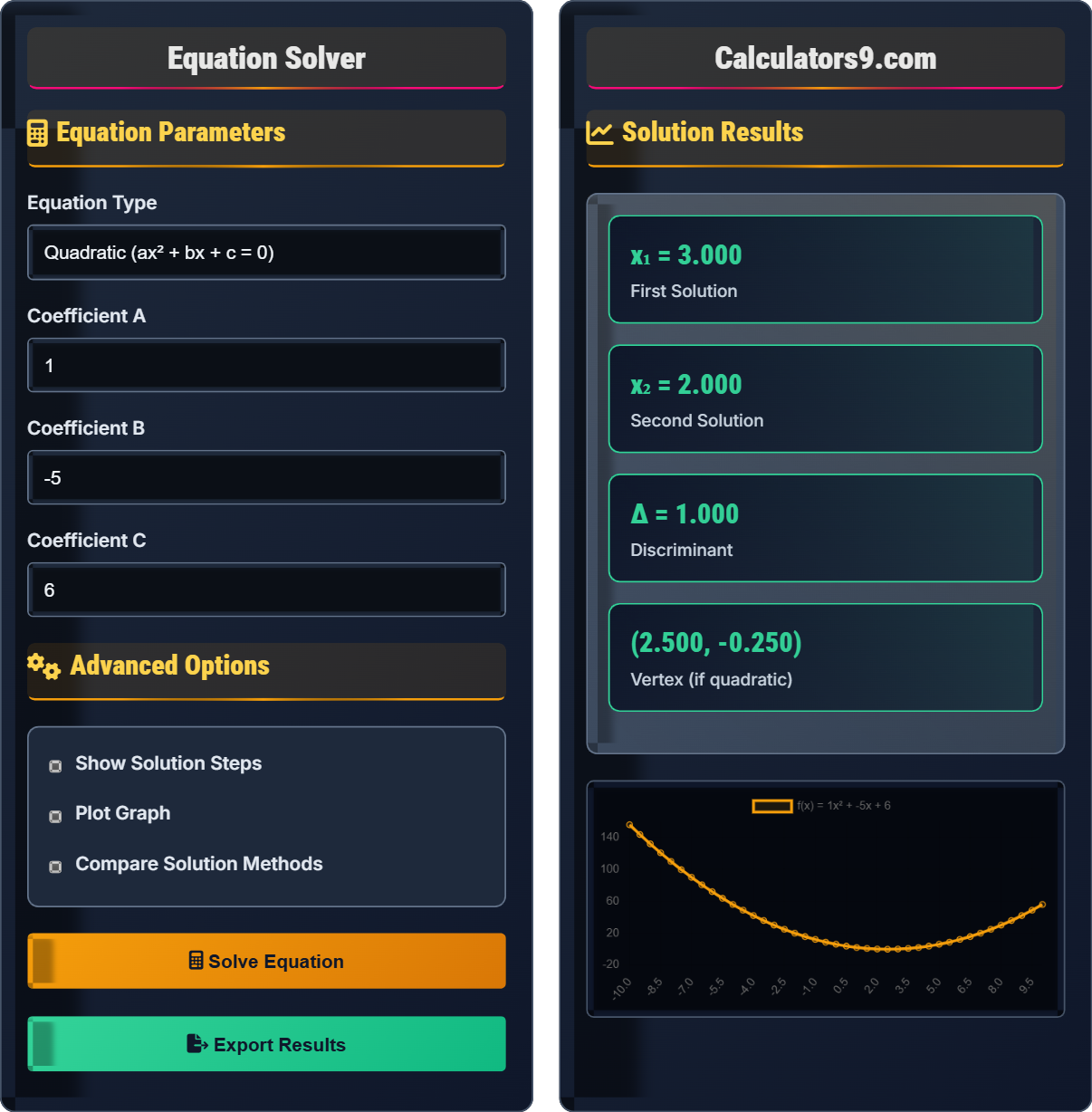
| 1 | Identify coefficients | a=1, b=-5, c=6 |
| 2 | Calculate discriminant | Δ = b² - 4ac = 25 - 24 = 1 |
| 3 | Apply quadratic formula | x = (-b ± √Δ) / (2a) |
| 4 | Calculate solutions | x₁ = (5 + 1)/2 = 3, x₂ = (5 - 1)/2 = 2 |
| 5 | Verify solutions | 1(3)² - 5(3) + 6 = 0 ✓ |
| Solution | Verification | Status |
|---|---|---|
| x₁ = 3 | 1(3)² - 5(3) + 6 = 9 - 15 + 6 = 0 | ✓ Correct |
| x₂ = 2 | 1(2)² - 5(2) + 6 = 4 - 10 + 6 = 0 | ✓ Correct |
Comprehensive Equation Solving Guide
Equation solving is the process of finding the value(s) of unknown variables that make an equation true. An equation states that two expressions are equal, and solving it involves determining the variable values that satisfy this equality. The solution set contains all possible values that make the equation valid.
Equations are classified by the highest power of the variable present:
Quadratic (Degree 2): ax² + bx + c = 0 → Up to 2 solutions
Cubic (Degree 3): ax³ + bx² + cx + d = 0 → Up to 3 solutions
Polynomial (Degree n): Up to n solutions
Where:
- a, b, c, d are coefficients with a ≠ 0
- Solutions may be real or complex numbers
- Higher-degree equations require more advanced methods
Systems of equations involve multiple equations with the same variables. Common solution methods include:
- Substitution: Solve one equation for a variable and substitute into others
- Elimination: Add/subtract equations to eliminate variables
- Matrix Methods: Represent systems as matrices and use operations like Gaussian elimination
- Graphical: Plot equations and find intersection points
- Extraneous Solutions: Some operations (squaring both sides) can introduce invalid solutions
- Domain Restrictions: Solutions must be within the domain of the original equation
- Complex Numbers: Equations may have complex solutions when discriminants are negative
- Multiple Solutions: Higher-degree equations can have multiple valid solutions
Equation Solving Learning Quiz
Solve the equation: 3x + 7 = 22
The answer is A) x = 5. To solve 3x + 7 = 22:
Step 1: Subtract 7 from both sides: 3x = 22 - 7 = 15
Step 2: Divide both sides by 3: x = 15/3 = 5
Verification: 3(5) + 7 = 15 + 7 = 22 ✓
This example demonstrates the fundamental principle of equation solving: performing the same operation on both sides maintains equality. We isolate the variable by undoing operations in reverse order of operations (PEMDAS). First, we undo addition (subtract 7), then we undo multiplication (divide by 3).
Linear Equation: First-degree equation with one variable
Inverse Operations: Operations that undo each other (add/subtract, multiply/divide)
Isolate Variable: Get variable alone on one side of equation
• Perform same operation on both sides
• Undo operations in reverse order of PEMDAS
• Always verify solutions by substitution
• Think of equation as balanced scale
• Undo operations step by step
• Check answer by substituting back
• Forgetting to perform operation on both sides
• Incorrect order of operations when undoing
• Not verifying the solution
Find the solutions to x² - 4x - 5 = 0 using the quadratic formula. Show your work.
For x² - 4x - 5 = 0, we have a=1, b=-4, c=-5.
Step 1: Calculate discriminant: Δ = b² - 4ac = (-4)² - 4(1)(-5) = 16 + 20 = 36
Step 2: Apply quadratic formula: x = (4 ± √36) / (2×1) = (4 ± 6) / 2
Step 3: Calculate solutions: x₁ = (4 + 6)/2 = 5, x₂ = (4 - 6)/2 = -1
Therefore, x = 5 or x = -1.
The quadratic formula is a universal method that works for all quadratic equations. The discriminant (Δ = b² - 4ac) determines the nature of solutions: positive for two real solutions, zero for one solution, and negative for complex solutions. Always identify coefficients correctly before applying the formula.
Quadratic Formula: x = (-b ± √(b² - 4ac)) / (2a)
Discriminant: b² - 4ac, determines nature of roots
Real Solutions: Solutions that exist on real number line
• Identify a, b, c correctly from standard form
• Calculate discriminant first
• Apply formula with correct signs
• Write coefficients clearly: a=1, b=-4, c=-5
• Calculate discriminant separately
• Check both solutions in original equation
• Sign errors with negative coefficients
• Forgetting to divide by 2a
• Miscounting decimal places
A store sells apples for $2 each and oranges for $3 each. If someone buys 10 fruits for $24, how many apples and oranges did they buy?
Let x = number of apples, y = number of oranges
System of equations:
1) x + y = 10 (total fruits)
2) 2x + 3y = 24 (total cost)
From equation 1: x = 10 - y
Substitute into equation 2: 2(10 - y) + 3y = 24
20 - 2y + 3y = 24
y = 4
Therefore x = 10 - 4 = 6
The person bought 6 apples and 4 oranges.
This problem demonstrates how to translate real-world situations into mathematical equations. We define variables for unknown quantities, create equations based on given relationships, and solve the system. The substitution method works well here because one equation is easily solved for one variable.
System of Equations: Multiple equations with same variables
Substitution Method: Solve one equation for variable, substitute
Word Problems: Real-world situations expressed mathematically
• Define variables clearly
• Translate words to equations
• Solve systematically
• Look for total quantity and total value
• One equation often represents total count
• Check solution in both original equations
• Defining variables incorrectly
• Setting up wrong equations
• Arithmetic errors in solving
Factor the quadratic expression x² + 7x + 12 completely. Then use the factored form to solve x² + 7x + 12 = 0.
To factor x² + 7x + 12, find two numbers that multiply to 12 and add to 7.
Numbers: 3 and 4 (since 3×4=12 and 3+4=7)
Factored form: (x + 3)(x + 4)
To solve x² + 7x + 12 = 0:
(x + 3)(x + 4) = 0
Using zero product property:
x + 3 = 0 → x = -3
x + 4 = 0 → x = -4
Therefore, x = -3 or x = -4.
Factoring is often the quickest method for solving quadratic equations when the polynomial is factorable. The zero product property states that if ab=0, then a=0 or b=0. This allows us to set each factor equal to zero to find solutions.
Factoring: Expressing polynomial as product of factors
Zero Product Property: If ab=0, then a=0 or b=0
Factorable Polynomial: Can be expressed as product of simpler polynomials
• Find numbers that multiply to c and add to b
• Use zero product property after factoring
• Check by expanding factored form
• List factor pairs of constant term
• Check which pair sums to middle coefficient
• Verify by FOIL method
• Forgetting to check signs
• Not listing all factor pairs
• Arithmetic errors in verification
What type of solutions does the equation x² + 4x + 5 = 0 have?
The answer is C) Two complex solutions. Calculate the discriminant: Δ = b² - 4ac = 4² - 4(1)(5) = 16 - 20 = -4. Since Δ < 0, the equation has two complex conjugate solutions: x = (-4 ± 2i)/2 = -2 ± i.
When the discriminant is negative, the square root of a negative number results in complex solutions. These solutions are complex conjugates of the form a ± bi, where i is the imaginary unit. Graphically, the parabola doesn't intersect the x-axis.
Complex Number: Number of form a + bi where i² = -1
Complex Conjugate: a + bi and a - bi
Imaginary Unit: i = √(-1)
• Δ > 0: Two real solutions
• Δ = 0: One real solution
• Δ < 0: Two complex solutions
• Calculate discriminant first to know solution type
• Complex solutions always come in pairs
• Graphically: parabola above x-axis
• Saying "no solutions" when complex exist
• Not recognizing complex conjugates
• Forgetting to include i in answers
Equation Fundamentals
ax + b = 0 → x = -b/a (when a ≠ 0)
For ax² + bx + c = 0: x = (-b ± √(b² - 4ac)) / (2a)
Where Δ = b² - 4ac determines solution nature.
- Perform identical operations on both sides
- Isolate variable using inverse operations
- Verify solutions by substitution
- Consider domain restrictions
Advanced Solution Techniques
For ax² + bx + c = 0 with roots r₁, r₂: r₁ + r₂ = -b/a, r₁ × r₂ = c/a
- Substitute solutions back into original equation
- Use discriminant to verify solution nature
- Apply Vieta's formulas for verification
- Graph to visualize solutions
- Check for extraneous solutions
- Quadratic equations have at most 2 real solutions
- Cubic equations have at most 3 real solutions
- Complex solutions come in conjugate pairs
- Always verify solutions in original equation
FAQ
Q: When should I use factoring versus the quadratic formula?
A: Use factoring when:
- The quadratic is easily factorable
- Coefficients are small integers
- You can quickly identify factor pairs
Use the quadratic formula when:
- The quadratic doesn't factor easily
- Coefficients are large or complex
- You need exact solutions (not approximations)
- The discriminant is negative (complex roots)
Factoring is faster when possible, but the quadratic formula works for ALL quadratic equations.
Q: How do I solve systems of equations with more than two variables?
A: For systems with n variables, you need n independent equations to find a unique solution. Common methods include:
Substitution Method: Solve one equation for a variable and substitute into others, reducing the system step by step.
Elimination Method: Add/subtract equations to eliminate variables systematically.
Matrix Methods: Represent the system as AX = B and solve using matrix operations like Gaussian elimination or Cramer's rule.
Computational Tools: For complex systems, use software like MATLAB, Python NumPy, or computer algebra systems.
Each method has advantages depending on the structure of the system and the number of variables involved.