Exponent Calculator
Calculate powers, roots, exponential functions • 2026 edition
Exponent Rules:
Show the calculatorProduct Rule: \(a^m \times a^n = a^{m+n}\)
Quotient Rule: \(\frac{a^m}{a^n} = a^{m-n}\)
Power Rule: \((a^m)^n = a^{mn}\)
Zero Exponent: \(a^0 = 1\) (when \(a \neq 0\))
Negative Exponent: \(a^{-n} = \frac{1}{a^n}\)
Fractional Exponent: \(a^{m/n} = \sqrt[n]{a^m}\)
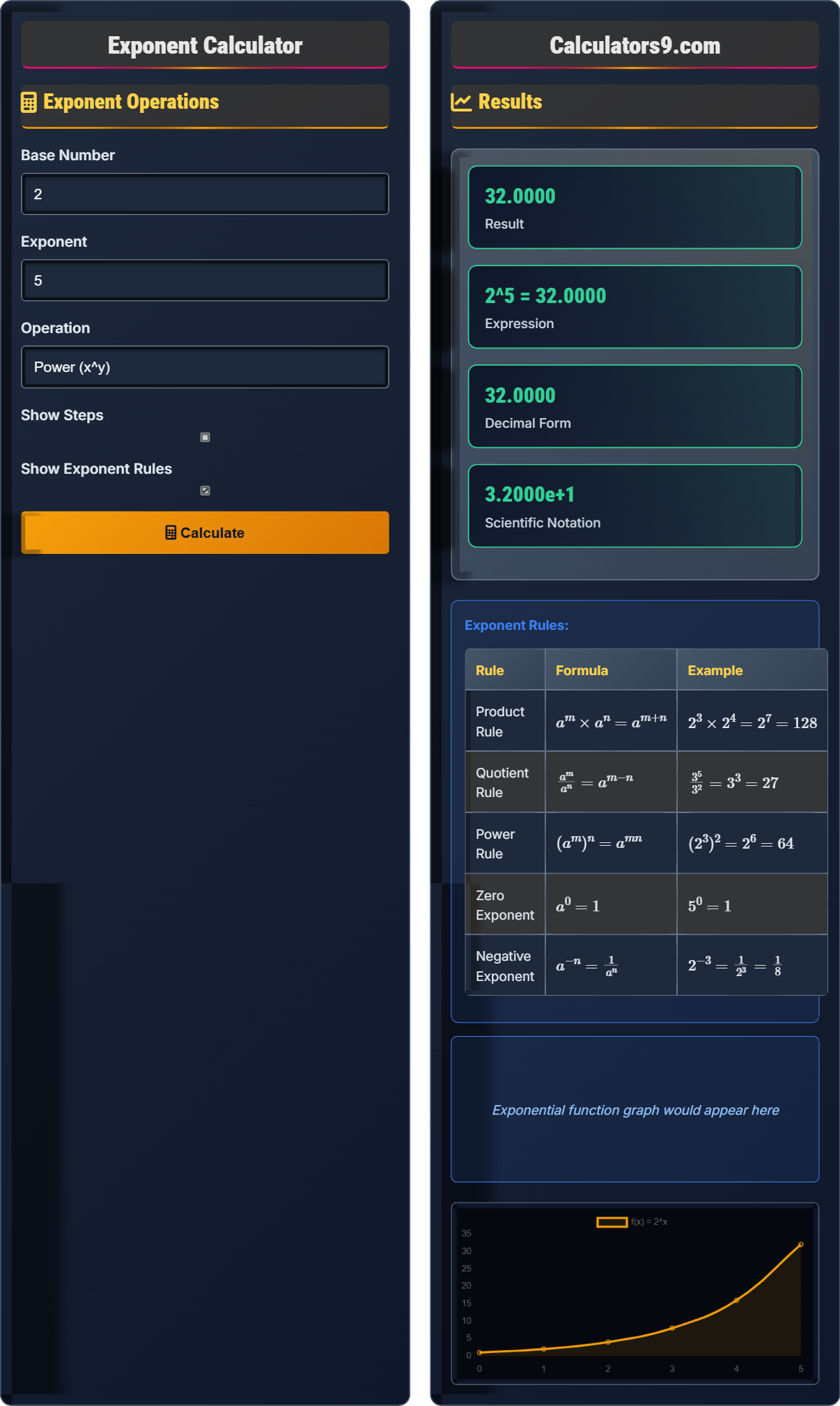
Example: Calculate \(2^5\)
\(2^5 = 2 \times 2 \times 2 \times 2 \times 2 = 32\)
Example: Calculate \(8^{2/3}\)
\(8^{2/3} = (8^{1/3})^2 = (\sqrt[3]{8})^2 = 2^2 = 4\)
Therefore, \(2^5 = 32\) and \(8^{2/3} = 4\).
Exponent Operations
Results
| Rule | Formula | Example |
|---|---|---|
| Product Rule | \(a^m \times a^n = a^{m+n}\) | \(2^3 \times 2^4 = 2^7 = 128\) |
| Quotient Rule | \(\frac{a^m}{a^n} = a^{m-n}\) | \(\frac{3^5}{3^2} = 3^3 = 27\) |
| Power Rule | \((a^m)^n = a^{mn}\) | \((2^3)^2 = 2^6 = 64\) |
| Zero Exponent | \(a^0 = 1\) | \(5^0 = 1\) |
| Negative Exponent | \(a^{-n} = \frac{1}{a^n}\) | \(2^{-3} = \frac{1}{2^3} = \frac{1}{8}\) |
Exponential function graph would appear here
Comprehensive Exponent Guide
An exponent is a mathematical notation that indicates the number of times a number (the base) is multiplied by itself. For example, in the expression 2³, the base is 2 and the exponent is 3, meaning 2 is multiplied by itself 3 times: 2 × 2 × 2 = 8. Exponents are fundamental to algebra and appear in many areas of mathematics, science, and engineering.
The main rules for working with exponents include:
Exponents are used in various fields:
- Compound interest calculations in finance
- Population growth models in biology
- Radioactive decay in physics
- Computer science algorithms and complexity
Exponent Fundamentals
\(a^n = \underbrace{a \times a \times \ldots \times a}_{n \text{ times}}\)
\(a \times 10^n\) where \(1 \leq a < 10\)
Used for very large or small numbers.
- \(a^0 = 1\) (when a ≠ 0)
- \(a^1 = a\)
- \(a^{-n} = \frac{1}{a^n}\)
Operations
\(\sqrt[n]{a} = a^{1/n}\)
- Same base: add exponents
- Different bases: calculate separately
- Same exponent: multiply bases
- \((ab)^n = a^n \times b^n\)
- \(\left(\frac{a}{b}\right)^n = \frac{a^n}{b^n}\)
- \(a^{m/n} = \sqrt[n]{a^m}\)
Exponent Learning Quiz
What is the value of \(3^4 \times 3^2\)?
The answer is A) \(3^6\). According to the Product Rule of exponents, when multiplying expressions with the same base, we add the exponents: \(3^4 \times 3^2 = 3^{4+2} = 3^6\). Calculating: \(3^6 = 729\).
The Product Rule is one of the fundamental exponent rules: when multiplying expressions with the same base, you add the exponents. This rule stems from the definition of exponents as repeated multiplication.
Base: The number being raised to a power
Exponent: The number indicating how many times to multiply the base
Product Rule: \(a^m \times a^n = a^{m+n}\)
• Only apply the product rule when bases are identical
• Keep the same base and add the exponents
• The rule applies to any real number base except 0
• Remember: multiply coefficients, add exponents
• Visualize as expanded form: \(3^4 \times 3^2 = (3×3×3×3) × (3×3)\)
• Count total number of base multiplications
• Multiplying exponents instead of adding them
• Changing the base when it should remain the same
• Forgetting that the rule only applies to same bases
Simplify the expression \(\frac{5^8}{5^3}\) using exponent rules. Show your work.
Step 1: Apply the Quotient Rule: \(\frac{a^m}{a^n} = a^{m-n}\)
Step 2: Substitute values: \(\frac{5^8}{5^3} = 5^{8-3} = 5^5\)
Step 3: Calculate if needed: \(5^5 = 5 \times 5 \times 5 \times 5 \times 5 = 3125\)
The simplified expression is \(5^5\) which equals 3125.
The Quotient Rule states that when dividing expressions with the same base, we subtract the exponents. This is intuitive when thinking of exponents as repeated multiplication: dividing removes common factors.
Quotient Rule: \(\frac{a^m}{a^n} = a^{m-n}\)
Division: Inverse operation of multiplication
Same Base: Essential condition for applying quotient rule
• Apply quotient rule only when bases are identical
• Subtract the exponent of the denominator from the numerator
• The base remains unchanged
• Remember: divide coefficients, subtract exponents
• Think of it as canceling common factors
• Verify by expanding if unsure
• Subtracting numerators from denominators instead of exponents
• Changing the base when dividing
• Forgetting that the rule only applies to same bases
A bacteria culture doubles every hour. If there are initially 100 bacteria, how many bacteria will there be after 5 hours? Express your answer as an exponential expression and calculate the final number.
Step 1: Identify the pattern - population doubles each hour
Step 2: Initial population = 100
Step 3: After 1 hour: \(100 \times 2^1 = 200\)
Step 4: After 2 hours: \(100 \times 2^2 = 400\)
Step 5: After 3 hours: \(100 \times 2^3 = 800\)
Step 6: After 4 hours: \(100 \times 2^4 = 1600\)
Step 7: After 5 hours: \(100 \times 2^5 = 100 \times 32 = 3200\)
The exponential expression is \(100 \times 2^5\), which equals 3,200 bacteria.
This problem demonstrates exponential growth, where quantities increase by a fixed percentage over equal time intervals. The exponential function models many natural phenomena like population growth, radioactive decay, and compound interest.
Exponential Growth: Growth proportional to current value
Compound Growth: Growth that builds upon previous growth
Initial Value: Starting quantity before growth begins
• Exponential growth follows the pattern: Initial × (Growth Factor)^Time
• Growth factor is 1 + growth rate
• Time is the exponent in exponential models
• Look for keywords like "doubles," "triples," or "increases by a factor"
• Set up the exponential function first
• Verify that your answer makes sense in context
• Adding instead of multiplying for compound growth
• Forgetting to include the initial value
• Confusing linear growth with exponential growth
The distance from Earth to the Sun is approximately 150 million kilometers. Express this distance in scientific notation. Then calculate how many times further away Jupiter is if it's 7.78 × 10⁸ km from the Sun. (Hint: Express 150 million in scientific notation first)
Step 1: Convert 150 million to standard form: 150,000,000 km
Step 2: Express in scientific notation: Move decimal point 8 places left: \(1.5 \times 10^8\) km
Step 3: Calculate the ratio: \(\frac{7.78 \times 10^8}{1.5 \times 10^8}\)
Step 4: Divide coefficients: \(\frac{7.78}{1.5} = 5.187\)
Step 5: Divide powers of 10: \(\frac{10^8}{10^8} = 10^0 = 1\)
Step 6: Multiply results: \(5.187 \times 1 = 5.187\)
Jupiter is approximately 5.19 times further from the Sun than Earth.
Scientific notation expresses numbers as a product of a decimal between 1 and 10 and a power of 10. This is especially useful for very large or small numbers. When dividing numbers in scientific notation, divide the decimal parts and subtract the exponents.
Scientific Notation: \(a \times 10^n\) where \(1 \leq a < 10\)
Decimal Part: Number between 1 and 10
Power of 10: Indicates the order of magnitude
• Decimal part must be between 1 and 10 (including 1 but not 10)
• Positive exponent indicates large number
• Negative exponent indicates small number
• Count decimal places moved to determine exponent
• Right move = negative exponent, Left move = positive exponent
• Use scientific notation for calculations with very large/small numbers
• Incorrectly determining the sign of the exponent
• Moving decimal to wrong position
• Forgetting to keep decimal between 1 and 10
Which of the following expressions is equivalent to \(2^{-3}\)?
The answer is C) \(\frac{1}{8}\). According to the Negative Exponent Rule, \(a^{-n} = \frac{1}{a^n}\). Therefore, \(2^{-3} = \frac{1}{2^3} = \frac{1}{8}\). Negative exponents indicate reciprocals, not negative values.
It's crucial to understand that negative exponents do not make the result negative. Instead, they indicate that we take the reciprocal of the base raised to the positive exponent. This is a common source of confusion for students.
Negative Exponent Rule: \(a^{-n} = \frac{1}{a^n}\)
Reciprocal: The multiplicative inverse of a number
Positive Exponent: Number of times to multiply the base
• Negative exponent ≠ negative result
• Negative exponent means reciprocal
• \(a^{-n} = \frac{1}{a^n}\) for any non-zero a
• Think of negative exponents as "flip to denominator"
• If in numerator, move to denominator with positive exponent
• If in denominator, move to numerator with positive exponent
• Thinking negative exponent makes result negative
• Forgetting to take reciprocal
• Confusing with opposite of the base
FAQ
Q: Why does any number to the power of 0 equal 1?
A: The zero exponent rule (\(a^0 = 1\)) can be understood through the quotient rule. Consider \(\frac{a^n}{a^n} = 1\) (any non-zero number divided by itself equals 1). Using the quotient rule: \(\frac{a^n}{a^n} = a^{n-n} = a^0\). Therefore, \(a^0 = 1\). This holds for any non-zero base.
Q: What's the difference between \((-2)^2\) and \(-2^2\)?
A: The parentheses make a crucial difference:
- \((-2)^2 = (-2) \times (-2) = 4\) (the negative sign is included in the squaring)
- \(-2^2 = -(2^2) = -4\) (order of operations: exponent first, then apply negative)
Remember: parentheses override order of operations.