Log Calculator
Advanced logarithmic operations • 2026 edition
Logarithmic Formulas:
Show the calculatorDefinition: If \( b^y = x \), then \( \log_b(x) = y \)
Natural Log: \( \ln(x) = \log_e(x) \)
Change of Base: \( \log_b(x) = \frac{\log_k(x)}{\log_k(b)} \)
Product Rule: \( \log_b(xy) = \log_b(x) + \log_b(y) \)
Quotient Rule: \( \log_b\left(\frac{x}{y}\right) = \log_b(x) - \log_b(y) \)
Power Rule: \( \log_b(x^n) = n \log_b(x) \)
Logarithms are the inverse operations of exponentiation. The natural logarithm (ln) uses Euler's number e ≈ 2.71828 as its base, while the common logarithm (log) uses base 10. These functions are essential in solving exponential equations and modeling phenomena with exponential growth or decay.
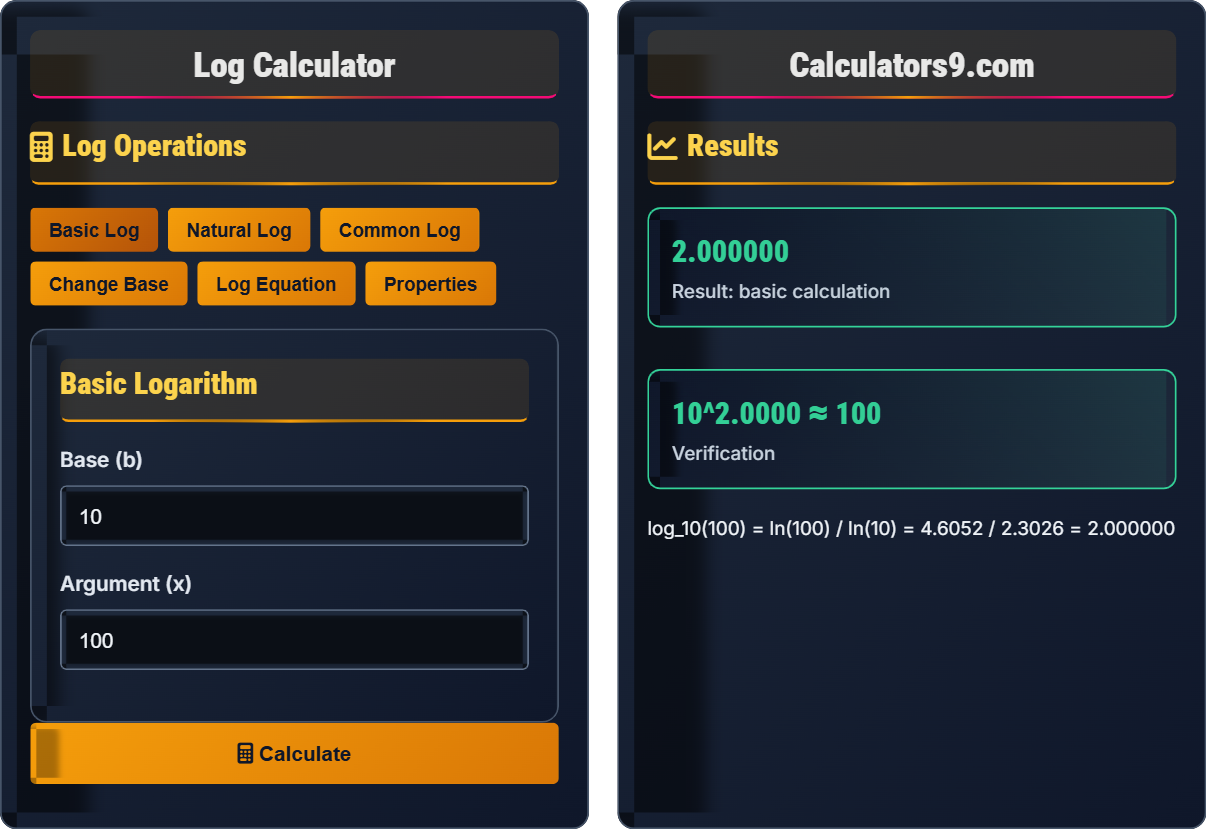
Log Operations
Basic Logarithm
Results
Logarithmic Operations Guide
A logarithm is the inverse operation of exponentiation. If b^y = x, then log_b(x) = y. It answers the question: "To what power must b be raised to get x?"
If \( b^y = x \), then \( \log_b(x) = y \)
Common bases: Natural log (base e), Common log (base 10)
\( \log_b(x) = \frac{\log_k(x)}{\log_k(b)} \)
Allows conversion between different logarithmic bases.
- Product Rule: log_b(xy) = log_b(x) + log_b(y)
- Quotient Rule: log_b(x/y) = log_b(x) - log_b(y)
- Power Rule: log_b(x^n) = n * log_b(x)
- log_b(1) = 0, log_b(b) = 1
Logarithmic Operations Learning Quiz
If log₂(8) = x, what is the value of x?
The answer is B) 3. By definition, log₂(8) = x means 2^x = 8. Since 2^3 = 8, x = 3. We can verify: 2^3 = 2 × 2 × 2 = 8
The logarithm asks "to what power must we raise the base to get the argument?" So log₂(8) asks "2 to what power equals 8?" The answer is 3 because 2³ = 8. This relationship between logarithms and exponents is fundamental: logarithms and exponentiation are inverse operations.
Logarithm: The exponent to which a base must be raised to produce a given number
Base: The number that is raised to a power in logarithmic expressions
Argument: The number for which we're finding the logarithm
• If log_b(x) = y, then b^y = x
• log_b(b) = 1 for any valid base b
• log_b(1) = 0 for any valid base b
• Convert log to exponential form: log_b(x) = y becomes b^y = x
• Memorize common powers: 2²=4, 2³=8, 2⁴=16, etc.
• Use the relationship between logs and exponents to verify answers
• Confusing the base and argument in logarithmic expressions
• Forgetting that logarithms are only defined for positive arguments
• Mixing up logarithmic and exponential relationships
Use the product rule to simplify: log₃(9) + log₃(27). Show your work.
Using the product rule: log_b(x) + log_b(y) = log_b(xy)
log₃(9) + log₃(27) = log₃(9 × 27)
= log₃(243)
To find the value: 3^5 = 243, so log₃(243) = 5
We can verify: log₃(9) = 2 (since 3² = 9) and log₃(27) = 3 (since 3³ = 27)
So 2 + 3 = 5 ✓
The product rule allows us to combine logarithms with the same base when they're added together. This is extremely useful for simplifying complex logarithmic expressions. The rule stems from the property of exponents that states b^m × b^n = b^(m+n). When we take the log of both sides, we get the product rule.
Product Rule: log_b(xy) = log_b(x) + log_b(y)
Logarithmic Properties: Rules that govern how logarithms behave under operations
Simplification: Using properties to make expressions easier to evaluate
• Product Rule: log_b(x) + log_b(y) = log_b(xy)
• Quotient Rule: log_b(x) - log_b(y) = log_b(x/y)
• Power Rule: log_b(x^n) = n × log_b(x)
• Look for opportunities to apply logarithmic properties
• Always verify simplified results by calculating original expression
• Remember that properties only apply to logs with the same base
• Applying properties to logarithms with different bases
• Confusing addition inside log with addition outside log
• Forgetting to check domain restrictions
A bacteria culture doubles every hour. If there are initially 100 bacteria, how many hours will it take to reach 6400 bacteria? Solve using logarithms.
Step 1: Set up the exponential equation
N(t) = N₀ × 2^t
Where N₀ = 100 (initial amount), N(t) = 6400 (final amount), t = time in hours
Step 2: Substitute known values
6400 = 100 × 2^t
Step 3: Divide both sides by 100
64 = 2^t
Step 4: Take log₂ of both sides
log₂(64) = log₂(2^t)
Step 5: Simplify using log property log_b(b^x) = x
log₂(64) = t
Step 6: Evaluate log₂(64)
Since 2^6 = 64, t = 6 hours
This problem demonstrates the practical application of logarithms in solving exponential equations. When we have an unknown in the exponent, we use logarithms to "bring down" the exponent. The relationship log_b(b^x) = x is key to solving such equations. This type of problem appears frequently in science, finance, and engineering.
Exponential Growth: Growth proportional to current value
Initial Value: Starting amount in exponential models
Domain Restriction: Values for which a function is defined
• To solve for exponent, take logarithm of both sides
• log_b(b^x) = x (inverse property)
• Exponential models: N(t) = N₀ × b^(kt)
• Always isolate the exponential term first
• Use the logarithm with the same base as the exponential when possible
• Verify your answer by substituting back into the original equation
• Taking the wrong logarithm base
• Forgetting to isolate the exponential term first
• Not checking if the answer makes sense in context
Calculate log₅(100) using the change of base formula. Express your answer in terms of natural logarithms and common logarithms. Which method is more convenient?
Using the change of base formula: log_b(x) = ln(x)/ln(b) = log₁₀(x)/log₁₀(b)
Method 1 (Natural log): log₅(100) = ln(100)/ln(5)
= 4.6052/1.6094 ≈ 2.861
Method 2 (Common log): log₅(100) = log₁₀(100)/log₁₀(5)
= 2/0.6990 ≈ 2.861
Both methods yield the same result. The common log method is more convenient since log₁₀(100) = 2 (since 10² = 100).
The change of base formula is incredibly useful when calculators only have natural log (ln) or common log (log₁₀) functions. It allows us to compute logarithms of any base. The formula works because of the fundamental relationship between logarithms of different bases. This property is essential for computational purposes since most calculators don't have direct functions for arbitrary bases.
Change of Base Formula: log_b(x) = log_k(x)/log_k(b) for any valid base k
Natural Logarithm: Logarithm with base e ≈ 2.71828
Common Logarithm: Logarithm with base 10
• log_b(x) = ln(x)/ln(b) = log₁₀(x)/log₁₀(b)
• Any base k can be used as the intermediate base
• The result is independent of the intermediate base chosen
• Choose an intermediate base that simplifies calculations
• Common logs are useful when dealing with powers of 10
• Natural logs are preferred in calculus and higher mathematics
• Forgetting to divide by log of the original base
• Mixing up numerator and denominator in the formula
• Not verifying that the intermediate base is valid
Which of the following logarithmic expressions is undefined?
The answer is C) log₁₀(-5). Logarithms are only defined for positive real numbers. Since -5 is negative, log₁₀(-5) is undefined. The other expressions are all valid: log₂(8)=3, log₃(1)=0, and ln(e)=1.
This question tests the domain of logarithmic functions. Remember that for log_b(x) to be defined, x must be positive and b must be positive and not equal to 1. This restriction comes from the fact that raising a positive number to any real power always yields a positive result. Therefore, there's no real number y such that b^y = x when x ≤ 0.
Domain: Set of all valid input values for a function
Range: Set of all possible output values of a function
Undefined Expression: Mathematical expression with no valid value
• log_b(x) is defined only for x > 0 and b > 0, b ≠ 1
• Negative arguments make logarithms undefined
• Zero arguments make logarithms undefined
• Always check domain before evaluating logarithms
• Remember: no positive base raised to any power gives a negative result
• Use domain restrictions to eliminate incorrect options
• Attempting to evaluate logarithms of negative numbers
• Forgetting that logarithms of zero are undefined
• Not recognizing domain restrictions in equations
FAQ
Q: What's the difference between ln and log?
A: The main difference is in their base:
- ln(x): Natural logarithm with base e ≈ 2.71828
- log(x): Common logarithm with base 10 (in some contexts) or can refer to natural log (in others)
Technically, ln(x) = log_e(x). The notation can vary: mathematicians often use "log" to mean natural log, while engineers and scientists may use "log" to mean common log (base 10). It's best to specify: ln for natural log, log₁₀ for common log.
Q: Where are logarithms used in real life?
A: Logarithms have numerous practical applications:
- Earthquake Magnitude: Richter scale uses logarithms (base 10)
- Sound Intensity: Decibel scale is logarithmic
- Chemistry: pH scale measures acidity on a logarithmic scale
- Finance: Compound interest calculations
- Computer Science: Algorithm complexity (O(log n))
- Biology: Population growth models
Logarithms help manage wide ranges of values by compressing them into more manageable scales.