Root Calculator
Calculate square roots, cube roots, nth roots • 2026 edition
Root Formulas:
Show the calculatorSquare Root: \(\sqrt{x} = x^{1/2}\)
Cube Root: \(\sqrt[3]{x} = x^{1/3}\)
Nth Root: \(\sqrt[n]{x} = x^{1/n}\)
Properties: \(\sqrt[n]{a \times b} = \sqrt[n]{a} \times \sqrt[n]{b}\)
Properties: \(\sqrt[n]{\frac{a}{b}} = \frac{\sqrt[n]{a}}{\sqrt[n]{b}}\)
Example: Calculate \(\sqrt[3]{27}\)
We need to find a number that when cubed gives 27
\(3^3 = 3 \times 3 \times 3 = 27\)
Therefore, \(\sqrt[3]{27} = 3\)
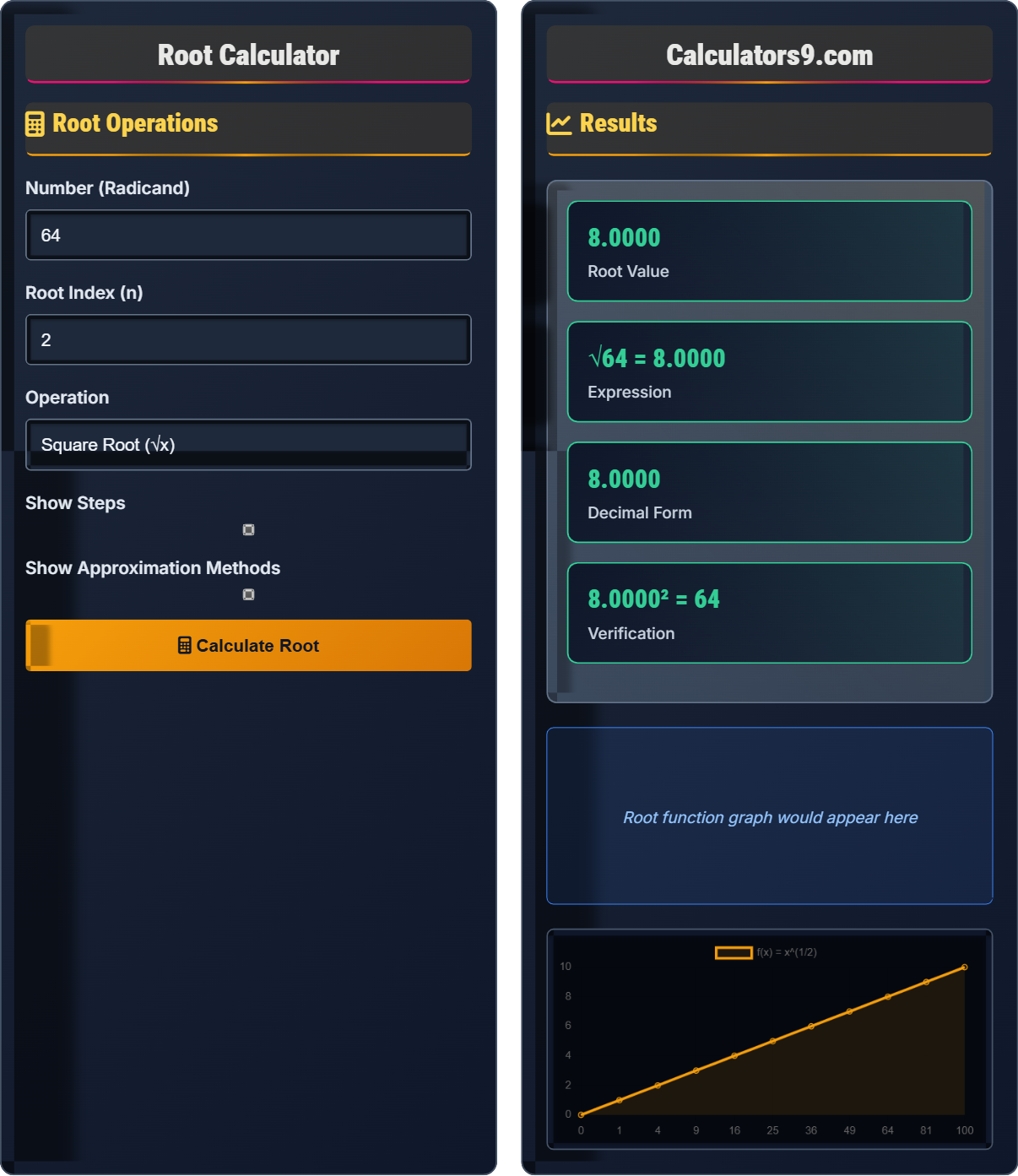
Example: Calculate \(\sqrt{64}\)
We need to find a number that when squared gives 64
\(8^2 = 8 \times 8 = 64\)
Therefore, \(\sqrt{64} = 8\)
Root Operations
Results
Root function graph would appear here
Comprehensive Root Guide
A root is the inverse operation of exponentiation. The nth root of a number x is a number r which, when raised to the power n, yields x. For example, the square root of 9 is 3 because 3² = 9. Roots are fundamental in algebra and appear in many mathematical contexts, from solving quadratic equations to calculating geometric properties.
The main types of roots include:
Roots are used in various fields:
- Geometry: calculating side lengths from areas/volumes
- Physics: calculating velocities, frequencies
- Finance: calculating compound interest rates
- Engineering: signal processing, control systems
Root Fundamentals
\(\sqrt[n]{x} = r\) where \(r^n = x\)
\(\sqrt[n]{x}\) where n is the index and x is the radicand
When n=2, we write \(\sqrt{x}\) (square root).
- \(\sqrt[n]{a^n} = a\) (when a ≥ 0 for even n)
- \(\sqrt{a^2} = |a|\) (absolute value)
- Even roots of negative numbers are undefined
Operations
\(\sqrt[n]{a^n} = a\) when a is positive
- Factor the radicand
- Identify perfect powers
- Simplify using root properties
- \(\sqrt[n]{a^m} = a^{m/n}\)
- \(\sqrt[n]{\sqrt[m]{a}} = \sqrt[nm]{a}\)
- \(\sqrt[n]{a} = a^{1/n}\)
Root Learning Quiz
What is the value of \(\sqrt{144}\)?
The answer is B) 12. The square root of 144 is the number that, when multiplied by itself, gives 144. Since 12 × 12 = 144, we have \(\sqrt{144} = 12\). This is a perfect square since 144 is the square of an integer.
Memorizing perfect squares and their square roots is helpful for quick mental calculations. Some common perfect squares include: 1, 4, 9, 16, 25, 36, 49, 64, 81, 100, 121, 144, 169, etc.
Square Root: The number that when multiplied by itself gives the original number
Perfect Square: A number that is the square of an integer
Radicand: The number under the radical sign
• \(\sqrt{x} \times \sqrt{x} = x\)
• \(\sqrt{x^2} = |x|\) (absolute value)
• Only non-negative numbers have real square roots
• Memorize perfect squares up to 15² = 225
• Use prime factorization for complex radicands
• Check your answer by squaring it
• Forgetting that \(\sqrt{x^2} = |x|\) not just x
• Taking square root of negative numbers in real number system
• Confusing square roots with cube roots
Simplify \(\sqrt{72}\) by factoring out perfect squares. Show your work.
Step 1: Factor 72 into prime factors: 72 = 8 × 9 = 2³ × 3²
Step 2: Group into perfect squares: 72 = 2² × 2 × 3² = 4 × 9 × 2
Step 3: Apply square root property: \(\sqrt{72} = \sqrt{4 \times 9 \times 2}\)
Step 4: Separate: \(\sqrt{72} = \sqrt{4} \times \sqrt{9} \times \sqrt{2}\)
Step 5: Calculate: \(\sqrt{72} = 2 \times 3 \times \sqrt{2} = 6\sqrt{2}\)
The simplified form is \(6\sqrt{2}\).
To simplify square roots, we factor the radicand into perfect squares and remaining factors. Perfect squares can be simplified to integers, while the remaining factors stay under the radical.
Prime Factorization: Breaking a number into prime factors
Perfect Square Factors: Factors that are perfect squares
Simplified Radical: Radical with no perfect square factors in radicand
• \(\sqrt{ab} = \sqrt{a} \times \sqrt{b}\)
• Factor out largest perfect square possible
• The result should have no perfect square factors in the radicand
• Look for the largest perfect square factor first
• Common perfect squares: 4, 9, 16, 25, 36, 49, 64, 81, 100
• Verify by squaring the simplified result
• Forgetting to factor out perfect squares
• Not fully simplifying the radical
• Making arithmetic errors in factorization
A square garden has an area of 169 square meters. What is the length of one side of the garden? If the owner wants to build a fence around the entire garden, how many meters of fencing will be needed?
Step 1: Find the side length using the area formula for a square: Area = side²
Step 2: Side² = 169, so side = √169 = 13 meters
Step 3: Find the perimeter (fence needed): Perimeter = 4 × side = 4 × 13 = 52 meters
The garden has sides of 13 meters each, and 52 meters of fencing is needed.
This problem demonstrates how square roots relate to geometric properties. When given the area of a square, taking the square root gives the side length. This is because area is calculated as side × side = side².
Area: Space inside a 2D shape
Perimeter: Distance around the edge of a shape
Side Length: Length of one edge of a square
• Area of square = side²
• Side length of square = √area
• Perimeter of square = 4 × side
• Draw a diagram to visualize the problem
• Remember that area is always in square units
• Perimeter is always in linear units
• Confusing area with perimeter
• Forgetting to take the square root for side length
• Using wrong formula for perimeter
The formula for the period of a pendulum is \(T = 2\pi\sqrt{\frac{L}{g}}\), where T is the period in seconds, L is the length in meters, and g is the acceleration due to gravity (approximately 9.8 m/s²). If a pendulum has a length of 1 meter, what is its period? Use π ≈ 3.14.
Step 1: Substitute values into the formula: \(T = 2\pi\sqrt{\frac{L}{g}}\)
Step 2: \(T = 2 \times 3.14 \times \sqrt{\frac{1}{9.8}}\)
Step 3: Calculate the fraction: \(\frac{1}{9.8} \approx 0.102\)
Step 4: Calculate the square root: \(\sqrt{0.102} \approx 0.32\)
Step 5: Complete the calculation: \(T = 2 \times 3.14 \times 0.32 \approx 2.01\) seconds
The period of the pendulum is approximately 2.01 seconds.
This problem shows how roots appear in physics formulas. The square root in the pendulum formula relates the length of the pendulum to its oscillation period. Understanding roots is essential for solving real-world physics problems.
Period: Time for one complete oscillation
Pendulum: Weight suspended from a pivot
Acceleration due to Gravity: 9.8 m/s² on Earth
• Substitute values carefully into formulas
• Follow order of operations
• Round only at the final step
• Calculate the expression under the radical first
• Keep intermediate steps precise
• Verify that units make sense
• Forgetting to take the square root
• Arithmetic errors in division
• Using wrong value for π
Which of the following statements about cube roots is TRUE?
The answer is A) \(\sqrt[3]{-8} = -2\). This is true because (-2)³ = (-2) × (-2) × (-2) = -8. Unlike square roots, cube roots exist for all real numbers, including negative numbers. For option B, cube roots have only one real value, not two. Option C is false because cube roots of negative numbers are defined. Option D is false because cube roots exist for negative numbers too.
Cube roots differ from square roots in that they exist for all real numbers, including negative ones. This is because odd powers preserve the sign of the original number. The cube root function is defined for all real numbers, unlike the square root function which is only defined for non-negative numbers.
Cube Root: The number that when cubed gives the original number
Odd Function: Function where f(-x) = -f(x)
Domain: Set of all possible input values
• Cube roots exist for all real numbers
• \(\sqrt[3]{-a} = -\sqrt[3]{a}\)
• Odd roots preserve sign of radicand
• Remember that cube roots can be negative
• Test your answer by cubing it
• Cube roots are unique (single value)
• Thinking cube roots of negatives are undefined
• Confusing with square root restrictions
• Forgetting that cube roots have only one value
FAQ
Q: Why can't we take the square root of a negative number?
A: In the real number system, we cannot take the square root of a negative number because no real number multiplied by itself gives a negative result. For example, there's no real number that satisfies \(x^2 = -4\). However, in the complex number system, we introduce the imaginary unit \(i\) where \(i = \sqrt{-1}\), allowing us to work with square roots of negative numbers.
Q: What's the difference between \(\sqrt{x^2}\) and \((\sqrt{x})^2\)?
A: There is a crucial difference:
- \(\sqrt{x^2} = |x|\) (absolute value of x) - defined for all real numbers
- \((\sqrt{x})^2 = x\) - only defined for \(x \geq 0\)
For example: \(\sqrt{(-3)^2} = \sqrt{9} = 3 = |-3|\), but \((\sqrt{-3})^2\) is undefined in real numbers.