Scientific Calculator
Trigonometry, logarithms, exponents • 2026 edition
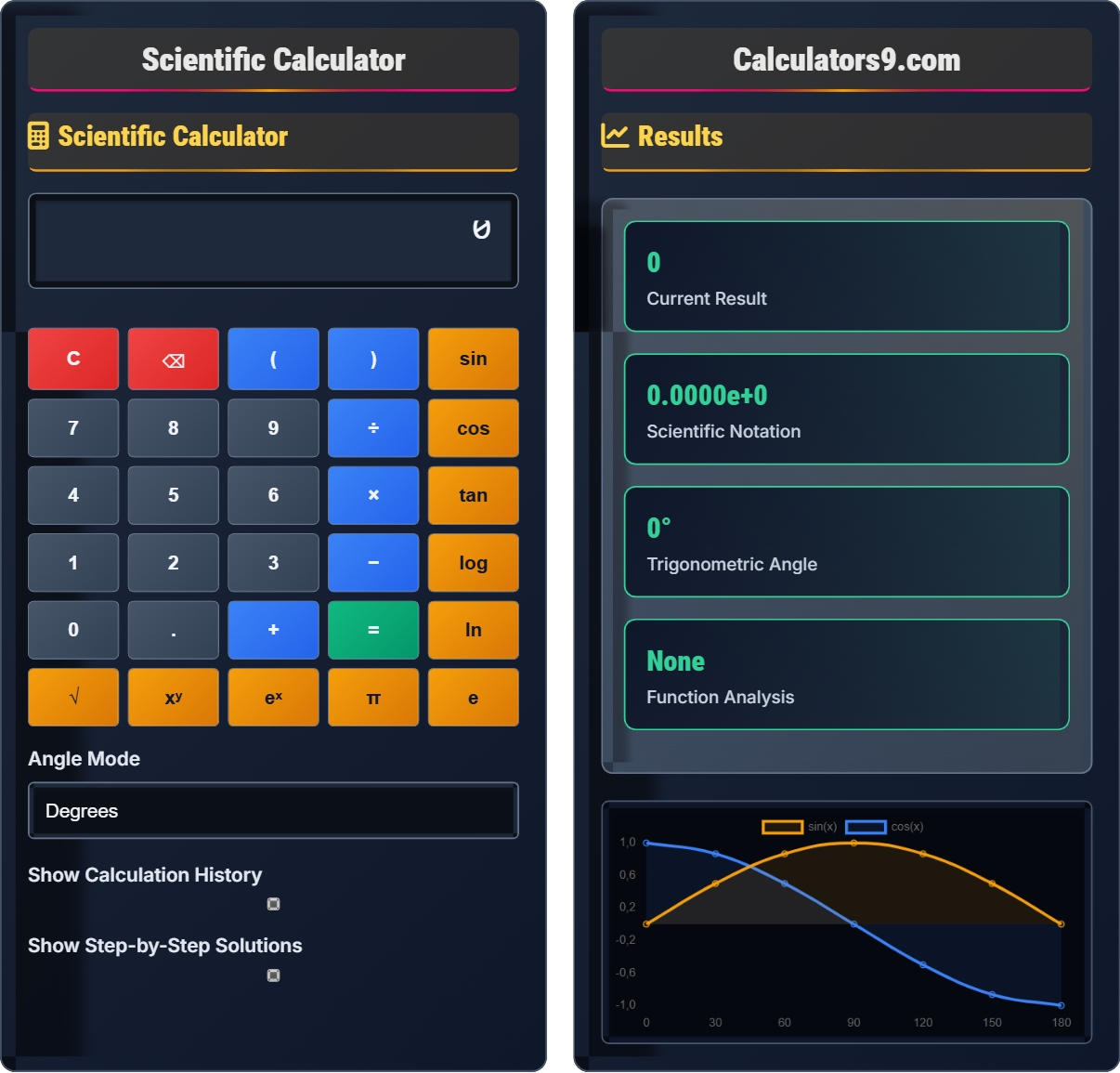
Scientific Functions:
Show the calculatorTrigonometric: sin(x), cos(x), tan(x)
Logarithmic: log₁₀(x), ln(x)
Exponential: eˣ, 10ˣ
Powers: xʸ, √x, ∛x
Constants: π, e
Example: Calculate sin(30°)
sin(30°) = 0.5
Example: Calculate log₁₀(100)
log₁₀(100) = 2 (since 10² = 100)
Example: Calculate e²
e² ≈ 7.389
Scientific Calculator
Results
Comprehensive Scientific Guide
A scientific calculator is a specialized electronic device designed to perform complex mathematical operations beyond basic arithmetic. It includes functions for trigonometry, logarithms, exponents, and advanced algebra. Scientific calculators are essential tools for students, engineers, scientists, and professionals who need to perform precise mathematical calculations.
The main categories of functions available on scientific calculators include:
Scientific calculators are used in various fields:
- Mathematics: Solving equations, calculus, statistics
- Physics: Calculating forces, velocities, energy
- Engineering: Structural analysis, circuit design
- Chemistry: Molar calculations, pH levels
Scientific Fundamentals
\(a \times 10^n\) where \(1 \leq a < 10\)
PEMDAS: Parentheses, Exponents, Multiplication/Division, Addition/Subtraction
Essential for complex calculations.
- Trigonometric functions depend on angle mode
- Logarithms are only defined for positive numbers
- Always consider domain restrictions
Operations
\(f(x) = a^x\) where a > 0 and a ≠ 1
- \(\log_a(xy) = \log_a(x) + \log_a(y)\)
- \(\log_a(\frac{x}{y}) = \log_a(x) - \log_a(y)\)
- \(\log_a(x^n) = n\log_a(x)\)
- \(\sin^2(x) + \cos^2(x) = 1\)
- \(\tan(x) = \frac{\sin(x)}{\cos(x)}\)
- \(\sin(2x) = 2\sin(x)\cos(x)\)
Scientific Learning Quiz
What is the value of sin(30°)?
The answer is A) 0.5. In a 30-60-90 triangle, the sine of 30° is the ratio of the opposite side to the hypotenuse. For a 30-60-90 triangle with sides in the ratio 1:√3:2, sin(30°) = 1/2 = 0.5. This is one of the special angles whose trigonometric values should be memorized.
Special angles (0°, 30°, 45°, 60°, 90°) have exact trigonometric values that are important to know. These values come from the properties of special right triangles (30-60-90 and 45-45-90 triangles).
Sine: Ratio of opposite side to hypotenuse in a right triangle
Special Angles: Angles with exact trigonometric values
30-60-90 Triangle: Right triangle with sides in ratio 1:√3:2
• sin(30°) = 1/2, cos(30°) = √3/2, tan(30°) = 1/√3
• sin(45°) = cos(45°) = √2/2
• sin(60°) = √3/2, cos(60°) = 1/2
• Remember the unit circle for common angles
• Use the SOH-CAH-TOA mnemonic
• Practice with special triangles
• Confusing sine with cosine
• Forgetting to check angle mode (degrees vs radians)
• Not knowing exact values for special angles
Calculate log₁₀(1000). Show your work.
Step 1: Recognize that 1000 is a power of 10
Step 2: Express 1000 as a power: 1000 = 10³
Step 3: Apply the logarithm: log₁₀(10³) = 3
Step 4: Verify: 10³ = 1000 ✓
Therefore, log₁₀(1000) = 3.
The common logarithm (base 10) asks "to what power must 10 be raised to get the number?" When the number is a power of 10, the logarithm equals the exponent. This is the definition of logarithms: if log_a(x) = y, then a^y = x.
Logarithm: The inverse operation of exponentiation
Common Log: Logarithm with base 10
Logarithmic Identity: log_a(a^x) = x
• log_a(a^x) = x (logarithm and exponent are inverse operations)
• log_a(1) = 0 for any valid base
• log_a(a) = 1
• Rewrite numbers as powers when possible
• Remember: log₁₀(10^n) = n
• Use the definition: if log_a(x) = y, then a^y = x
• Forgetting that log₁₀(1000) = 3, not 1000
• Not recognizing powers of the base
• Confusing logarithm with natural logarithm
A bacteria population grows according to the formula P(t) = P₀e^(rt), where P₀ is the initial population, r is the growth rate, and t is time in hours. If the initial population is 100 and the growth rate is 0.1 per hour, what will the population be after 3 hours? Use e ≈ 2.718.
Step 1: Identify given values: P₀ = 100, r = 0.1, t = 3
Step 2: Substitute into formula: P(3) = 100e^(0.1×3)
Step 3: Calculate exponent: 0.1 × 3 = 0.3
Step 4: Calculate e^0.3: e^0.3 ≈ 2.718^0.3 ≈ 1.349
Step 5: Complete calculation: P(3) = 100 × 1.349 = 134.9
The population will be approximately 135 bacteria after 3 hours.
Exponential growth models appear frequently in biology, finance, and physics. The base e (natural base) is particularly important because it arises naturally in continuous growth processes. The formula P(t) = P₀e^(rt) describes continuous growth.
Exponential Growth: Growth proportional to current value
Natural Base (e): Approximately 2.718, base of natural logarithm
Continuous Growth: Growth happening at every instant
• Exponential functions have the form f(x) = ab^x
• Continuous growth uses base e
• Growth rate r is typically expressed as a decimal
• Use the memory function to store intermediate results
• Round only at the final step
• Verify that growth produces increasing values
• Forgetting to convert percentage rates to decimals
• Using wrong base (10 instead of e for continuous growth)
• Arithmetic errors in exponent calculations
The intensity of light decreases exponentially as it passes through a medium according to the formula I = I₀e^(-μx), where I₀ is initial intensity, μ is the absorption coefficient, and x is distance. If I₀ = 100, μ = 0.2, and x = 5, calculate the remaining intensity. Show your work.
Step 1: Identify values: I₀ = 100, μ = 0.2, x = 5
Step 2: Substitute into formula: I = 100e^(-0.2×5)
Step 3: Calculate exponent: -0.2 × 5 = -1
Step 4: Calculate e^(-1): e^(-1) = 1/e ≈ 1/2.718 ≈ 0.368
Step 5: Complete calculation: I = 100 × 0.368 = 36.8
The remaining intensity is approximately 36.8 units.
This problem demonstrates exponential decay, which is common in physics (radioactive decay, light absorption, cooling). The negative exponent indicates decreasing values. The Beer-Lambert law is fundamental in optics and spectroscopy.
Exponential Decay: Decrease proportional to current value
Absorption Coefficient: Measures how strongly a material absorbs light
Beer-Lambert Law: Describes light absorption in media
• Negative exponents indicate decay
• Intensity decreases as distance increases
• Absorption coefficient is always positive
• Pay attention to sign of exponent
• Verify that result is less than initial value
• Use scientific notation for very small numbers
• Forgetting negative sign in exponent
• Calculating e^(-x) as e^x
• Not verifying that decay produces smaller values
Which of the following statements about inverse functions is TRUE?
The answer is B) ln(e^x) = x. This is true because the natural logarithm and exponential function are inverse operations. For option A, sin⁻¹(x) is the arcsine function, not the reciprocal. For option C, log₁₀(x) and 10^x are inverses, but log₁₀(x) ≠ 10^x. For option D, √x and x² are not inverses for all x (only for x ≥ 0).
Inverse functions "undo" each other. If f and g are inverse functions, then f(g(x)) = x and g(f(x)) = x. Common inverse pairs include: (e^x, ln(x)), (sin(x), sin⁻¹(x)), (x², √x) for x ≥ 0.
Inverse Function: Function that reverses the effect of another function
Arithmetic Inverse: Function that undoes another function
Domain Restriction: Limiting function domain for inverse to exist
• f(f⁻¹(x)) = x and f⁻¹(f(x)) = x
• Only one-to-one functions have inverses
• Domain and range are swapped for inverse functions
• Remember: sin⁻¹(x) is arcsin, not 1/sin(x)
• Inverse functions are reflections over y=x
• Check by composition: f(g(x)) should equal x
• Confusing inverse with reciprocal
• Forgetting domain restrictions
• Not verifying that functions are truly inverses
FAQ
Q: What's the difference between log and ln?
A: The difference lies in their base:
- log (common log): Base 10, so log(x) = log₁₀(x)
- ln (natural log): Base e, so ln(x) = logₑ(x) where e ≈ 2.718
For example: log(100) = 2 (since 10² = 100), while ln(e²) = 2 (since e² = e²). The natural logarithm is more common in calculus and higher mathematics.
Q: Why do I sometimes get "Error" when calculating trigonometric functions?
A: Common error causes include:
- Angle mode mismatch: Calculating sin(90) in radians instead of degrees
- Domain restrictions: tan(90°) is undefined (cos(90°) = 0)
- Range issues: sin⁻¹(x) is only defined for -1 ≤ x ≤ 1
Always check your angle mode settings and verify that inputs are within valid domains.