Decimal Calculator
Precision Math Operations Tool • 2026
Decimal Operation Formulas:
Show the calculator\( \text{Addition}: a + b = c \)
\( \text{Subtraction}: a - b = c \)
\( \text{Multiplication}: a \times b = c \)
\( \text{Division}: a \div b = c \)
Where:
- \( a, b \) = Input decimal values
- \( c \) = Result after operation
- \( b \neq 0 \) for division operations
These formulas represent the basic arithmetic operations for decimal numbers. Decimal operations follow the same rules as integer operations but with consideration for place values after the decimal point. The precision of calculations depends on the number of decimal places specified.
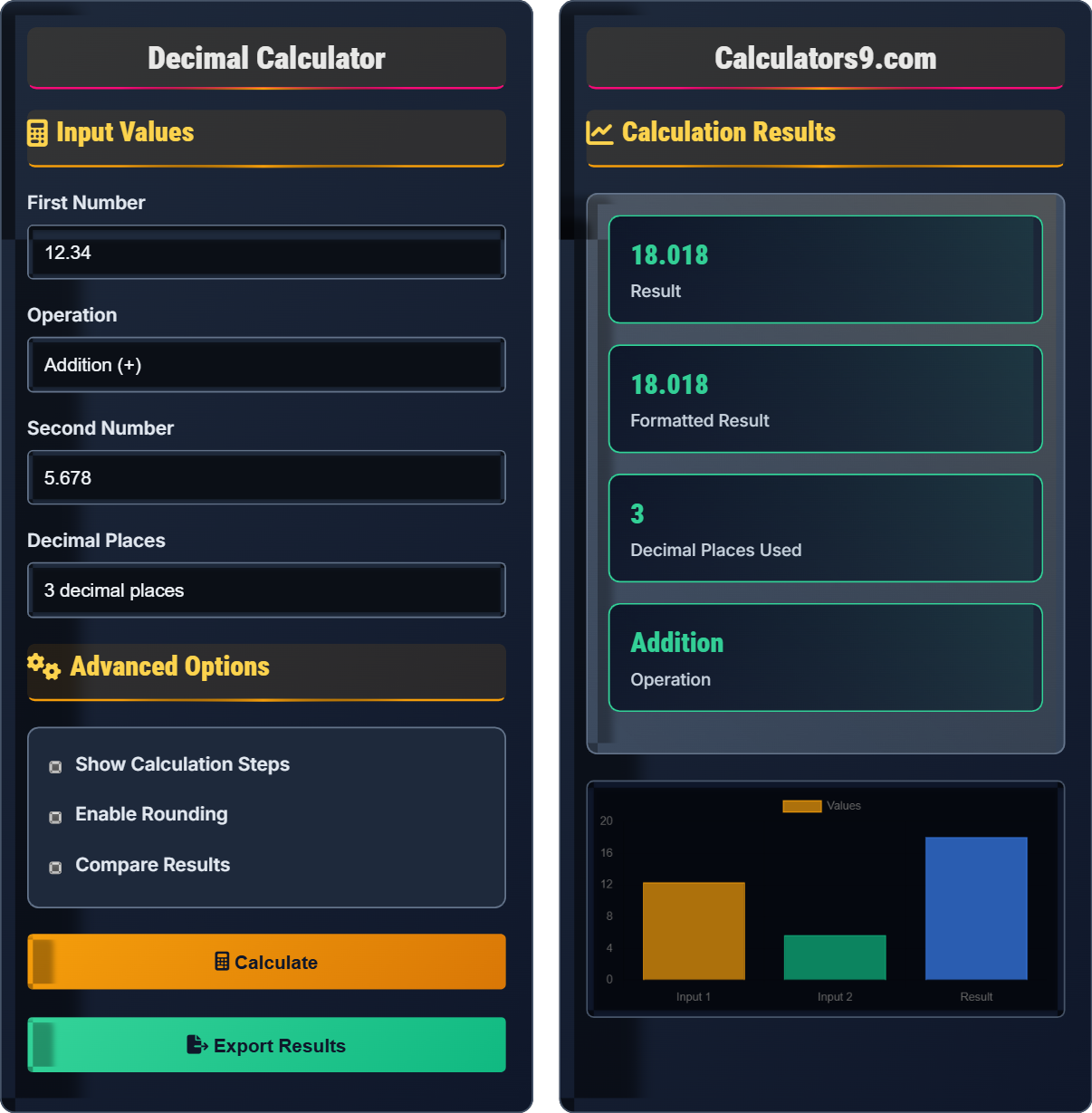
Example: For addition of 12.34 and 5.678:
12.340 + 5.678 = 18.018
Thus, the result is 18.018.
Input Values
Advanced Options
Calculation Results
| Step | Action | Value |
|---|---|---|
| 1 | Input First Number | 12.340 |
| 2 | Input Second Number | 5.678 |
| 3 | Perform Operation | 18.018 |
| 4 | Apply Precision | 18.018 |
| 5 | Final Result | 18.018 |
| Analysis | Value | Details |
|---|---|---|
| Precision Used | 3 | Decimal places |
| Original Value | 18.018 | Unrounded result |
| Rounded Value | 18.018 | After rounding |
| Accuracy | High | Within specified precision |
| Scientific Notation | 1.802 × 10¹ | Standard scientific format |
Comprehensive Decimal Math Guide
Decimal numbers are a way of representing fractional values using a base-10 positional notation system. They consist of a whole number part and a fractional part separated by a decimal point. Each position after the decimal point represents a power of 10 (tenths, hundredths, thousandths, etc.). Decimals allow for precise representation of non-whole quantities.
The fundamental operations for decimal numbers follow the same principles as integer operations but require attention to decimal placement:
Subtraction: Align decimal points vertically
Multiplication: Count total decimal places
Division: Convert divisor to whole number if needed
Where:
- Alignment ensures proper place value
- Decimal places count from the right
- Division may require moving decimal points
Decimal precision refers to the number of digits after the decimal point. Different rounding methods affect final results:
- Half Up: Midpoints (0.5) round up to next integer
- Half Down: Midpoints (0.5) round down to previous integer
- Half to Even: Midpoints round to nearest even number
- Always Up: All fractional parts round up
- Always Down: Fractional parts are truncated
- Financial Calculations: Precise currency and interest calculations
- Scientific Measurements: Accurate data representation
- Engineering: Dimensional tolerances and specifications
- Statistics: Mean, median, and probability calculations
- Everyday Use: Cooking measurements, shopping, and budgeting
Decimal Math Learning Quiz
What is the sum of 12.34 and 5.678?
The answer is B) 18.018. To add decimals, align the decimal points:
12.340
+ 5.678
------
18.018
We added a zero to 12.34 to make it 12.340, ensuring proper alignment of decimal places.
This example demonstrates the importance of decimal point alignment in addition. When adding decimals, we must ensure that tenths are added to tenths, hundredths to hundredths, and so on. Adding placeholder zeros helps maintain proper alignment and prevents calculation errors.
Decimal Point: Separator between whole and fractional parts
Place Value: Position determines value (tenths, hundredths, etc.)
Placeholder Zero: Zero added to maintain decimal alignment
• Align decimal points vertically
• Add placeholder zeros as needed
• Add column by column from right to left
• Line up decimal points before adding
• Use placeholder zeros to match decimal places
• Check your work by estimating
• Misaligning decimal points
• Forgetting to carry over values
• Not matching decimal places properly
Calculate 3.5 × 2.4. Show your work.
Step 1: Ignore decimal points and multiply: 35 × 24 = 840
Step 2: Count decimal places in factors: 1 in 3.5 + 1 in 2.4 = 2 total decimal places
Step 3: Place decimal point 2 places from right: 8.40
Therefore, 3.5 × 2.4 = 8.40 or 8.4.
Decimal multiplication follows a systematic approach. First, multiply as if the numbers were whole numbers. Then, count the total number of decimal places in both factors. Finally, place the decimal point in the product so that it has the same number of decimal places as the total from both factors.
Factors: Numbers being multiplied together
Product: Result of multiplication
Decimal Places: Positions after decimal point
• Multiply as whole numbers first
• Count total decimal places in factors
• Place decimal point in product accordingly
• Count decimal places before placing point
• Estimate to verify reasonableness
• Zeros at end after decimal can be dropped
• Forgetting to count decimal places
• Placing decimal point incorrectly
• Not accounting for all decimal places
You have 15.75 meters of rope and need to cut it into pieces that are 2.5 meters long each. How many complete pieces can you make and how much rope will remain?
Step 1: Perform division: 15.75 ÷ 2.5
Step 2: Convert to whole numbers by multiplying both by 10: 157.5 ÷ 25
Step 3: Further multiply by 2 to eliminate decimal: 315 ÷ 50 = 6.3
Step 4: Interpret result: 6 complete pieces with remainder
Step 5: Calculate remainder: 15.75 - (6 × 2.5) = 15.75 - 15 = 0.75
Therefore, you can make 6 complete pieces with 0.75 meters remaining.
This problem demonstrates practical decimal division. We first perform the division to find how many complete units fit. Then, we multiply back to find the total used, and subtract from the original to find the remainder. This approach is useful for real-world applications involving measurements.
Dividend: Number being divided
Divisor: Number dividing the dividend
Remainder: Amount left after division
• Move decimal points equally in both numbers
• Complete pieces = whole number part of quotient
• Remainder = original - (pieces × piece size)
• Convert to whole numbers by multiplying both
• Verify by multiplying quotient by divisor
• Always check remainder makes sense
• Not moving decimal points equally
• Forgetting to calculate the remainder
• Confusing quotient with remainder
Round 7.845 to the nearest hundredth using the half-up rounding method. Explain your reasoning.
To round to the nearest hundredth, look at the thousandths place (5).
Since we're using half-up rounding, any digit 5 or above rounds up.
The hundredths digit is 4, and the thousandths digit is 5.
Since 5 ≥ 5, we round up: 7.845 → 7.85
Therefore, 7.845 rounded to the nearest hundredth is 7.85.
This example demonstrates half-up rounding, which is the most commonly used rounding method. The rule is simple: if the digit immediately after the desired precision is 5 or greater, round up. If it's less than 5, round down. This preserves the value as closely as possible to the original.
Hundredth: Second digit after decimal point
Thousandth: Third digit after decimal point
Half-Up Rounding: Midpoint (0.5) rounds up
• Look at digit one place beyond desired precision
• Half-up: 5 or greater rounds up
• Round the target digit up or down accordingly
• Identify the rounding digit first
• Look only at the next digit
• Don't consider digits beyond the next one
• Looking at too many digits beyond target
• Forgetting the half-up rule
• Changing digits other than the target
Which of the following represents 0.00456 in scientific notation?
The answer is B) 4.56 × 10⁻³. To convert to scientific notation, move the decimal point to get a number between 1 and 10. For 0.00456, move the decimal point 3 places to the right to get 4.56. Since we moved right, the exponent is negative: 4.56 × 10⁻³.
Scientific notation expresses numbers as a coefficient between 1 and 10 multiplied by a power of 10. For small numbers (less than 1), we move the decimal point to the right to get the coefficient, and the number of places moved becomes the negative exponent. This is useful for representing very large or very small numbers concisely.
Scientific Notation: a × 10^n where 1 ≤ a < 10
Coefficient: Number between 1 and 10
Exponent: Power of 10 indicating magnitude
• Coefficient must be between 1 and 10
• Moving decimal right gives negative exponent
• Moving decimal left gives positive exponent
• Count decimal places moved
• Direction determines sign of exponent
• Verify by converting back to standard form
• Coefficient outside 1-10 range
• Wrong sign for exponent
• Incorrect counting of decimal places
Decimal Math Fundamentals
Addition: a + b = c | Subtraction: a - b = c
Multiplication: a × b = c | Division: a ÷ b = c
Half-Up: 0.5 rounds up | Half-Down: 0.5 rounds down
Always consider the digit immediately after target precision.
- Align decimal points for addition/subtraction
- Count total decimal places for multiplication
- Move decimal points equally for division
- Look at next digit only for rounding
Advanced Decimal Applications
Express small/large numbers as a × 10^n format for convenience.
- Determine required precision
- Perform calculations with extra precision
- Round only final result
- Consider significant figures
- Verify accuracy requirements
- Carry extra decimal places during intermediate steps
- Consider context for appropriate precision
- Be aware of cumulative rounding errors
- Use appropriate rounding method for application
FAQ
Q: Why is it important to align decimal points when adding or subtracting?
A: Aligning decimal points ensures that you're adding or subtracting digits with the same place value. When decimal points are aligned:
- Units are added to units
- Tenths are added to tenths
- Hundredths are added to hundredths
- And so on...
Without proper alignment, you might accidentally add tenths to units or hundredths to tenths, leading to incorrect results. For example, misaligning 12.34 + 5.678 could result in treating 3 (tenths) as if it were 3 (units), creating a significant error.
Q: What's the difference between precision and accuracy in decimal calculations?
A: Precision and accuracy are distinct but related concepts:
Precision:
- Refers to the number of decimal places or significant figures
- Measures how detailed or fine-grained a measurement is
- Example: 3.14159 is more precise than 3.14
Accuracy:
- Refers to how close a measured value is to the true value
- Measures correctness of the measurement
- Example: 3.14159 is more accurate than 3.14150 for π
You can have high precision (many decimal places) but low accuracy (far from true value), or high accuracy (close to true value) but low precision (few decimal places).