Factor Calculator
All Factors Finder • 2026 Edition
Factor Calculation Methods:
Calculate NowDefinition: A factor of a number is an integer that divides that number without remainder
Method 1: Trial Division (test all numbers up to √n)
Method 2: Prime Factorization (find prime factors, generate all combinations)
Where:
- Factors: Numbers that divide another number evenly
- Prime Factors: Factors that are prime numbers
- Factor Pairs: Two factors that multiply to give the original number
- √n: Square root of the number (upper limit for trial division)
Example: For number 12:
Trial Division: Test 1, 2, 3, √12 ≈ 3.5
12 ÷ 1 = 12, 12 ÷ 2 = 6, 12 ÷ 3 = 4
All factors: {1, 2, 3, 4, 6, 12}
Prime factorization: 12 = 2² × 3
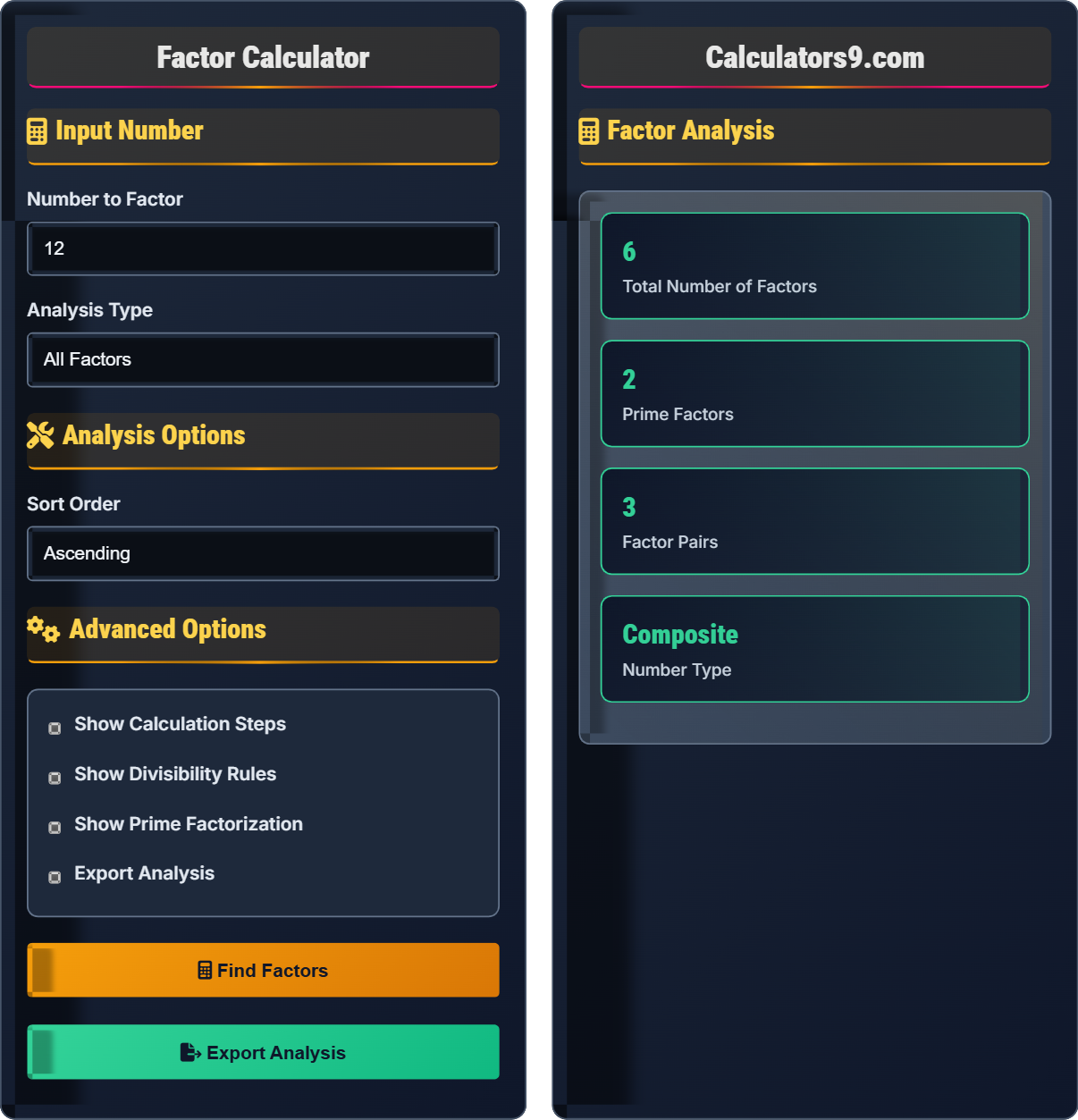
Input Number
Analysis Options
Advanced Options
Factor Analysis
Number analyzed: 12
Total factors: 6
Sum of factors: 28
Product of factors: 1728
| Factor | Type | Factor Pair | Properties |
|---|---|---|---|
| 1 | Unit | 1 × 12 | Always a factor |
| 2 | Prime | 2 × 6 | Even divisor |
| 3 | Prime | 3 × 4 | Sum of digits rule |
| 4 | Composite | 4 × 3 | Perfect square divisor |
| 6 | Composite | 6 × 2 | Even, divisible by 3 |
| 12 | Composite | 12 × 1 | Number itself |
12 = 2² × 3
Prime factors: 2, 2, 3
Unique prime factors: 2, 3
- 12 ÷ 1 = 12 (remainder 0) ✓
- 12 ÷ 2 = 6 (remainder 0) ✓
- 12 ÷ 3 = 4 (remainder 0) ✓
- 12 ÷ 4 = 3 (remainder 0) ✓
- 12 ÷ 6 = 2 (remainder 0) ✓
- 12 ÷ 12 = 1 (remainder 0) ✓
Type: Composite number
Even/Odd: Even
Perfect Square: No
Perfect Cube: No
Abundant Number: Yes (sum of proper factors > number)
For prime factorization n = p₁^a₁ × p₂^a₂ × ... × pₖ^aₖ
Number of factors = (a₁ + 1)(a₂ + 1)...(aₖ + 1)
For 12 = 2² × 3¹: (2+1)(1+1) = 3 × 2 = 6 factors
Factor Analysis Guide
A factor of a number is an integer that divides that number exactly without leaving a remainder. For example, the factors of 12 are 1, 2, 3, 4, 6, and 12 because each of these numbers divides 12 without remainder.
Two primary methods for finding all factors:
Where:
- n: The number to factor
- √n: Square root of n (upper limit for trial division)
- Prime factorization: Expressing n as product of primes
Factors have numerous practical applications:
- Simplifying fractions: Reduce to lowest terms
- Grouping objects: Find equal group sizes
- Pattern recognition: Identify repeating sequences
- Cryptography: Key generation in encryption algorithms
- Music theory: Finding common rhythmic patterns
- Construction: Finding common measurements
- Start with 1: Always a factor for positive integers
- Check divisibility: Use divisibility rules to identify factors
- Stop at √n: Avoid redundant checks
- Record pairs: For each divisor d, n/d is also a factor
- Prime factorization: Most systematic approach
- Verify results: Ensure each factor divides the number
Factor Basics
An integer that divides another integer exactly without remainder.
Trial Division, Prime Factorization, Divisibility Rules
Most efficient for different scenarios.
- 1 is always a factor
- n is always a factor of n
- Factors come in pairs
Factor Properties
Properties and relationships of factors.
- Factors divide the number evenly
- Factors come in pairs (except perfect squares)
- Prime factors form the building blocks
- Number of factors follows a formula
- Perfect squares have odd number of factors
- Prime numbers have exactly 2 factors
- Composite numbers have more than 2 factors
- Factor count formula: (a₁+1)(a₂+1)...
Factor Analysis Quiz
What is a factor of a number?
The answer is B) A number that divides the original number without remainder. A factor is a number that can divide another number evenly, leaving no remainder. For example, 3 is a factor of 12 because 12 ÷ 3 = 4 with no remainder.
Students often confuse factors with multiples. Factors divide the original number, while multiples are what the original number divides into. The key concept is "without remainder," which means the division results in a whole number. This is the defining characteristic of a factor.
Factor: Number that divides another number evenly
Divides without remainder: Division results in whole number
Evenly: No fractional part
• Must divide without remainder
• Results in whole number quotient
• 1 is always a factor
• Think "goes into" not "goes out of"
• Check by division
• Always include 1 and the number itself
• Confusing factors with multiples
• Forgetting that 1 is always a factor
• Not checking remainder condition
Find all factors of 24. Show your work using the systematic approach.
Step 1: Calculate √24 ≈ 4.9, so test divisors from 1 to 4
Step 2: Test each divisor
24 ÷ 1 = 24 (remainder 0) → Factors: 1, 24
24 ÷ 2 = 12 (remainder 0) → Factors: 2, 12
24 ÷ 3 = 8 (remainder 0) → Factors: 3, 8
24 ÷ 4 = 6 (remainder 0) → Factors: 4, 6
Step 3: List all factors in ascending order
All factors of 24: {1, 2, 3, 4, 6, 8, 12, 24}
Step 4: Verify by checking each division
24 ÷ 1 = 24, 24 ÷ 2 = 12, 24 ÷ 3 = 8, 24 ÷ 4 = 6, 24 ÷ 6 = 4, 24 ÷ 8 = 3, 24 ÷ 12 = 2, 24 ÷ 24 = 1
Therefore, the factors of 24 are {1, 2, 3, 4, 6, 8, 12, 24}.
This systematic approach ensures we don't miss any factors. By testing divisors only up to √n, we avoid redundant checks. For each divisor d, we automatically get the corresponding factor n/d. This method is efficient and comprehensive.
Systematic approach: Methodical, ordered process
Factor pair: Two numbers that multiply to give original number
√n limit: Upper bound for efficient checking
• Test divisors up to √n
• Record both d and n/d
• Check for remainder = 0
• Calculate √n first
• Use divisibility rules to speed up
• Testing beyond √n unnecessarily
• Missing factor pairs
• Not sorting the final list
A teacher has 36 students and wants to arrange them in equal rows with no students left over. What are all the possible arrangements (number of rows and students per row) she can make?
Step 1: Identify the problem
We need to find all ways to arrange 36 students in equal rows, which means finding all factor pairs of 36.
Step 2: Find all factors of 36
√36 = 6, so test divisors from 1 to 6
36 ÷ 1 = 36 → Factor pair: (1, 36)
36 ÷ 2 = 18 → Factor pair: (2, 18)
36 ÷ 3 = 12 → Factor pair: (3, 12)
36 ÷ 4 = 9 → Factor pair: (4, 9)
36 ÷ 6 = 6 → Factor pair: (6, 6)
Step 3: List all possible arrangements
• 1 row of 36 students
• 2 rows of 18 students each
• 3 rows of 12 students each
• 4 rows of 9 students each
• 6 rows of 6 students each
• 9 rows of 4 students each
• 12 rows of 3 students each
• 18 rows of 2 students each
• 36 rows of 1 student each
Therefore, there are 9 possible arrangements.
This problem demonstrates a practical application of factors. When arranging objects in equal groups, the possible arrangements correspond to the factor pairs of the total number of objects. Each factor pair (a, b) represents a possible arrangement with a rows of b objects each, or b rows of a objects each.
Factor pair: Two factors that multiply to give original number
Equal arrangement: Same number of objects in each group
No remainder: All objects used in arrangement
• Factor pairs give possible arrangements
• Each arrangement uses all objects
• No objects left over
• Look for "equal groups" keywords
• Factor pairs = possible arrangements
• Consider practical constraints
• Missing some factor pairs
• Not considering both orientations
• Forgetting extreme cases (1 row or 1 per row)
Find all factors of 60 using prime factorization. Then explain how to calculate the total number of factors using the prime factorization.
Step 1: Find prime factorization of 60
60 = 4 × 15 = 2² × 3 × 5
Step 2: Generate all factors from prime factorization
Factors are of the form 2^a × 3^b × 5^c
Where: a ∈ {0, 1, 2}, b ∈ {0, 1}, c ∈ {0, 1}
Step 3: List all combinations
2⁰×3⁰×5⁰ = 1, 2¹×3⁰×5⁰ = 2, 2²×3⁰×5⁰ = 4
2⁰×3¹×5⁰ = 3, 2¹×3¹×5⁰ = 6, 2²×3¹×5⁰ = 12
2⁰×3⁰×5¹ = 5, 2¹×3⁰×5¹ = 10, 2²×3⁰×5¹ = 20
2⁰×3¹×5¹ = 15, 2¹×3¹×5¹ = 30, 2²×3¹×5¹ = 60
All factors: {1, 2, 3, 4, 5, 6, 10, 12, 15, 20, 30, 60}
Step 4: Calculate total number of factors
For 60 = 2² × 3¹ × 5¹
Total factors = (2+1)(1+1)(1+1) = 3 × 2 × 2 = 12
This matches our count of 12 factors.
The prime factorization method systematically generates all factors by considering all possible combinations of prime powers. The formula for counting factors is derived from this principle: if n = p₁^a₁ × p₂^a₂ × ... × pₖ^aₖ, then the number of factors is (a₁+1)(a₂+1)...(aₖ+1), because for each prime pᵢ we can choose an exponent from 0 to aᵢ.
Prime factorization: Expressing number as product of primes
Factor counting formula: (a₁+1)(a₂+1)...(aₖ+1)Systematic generation: Ordered, complete listing
• Exponent ranges: 0 to aᵢ
• Multiply possibilities for each prime
• Add 1 to each exponent in formula
• Use prime factorization for large numbers
• Count factors using formula
• Verify by direct calculation
• Forgetting to add 1 in formula
• Missing some combinations
• Calculation errors in exponents
Which statement about factors is ALWAYS true?
The answer is B) 1 is always a factor of any positive integer. This is true because 1 divides any positive integer without remainder. For example, 1 divides 7 (7÷1=7) and 1 divides 100 (100÷1=100). All other options are false: the number of factors is finite, the largest factor is the number itself, and factors can be composite.
This property is fundamental to factor theory. The number 1 is the multiplicative identity and divides every positive integer. Understanding this property helps verify factor calculations and provides a lower bound for the set of factors. It's also the foundation for defining prime and composite numbers.
Universal factor: Factor of all numbers in domain
Multiplicative identity: 1 × n = n
Finite set: Limited number of elements
• 1 divides every positive integer
• Number of factors is finite
• Largest factor is the number itself
• Always include 1 as a factor
• Check for universal properties
• Use as verification tool
• Forgetting 1 as a factor
• Thinking factors are infinite
• Assuming largest factor > number
FAQ
Q: How do I find all factors of a number efficiently?
A: To find all factors efficiently:
Method: Find factor pairs by testing divisors from 1 up to √n
- Test each number from 1 to √n
- If d divides n, then both d and n/d are factors
- Stop at √n to avoid duplicates
Example for 24:
√24 ≈ 4.9, so test 1, 2, 3, 4
1 divides 24 → factors: 1, 24
2 divides 24 → factors: 2, 12
3 divides 24 → factors: 3, 8
4 divides 24 → factors: 4, 6
All factors: {1, 2, 3, 4, 6, 8, 12, 24}
Q: What's the most efficient algorithm for finding factors of large numbers?
A: For large numbers, the most efficient approach depends on the context:
For finding all factors: Trial division up to √n (O(√n))
For prime factorization: Pollard's rho algorithm or quadratic sieve
For cryptographic applications: Quantum algorithms (Shor's algorithm)
For practical purposes: Optimized trial division with wheel factorization
For most educational and general purposes, the √n method is sufficient and efficient.