Least Common Multiple Calculator
Fast LCM finder • 2026 edition
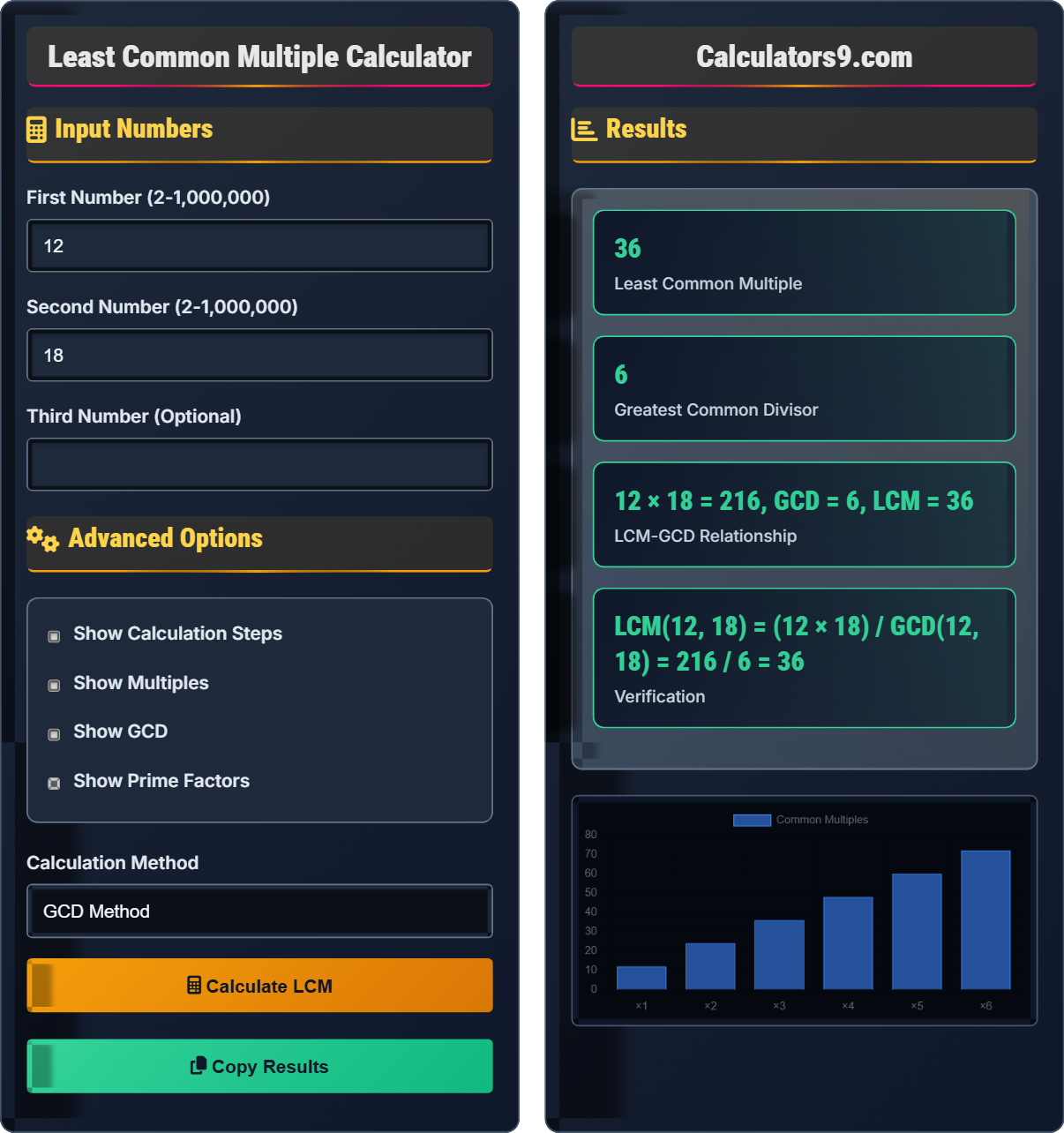
Input Numbers
Advanced Options
Results
| Number | Prime Factors | LCM Factors |
|---|
Least Common Multiple Fundamentals
The least common multiple (LCM) of two or more integers is the smallest positive integer that is evenly divisible by each of the numbers. It represents the smallest number that all given numbers divide into without leaving a remainder.
For two numbers a and b, the LCM can be calculated using the relationship with GCD:
For multiple numbers, LCM can be computed iteratively:
LCM is used in various mathematical and real-world applications:
- Fraction Operations: Adding/subtracting fractions with different denominators
- Scheduling: Finding when recurring events coincide
- Number Theory: Solving Diophantine equations
- Cryptography: Some encryption algorithms
- Engineering: Timing and synchronization problems
- Commutative: LCM(a, b) = LCM(b, a)
- Associative: LCM(LCM(a, b), c) = LCM(a, LCM(b, c))
- Identity: LCM(a, a) = a
- Relationship with GCD: LCM(a, b) × GCD(a, b) = a × b
Least Common Multiple Quiz
What is the least common multiple (LCM) of two numbers?
The answer is B) The smallest number that both numbers divide into. The LCM of two numbers is the smallest positive integer that is divisible by both numbers. For example, LCM(4, 6) = 12 because 12 is the smallest number that both 4 and 6 divide into evenly (12 ÷ 4 = 3, 12 ÷ 6 = 2).
It's important to distinguish LCM from GCD (Greatest Common Divisor). While GCD finds the largest number that divides both numbers, LCM finds the smallest number that both numbers divide into. This duality is a fundamental concept in number theory and helps in understanding the relationship between these two operations.
Least Common Multiple (LCM): Smallest positive integer divisible by both numbers
Greatest Common Divisor (GCD): Largest positive integer that divides both numbers
Divisible: Division results in an integer with no remainder
• LCM is always ≥ both numbers
• LCM(a, a) = a
• LCM(a, 1) = a
• Think "smallest shared multiple"
• LCM is always a multiple of both numbers
• Use the GCD formula: LCM = (a×b)/GCD
• Confusing LCM with GCD
• Forgetting that LCM must be divisible by both numbers
• Not considering that LCM could equal one of the numbers
Find the LCM of 15 and 25 using the prime factorization method. Show your work.
Step 1: Find prime factorization of each number
15 = 3 × 5
25 = 5²
Step 2: Identify highest power of each prime factor
Prime 3: highest power is 3¹
Prime 5: highest power is 5²
Step 3: Multiply highest powers of all prime factors
LCM(15, 25) = 3¹ × 5² = 3 × 25 = 75
Verification: 75 ÷ 15 = 5, 75 ÷ 25 = 3 ✓
This method is particularly useful when you need to find the LCM of more than two numbers. The key insight is to take the highest power of each prime that appears in any of the factorizations. This ensures the result is divisible by each original number while keeping the result as small as possible.
Prime Factorization: Expressing a number as a product of primes
Highest Power: Greatest exponent for each prime factor
Divisibility: Division results in integer with no remainder
• Take highest power of each prime factor
• Include primes from all numbers
• Multiply all selected prime powers
• Organize prime factors in order
• Circle highest powers for clarity
• Verify by dividing LCM by original numbers
• Taking lowest instead of highest powers
• Missing prime factors that appear in only one number
• Forgetting to multiply all prime factors
Two buses leave a station at the same time. Bus A returns every 12 minutes, and Bus B returns every 18 minutes. After how many minutes will both buses return to the station at the same time again?
This is an LCM problem because we need to find when the buses' schedules align.
Bus A returns at: 12, 24, 36, 48, 60, 72, ... minutes
Bus B returns at: 18, 36, 54, 72, 90, ... minutes
Find LCM(12, 18):
12 = 2² × 3
18 = 2 × 3²
LCM = 2² × 3² = 4 × 9 = 36
Both buses will return together after 36 minutes.
This demonstrates a classic application of LCM in scheduling and timing problems. The buses represent periodic events, and their simultaneous return corresponds to the LCM of their periods. This type of problem appears frequently in engineering, logistics, and planning contexts.
Periodic Event: Something that happens at regular intervals
Synchronization: Events happening simultaneously
Schedule Alignment: When recurring events coincide
• Scheduling problems often involve LCM
• Look for "when will they meet again" questions
• Periods are the numbers to use in LCM
• List out first few multiples to see the pattern
• Look for keywords like "together", "simultaneously"
• Verify by checking that both periods divide the LCM
• Using GCD instead of LCM for scheduling problems
• Misidentifying the periods to use
• Forgetting to verify the answer
Two numbers have a GCD of 6 and a product of 360. What is their LCM? Explain the relationship between LCM and GCD.
Step 1: Use the fundamental relationship between LCM and GCD
For any two numbers a and b: LCM(a, b) × GCD(a, b) = a × b
Step 2: Substitute known values
LCM × 6 = 360
Step 3: Solve for LCM
LCM = 360 ÷ 6 = 60
The relationship shows that LCM and GCD are complementary: as one increases, the other tends to decrease to keep their product constant.
This fundamental theorem connects LCM and GCD in a beautiful way. It's extremely useful when you know one value and the product of the numbers. The relationship LCM(a,b) × GCD(a,b) = a × b holds for all positive integers and is derived from prime factorization properties. This allows for efficient calculation of LCM when GCD is easier to find.
LCM-GCD Relationship: LCM(a,b) × GCD(a,b) = a × b
Complementary Values: Related quantities that determine each other
Fundamental Theorem: Basic mathematical truth connecting concepts
• LCM × GCD = Product of numbers
• Knowing two values allows finding the third
• Applies to all positive integers
• Remember: LCM × GCD = a × b
• Use this when direct calculation is difficult
• Great for word problems with limited information
• Forgetting the multiplication relationship
• Adding instead of multiplying LCM and GCD
• Misapplying the formula to more than two numbers
Which of the following statements about LCM is TRUE?
The answer is A) LCM of two prime numbers is their product. Since prime numbers have no common factors other than 1, their GCD is 1. Using the relationship LCM(a,b) = (a×b)/GCD(a,b), we get LCM(a,b) = (a×b)/1 = a×b. For example, LCM(5,7) = 5×7 = 35. The other options are false: B) LCM of consecutive numbers is their product (not sum); C) LCM of a number and its multiple is the multiple; D) LCM can equal one of the numbers.
This question tests understanding of special cases and properties of LCM. When two numbers share no common factors (like two different primes), their LCM is simply their product. This is because there are no common factors to "cancel out" in the GCD, making the relationship LCM = (a×b)/GCD become LCM = (a×b)/1.
Relatively Prime: Numbers with GCD = 1
Special Case: Situation where general rule simplifies
Prime Number: Number with exactly two divisors
• LCM of coprime numbers = their product
• LCM(a, ka) = ka (where k is an integer)
• LCM(a, b) ≥ max(a, b)
• Two different primes are always coprime
• When one number divides another, LCM is the larger
• Always verify special cases with examples
• Forgetting that LCM can equal one of the numbers
• Not recognizing special cases like coprime numbers
• Confusing properties of LCM with those of GCD
LCM Basics
Smallest positive integer divisible by both numbers.
\(\text{LCM}(a, b) = \frac{a \times b}{\text{GCD}(a, b)}\)
Use GCD to calculate LCM efficiently.
- LCM ≥ both numbers
- LCM(a, a) = a
- LCM-GCD relationship: LCM×GCD = a×b
Applications
Find common denominators for adding/subtracting fractions.
- Fraction operations
- Scheduling problems
- Timing synchronization
- Number theory
- Efficient for small numbers
- Multiple methods available
- Important in algebra
- Connected to GCD
FAQ
Q: How is LCM related to GCD?
A: They're connected by: LCM(a,b) × GCD(a,b) = a × b. This means LCM = (a×b)/GCD. This relationship makes calculating LCM easier when GCD is known.
Q: What's the fastest way to calculate LCM?
A: Use the GCD method: LCM(a,b) = (a×b)/GCD(a,b). GCD can be efficiently calculated using Euclidean algorithm, making LCM calculation fast.