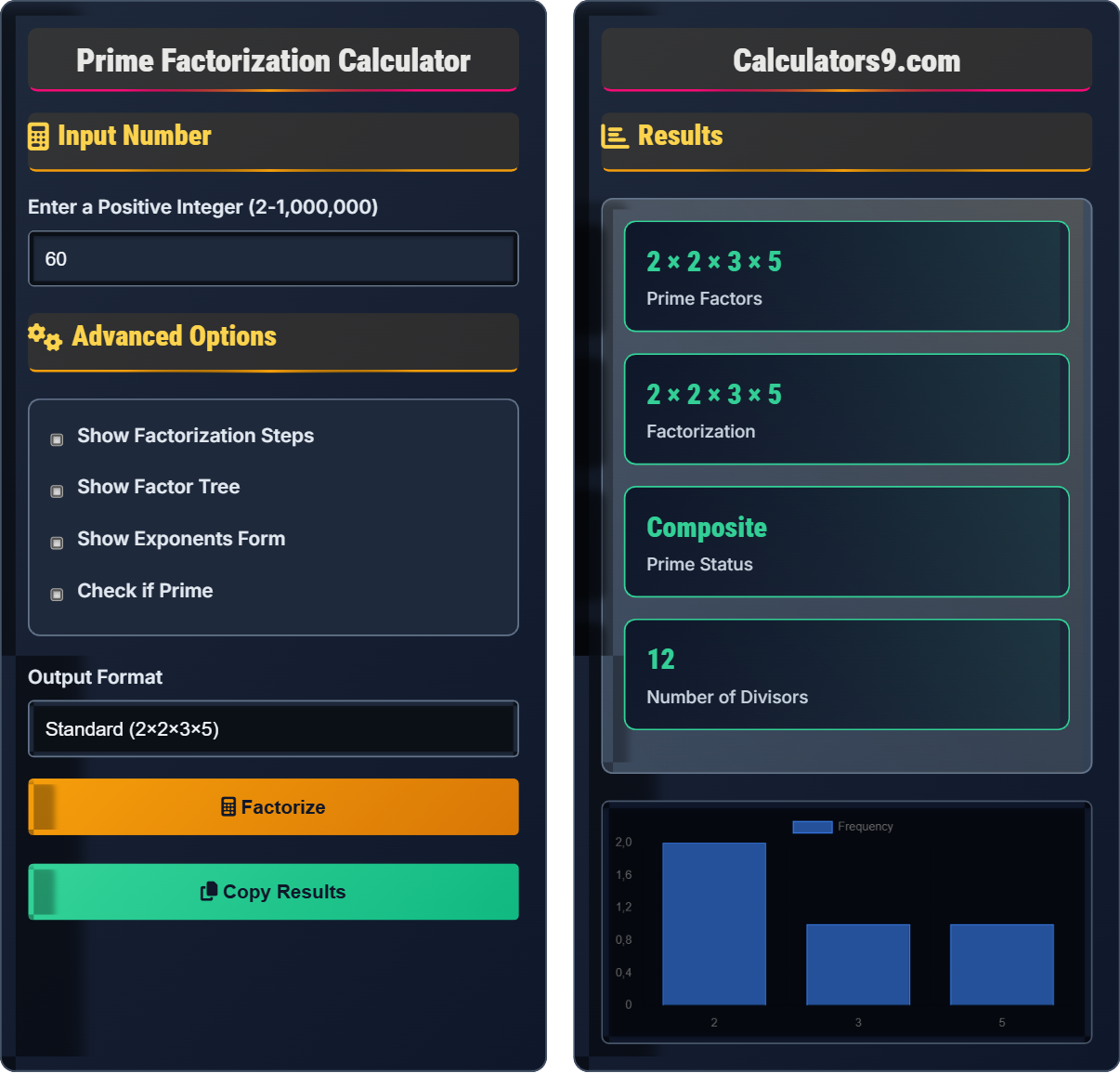
Prime Factorization Calculator
Fast prime decomposition • 2026 edition
Input Number
Advanced Options
Results
| Prime Factor | Count | Exponent |
|---|
Prime Factorization Fundamentals
Prime factorization is the process of expressing a composite number as a product of its prime factors. According to the Fundamental Theorem of Arithmetic, every integer greater than 1 has a unique prime factorization, up to the order of the factors.
For any integer n > 1, the prime factorization can be expressed as:
Where:
- \(p_1, p_2, \ldots, p_k\) are distinct prime numbers
- \(e_1, e_2, \ldots, e_k\) are positive integers (exponents)
- The factorization is unique up to the order of factors
Prime factorization is used in various mathematical and computational applications:
- GCD/LCM Calculation: Finding greatest common divisor and least common multiple
- Cryptography: RSA encryption relies on difficulty of factoring large numbers
- Number Theory: Analyzing properties of integers
- Algebra: Simplifying expressions and solving equations
- Computer Science: Hash functions and algorithm design
- Division Method: Systematically divide by primes
- Factor Tree: Visual representation of factorization
- Sieve Methods: Generate primes efficiently for large numbers
- Optimization: Only check divisors up to √n
Prime Factorization Quiz
According to the Fundamental Theorem of Arithmetic, what is true about the prime factorization of any integer greater than 1?
The answer is B) It has a unique prime factorization. The Fundamental Theorem of Arithmetic states that every integer greater than 1 can be expressed as a product of prime numbers in exactly one way, disregarding the order of the factors. For example, 60 = 2² × 3 × 5 is the unique prime factorization of 60.
This theorem is fundamental to number theory because it establishes that prime numbers are the building blocks of all integers. It means that no matter what method you use to find the prime factorization, you will always arrive at the same set of prime factors with the same exponents. This uniqueness is crucial for many mathematical proofs and algorithms.
Prime Factorization: Expressing a number as a product of prime numbers
Prime Number: A number greater than 1 with exactly two divisors (1 and itself)
Composite Number: A number with more than two divisors
• Every integer > 1 has a prime factorization
• The factorization is unique (up to order)
• Primes cannot be factored further
• Remember: 1 is neither prime nor composite
• The smallest prime is 2 (the only even prime)
• All other primes are odd
• Including 1 as a prime factor
• Forgetting that factorization is unique
• Confusing prime with composite numbers
Find the prime factorization of 84. Show your work using the division method.
Step 1: Divide by the smallest prime (2): 84 ÷ 2 = 42
Step 2: Divide by 2 again: 42 ÷ 2 = 21
Step 3: 21 is not divisible by 2, try next prime (3): 21 ÷ 3 = 7
Step 4: 7 is a prime number
Therefore: 84 = 2 × 2 × 3 × 7 = 2² × 3 × 7
This step-by-step approach demonstrates the systematic nature of prime factorization. We start with the smallest prime and continue dividing until we reach a prime number. The key insight is that we only need to test prime divisors up to the square root of the number. Once we've divided out all possible factors, what remains must be prime.
Division Method: Systematically dividing by primes
Exponential Form: Writing repeated factors as powers
Prime Divisor: A prime that divides the number evenly
• Start with the smallest prime (2)
• Continue until the quotient is prime
• Record all divisors used
• Use divisibility rules to identify factors quickly
• Group identical factors using exponents
• Stop testing when divisor > √remaining number
• Forgetting to group identical factors
• Stopping too early before reaching a prime
• Including composite numbers as factors
Two numbers have prime factorizations: A = 2³ × 3² × 5 and B = 2² × 3³ × 7. What is the greatest common divisor (GCD) of A and B? Explain how prime factorization helps find the GCD.
Step 1: Identify common prime factors
Common primes: 2 and 3 (5 and 7 are not common)
Step 2: Take the lowest exponent for each common prime
For 2: min(3, 2) = 2
For 3: min(2, 3) = 2
Step 3: Multiply common factors with lowest exponents
GCD(A, B) = 2² × 3² = 4 × 9 = 36
Prime factorization makes finding GCD straightforward by comparing exponents.
This demonstrates a powerful application of prime factorization. To find the GCD of two numbers, we identify their common prime factors and take the lowest exponent for each. This method is particularly useful for large numbers where other methods like Euclidean algorithm might be more complex. Prime factorization reveals the fundamental structure of numbers.
Greatest Common Divisor (GCD): Largest number that divides both numbers
Common Factors: Prime factors present in both numbers
Minimum Exponent Rule: Take lowest exponent for common primes
• GCD uses common prime factors only
• Use minimum exponent for each common prime
• Multiply the selected factors
• Organize prime factors in order
• Circle common factors for clarity
• Double-check by multiplying back
• Including non-common prime factors
• Taking the highest instead of lowest exponent
• Forgetting to multiply the factors together
When finding the prime factorization of a number n, explain why you only need to check prime divisors up to √n. Use this principle to determine the maximum number of primes you'd need to test for n = 1000.
Step 1: Reasoning behind the √n limit
If n has a factor greater than √n, then it must also have a corresponding factor less than √n, since factors come in pairs. If both factors were greater than √n, their product would exceed n.
Step 2: Calculate √1000
√1000 ≈ 31.62
Step 3: List primes ≤ 31
Primes: 2, 3, 5, 7, 11, 13, 17, 19, 23, 29, 31
Therefore: You only need to test 11 primes for n = 1000.
This optimization significantly reduces computation time. Instead of testing all numbers up to n, we only need to test up to √n. This is because factors come in pairs - if p is a factor of n, then n/p is also a factor. One of these must be ≤ √n and the other ≥ √n. This principle is fundamental to efficient factorization algorithms.
Factor Pair: Two numbers whose product equals the original number
Square Root Limit: Maximum prime to test for factorizationComputational Efficiency: Reducing unnecessary calculations
• Only test primes up to √n
• Factors come in pairs (p, n/p)
• At least one factor in each pair ≤ √n
• Memorize primes up to 30 for quick calculations
• Use divisibility rules to speed up testing
• Stop as soon as the remaining quotient is prime
• Testing all numbers instead of just primes
• Going beyond √n unnecessarily
• Forgetting that factors come in pairs
Which of the following statements about prime numbers is FALSE?
The answer is C) All prime numbers are odd. This is false because 2 is a prime number and it is even. All other prime numbers are indeed odd, but 2 is the exception as the only even prime. Statement A is true (proven by Euclid), B is true (2 is the only even prime), and D is true (primes have exactly two divisors: 1 and themselves).
This highlights an important exception in prime number theory. While most students learn that primes are odd, they must remember that 2 is the only even prime. This is because 2 is divisible only by 1 and itself, satisfying the definition of a prime number. Understanding exceptions like this is crucial for mathematical accuracy.
Prime Number: A number with exactly two positive divisors
Even Number: Divisible by 2
Odd Number: Not divisible by 2
• 2 is the only even prime
• All primes > 2 are odd
• Primes have exactly two divisors
• Remember: 2 is the only even prime
• Primes end in 1, 3, 7, or 9 (except 2 and 5)
• Use the definition to verify primality
• Forgetting that 2 is prime
• Assuming all primes are odd
• Including 1 as a prime number
Prime Factorization Basics
Expressing a number as a product of prime numbers.
\(n = p_1^{e_1} \times p_2^{e_2} \times \cdots \times p_k^{e_k}\)
Divide by smallest primes repeatedly until reaching 1.
- Factorization is unique
- Test primes up to √n
- Start with smallest prime (2)
Applications
Use prime factorization to find greatest common divisor and least common multiple.
- GCD/LCM calculations
- Cryptography (RSA)
- Number theory
- Algebraic simplification
- Efficient for small numbers
- Challenging for very large numbers
- Essential for number theory
- Used in many algorithms
FAQ
Q: Is the prime factorization of a number always unique?
A: Yes! The Fundamental Theorem of Arithmetic guarantees uniqueness. For example, 60 = 2²×3×5 is the only prime factorization (disregarding order).
Q: Why do we only test primes up to √n?
A: Because factors come in pairs. If p is a factor > √n, then n/p is a factor < √n. So we only need to find the smaller factor in each pair.