Rounding Calculator
Decimal Places, Significant Figures, Scientific Notation • 2026
Input Number
Advanced Options
Results
| Method | Result | Explanation |
|---|
| Alternative | Value | Description |
|---|
Comprehensive Rounding Guide
Rounding is the process of reducing the digits in a number while trying to keep its value similar. The result is a number that is easier to work with but less precise. Rounding follows specific rules based on the digit following the rounding position.
The standard rounding rule is:
If digit < 5, round down
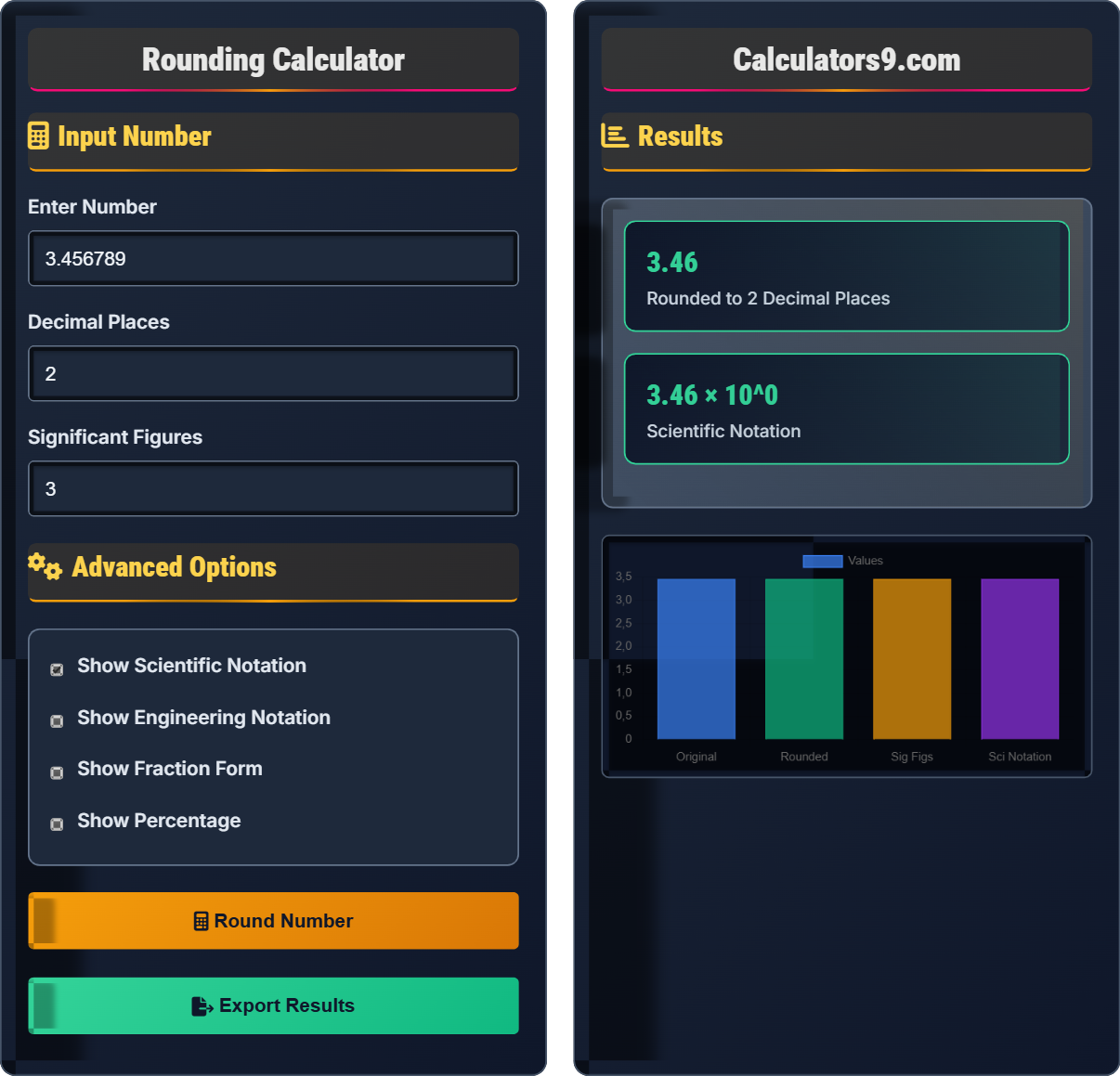
For example, rounding 3.456 to 2 decimal places: look at the 3rd decimal place (6). Since 6 ≥ 5, round up: 3.46.
Choose the appropriate rounding method based on context:
- Decimal Places: Financial calculations, measurements
- Significant Figures: Scientific measurements, experimental data
- Scientific Notation: Very large or very small numbers
- Nearest Integer: Counting, whole units
- Banker's Rounding: Statistical analysis, financial systems
- Halfway Cases: When digit is exactly 5, some systems use "round half to even"
- Negative Numbers: Same rules apply, but consider sign
- Carrying: When rounding up causes a digit to become 10, carry to next place
- Trailing Zeros: In significant figures, trailing zeros may or may not be significant
- Leading Zeros: Never count as significant figures
Rounding Learning Quiz
Round 4.756 to 2 decimal places.
The answer is B) 4.76. To round to 2 decimal places, look at the 3rd decimal place (6). Since 6 ≥ 5, round up the 2nd decimal place from 5 to 6. Therefore, 4.756 becomes 4.76.
When rounding to a specific decimal place, identify the digit at that place and look at the next digit. If the next digit is 5 or greater, increase the target digit by 1. If it's less than 5, leave the target digit unchanged. All digits after the target place become zero (or are dropped).
Decimal Place: Position of a digit after the decimal point
Rounding Rule: If next digit ≥ 5, round up; if < 5, round down
Target Digit: The digit that may change during rounding
• Look at the digit immediately after the rounding position
• Round up if this digit is 5 or greater
• Drop all digits after the rounding position
• Remember: 5 or more, raise the score (round up)
• 4 or less, let it rest (round down)
• Count decimal places starting from the decimal point
• Looking at the wrong digit when determining to round up or down
• Forgetting to change the target digit when rounding up
• Not dropping digits after the rounding position
Round 0.004567 to 2 significant figures. Show your work.
Step 1: Identify significant figures in 0.004567
Leading zeros (0.00) are not significant. Significant figures start with the first non-zero digit: 4, 5, 6, 7
Step 2: Keep 2 significant figures: 4 and 5
Step 3: Look at the next digit after the 2nd significant figure (6)
Step 4: Since 6 ≥ 5, round up the 2nd significant figure (5 → 6)
Step 5: Result: 0.0046 (only 2 significant figures)
Significant figures count all non-zero digits and any zeros between them. Leading zeros are never significant. When rounding to significant figures, identify the significant digits first, then apply the standard rounding rule to the digit following the target position.
Significant Figures: Meaningful digits in a measurement
Leading Zeros: Zeros before the first non-zero digit (not significant)
Non-Zero Digits: Always significant
• Leading zeros are never significant
• All non-zero digits are significant
• Zeros between non-zeros are significant
• Find the first non-zero digit, then count from there
• Use scientific notation to easily identify significant figures
• Remember: 0.0045 has 2 sig figs, not 4
• Counting leading zeros as significant figures
• Forgetting to apply rounding rules after identifying sig figs
• Misidentifying which digits are significant
A laboratory measurement yields 12.34567 grams. For reporting purposes, the lab requires measurements to be rounded to 3 significant figures. What should the reported value be? How does this differ from rounding to 3 decimal places?
Part 1: Rounding to 3 significant figures
Step 1: Identify significant figures: 1, 2, 3, 4, 5, 6, 7
Step 2: Keep 3 significant figures: 1, 2, 3
Step 3: Look at next digit (4)
Step 4: Since 4 < 5, round down (don't change 3)
Result: 12.3 grams
Part 2: Rounding to 3 decimal places
Step 1: Look at 4th decimal place (6)
Step 2: Since 6 ≥ 5, round up 3rd decimal place (5 → 6)
Result: 12.346 grams
3 significant figures gives 12.3g, while 3 decimal places gives 12.346g.
This problem highlights the difference between significant figures and decimal places. Significant figures focus on precision of measurement, while decimal places focus on position after the decimal. Scientific measurements typically use significant figures to reflect the precision of instruments.
Measurement Precision: How exact a measurement is
Instrument Limitation: How precise measuring equipment can be
Reporting Standards: Requirements for how to present measurements
• Significant figures reflect measurement precision
• Decimal places are positional, not precision-based
• Always follow laboratory standards for reporting
• Convert to scientific notation to clearly see significant figures
• Remember: 12.3g vs 12.346g represent different precisions
• Follow industry-specific rounding standards
• Confusing significant figures with decimal places
• Not following laboratory or industry standards
• Reporting more precision than the instrument allows
Express 0.000045678 in scientific notation rounded to 2 significant figures. Then express the result in engineering notation.
Step 1: Convert to scientific notation
Move decimal point to after first non-zero digit: 4.5678 × 10⁻⁵
Step 2: Round to 2 significant figures
Keep 4 and 5, look at next digit (6)
Since 6 ≥ 5, round up: 4.6 × 10⁻⁵
Step 3: Convert to engineering notation
Engineering notation uses powers of 10 that are multiples of 3
4.6 × 10⁻⁵ = 46 × 10⁻⁶ = 46.0 μ (micro-units)
Scientific notation: 4.6 × 10⁻⁵
Engineering notation: 46.0 × 10⁻⁶
Scientific notation expresses numbers as coefficient × 10^n where 1 ≤ coefficient < 10. Engineering notation uses powers of 10 that are multiples of 3 (like kilo, mega, milli, micro). Both are useful for very large or small numbers, with engineering notation matching SI prefixes.
Scientific Notation: a × 10^n where 1 ≤ a < 10
Engineering Notation: Similar to scientific, but n is multiple of 3
SI Prefixes: Standard multipliers like kilo (10³), milli (10⁻³)
• Scientific notation: coefficient between 1 and 10
• Engineering notation: exponent multiple of 3
• Apply rounding to coefficient, not exponent
• Move decimal point to get coefficient between 1-10
• Count positions moved to determine exponent
• Positive exponent when moving left, negative when moving right
• Forgetting to adjust the exponent when moving the decimal point
• Applying rounding rules to the exponent instead of coefficient
• Not recognizing the difference between scientific and engineering notation
What is 9.99 rounded to 1 decimal place?
The answer is B) 10.0. When rounding 9.99 to 1 decimal place, look at the 2nd decimal place (9). Since 9 ≥ 5, round up the 1st decimal place (9 → 10). This causes carrying: 9.9 + 0.1 = 10.0.
This problem demonstrates carrying in rounding. When rounding up causes a digit to become 10, it carries to the next position. This is similar to addition carrying, where 9 + 1 = 10. Always check for carrying when the rounding position contains a 9.
Carrying: When rounding up creates a value of 10, causing addition to next place
Overflow: When a digit exceeds 9 during rounding
Place Value: Value of a digit based on its position
• When rounding up a 9, it becomes 10 (carry to next place)
• Check for carrying when rounding position has 9
• Carrying affects all consecutive 9s
• Remember: 9.99 → 10.0 (not 9.10)
• Think of it as 9.9 + 0.1 = 10.0
• Check if rounded number makes sense in context
• Writing 9.10 instead of 10.0 when carrying occurs
• Forgetting that 9.99 rounds up to 10.0
• Not accounting for carrying in multi-digit rounding
Rounding Basics
Process of reducing digits while keeping approximate value.
If next digit ≥ 5, round up
If next digit < 5, round down
- Look at digit after rounding place
- Round up if ≥ 5
- Round down if < 5
Methods
Decimal places, significant figures, scientific notation, nearest integer.
- Identify rounding position
- Look at next digit
- Apply rounding rule
- Handle carrying if needed
- Context determines method
- Preserve significant digits
- Follow industry standards
- Account for carrying
FAQ
Q: What's the difference between significant figures and decimal places?
A: Decimal places count positions after the decimal point (12.34 has 2 d.p.). Significant figures count meaningful digits (12.34 has 4 s.f.). Example: 0.00123 has 3 s.f. but 5 d.p.
Q: Why does 9.99 round to 10.0?
A: When rounding 9.99 to 1 decimal place, the second 9 rounds the first 9 up to 10. This causes carrying: 9.9 + 0.1 = 10.0. Always check for carrying when rounding 9s.