Percentage Calculator
Calculate percentages, increases, decreases • 2026 edition
Percentage Formulas:
Show the calculatorFind percentage of a number: \(P = \frac{n \times \%}{100}\)
Find what percent one number is of another: \(\% = \frac{n_1}{n_2} \times 100\)
Percentage increase/decrease: \(\% = \frac{\text{new} - \text{old}}{\text{old}} \times 100\)
Original number from percentage: \(\text{original} = \frac{\text{part}}{\%} \times 100\)
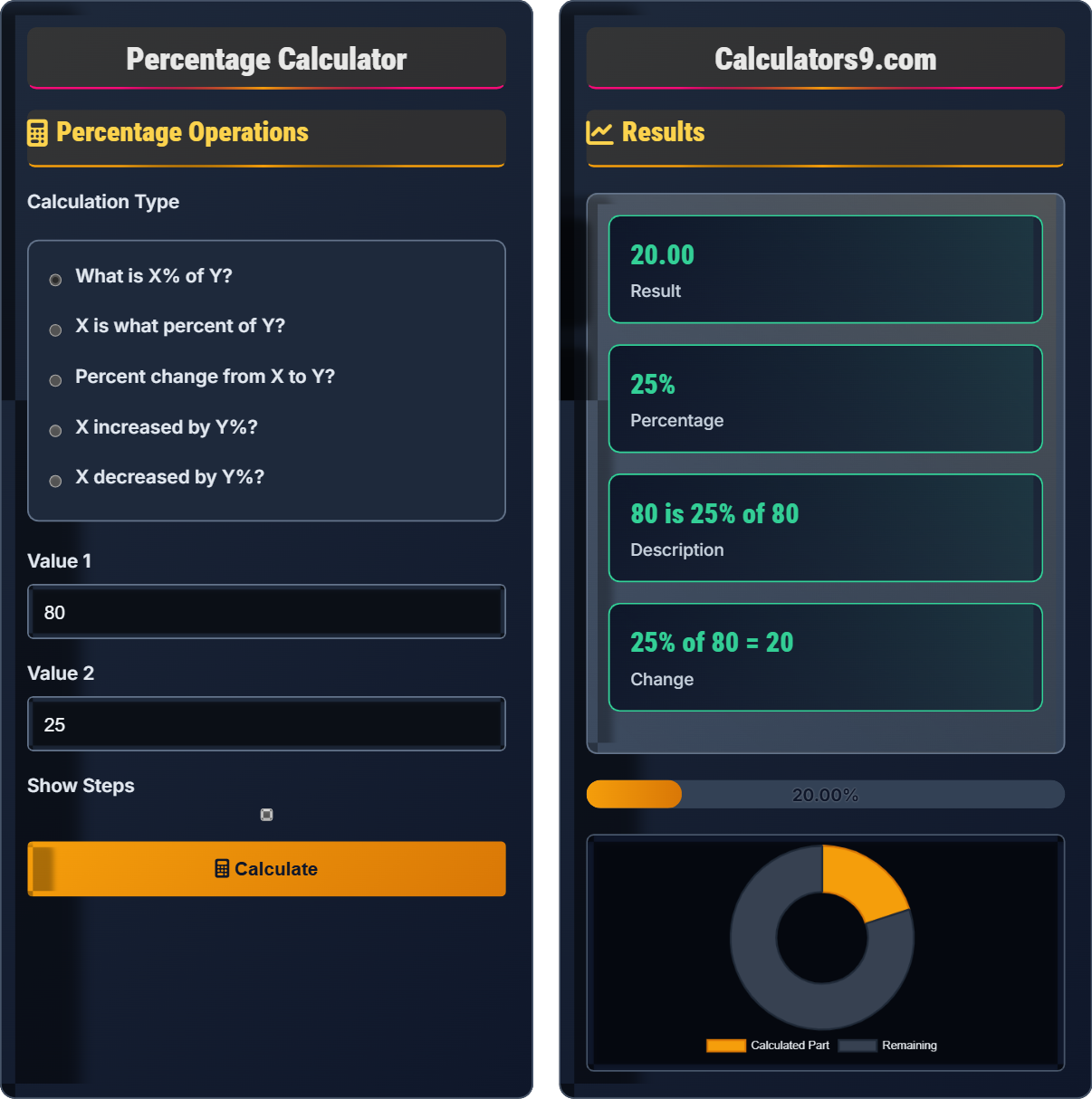
Example: What is 25% of 80?
\(P = \frac{80 \times 25}{100} = \frac{2000}{100} = 20\)
So 25% of 80 is 20.
Example: What percent is 15 of 60?
\(\% = \frac{15}{60} \times 100 = 0.25 \times 100 = 25\%\)
So 15 is 25% of 60.
Percentage Operations
Results
Comprehensive Percentage Guide
A percentage is a way of expressing a number as a fraction of 100. The word "percent" comes from the Latin "per centum," meaning "by the hundred." Percentages are used to describe parts of a whole, ratios, and changes. For example, 25% means 25 out of 100, or 25/100, or 0.25 in decimal form.
The main operations with percentages include:
Percentages can be converted to and from decimals and fractions:
- To convert percentage to decimal: divide by 100 (25% = 0.25)
- To convert decimal to percentage: multiply by 100 (0.25 = 25%)
- To convert percentage to fraction: put percentage over 100 and simplify (25% = 25/100 = 1/4)
Percentage Basics
A percentage is a number or ratio expressed as a fraction of 100.
\(\text{percentage} = \frac{\text{part}}{\text{whole}} \times 100\)
Or: \(\text{part} = \frac{\text{percentage}}{100} \times \text{whole}\)
- Percentage means per hundred
- 100% represents the whole
- Percentages can exceed 100%
Calculations
\(\text{New Value} = \text{Original} \times (1 + \frac{\%}{100})\)
- Calculate the percentage of the original value
- Subtract from the original value
- Or: New Value = Original × (1 - %/100)
- \(\text{Change \%} = \frac{\text{New} - \text{Old}}{\text{Old}} \times 100\)
- Positive = increase, Negative = decrease
- Used for growth, inflation, discounts
Percentage Learning Quiz
What is 30% of 150?
The answer is B) 45. To find 30% of 150, we use the formula: \(\frac{30}{100} \times 150 = 0.30 \times 150 = 45\). Alternatively, we can think of it as moving the decimal point: 30% = 0.30, then multiply by 150.
When finding a percentage of a number, convert the percentage to a decimal by dividing by 100, then multiply by the number. This works because percentage literally means "per hundred," so 30% means 30 per hundred or 30/100.
Percentage: A number expressed as a fraction of 100
Decimal Conversion: Divide percentage by 100
Part of Whole: The result of a percentage calculation
• To find X% of Y: multiply Y by (X/100)
• Always convert percentage to decimal first
• The result should be smaller than the original number when X < 100%
• 10% of any number is found by moving decimal one place left
• 50% is the same as dividing by 2
• 25% is the same as dividing by 4
• Forgetting to divide by 100 when converting percentage to decimal
• Adding instead of multiplying
• Getting confused about which number is the base (100%)
A store offers a 20% discount on a $120 jacket. What is the final price after the discount? Show your work.
Step 1: Calculate the discount amount: 20% of $120 = \(\frac{20}{100} \times 120 = 0.20 \times 120 = \$24\)
Step 2: Subtract the discount from the original price: $120 - $24 = $96
Alternatively: Final price = Original price × (1 - Discount %) = $120 × (1 - 0.20) = $120 × 0.80 = $96
The final price is $96.
This problem demonstrates how percentages apply to real-world scenarios. When calculating discounts, first find the discount amount (percentage of original price), then subtract from the original. Alternatively, you can multiply by the remaining percentage (100% - discount %).
Discount: A reduction in price, usually expressed as a percentage
Final Price: The price after applying the discount
Remaining Percentage: 100% minus the discount percentage
• Discount amount = Original price × (discount % / 100)
• Final price = Original price - Discount amount
• Final price = Original price × (1 - discount % / 100)
• To find the final price after discount, multiply by (100% - discount %)
• 20% discount means you pay 80% of the original price
• Always check that the final price is less than the original
• Adding the discount instead of subtracting it
• Forgetting to convert percentage to decimal
• Calculating the discount amount as the final price
Tom's salary increased from $40,000 to $46,000. What was the percentage increase in his salary? Express your answer as a percentage.
Step 1: Find the actual increase: $46,000 - $40,000 = $6,000
Step 2: Apply the percentage change formula: \(\% = \frac{\text{increase}}{\text{original}} \times 100\)
Step 3: Calculate: \(\% = \frac{6,000}{40,000} \times 100 = 0.15 \times 100 = 15\%\)
Tom's salary increased by 15%.
This problem demonstrates how to calculate percentage change. The formula compares the difference between new and old values to the original value. This concept is widely used in finance, economics, and statistics to measure growth or decline.
Percentage Increase: The relative change from an original value to a higher value
Percentage Change Formula: \(\frac{\text{new} - \text{old}}{\text{old}} \times 100\)
Relative Change: Change compared to the original value
• Percentage change = (difference/original) × 100
• Use original value as the denominator
• Positive result = increase, negative result = decrease
• Always use the original value as the base for comparison
• Double-check that the result makes sense in context
• Percentage change tells you how much the value changed relative to its starting point
• Using the new value instead of the original as the denominator
• Forgetting to multiply by 100 to get percentage
• Getting the order wrong in the numerator (new-old vs old-new)
A company's revenue was $200,000 last year. This year it increased by 15%, and next year it's projected to decrease by 10% from this year's value. What will be the revenue next year? Calculate the overall percentage change from last year to next year.
Step 1: Calculate this year's revenue after 15% increase: $200,000 × (1 + 0.15) = $200,000 × 1.15 = $230,000
Step 2: Calculate next year's revenue after 10% decrease: $230,000 × (1 - 0.10) = $230,000 × 0.90 = $207,000
Step 3: Calculate overall percentage change: \(\frac{207,000 - 200,000}{200,000} \times 100 = \frac{7,000}{200,000} \times 100 = 3.5\%\)
Next year's revenue will be $207,000, which is a 3.5% overall increase from last year.
This multi-step problem combines consecutive percentage changes. Each change is applied to the previous result, not the original value. The overall percentage change is calculated from the original to the final value. Note that consecutive percentage changes don't simply add up (15% - 10% ≠ 5% in this case).
Consecutive Changes: Multiple percentage changes applied sequentially
Overall Change: The total change from beginning to end
Compounding Effect: When each change builds on the previous result
• Apply each percentage change to the current value, not the original
• Overall change is calculated from original to final value
• Consecutive changes don't simply add algebraically
• Use multipliers: increase by 15% = multiply by 1.15
• Decrease by 10% = multiply by 0.90
• Always verify that the final result makes sense
• Adding percentage changes directly instead of applying them sequentially
• Applying each change to the original value instead of the current value
• Calculating overall change incorrectly
Which of the following statements about percentages is TRUE?
The answer is A) 200% of a number is twice the number. This is true because 200% = 200/100 = 2. So 200% of X = 2X, which is indeed twice the number. For the other options: B) 50% = 0.50, whereas 0.5% = 0.005; C) If we start with 100, decrease by 50% (to 50), then increase by 50% (to 75), we don't return to 100; D) Percentages can exceed 100% (e.g., 200% of 50 is 100).
This question tests understanding of percentage concepts. 200% means 200 per 100, or 2 times the original amount. Percentages can indeed exceed 100% when the part is larger than the whole. Also, percentage increases and decreases are not symmetric - a 50% decrease followed by a 50% increase does not return to the original value because the base changes.
Percentage Greater Than 100%: Occurs when the part exceeds the whole
Asymmetric Changes: Percentage increases and decreases have different effects
Base Value: The value against which the percentage is calculated
• Percentages can exceed 100%
• Percentage changes are not symmetric
• The base value changes after each percentage operation
• Always identify what the percentage is taken of
• Use examples to verify percentage relationships
• Remember that percentages are relative to the base value
• Thinking percentages cannot exceed 100%
• Assuming percentage increases and decreases are symmetric
• Confusing 50% with 0.5%
FAQ
Q: How do I calculate percentage change?
A: The formula for percentage change is: \(\% = \frac{\text{new} - \text{old}}{\text{old}} \times 100\)
This formula compares the difference between the new and old values to the original value. For example, if a stock price increases from $50 to $60, the percentage change is: \(\frac{60 - 50}{50} \times 100 = \frac{10}{50} \times 100 = 0.2 \times 100 = 20\%\)
If the result is positive, it's an increase; if negative, it's a decrease.
Q: What's the difference between percentage points and percent change?
A: Percentage points measure the arithmetic difference between two percentages, while percent change measures the relative change.
For example, if an interest rate increases from 5% to 7%:
- It increased by 2 percentage points (7 - 5 = 2)
- It increased by 40% in relative terms: \(\frac{7-5}{5} \times 100 = 40\%\)
This distinction is important in finance and statistics where the difference matters.