Ratio Calculator
Calculate ratios, proportions, equivalent ratios • 2026 edition
Ratio Formulas:
Show the calculatorSimplify ratio: Find GCD of terms and divide both by GCD
Proportion equation: \(\frac{a}{b} = \frac{c}{d}\) or \(a:b = c:d\)
Cross multiplication: \(a \times d = b \times c\)
Equivalent ratios: \(\frac{a}{b} = \frac{na}{nb}\) where n is any non-zero number
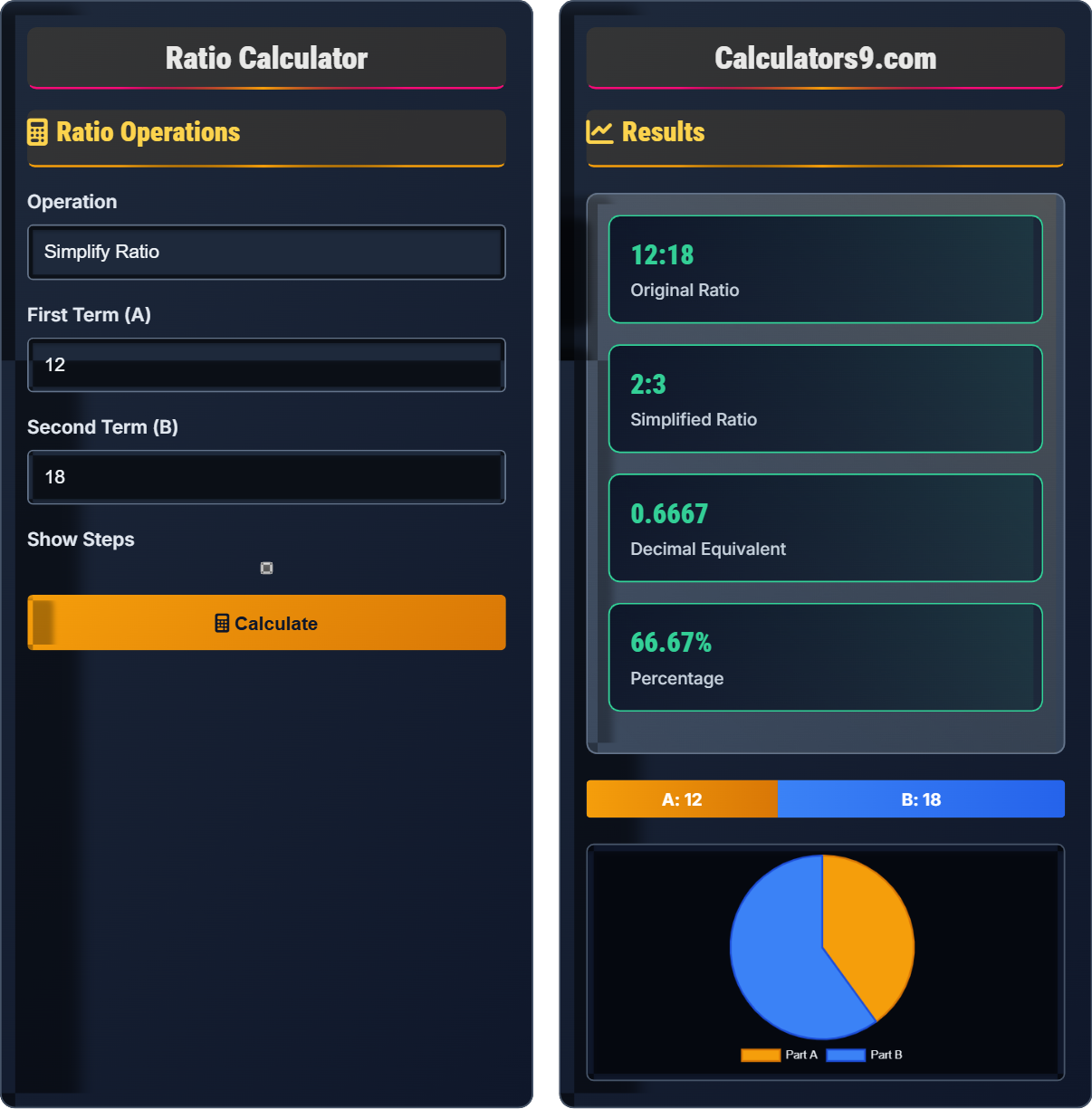
Example: Simplify 12:18
GCD of 12 and 18 is 6
12 ÷ 6 = 2, 18 ÷ 6 = 3
Simplified ratio: 2:3
Example: Solve proportion 2:3 = x:12
Cross multiply: 2 × 12 = 3 × x
24 = 3x, so x = 8
Therefore, 2:3 = 8:12
Ratio Operations
Results
Comprehensive Ratio Guide
A ratio is a mathematical comparison of two or more quantities that shows how much of one thing there is compared to another. Ratios can be expressed in various forms: A:B, A/B, or "A to B". For example, if there are 3 red marbles and 5 blue marbles, the ratio of red to blue marbles is 3:5.
The main operations with ratios include:
To simplify ratios, find the Greatest Common Divisor (GCD) of all terms, then divide each term by the GCD. For example, to simplify 12:18:6:
- GCD of 12, 18, and 6 is 6
- Divide each by 6: (12÷6):(18÷6):(6÷6) = 2:3:1
- So 12:18:6 simplifies to 2:3:1
Ratio Basics
A ratio compares two or more quantities by division.
\(A:B\) or \(\frac{A}{B}\) or "A to B"
All represent the same relationship.
- Terms must be in the same units
- Ratios remain unchanged when multiplied/divided by same number
- Order matters: A:B ≠ B:A
Operations
\(\frac{a}{b} = \frac{c}{d}\) means \(a \times d = b \times c\)
- Find GCD of all terms
- Divide each term by GCD
- Result is in lowest terms
- \(\frac{a}{b} = \frac{na}{nb}\) for any non-zero n
- Multiply both terms by same number
- Examples: 1:2 = 2:4 = 3:6
Ratio Learning Quiz
What is the simplified form of the ratio 24:36?
The answer is B) 2:3. To simplify 24:36, find the GCD (Greatest Common Divisor) of 24 and 36. The factors of 24 are: 1, 2, 3, 4, 6, 8, 12, 24. The factors of 36 are: 1, 2, 3, 4, 6, 9, 12, 18, 36. The greatest common factor is 12. Divide both terms by 12: 24÷12 = 2, 36÷12 = 3. So the simplified ratio is 2:3.
Simplifying ratios follows the same principle as simplifying fractions. We find the largest number that divides both terms evenly (the GCD) and divide both terms by this number. This gives us the ratio in its simplest form, which is easier to work with and understand.
GCD (Greatest Common Divisor): The largest number that divides two or more numbers evenly
Simplified Ratio: A ratio in its lowest terms where the terms have no common factors other than 1
Factors: Numbers that divide another number evenly
• Always simplify ratios to their lowest terms
• Divide both terms by the same number
• The simplified ratio maintains the same relationship as the original
• Look for common factors like 2, 3, 5 first
• Use prime factorization for complex numbers
• Check by multiplying back to see if you get the original ratio
• Forgetting to divide both terms by the same number
• Not simplifying completely (stopping before lowest terms)
• Dividing by a number that doesn't go into both terms evenly
If the ratio of boys to girls in a class is 3:4 and there are 12 boys, how many girls are in the class? Show your work.
Step 1: Set up the proportion: Boys:Girls = 3:4
Step 2: Write as fraction equation: 3/4 = 12/girls
Step 3: Cross multiply: 3 × girls = 4 × 12
Step 4: Solve: 3 × girls = 48, so girls = 48 ÷ 3 = 16
There are 16 girls in the class.
This problem demonstrates how to use proportions to find missing values. When we know a ratio and one part of the actual quantities, we can set up a proportion to find the unknown part. Cross multiplication is the key technique for solving proportion equations.
Proportion: An equation stating that two ratios are equal
Cross Multiplication: Multiplying the numerator of one fraction by the denominator of the other
Equivalent Ratios: Ratios that express the same relationship
• In proportion a/b = c/d, ad = bc (cross products are equal)
• Always verify your answer makes sense in context
• Maintain the same order in both ratios
• Set up proportions with like terms in the same positions
• Use the relationship to check your answer
• Draw diagrams to visualize the problem
• Setting up the proportion with terms in wrong positions
• Forgetting to cross multiply correctly
• Not verifying that the answer makes sense
A recipe calls for flour and sugar in the ratio 5:3. If you want to make a batch that uses 20 cups of flour, how much sugar should you use? Express your answer as a simplified ratio.
Step 1: Set up the proportion: Flour:Sugar = 5:3
Step 2: Write as equation: 5/3 = 20/sugar
Step 3: Cross multiply: 5 × sugar = 3 × 20
Step 4: Solve: 5 × sugar = 60, so sugar = 60 ÷ 5 = 12
Step 5: Verify: 20:12 simplifies to 5:3 ✓
You should use 12 cups of sugar. The ratio is 20:12 which simplifies to 5:3.
This problem shows a practical application of ratios in cooking. When scaling recipes, maintaining the original ratio ensures the taste and texture remain consistent. The proportional relationship allows us to calculate the correct amounts for any desired quantity.
Recipe Scaling: Adjusting ingredient quantities while maintaining proportions
Proportional Relationship: A constant ratio between quantities
Verification: Checking that the solution maintains the original ratio
• Maintain the same ratio when scaling recipes
• Use proportions to find missing values
• Always verify your answer maintains the original ratio
• Set up the proportion with the known ratio on one side
• Use the factor method: 20÷5 = 4, so multiply 3 by 4 to get 12
• Always check that your scaled ratio simplifies to the original
• Forgetting to maintain the same order in ratios
• Not verifying the final ratio matches the original
• Confusing which quantity corresponds to which part of the ratio
A company has a debt-to-equity ratio of 2:5. If the total equity is $250,000, what is the total debt? If the company wants to improve this ratio to 1:3, how much equity would need to be added, assuming debt remains constant?
Part 1: Find current debt
Debt:Equity = 2:5, Equity = $250,000
2/5 = Debt/250,000
Cross multiply: 2 × 250,000 = 5 × Debt
500,000 = 5 × Debt
Debt = $100,000
Part 2: Find equity needed for 1:3 ratio
New ratio: Debt:Equity = 1:3
With debt = $100,000: 1/3 = 100,000/New Equity
Cross multiply: 1 × New Equity = 3 × 100,000
New Equity = $300,000
Additional equity needed = $300,000 - $250,000 = $50,000
The current debt is $100,000. To achieve a 1:3 ratio, $50,000 more equity is needed.
This problem demonstrates how ratios are used in business finance. The debt-to-equity ratio is a critical financial metric that shows the relationship between borrowed money and owner's capital. Understanding how to manipulate ratios helps businesses plan their financial structure.
Debt-to-Equity Ratio: Measures financial leverage (debt vs. equity financing)
Financial Leverage: Use of borrowed money to increase investment returns
Equity: Owner's stake in the company
• Maintain consistent units in ratios
• Understand what each part of the ratio represents
• Use proportions to solve for unknown values
• Write ratios as fractions to solve more easily
• Label each part of the ratio clearly
• Verify answers by checking the final ratio
• Confusing which value corresponds to which part of the ratio
• Forgetting to keep units consistent
• Not properly setting up the proportion equation
Which of the following statements about ratios is TRUE?
The answer is B) 3:4 is equivalent to 6:8. This is true because 6:8 simplifies to 3:4 (both terms divided by 2). For the other options: A) Order does matter - 3:4 ≠ 4:3; C) Ratios can compare multiple quantities (e.g., 2:3:5); D) Ratios can be expressed with decimals or fractions (e.g., 1.5:2.5 or 3/2:5/2).
This question tests fundamental concepts about ratios. Equivalent ratios maintain the same relationship between quantities. When both terms of a ratio are multiplied or divided by the same non-zero number, the relationship remains the same. Understanding these concepts is crucial for working with ratios effectively.
Equivalent Ratios: Ratios that express the same relationship
Ratio Order: The sequence of terms in a ratio matters (A:B ≠ B:A)
Multiple Term Ratios: Ratios can compare more than two quantities
• Order matters in ratios: A:B ≠ B:A
• Equivalent ratios: a:b = na:nb for any non-zero n
• Ratios can compare multiple quantities simultaneously
• To check if ratios are equivalent, simplify both to lowest terms
• Ratios can be expressed as fractions for easier manipulation
• Always consider the context when interpreting ratios
• Thinking that ratio order doesn't matter
• Believing ratios can only compare two quantities
• Assuming ratios must always be whole numbers
FAQ
Q: How do I simplify a ratio to its lowest terms?
A: To simplify a ratio to its lowest terms, find the Greatest Common Divisor (GCD) of all the terms and divide each term by the GCD. For example, to simplify 24:36:
1. Find factors of 24: 1, 2, 3, 4, 6, 8, 12, 24
2. Find factors of 36: 1, 2, 3, 4, 6, 9, 12, 18, 36
3. The GCD is 12 (largest common factor)
4. Divide both terms by 12: 24÷12 = 2, 36÷12 = 3
5. So 24:36 simplifies to 2:3
Q: What's the difference between a ratio and a fraction?
A: While ratios and fractions look similar, they represent different concepts:
- Ratios: Compare two or more quantities (e.g., 3:4 means for every 3 of one thing, there are 4 of another)
- Fractions: Represent a part of a whole (e.g., 3/4 means 3 parts out of 4 total parts)
However, ratios can be expressed as fractions for calculation purposes. For example, the ratio 3:4 can be written as the fraction 3/4 when solving proportion problems.