Area Calculator
Square, rectangle, triangle, circle • 2026 edition
Area Formulas:
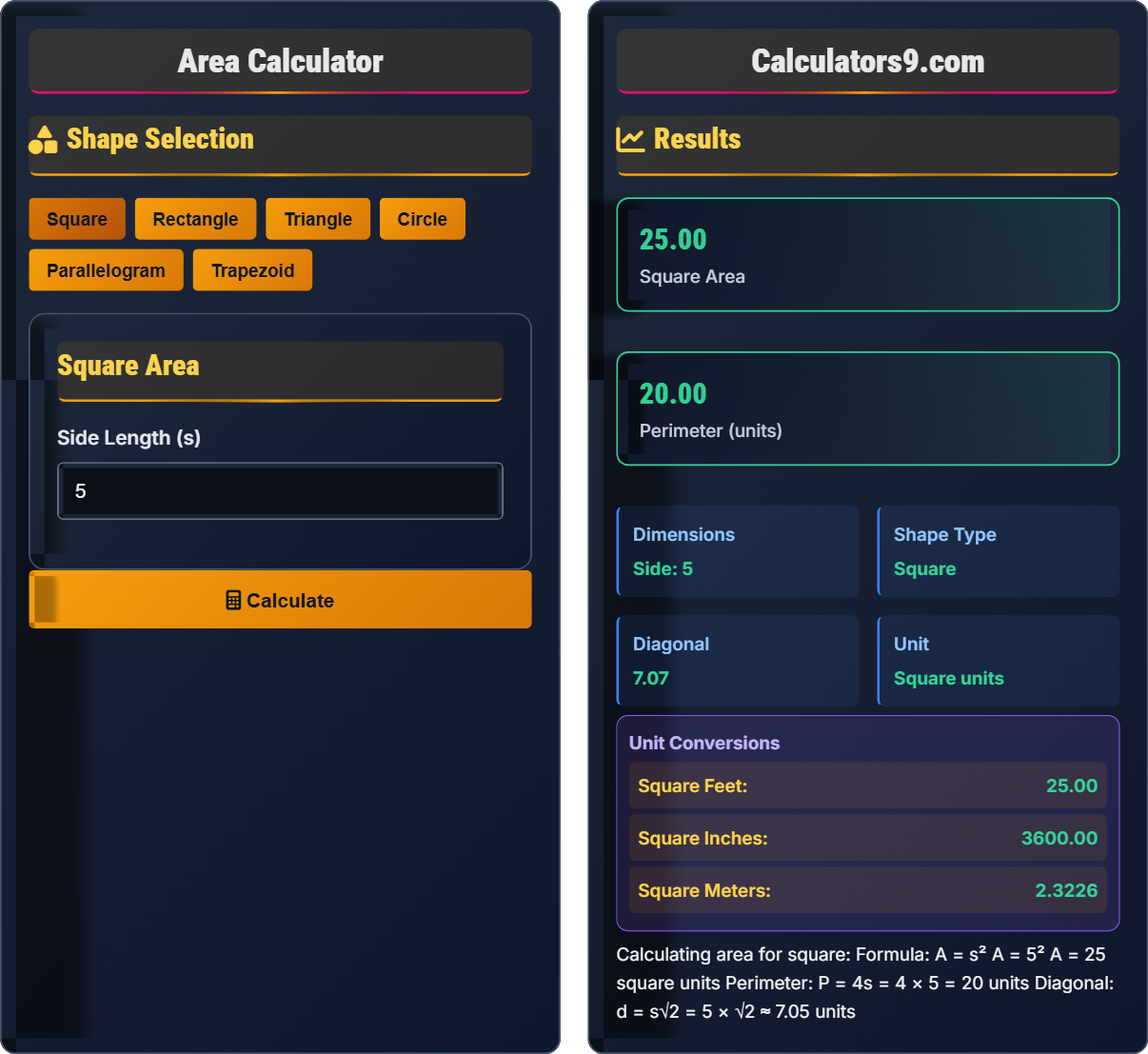
Show the calculatorSquare: \( A = s^2 \)
Rectangle: \( A = l \times w \)
Triangle: \( A = \frac{1}{2}bh \) or \( A = \sqrt{s(s-a)(s-b)(s-c)} \)
Circle: \( A = \pi r^2 \)
Parallelogram: \( A = bh \)
Trapezoid: \( A = \frac{1}{2}(b_1 + b_2)h \)
Area is the measure of the space inside a two-dimensional shape. Different shapes have specific formulas for calculating area. Area is always measured in square units (square inches, square meters, etc.).
Shape Selection
Square Area
Results
Area Calculation Guide
Area is the measure of the space inside a two-dimensional shape. It quantifies the amount of surface enclosed by the boundary of a flat shape. Area is measured in square units (square inches, square feet, square meters, etc.) because it represents the number of unit squares that fit inside the shape.
\( A = s^2 \)
Where s is the length of one side of the square.
\( A = l \times w \)
Where l is the length and w is the width of the rectangle.
- Area is always positive
- Measured in square units
- Depends on the shape's dimensions
- Can be added for composite shapes
Area Calculation Learning Quiz
What is the area of a square with a side length of 7 units?
The answer is C) 49 square units. The area of a square is calculated using the formula A = s², where s is the length of a side. For a square with side length 7: A = 7² = 49 square units. This is because a square has all sides equal, so the area is the side length multiplied by itself.
The area of a square is the simplest area formula, A = s². This formula comes from the fact that a square is a special rectangle where length and width are equal. Since area of a rectangle is length × width, for a square this becomes side × side, or side². The exponent 2 represents the two dimensions of the shape.
Area: Measure of the space inside a two-dimensional shape
Square: Quadrilateral with four equal sides and four right angles
Units: Standard quantities used to measure physical properties
• Area of square: A = s²
• Area is always in square units
• Square units = linear unit × linear unit
• Remember: s² means s × s
• Area is always in square units
• Square area is side length squared
• Forgetting to square the side length
• Using perimeter formula instead of area
• Omitting square units in the answer
Find the area of a rectangle with length 12 units and width 8 units. Also calculate its perimeter. Show your work.
Step 1: Calculate the area of the rectangle
A = length × width
A = 12 × 8 = 96 square units
Step 2: Calculate the perimeter of the rectangle
P = 2(length + width)
P = 2(12 + 8) = 2(20) = 40 units
The area is 96 square units and the perimeter is 40 units.
The area of a rectangle is calculated by multiplying its length by its width. This formula, A = lw, represents the number of unit squares that can fit inside the rectangle. The perimeter is the total distance around the rectangle, calculated as P = 2(l + w), which adds up all four sides (two lengths and two widths).
Area: Space inside a shape
Perimeter: Distance around the edge of a shape
Rectangle: Quadrilateral with four right angles
• Area of rectangle: A = l × w
• Perimeter of rectangle: P = 2(l + w)
• Area is in square units
• Perimeter is in linear units
• Area: multiply length by width
• Perimeter: add all sides or use 2(l + w)
• Remember units: area is square, perimeter is linear
• Confusing area with perimeter formulas
• Using wrong units (linear instead of square)
• Forgetting to multiply by 2 in perimeter formula
A rectangular room measures 15 feet by 12 feet. If carpet costs $3 per square foot, how much will it cost to carpet the entire room? How much trim is needed for the perimeter?
Step 1: Calculate the area of the room
A = length × width = 15 × 12 = 180 square feet
Step 2: Calculate the cost of carpeting
Cost = Area × Price per square foot = 180 × $3 = $540
Step 3: Calculate the perimeter for trim
P = 2(length + width) = 2(15 + 12) = 2(27) = 54 feet
It will cost $540 to carpet the room and 54 feet of trim is needed.
This problem demonstrates how area calculations apply to real-world situations. When covering a floor with carpet, we need to know the area to determine how much material to buy. When installing trim around the edges, we need to know the perimeter. This shows the practical importance of geometric calculations in everyday life.
Carpet Installation: Covering floor with material
Trim: Decorative edging around the perimeter
Cost Calculation: Multiplying area by price per unit
• Area determines material needed for covering
• Perimeter determines material needed for edges
• Cost = Area × Price per square unit
• Always calculate area for floor coverage
• Calculate perimeter for border materials
• Check units match in calculations
• Using perimeter instead of area for flooring
• Using area instead of perimeter for trim
• Mismatched units in cost calculations
A garden consists of a rectangular section (20 ft × 15 ft) with a semicircular flower bed attached to one of the 20 ft sides. If the semicircle has a radius of 10 ft, what is the total area of the garden? Use π ≈ 3.14.
Step 1: Calculate the area of the rectangular section
A_rect = length × width = 20 × 15 = 300 square feet
Step 2: Calculate the area of the semicircular flower bed
A_semi_circle = ½ × π × r² = ½ × 3.14 × 10² = ½ × 3.14 × 100 = 157 square feet
Step 3: Calculate the total area
A_total = A_rect + A_semi_circle = 300 + 157 = 457 square feet
The total area of the garden is 457 square feet.
Composite shapes are made up of simpler shapes. To find the area of a composite shape, we calculate the area of each component shape separately and then add them together. In this case, the garden is composed of a rectangle and a semicircle. The area of a semicircle is half the area of a full circle: A = ½πr².
Composite Shape: Shape made up of multiple simpler shapes
Semicircle: Half of a circle
Additive Property: Areas of non-overlapping shapes can be added
• Area of semicircle: A = ½πr²
• Total area = sum of component areas
• Components must not overlap
• Break complex shapes into simpler ones
• Calculate each component separately
• Add the areas together
• Forgetting that semicircle is half of a circle
• Adding overlapping areas multiple times
• Not accounting for shared boundaries
Which of the following statements about triangle area is TRUE?
The answer is B) Area = ½ × base × height. The area of a triangle is calculated as half the product of its base and corresponding height. This is because a triangle is essentially half of a parallelogram with the same base and height. The height must be perpendicular to the base.
The formula A = ½bh for a triangle comes from the relationship between triangles and parallelograms. If you take a parallelogram and cut it diagonally, you get two congruent triangles. Since the area of the parallelogram is bh, each triangle has area ½bh. The height must be measured perpendicular to the base.
Triangle: Polygon with three sides and three angles
Base: Side used as reference for height measurement
Height: Perpendicular distance from base to opposite vertex
• Area of triangle: A = ½bh
• Height must be perpendicular to base
• Any side can be used as the base
• Always use ½ in the triangle area formula
• Height is perpendicular to the base
• The same triangle can have different base-height pairs
• Forgetting the ½ factor in the formula
• Using slanted side instead of perpendicular height
• Confusing base with other sides of the triangle
FAQ
Q: Why do we use square units for area?
A: We use square units for area because area measures two-dimensional space. When we calculate area, we're essentially counting how many unit squares fit inside a shape. For example, if we have a rectangle that is 3 units long and 4 units wide, we can fit 3 × 4 = 12 unit squares inside it. Since we're multiplying two linear dimensions, the result has units² (square units).
Q: How is area calculation used in engineering?
A: Area calculations are fundamental in engineering:
- Structural Engineering: Calculating beam cross-sectional areas for strength analysis
- Civil Engineering: Determining land areas for construction projects
- Mechanical Engineering: Heat transfer calculations based on surface areas
- Fluid Mechanics: Pipe cross-sectional areas for flow calculations
- Electrical Engineering: Wire cross-sectional areas for current capacity
Accurate area measurements are critical for safety and efficiency in all engineering disciplines.