Distance Calculator
Point-to-point, coordinate geometry • 2026 edition
Distance Formulas:
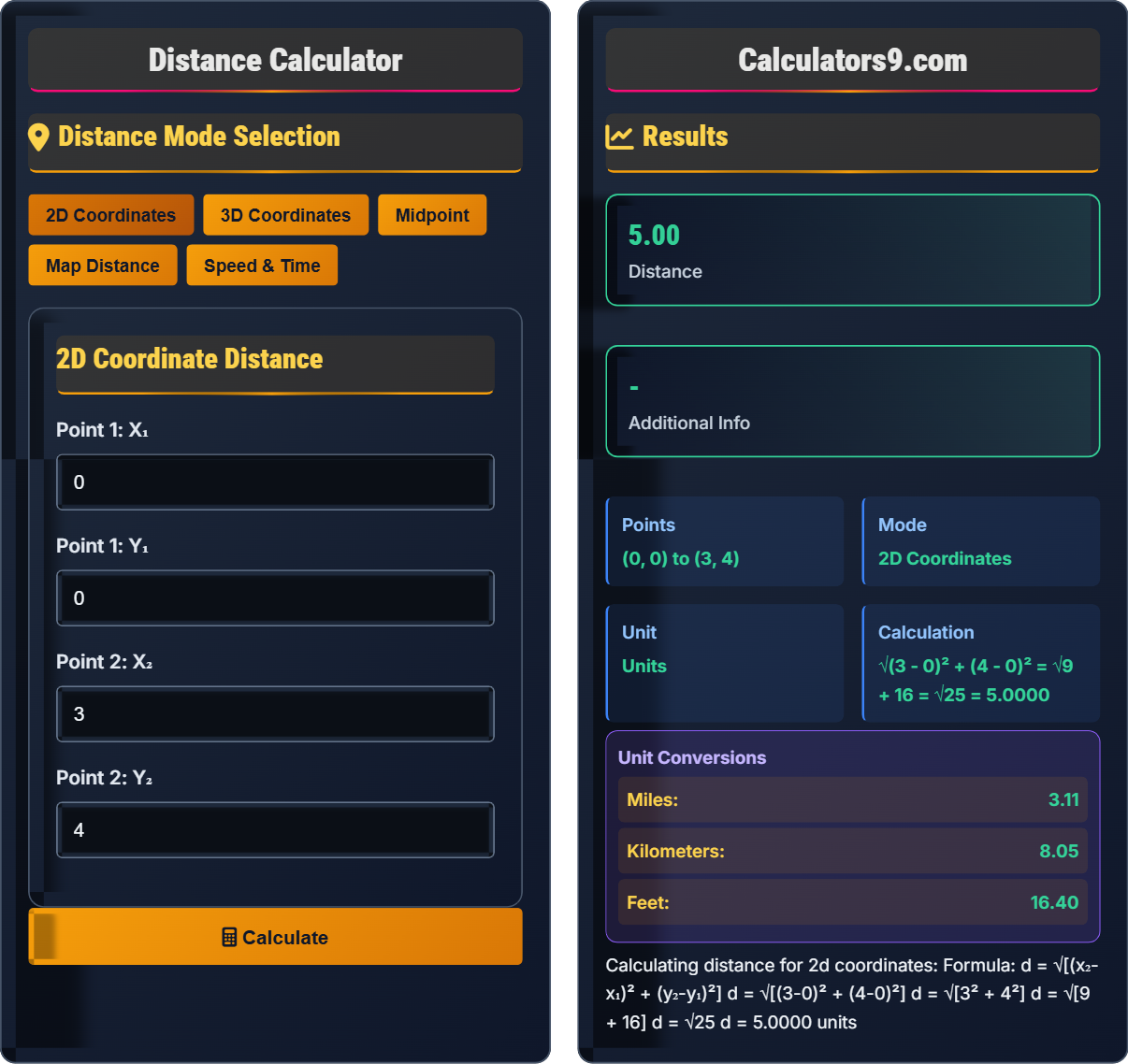
Show the calculator2D Coordinate Distance: \( d = \sqrt{(x_2-x_1)^2 + (y_2-y_1)^2} \)
3D Coordinate Distance: \( d = \sqrt{(x_2-x_1)^2 + (y_2-y_1)^2 + (z_2-z_1)^2} \)
Map Distance: \( d = R \cdot \arccos(\sin \phi_1 \cdot \sin \phi_2 + \cos \phi_1 \cdot \cos \phi_2 \cdot \cos(\Delta\lambda)) \)
Midpoint Formula: \( \left(\frac{x_1+x_2}{2}, \frac{y_1+y_2}{2}\right) \)
Distance is the measure of the shortest path between two points. In coordinate geometry, the distance formula is derived from the Pythagorean theorem. These calculations are essential in navigation, physics, and engineering applications.
Distance Mode Selection
2D Coordinate Distance
Results
Distance Calculation Guide
Distance is the measure of the shortest path between two points. In coordinate geometry, distance is calculated using the distance formula, which is derived from the Pythagorean theorem. Distance is always a positive value and is measured in linear units.
\( d = \sqrt{(x_2-x_1)^2 + (y_2-y_1)^2} \)
Where (x₁, y₁) and (x₂, y₂) are the coordinates of the two points.
\( d = \sqrt{(x_2-x_1)^2 + (y_2-y_1)^2 + (z_2-z_1)^2} \)
Extends the 2D formula to include the z-coordinate.
- Distance is always positive
- Measured in linear units
- Represents the shortest path between points
- Equals zero only when points are identical
Distance Calculation Learning Quiz
What is the distance between points (2, 3) and (5, 7)?
The answer is B) 5 units. Using the distance formula: d = √[(x₂-x₁)² + (y₂-y₁)²]. Substituting: d = √[(5-2)² + (7-3)²] = √[3² + 4²] = √[9 + 16] = √25 = 5 units. This is actually a 3-4-5 Pythagorean triple.
The distance formula is derived from the Pythagorean theorem. When you have two points in a coordinate plane, you can form a right triangle by drawing horizontal and vertical lines from the points. The distance between the points is the hypotenuse of this right triangle. The legs of the triangle are the differences in the x-coordinates and y-coordinates.
Distance Formula: Formula to calculate distance between two points
Coordinate Plane: Two-dimensional plane with x and y axes
Pythagorean Theorem: a² + b² = c² for right triangles
• Distance formula: d = √[(x₂-x₁)² + (y₂-y₁)²]
• Distance is always positive
• Derived from Pythagorean theorem
• Subtract coordinates in the same order
• Square the differences first
• Take square root of the sum
• Forgetting to subtract coordinates
• Squaring before subtracting instead of after
• Forgetting to take the square root
Find the midpoint of the line segment connecting points (4, 6) and (8, 10). Show your work using the midpoint formula.
Step 1: Write the midpoint formula
M = ((x₁ + x₂)/2, (y₁ + y₂)/2)
Step 2: Identify the coordinates
(x₁, y₁) = (4, 6) and (x₂, y₂) = (8, 10)
Step 3: Substitute into the formula
M = ((4 + 8)/2, (6 + 10)/2)
Step 4: Calculate each coordinate
M = (12/2, 16/2)
Step 5: Simplify
M = (6, 8)
The midpoint is at (6, 8).
The midpoint formula finds the point that lies exactly halfway between two given points. It works by averaging the x-coordinates and averaging the y-coordinates separately. The midpoint is equidistant from both endpoints and lies on the line segment connecting them.
Midpoint: Point exactly halfway between two endpoints
Line Segment: Part of a line between two points
Average: Sum of values divided by number of values
• Midpoint formula: M = ((x₁ + x₂)/2, (y₁ + y₂)/2)
• Midpoint lies on the line segment
• Equidistant from both endpoints
• Average x-coordinates separately
• Average y-coordinates separately
• Midpoint is always between the two points
• Forgetting to divide by 2
• Mixing up x and y coordinates
• Using distance formula instead of midpoint formula
A ship sails from point A at coordinates (10, 15) to point B at coordinates (40, 60). If the ship travels at a constant speed of 15 units per hour, how long will the journey take?
Step 1: Calculate the distance between the two points
d = √[(x₂-x₁)² + (y₂-y₁)²]
d = √[(40-10)² + (60-15)²]
d = √[30² + 45²]
d = √[900 + 2025]
d = √2925 ≈ 54.08 units
Step 2: Calculate the time using the formula Time = Distance ÷ Speed
Time = 54.08 ÷ 15 ≈ 3.61 hours
The journey will take approximately 3.61 hours.
This problem combines coordinate geometry with basic physics. First, we use the distance formula to find the straight-line distance between the two points. Then we apply the relationship between distance, speed, and time (d = rt, so t = d/r) to find the travel time. This demonstrates how coordinate geometry applies to real-world navigation problems.
Navigation: Planning and monitoring of route
Constant Speed: Unchanging rate of travel
Distance-Speed-Time Relationship: d = rt
• Distance = Speed × Time
• Time = Distance ÷ Speed
• Use distance formula for coordinate distances
• Calculate distance first
• Use d = rt relationship
• Check units are consistent
• Forgetting to calculate distance first
• Using wrong formula for time calculation
• Unit conversion errors
An airplane flies from point A at coordinates (0, 0, 0) to point B at coordinates (3, 4, 12) in a 3D coordinate system where z represents altitude in thousands of feet. What is the straight-line distance of the flight path?
Step 1: Use the 3D distance formula
d = √[(x₂-x₁)² + (y₂-y₁)² + (z₂-z₁)²]
Step 2: Identify the coordinates
(x₁, y₁, z₁) = (0, 0, 0) and (x₂, y₂, z₂) = (3, 4, 12)
Step 3: Substitute into the formula
d = √[(3-0)² + (4-0)² + (12-0)²]
Step 4: Calculate each squared difference
d = √[3² + 4² + 12²]
d = √[9 + 16 + 144]
Step 5: Add and take the square root
d = √169 = 13 thousand feet
The straight-line distance is 13,000 feet.
The 3D distance formula extends the 2D formula by adding the z-coordinate difference. This is essential for calculating distances in three-dimensional space, such as flight paths, architectural measurements, or molecular structures. The concept remains the same as the Pythagorean theorem, just extended to three dimensions.
3D Coordinate System: System with x, y, and z axes
Altitude: Height above sea level
Flight Path: Route taken by aircraft
• 3D distance formula: d = √[(x₂-x₁)² + (y₂-y₁)² + (z₂-z₁)²]
• Extension of 2D formula to three dimensions
• All three coordinates must be considered
• Include z-coordinate differences
• Square all three differences
• Add all three squared differences
• Forgetting the z-coordinate in 3D problems
• Using 2D formula for 3D problems
• Arithmetic errors with three terms
Which of the following statements about distance is TRUE?
The answer is B) Distance between identical points is zero. Distance is always a non-negative value, representing the shortest path between two points. When two points are identical, the distance between them is zero. Distance is measured in linear units, not square units, and it represents the shortest path, not any particular path taken.
Distance has several important mathematical properties: it's always non-negative, it's zero only when the two points are identical, and it represents the shortest possible path between two points. These properties make distance a fundamental concept in geometry, physics, and many other fields. Understanding these properties helps in solving more complex problems.
Non-Negative: Value that is zero or positive
Identical Points: Points with same coordinates
Shortest Path: Minimum distance between points
• Distance ≥ 0 (never negative)
• Distance = 0 only if points are identical
• Distance is in linear units
• Distance is always positive or zero
• Represents straight-line distance
• Measured in linear units (not square)
• Thinking distance can be negative
• Confusing distance with displacement
• Using area units instead of length units
FAQ
Q: How is the distance formula related to the Pythagorean theorem?
A: The distance formula is directly derived from the Pythagorean theorem. When you have two points (x₁, y₁) and (x₂, y₂), you can form a right triangle by drawing horizontal and vertical lines. The horizontal leg has length |x₂ - x₁|, the vertical leg has length |y₂ - y₁|, and the distance between the points is the hypotenuse. By the Pythagorean theorem: c² = a² + b², so d² = (x₂ - x₁)² + (y₂ - y₁)², giving us d = √[(x₂ - x₁)² + (y₂ - y₁)²].
Q: How is distance calculation used in GPS and navigation?
A: GPS systems use distance calculations extensively:
- Satellite Ranging: Calculates distance to satellites using signal travel time
- Triangulation: Uses distances to multiple satellites to determine position
- Route Planning: Calculates distances between waypoints
- Speed Estimation: Uses distance over time between positions
- Map Matching: Finds closest road segment to GPS coordinates
The Haversine formula is used for calculating distances between coordinates on Earth's curved surface.