Pythagorean Theorem Calculator
a² + b² = c² • 2026 edition
Pythagorean Theorem Formula:
Show the calculator\( a^2 + b^2 = c^2 \)
Where a and b are the lengths of the legs of a right triangle, and c is the length of the hypotenuse. This fundamental theorem states that in a right triangle, the square of the hypotenuse (the side opposite the right angle) equals the sum of the squares of the other two sides.
Applications: Construction, navigation, distance calculations, trigonometry, and countless geometric problems.
Pythagorean Calculator
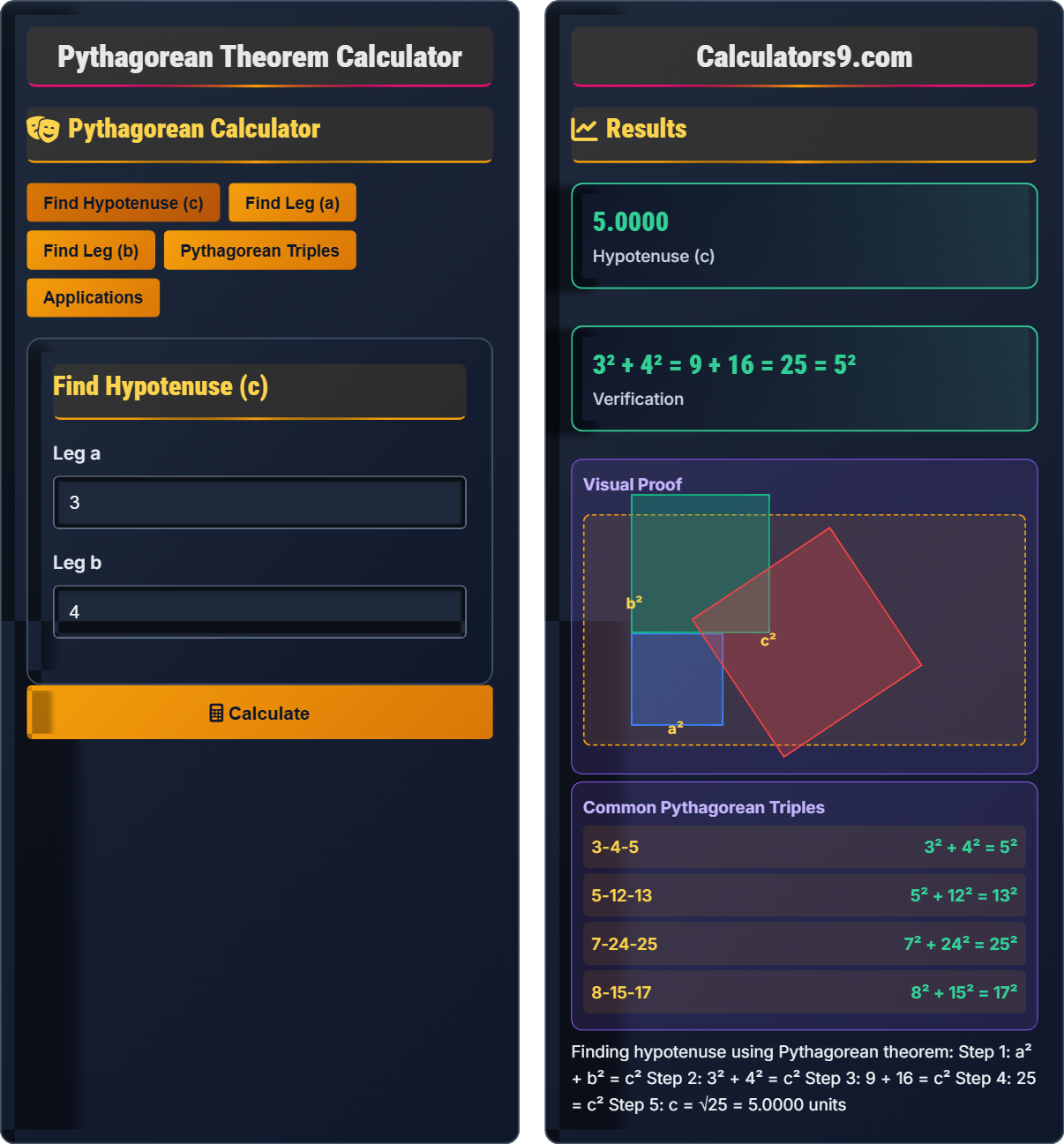
Find Hypotenuse (c)
Results
Pythagorean Theorem Guide
The Pythagorean Theorem states that in a right triangle, the square of the hypotenuse (the side opposite the right angle) equals the sum of the squares of the other two sides. The formula is a² + b² = c², where a and b are the legs and c is the hypotenuse.
\( a^2 + b^2 = c^2 \)
This relationship holds for all right triangles, regardless of size.
\( a = \sqrt{c^2 - b^2} \) or \( b = \sqrt{c^2 - a^2} \)
Use these forms when solving for a leg instead of the hypotenuse.
- Only applies to right triangles
- Hypotenuse is always the longest side
- Works in any dimensional space
- Foundation for distance formula
Pythagorean Theorem Learning Quiz
In a right triangle, if the legs measure 6 units and 8 units, what is the length of the hypotenuse?
The answer is A) 10 units. Using the Pythagorean theorem: a² + b² = c², where a = 6 and b = 8. Substituting: 6² + 8² = c² → 36 + 64 = c² → 100 = c² → c = √100 = 10. This is the famous 6-8-10 Pythagorean triple.
The Pythagorean theorem is fundamental in right triangle calculations. It states that in a right triangle, the square of the hypotenuse equals the sum of the squares of the other two sides. Always remember to take the square root of the result to find the actual length, not just the squared value.
Hypotenuse: The longest side of a right triangle, opposite the right angle
Legs: The two shorter sides of a right triangle that form the right angle
Pythagorean Triple: Three positive integers that satisfy a² + b² = c²
• Pythagorean theorem: a² + b² = c²
• Applies only to right triangles
• Hypotenuse is always the longest side
• Remember: hypotenuse² = leg₁² + leg₂²
• Learn common Pythagorean triples: (3,4,5), (5,12,13), (7,24,25)
• Always check that the hypotenuse is the longest side
• Forgetting to take the square root at the end
• Adding the sides instead of squaring them first
• Misidentifying which side is the hypotenuse
In a right triangle, if one leg measures 5 units and the hypotenuse measures 13 units, what is the length of the other leg? Show your work using the Pythagorean theorem.
Step 1: Identify what we know: a = 5, c = 13, need to find b
Step 2: Use the Pythagorean theorem: a² + b² = c²
Step 3: Substitute known values: 5² + b² = 13²
Step 4: Simplify: 25 + b² = 169
Step 5: Solve for b²: b² = 169 - 25 = 144
Step 6: Solve for b: b = √144 = 12 units
Verification: 5² + 12² = 25 + 144 = 169 = 13²
When solving for a missing leg, rearrange the Pythagorean theorem. If solving for leg a: a² = c² - b², so a = √(c² - b²). If solving for leg b: b² = c² - a², so b = √(c² - a²). The key is to isolate the unknown variable before taking the square root.
Rearranging Equations: Manipulating formulas to solve for a specific variable
Isolating Variables: Getting the unknown alone on one side of the equation
Verification: Checking that the solution satisfies the original equation
• To find leg a: a = √(c² - b²)
• To find leg b: b = √(c² - a²)
• Always verify your solution
• Subtract the known leg squared from hypotenuse squared
• The missing leg will always be shorter than the hypotenuse
• Double-check by plugging values back into original equation
• Adding instead of subtracting when solving for a leg
• Taking square root of the wrong expression
• Forgetting to verify the solution
A hiker walks 3 miles north and then 4 miles east. How far is the hiker from the starting point as the crow flies? Draw the path and explain how the Pythagorean theorem applies.
Step 1: Visualize the problem. The hiker's path forms a right triangle with legs of 3 miles (north) and 4 miles (east).
Step 2: The straight-line distance from start to finish is the hypotenuse of this right triangle.
Step 3: Apply the Pythagorean theorem: a² + b² = c²
3² + 4² = c²
9 + 16 = c²
25 = c²
c = √25 = 5 miles
The hiker is 5 miles from the starting point as the crow flies.
This problem demonstrates how the Pythagorean theorem applies to distance calculations in coordinate systems. When movement occurs in perpendicular directions (north-south and east-west), the resulting displacement forms a right triangle. The theorem calculates the direct distance between two points.
Displacement: Direct distance and direction from start to end point
Coordinate System: Framework using perpendicular axes to locate points
As the Crow Flies: Direct straight-line distance between two points
• Movement in perpendicular directions creates right triangles
• Direct distance is always shorter than the path taken
• Pythagorean theorem calculates straight-line distance
• Draw a diagram to visualize the right triangle
• North-south and east-west movements form perpendicular legs
• The direct path is always the hypotenuse
• Adding the distances instead of using the theorem
• Not recognizing the right triangle formation
• Confusing total distance traveled with direct distance
A contractor needs to verify if a corner is perfectly square (90°). She measures 3 feet along one wall and 4 feet along the adjacent wall. If the diagonal measurement is 5 feet, is the corner square? Explain your reasoning using the Pythagorean theorem.
Step 1: If the corner is square (90°), the three measurements form a right triangle.
Step 2: According to the Pythagorean theorem, if it's a right triangle: a² + b² = c²
Step 3: Substitute the measurements: 3² + 4² = 5²
Step 4: Calculate: 9 + 16 = 25
Step 5: Verify: 25 = 25 ✓
Yes, the corner is perfectly square because the measurements satisfy the Pythagorean theorem.
The 3-4-5 method is a practical application of the Pythagorean theorem used in construction to ensure corners are square. Carpenters and contractors use this technique because 3² + 4² = 5², making it a quick verification method. This is based on the principle that if three sides satisfy the Pythagorean theorem, they form a right triangle.
Construction Application: Practical use of geometric principles in building
3-4-5 Method: Technique to verify right angles in construction
Square Corner: Corner with a 90-degree angle
• 3-4-5 is a Pythagorean triple
• Scales proportionally (6-8-10, 9-12-15, etc.)
• Used to verify right angles in construction
• Use the 3-4-5 method to check right angles
• Larger measurements (like 6-8-10) provide greater accuracy
• The theorem works for any unit of measurement
• Not recognizing that the diagonal should be the hypotenuse
• Misapplying the theorem to non-right triangles
• Not verifying that the measurements form a valid triangle
Which of the following is NOT a Pythagorean triple?
The answer is D) 6, 9, 11. Let's verify each option by checking if a² + b² = c²:
A) 5² + 12² = 25 + 144 = 169 = 13² ✓
B) 8² + 15² = 64 + 225 = 289 = 17² ✓
C) 7² + 24² = 49 + 576 = 625 = 25² ✓
D) 6² + 9² = 36 + 81 = 117 ≠ 121 = 11² ✗
Option D does not satisfy the Pythagorean theorem, so it's not a Pythagorean triple.
Pythagorean triples are sets of three positive integers that satisfy the Pythagorean theorem. Knowing common triples speeds up problem-solving. To verify if three numbers form a triple, simply check if the sum of the squares of the two smaller numbers equals the square of the largest number.
Pythagorean Triple: Three positive integers satisfying a² + b² = c²
Verification: Process of confirming a mathematical statement
Integer Solutions: Whole number solutions to equations
• Must satisfy a² + b² = c² exactly
• All three numbers must be positive integers
• The largest number is always the hypotenuse
• Memorize common triples: (3,4,5), (5,12,13), (7,24,25), (8,15,17)
• Check the largest number is the hypotenuse
• Verify by substituting into the theorem
• Not identifying the largest number as the potential hypotenuse
• Arithmetic errors when squaring numbers
• Forgetting to verify the equation balances
FAQ
Q: Why is the Pythagorean theorem so important in mathematics?
A: The Pythagorean theorem is foundational for several reasons:
- Distance Calculation: Forms the basis for the distance formula in coordinate geometry
- Trigonometry: Leads to fundamental trigonometric identities
- Construction: Essential for ensuring square corners and structural integrity
- Physics: Used in vector calculations and mechanics
- Navigation: Critical for GPS and mapping systems
Its applications extend far beyond geometry into virtually every field of science and engineering.
Q: How is the Pythagorean theorem used in modern technology?
A: Modern applications include:
- GPS Systems: Calculating distances between coordinates
- Computer Graphics: Determining pixel distances and object positioning
- Machine Learning: Computing Euclidean distances in clustering algorithms
- Architecture Software: Ensuring structural integrity and accurate measurements
- Gaming: Collision detection and pathfinding algorithms
The theorem remains vital in our digital world for spatial calculations.