Slope Calculator
Line slope, gradient, rate of change • 2026 edition
Slope Formulas:
Show the calculatorSlope Formula: \( m = \frac{y_2 - y_1}{x_2 - x_1} \)
Slope-Intercept Form: \( y = mx + b \)
Point-Slope Form: \( y - y_1 = m(x - x_1) \)
Standard Form: \( Ax + By = C \)
Parallel Lines: Same slope (\( m_1 = m_2 \))
Perpendicular Lines: Negative reciprocal slopes (\( m_1 \cdot m_2 = -1 \))
Slope measures the steepness and direction of a line. It represents the rate of change of y with respect to x. Positive slopes indicate upward lines, negative slopes indicate downward lines, zero slope indicates horizontal lines, and undefined slope indicates vertical lines.
Slope Mode Selection
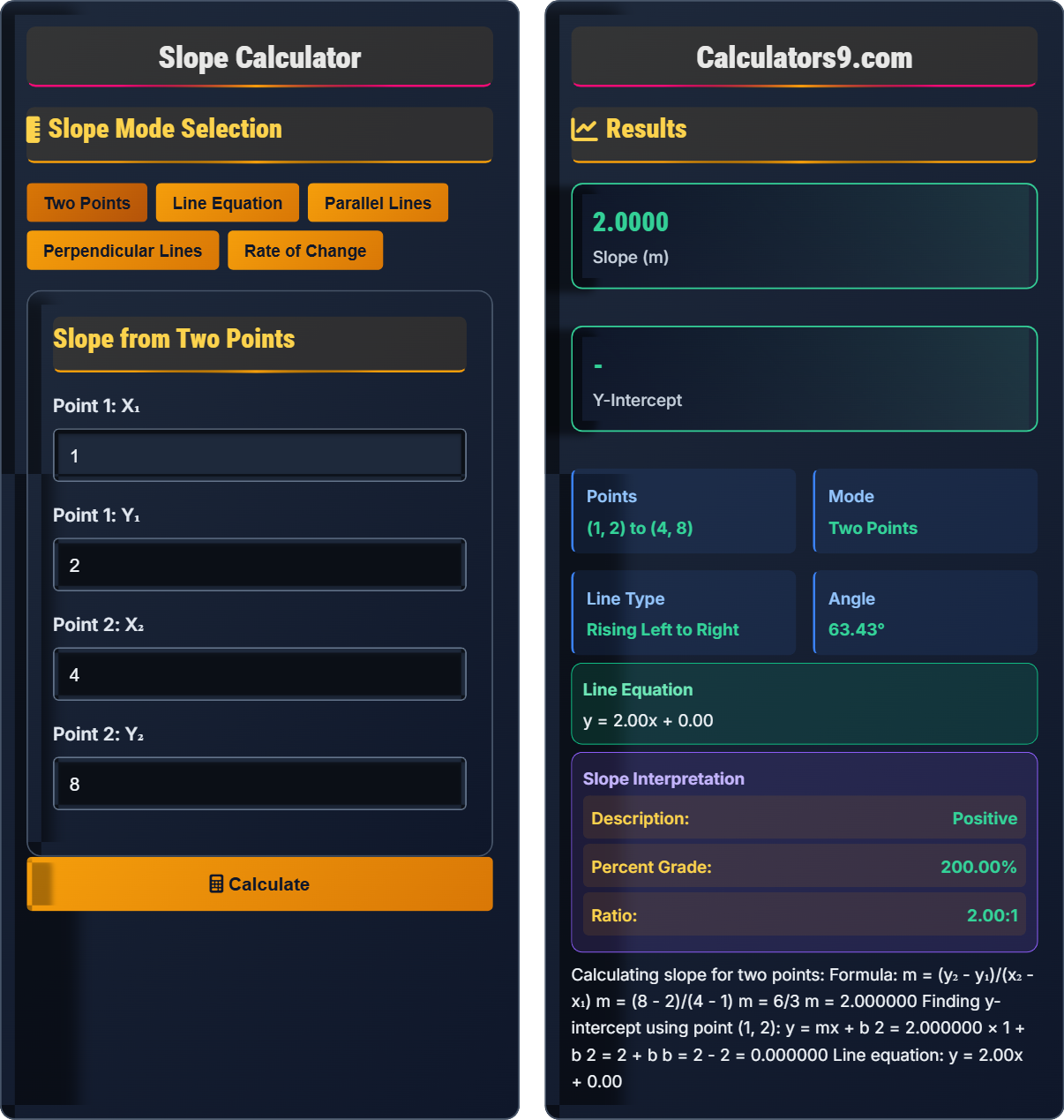
Slope from Two Points
Results
Slope Calculation Guide
Slope is a measure of the steepness and direction of a line. It represents the rate of change of y with respect to x. The slope formula is m = (y₂ - y₁)/(x₂ - x₁), where (x₁, y₁) and (x₂, y₂) are two points on the line.
\( m = \frac{y_2 - y_1}{x_2 - x_1} \)
Where (x₁, y₁) and (x₂, y₂) are two points on the line.
Slope-Intercept: \( y = mx + b \)
Point-Slope: \( y - y_1 = m(x - x_1) \)
- Positive slope: line rises from left to right
- Negative slope: line falls from left to right
- Zero slope: horizontal line
- Undefined slope: vertical line
Slope Calculation Learning Quiz
What is the slope of the line passing through points (2, 3) and (6, 11)?
The answer is B) 2. Using the slope formula: m = (y₂ - y₁)/(x₂ - x₁). Substituting: m = (11 - 3)/(6 - 2) = 8/4 = 2. This means for every 1 unit increase in x, y increases by 2 units.
The slope formula measures the rate of change between two points. It tells us how much y changes for a given change in x. The order of subtraction is important: both the numerator and denominator must use the same order (either (x₂,y₂) - (x₁,y₁) or (x₁,y₁) - (x₂,y₂)), but not mixed.
Slope: Measure of steepness and direction of a line
Rate of Change: How one variable changes with respect to another
Coordinate Plane: Two-dimensional plane with x and y axes
• Slope formula: m = (y₂ - y₁)/(x₂ - x₁)
• Consistent order in numerator and denominator
• Positive slope rises left to right
• Rise over run: (change in y)/(change in x)
• Remember: y₂ - y₁ in numerator
• Check sign of result matches line direction
• Mixing up numerator and denominator order
• Forgetting to subtract coordinates
• Arithmetic errors with negative numbers
Find the equation of the line passing through point (3, 5) with a slope of 2. Write in slope-intercept form.
Step 1: Use point-slope form: y - y₁ = m(x - x₁)
Step 2: Substitute the point (3, 5) and slope m = 2
y - 5 = 2(x - 3)
Step 3: Distribute the slope
y - 5 = 2x - 6
Step 4: Solve for y to get slope-intercept form
y = 2x - 6 + 5
y = 2x - 1
The equation in slope-intercept form is y = 2x - 1.
The point-slope form is useful when we know one point and the slope. We substitute the known values and then rearrange to slope-intercept form (y = mx + b). This form clearly shows the slope and y-intercept, making the line easy to graph and analyze.
Point-Slope Form: y - y₁ = m(x - x₁)
Slope-Intercept Form: y = mx + b
Y-Intercept: Point where line crosses y-axis (when x = 0)
• Point-slope form: y - y₁ = m(x - x₁)
• Slope-intercept form: y = mx + b
• m is the slope, b is the y-intercept
• Use point-slope when you know a point and slope
• Convert to slope-intercept for easy graphing
• The y-intercept is the value of b
• Forgetting to distribute the slope
• Sign errors when subtracting negative numbers
• Not properly isolating y in final step
A car travels 120 miles in 2 hours and then 180 miles in 3 hours. What is the average rate of change (slope) of distance with respect to time for the entire trip? Interpret what this slope means.
Step 1: Identify the two data points
Point 1: (time₁, distance₁) = (2, 120)
Point 2: (time₂, distance₂) = (5, 300) [total time: 2+3=5 hours, total distance: 120+180=300 miles]
Step 2: Calculate the slope (rate of change)
m = (distance₂ - distance₁)/(time₂ - time₁)
m = (300 - 120)/(5 - 2)
m = 180/3 = 60 miles per hour
The average rate of change is 60 mph, meaning the car traveled at an average speed of 60 miles per hour over the entire trip.
In real-world contexts, slope often represents a rate of change. Here, the slope of 60 mph represents the average speed over the entire trip. The rate of change tells us how the dependent variable (distance) changes for each unit change in the independent variable (time). This demonstrates how mathematical concepts apply to practical situations.
Rate of Change: How one quantity changes relative to another
Independent Variable: Variable that is controlled or changed
Dependent Variable: Variable that responds to changes
• Slope represents rate of change in real-world contexts
• Independent variable typically on x-axis
• Dependent variable typically on y-axis
• Identify which variable depends on the other
• Units of slope = units of y ÷ units of x
• Interpret the meaning of the numerical value
• Mixing up independent and dependent variables
• Forgetting to calculate total values when needed
• Not interpreting the units of the slope
Find the equation of a line that is parallel to y = 3x + 5 and passes through the point (2, 7). Then find the equation of a line that is perpendicular to the same line and passes through the same point.
Step 1: Find the parallel line
Parallel lines have the same slope. The given line y = 3x + 5 has slope m = 3.
Using point-slope form with point (2, 7) and slope m = 3:
y - 7 = 3(x - 2)
y - 7 = 3x - 6
y = 3x + 1
Step 2: Find the perpendicular line
Perpendicular lines have slopes that are negative reciprocals. If the original slope is 3, the perpendicular slope is -1/3.
Using point-slope form with point (2, 7) and slope m = -1/3:
y - 7 = -1/3(x - 2)
y - 7 = -1/3x + 2/3
y = -1/3x + 2/3 + 7
y = -1/3x + 23/3
Parallel lines have identical slopes, while perpendicular lines have slopes that are negative reciprocals of each other (their product equals -1). Understanding these relationships is crucial for geometric constructions and analytical geometry. The negative reciprocal relationship comes from the fact that perpendicular lines are rotated 90° from each other.
Parallel Lines: Lines that never intersect, same slope
Perpendicular Lines: Lines that intersect at 90°, negative reciprocal slopes
Negative Reciprocal: -1 divided by the original number
• Parallel lines: m₁ = m₂
• Perpendicular lines: m₁ × m₂ = -1
• Negative reciprocal of a: -1/a
• For parallel lines, use same slope
• For perpendicular lines, flip and change sign
• Verify: m₁ × m₂ should equal -1
• Forgetting that perpendicular slopes are negative reciprocals
• Not flipping the fraction for perpendicular lines
• Sign errors when finding negative reciprocals
Which of the following statements about slope is FALSE?
The answer is C) Negative slope means the line rises from left to right. This statement is false. A negative slope means the line falls from left to right. As x increases, y decreases. A positive slope means the line rises from left to right. Horizontal lines have zero slope (no rise), and vertical lines have undefined slope (division by zero).
Understanding the characteristics of slope is crucial for graphing and analyzing linear functions. The sign of the slope indicates the direction of the line, while the magnitude indicates the steepness. A positive slope means the line moves upward as we read from left to right, while a negative slope means it moves downward. This relationship is fundamental to understanding linear relationships.
Horizontal Line: Line parallel to x-axis, slope = 0
Vertical Line: Line parallel to y-axis, slope undefined
Positive Slope: Line rises from left to right
Negative Slope: Line falls from left to right
• Horizontal line: slope = 0
• Vertical line: slope undefined
• Positive slope: rises left to right
• Negative slope: falls left to right
• Read the line from left to right to determine direction
• Larger absolute value = steeper line
• Zero slope = horizontal line
• Confusing positive and negative slope directions
• Thinking vertical lines have infinite slope (undefined)
• Not recognizing zero slope as horizontal
FAQ
Q: Why do we call it "slope" and how does it relate to real-world applications?
A: The term "slope" comes from the idea of the steepness of a hill or incline. In mathematics, slope measures how steep a line is. Real-world applications include:
- Construction: Roof pitch, road grade, wheelchair accessibility
- Economics: Rate of change in prices, population growth
- Physics: Velocity from position-time graphs
- Engineering: Stress-strain relationships
- Medicine: Rate of drug concentration change
Essentially, any time we want to measure how one quantity changes relative to another, we're looking at a slope.
Q: How is slope used in engineering and data analysis?
A: Slope is fundamental in engineering and data analysis:
- Signal Processing: Slope detects changes in time-series data
- Structural Engineering: Load-deflection relationships
- Thermodynamics: Rate of temperature change
- Machine Learning: Gradient descent algorithms
- Quality Control: Trend analysis in manufacturing
In data analysis, slope represents the rate of change and helps predict future values based on historical trends.