Surface Area Calculator
Cube, rectangular prism, cylinder, sphere • 2026 edition
Surface Area Formulas:
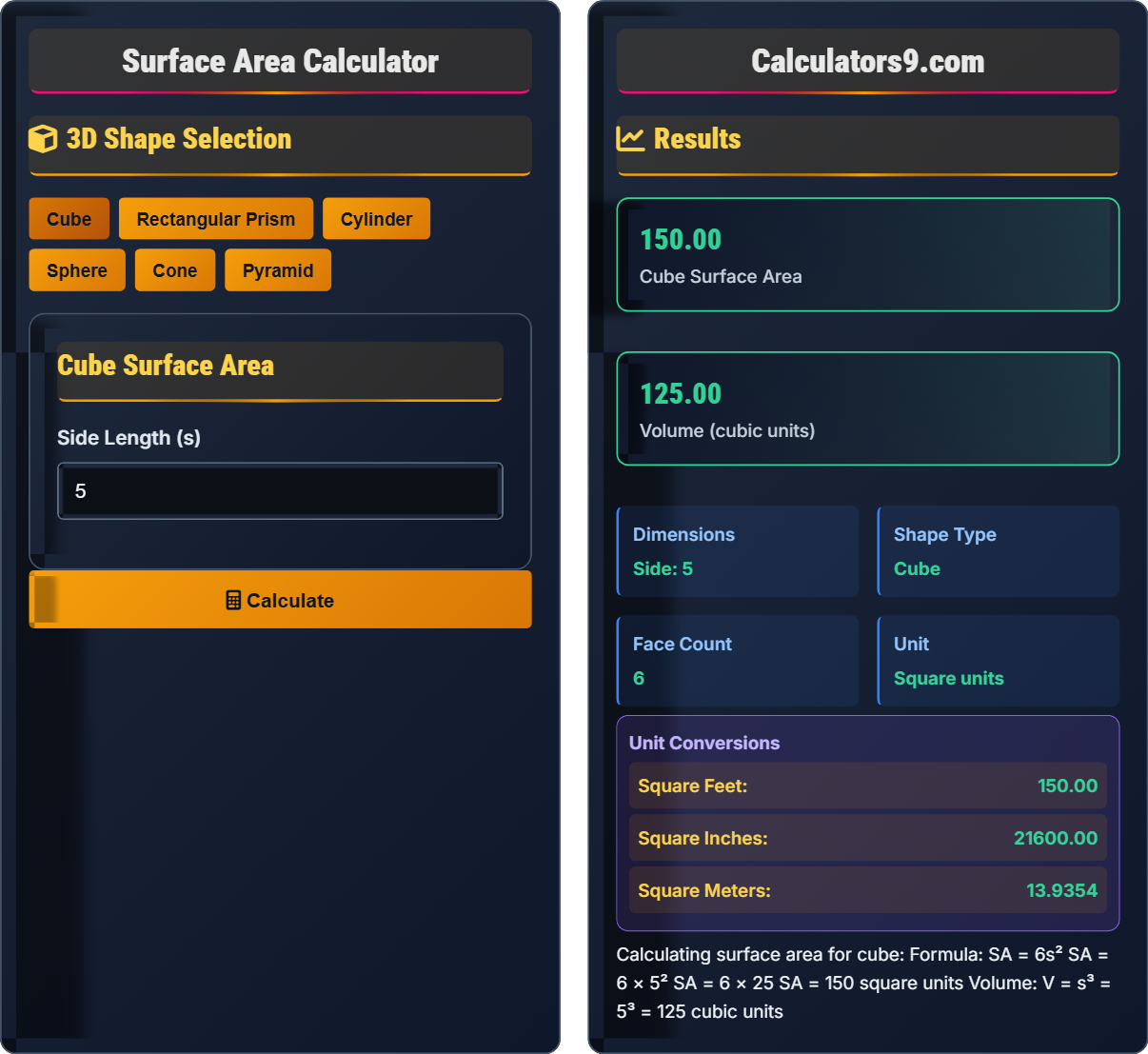
Show the calculatorCube: \( SA = 6s^2 \)
Rectangular Prism: \( SA = 2(lw + lh + wh) \)
Cylinder: \( SA = 2\pi r^2 + 2\pi rh \)
Sphere: \( SA = 4\pi r^2 \)
Cone: \( SA = \pi r^2 + \pi rl \)
Pyramid: \( SA = B + \frac{1}{2}Pl \)
Surface area is the total area of all faces of a three-dimensional object. It measures the extent of the object's surface in square units. Surface area is important in real-world applications like packaging, construction, and heat transfer calculations.
3D Shape Selection
Cube Surface Area
Results
Surface Area Calculation Guide
Surface area is the total area of all the faces or surfaces of a three-dimensional object. It measures the extent of the object's outer surface in square units. Surface area is important in real-world applications such as determining the amount of paint needed to cover an object or the amount of wrapping paper needed to wrap a gift.
\( SA = 6s^2 \)
Where s is the length of one side of the cube.
\( SA = 2(lw + lh + wh) \)
Where l is length, w is width, and h is height.
- Surface area is always positive
- Measured in square units
- Depends on the shape's dimensions
- Represents the total area of all faces
Surface Area Calculation Learning Quiz
What is the surface area of a cube with a side length of 4 units?
The answer is C) 96 square units. The surface area of a cube is calculated using the formula SA = 6s², where s is the length of a side. For a cube with side length 4: SA = 6 × 4² = 6 × 16 = 96 square units. A cube has 6 identical square faces, each with area s².
The surface area of a cube is straightforward because all six faces are identical squares. Since each face has area s², and there are 6 faces, the total surface area is 6s². This is different from volume, which would be s³ for a cube. Surface area measures the total area of all faces, while volume measures the space inside.
Surface Area: Total area of all faces of a 3D object
Cube: 3D shape with 6 identical square faces
Face: Flat surface of a 3D shape
• Surface area of cube: SA = 6s²
• Surface area is always in square units
• Cube has 6 identical faces
• Remember: 6 faces × area of one face
• Each face is a square with area s²
• Surface area is 2D measurement of 3D object
• Confusing surface area with volume
• Forgetting to count all 6 faces
• Using linear units instead of square units
Find the surface area of a rectangular prism with dimensions 6 units × 4 units × 3 units. Show your work using the formula.
Step 1: Identify the dimensions
Length (l) = 6 units, Width (w) = 4 units, Height (h) = 3 units
Step 2: Use the formula for rectangular prism surface area
SA = 2(lw + lh + wh)
Step 3: Calculate the area of each pair of faces
lw = 6 × 4 = 24
lh = 6 × 3 = 18
wh = 4 × 3 = 12
Step 4: Add the areas and multiply by 2
SA = 2(24 + 18 + 12) = 2(54) = 108 square units
A rectangular prism has 6 faces: front/back, left/right, and top/bottom. Each pair of opposite faces has the same area. The formula SA = 2(lw + lh + wh) accounts for this by calculating the area of each unique face and multiplying by 2. This is more efficient than calculating each face individually.
Rectangular Prism: 3D shape with 6 rectangular faces
Opposite Faces: Parallel faces that are identical in size
Dimensions: Length, width, and height of a 3D shape
• Surface area of rectangular prism: SA = 2(lw + lh + wh)
• Has 6 rectangular faces
• Opposite faces are equal
• Remember: 2 × (sum of three unique face areas)
• Draw a net to visualize all faces
• Label dimensions clearly to avoid confusion
• Forgetting to multiply by 2
• Confusing which dimensions correspond to which faces
• Adding dimensions instead of multiplying them
A rectangular storage box has dimensions of 10 feet × 8 feet × 6 feet. If one gallon of paint covers 350 square feet, how many gallons are needed to paint the entire exterior surface of the box? Round up to the nearest whole gallon.
Step 1: Calculate the surface area of the rectangular prism
SA = 2(lw + lh + wh)
SA = 2(10×8 + 10×6 + 8×6)
SA = 2(80 + 60 + 48)
SA = 2(188) = 376 square feet
Step 2: Calculate the number of gallons needed
Gallons = Surface Area ÷ Coverage per gallon
Gallons = 376 ÷ 350 = 1.074 gallons
Step 3: Round up to the nearest whole gallon
Since we need to round up: 2 gallons are required
This problem demonstrates a real-world application of surface area calculation. We first find the total surface area that needs to be painted, then divide by the coverage rate of the paint. Since partial gallons aren't available, we round up to ensure complete coverage. This is an example of how geometry applies to practical situations.
Paint Coverage: Area that can be covered by one unit of paint
Exterior Surface: Outer faces of a 3D object
Practical Applications: Real-world uses of geometric calculations
• Calculate total surface area first
• Divide by coverage rate to find gallons needed
• Always round up when dealing with materials
• Always calculate surface area before determining material needs
• Remember to round up for discrete materials
• Check units match in calculations
• Forgetting to calculate surface area of all faces
• Not rounding up to the next whole unit
• Using volume instead of surface area
A cylindrical water tank has a radius of 3 feet and a height of 8 feet. If the tank needs to be painted both inside and outside (including the top and bottom), what is the total surface area that needs to be painted? Use π ≈ 3.14.
Step 1: Calculate the surface area of the outside of the cylinder
SA_outside = 2πr² + 2πrh
SA_outside = 2π(3)² + 2π(3)(8)
SA_outside = 2π(9) + 2π(24)
SA_outside = 18π + 48π = 66π square feet
Step 2: Calculate the surface area of the inside of the cylinder
Assuming negligible wall thickness, the inside surface area is the same as outside
SA_inside = 66π square feet
Step 3: Calculate the total surface area to be painted
SA_total = SA_outside + SA_inside = 66π + 66π = 132π square feet
SA_total = 132 × 3.14 = 414.48 square feet
This problem requires understanding the components of a cylinder's surface area: two circular bases (top and bottom) and the curved lateral surface. The formula SA = 2πr² + 2πrh accounts for both bases (2πr²) and the lateral surface (2πrh). Since both inside and outside surfaces need painting, we double the surface area.
Cylinder: 3D shape with two parallel circular bases connected by a curved surface
Lateral Surface: Curved side surface of a 3D shape
Circular Bases: Top and bottom circular faces of a cylinder
• Surface area of cylinder: SA = 2πr² + 2πrh
• 2πr² = area of both circular bases
• 2πrh = area of lateral surface
• Remember: two circular bases + curved side
• Lateral surface area = circumference × height
• When painting inside and outside, double the surface area
• Forgetting to include both circular bases
• Using volume formula instead of surface area
• Not accounting for both inside and outside surfaces
Which of the following formulas correctly calculates the surface area of a sphere?
The answer is B) SA = 4πr². The surface area of a sphere is four times the area of a circle with the same radius. This formula comes from calculus, but intuitively, it represents the total area of the spherical surface. Note that this is different from the volume of a sphere, which is (4/3)πr³.
The surface area of a sphere is 4πr², which is exactly four times the area of a circle with the same radius. This is a fundamental formula in geometry. The sphere is unique among 3D shapes because its surface area formula involves the square of the radius, just like a circle's area formula, but with a coefficient of 4. This relationship is important in physics and engineering.
Sphere: 3D shape where all points are equidistant from center
Surface Area: Total area of the outer surface
Radius: Distance from center to any point on the surface
• Surface area of sphere: SA = 4πr²
• Volume of sphere: V = (4/3)πr³
• Surface area is in square units
• Remember: 4 times the area of a circle
• Surface area = 4πr², volume = (4/3)πr³
• Sphere has the smallest surface area for a given volume
• Confusing surface area with volume formula
• Forgetting the coefficient of 4
• Using cubic units instead of square units
FAQ
Q: How is surface area different from volume?
A: Surface area and volume are both measurements of 3D objects but represent different properties:
- Surface Area: Measures the total area of all faces/surfaces of an object (square units)
- Volume: Measures the space inside an object (cubic units)
Think of surface area as how much wrapping paper you'd need to cover an object, while volume is how much candy fits inside it.
Q: How is surface area used in engineering and manufacturing?
A: Surface area is critical in many engineering applications:
- Heat Transfer: Surface area affects cooling and heating rates
- Material Coatings: Determines amount of paint, insulation, or protective coating needed
- Fluid Dynamics: Surface area influences drag and friction
- Chemical Reactions: More surface area = faster reaction rates
- Manufacturing: Packaging, containers, and structural components
Accurate surface area calculations are essential for cost estimation and performance optimization.