Triangle Calculator
Advanced geometry calculations • 2026 edition
Triangle Formulas:
Show the calculatorArea: \( A = \frac{1}{2}bh \) or \( A = \sqrt{s(s-a)(s-b)(s-c)} \) (Heron's formula)
Perimeter: \( P = a + b + c \)
Pythagorean Theorem: \( a^2 + b^2 = c^2 \) (for right triangles)
Law of Cosines: \( c^2 = a^2 + b^2 - 2ab\cos(C) \)
Law of Sines: \( \frac{a}{\sin(A)} = \frac{b}{\sin(B)} = \frac{c}{\sin(C)} \)
Sum of Angles: \( A + B + C = 180° \)
Triangles are fundamental geometric shapes with three sides and three angles. The area can be calculated using base and height or Heron's formula when all three sides are known. Right triangles follow the Pythagorean theorem, while oblique triangles require the Law of Cosines or Sines for calculations.
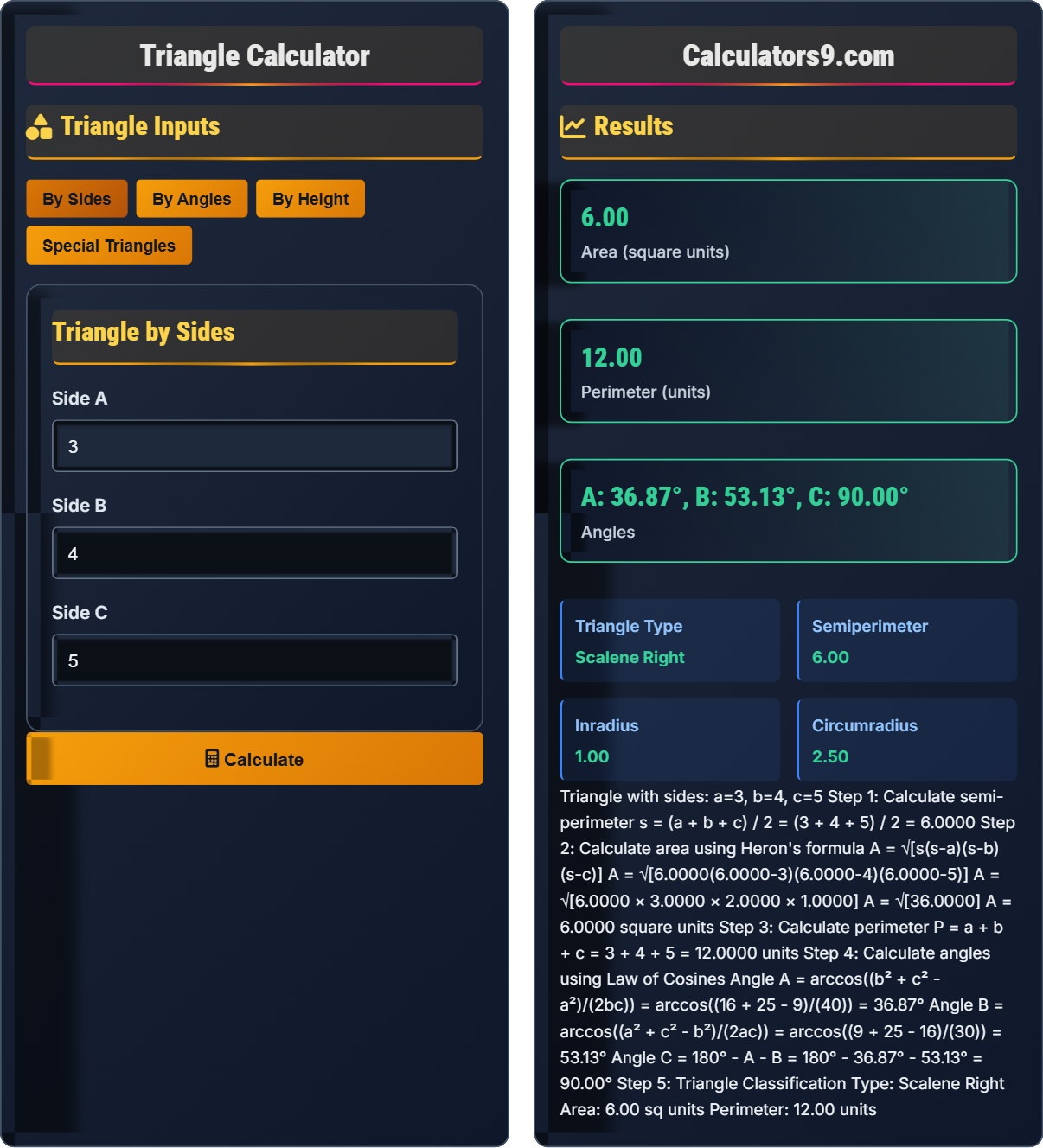
Triangle Inputs
Triangle by Sides
Results
Triangle Geometry Guide
A triangle is a polygon with three edges and three vertices. It's one of the basic shapes in geometry. Any three non-collinear points determine a unique triangle and a unique plane.
\( A = \frac{1}{2}bh \) or \( A = \sqrt{s(s-a)(s-b)(s-c)} \)
Where s is the semiperimeter: \( s = \frac{a+b+c}{2} \)
\( a^2 + b^2 = c^2 \)
Applies to right triangles where c is the hypotenuse.
- Sum of interior angles = 180°
- Triangle inequality: sum of any two sides > third side
- Right triangles follow Pythagorean theorem
- Area = ½ × base × height
Triangle Geometry Learning Quiz
A triangle has sides measuring 5 cm, 5 cm, and 8 cm. What type of triangle is this?
The answer is B) Isosceles. An isosceles triangle has at least two sides of equal length. In this case, two sides measure 5 cm each, making it isosceles. An equilateral triangle would have all three sides equal, a scalene triangle would have all sides different, and a right triangle would satisfy the Pythagorean theorem.
Triangle classification is based on both side lengths and angle measures. By sides: equilateral (all equal), isosceles (two equal), scalene (all different). By angles: acute (all < 90°), right (one = 90°), obtuse (one > 90°). Understanding these classifications helps identify triangle properties and applicable formulas.
Equilateral Triangle: All three sides are equal
Isosceles Triangle: At least two sides are equal
Scalene Triangle: All three sides are different
Right Triangle: One angle measures exactly 90°
• Triangle inequality: sum of any two sides > third side
• Sum of interior angles = 180°
• Isosceles triangles have equal angles opposite equal sides
• Count equal sides to classify by sides
• Use the longest side to check for right triangles (Pythagorean theorem)
• Remember: equal sides → equal angles opposite
• Confusing isosceles with equilateral triangles
• Assuming all equal angles mean equal sides (true for triangles)
• Forgetting to verify triangle inequality
Find the area of a triangle with sides measuring 6 cm, 8 cm, and 10 cm. Show your work using Heron's formula.
Step 1: Identify the sides: a = 6, b = 8, c = 10
Step 2: Calculate the semiperimeter: s = (a + b + c)/2 = (6 + 8 + 10)/2 = 12
Step 3: Apply Heron's formula: A = √[s(s-a)(s-b)(s-c)]
A = √[12(12-6)(12-8)(12-10)]
A = √[12 × 6 × 4 × 2]
A = √[576]
A = 24 cm²
Alternative verification: Since 6² + 8² = 36 + 64 = 100 = 10², this is a right triangle. Area = ½ × 6 × 8 = 24 cm² ✓
Heron's formula is valuable when we know all three sides but not the height. It's derived from the law of cosines and the basic area formula. For a triangle with sides a, b, and c, the semiperimeter s = (a+b+c)/2, and the area A = √[s(s-a)(s-b)(s-c)]. This formula works for any valid triangle.
Semiperimeter: Half the perimeter of a triangle (s = (a+b+c)/2)
Heron's Formula: A = √[s(s-a)(s-b)(s-c)] for area calculation
Right Triangle: Triangle with one 90° angle
• Heron's formula requires all three sides
• Semiperimeter is half the perimeter
• Area is always positive
• Check if it's a right triangle first (may be easier)
• Calculate s first, then each (s-x) term
• Verify with alternative method when possible
• Forgetting to take the square root at the end
• Miscalculating the semiperimeter
• Using negative values under the square root (invalid triangle)
A triangular garden has sides measuring 15 feet, 20 feet, and 25 feet. If grass seed covers 100 square feet per bag, how many bags are needed to cover the entire garden? Round up to the nearest whole bag.
Step 1: Calculate the area using Heron's formula
s = (15 + 20 + 25)/2 = 30
A = √[30(30-15)(30-20)(30-25)]
A = √[30 × 15 × 10 × 5]
A = √[22,500]
A = 150 square feet
Step 2: Calculate number of bags needed
Bags needed = 150/100 = 1.5
Since we need to round up: 2 bags are required
This problem combines geometric calculation with a practical application. First, we calculate the area of the triangular garden using Heron's formula. Then we divide by the coverage rate to find the number of bags needed. The requirement to round up reflects real-world constraints where partial units aren't available.
Coverage Rate: Area covered per unit of material
Rounding Up: Using the next highest integer when dealing with discrete items
Practical Constraints: Real-world limitations affecting mathematical solutions
• Calculate area before determining material needs
• Always round up when materials come in discrete units
• Verify triangle validity using triangle inequality
• Check if it's a right triangle (15-20-25 is 3-4-5 scaled by 5)
• For right triangles: Area = ½ × 15 × 20 = 150 (same result)
• Always consider practical constraints in word problems
• Forgetting to round up when dealing with discrete items
• Using the wrong area formula for irregular triangles
• Not checking if the given sides form a valid triangle
A ladder leans against a wall, forming a 60° angle with the ground. If the ladder is 12 feet long, how far is the base of the ladder from the wall? What is the height where the ladder touches the wall? Identify the type of triangle formed.
The setup forms a right triangle with a 60° angle, making it a 30-60-90 triangle (since 90° + 60° + 30° = 180°).
In a 30-60-90 triangle, sides are in the ratio 1 : √3 : 2
The ladder (hypotenuse) = 12 feet
Side opposite 30° (base distance) = 12/2 = 6 feet
Side opposite 60° (wall height) = 6√3 ≈ 10.39 feet
Triangle type: Right triangle (specifically 30-60-90 special right triangle)
Special right triangles have specific angle and side ratios that make calculations easier. The 30-60-90 triangle has sides in the ratio 1:√3:2, while the 45-45-90 triangle has sides in the ratio 1:1:√2. Recognizing these special triangles can simplify trigonometric calculations significantly.
Special Right Triangle: Right triangle with specific angle measures
30-60-90 Triangle: Sides in ratio 1:√3:2
45-45-90 Triangle: Sides in ratio 1:1:√2
• 30-60-90: shortest side (30°) : middle side (60°) : hypotenuse (90°) = 1:√3:2
• 45-45-90: legs : hypotenuse = 1:1:√2
• These ratios are always consistent
• Memorize the ratios for 30-60-90 and 45-45-90 triangles
• Identify the hypotenuse first (longest side, opposite 90°)
• Use the known side to find the scaling factor
• Confusing which side corresponds to which angle in special triangles
• Forgetting that √3 ≈ 1.732 for approximations
• Not recognizing special triangles when they appear
Which of the following sets of lengths CAN form a triangle?
The answer is C) 5, 12, 13. For a valid triangle, the sum of any two sides must be greater than the third side (Triangle Inequality Theorem). Checking each option:
A) 2 + 3 = 5 < 6 ❌
B) 4 + 5 = 9 = 9 (not greater) ❌
C) 5 + 12 = 17 > 13, 5 + 13 = 18 > 12, 12 + 13 = 25 > 5 ✅
D) 1 + 1 = 2 < 3 ❌
As a bonus, 5-12-13 is a Pythagorean triple (5² + 12² = 13²).
The triangle inequality theorem is fundamental: the sum of the lengths of any two sides of a triangle must be greater than the length of the third side. This ensures that the three sides can actually meet to form a closed figure. This principle prevents impossible triangles where one side is too long relative to the others.
Triangle Inequality Theorem: Sum of any two sides > third side
Pythagorean Triple: Three integers that satisfy a² + b² = c²
Valid Triangle: Three lengths that satisfy the triangle inequality
• Must satisfy triangle inequality for ALL three combinations
• a + b > c AND a + c > b AND b + c > a
• Equality does not satisfy the theorem
• Always check all three combinations
• Focus on the largest side - it's most likely to violate the inequality
• Remember: sum must be STRICTLY greater, not equal
• Only checking one combination instead of all three
• Accepting equality (a + b ≥ c) instead of strict inequality
• Forgetting to check if the triangle is degenerate
FAQ
Q: When should I use Heron's formula vs the basic area formula?
A: Use the basic area formula (A = ½bh) when you know the base and height of the triangle. This is the simplest method when applicable.
Use Heron's formula (A = √[s(s-a)(s-b)(s-c)]) when you know all three sides but not the height. This is particularly useful in problems where only side lengths are given.
For example, if you're given sides 3, 4, 5: use Heron's. If you're given a base of 6 and height of 4: use A = ½bh.
Q: How are triangles used in structural engineering?
A: Triangles are fundamental in structural engineering due to their inherent stability:
- Trusses: Bridge and roof structures use triangular trusses which distribute loads efficiently
- Stability: Unlike rectangles, triangles cannot be deformed without changing side lengths
- Force Distribution: Loads applied to a joint are distributed along the sides according to trigonometric principles
- Space Frames: Complex 3D structures built from interconnected triangles
This is why you see triangular supports in bridges, towers, and cranes.