Volume Calculator
Cube, rectangular prism, cylinder, sphere • 2026 edition
Volume Formulas:
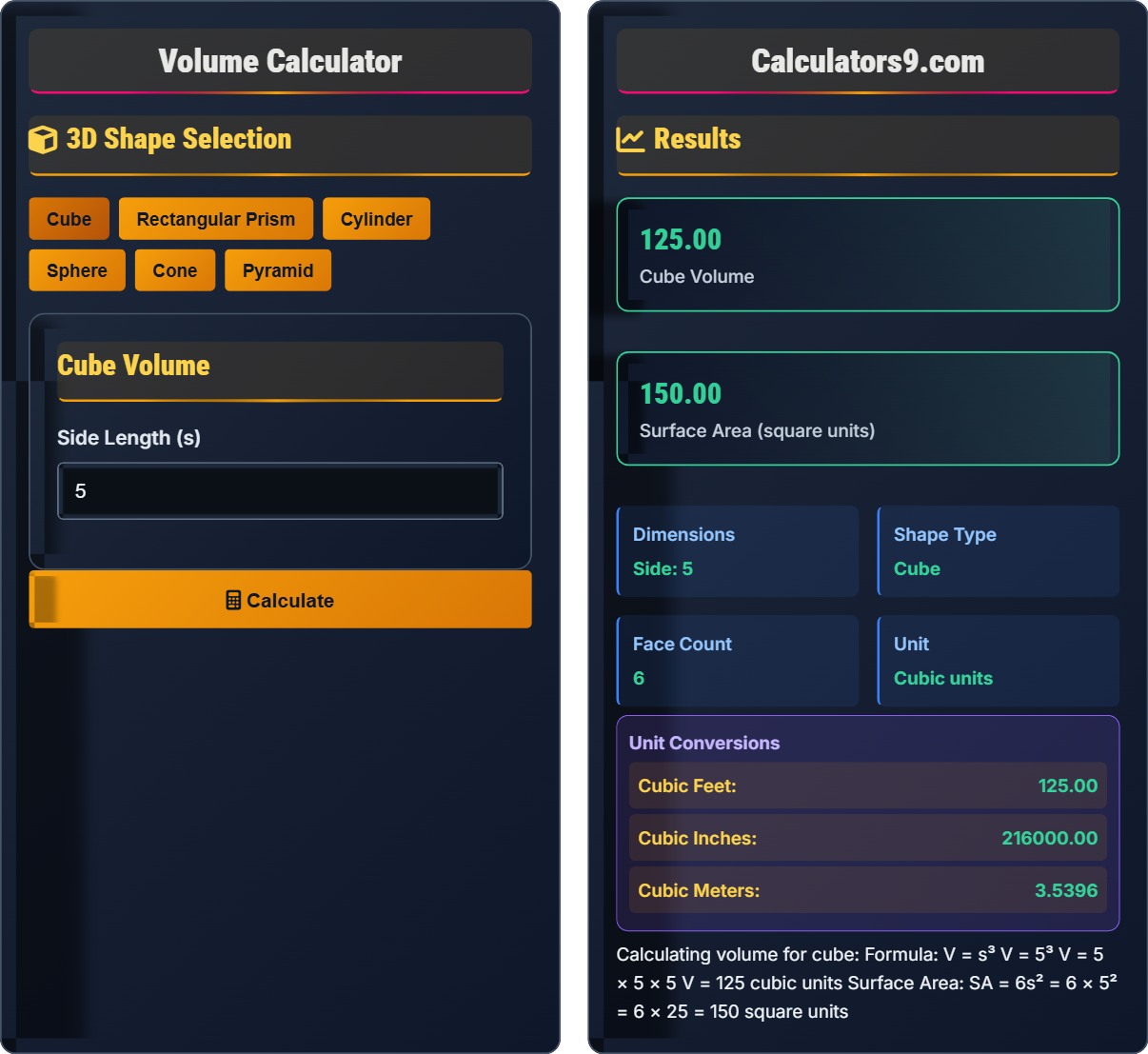
Show the calculatorCube: \( V = s^3 \)
Rectangular Prism: \( V = l \times w \times h \)
Cylinder: \( V = \pi r^2 h \)
Sphere: \( V = \frac{4}{3}\pi r^3 \)
Cone: \( V = \frac{1}{3}\pi r^2 h \)
Pyramid: \( V = \frac{1}{3}Bh \)
Volume is the measure of the space occupied by a three-dimensional object. It quantifies the capacity of a shape in cubic units. Volume calculations are essential in engineering, construction, and scientific applications.
3D Shape Selection
Cube Volume
Results
Volume Calculation Guide
Volume is the measure of the space occupied by a three-dimensional object. It quantifies the capacity of a shape in cubic units. Volume is important in real-world applications such as determining how much liquid a container can hold or how much material is needed to construct an object.
\( V = s^3 \)
Where s is the length of one side of the cube.
\( V = l \times w \times h \)
Where l is length, w is width, and h is height.
- Volume is always positive
- Measured in cubic units
- Depends on the shape's dimensions
- Represents the space inside the object
Volume Calculation Learning Quiz
What is the volume of a cube with a side length of 3 units?
The answer is C) 27 cubic units. The volume of a cube is calculated using the formula V = s³, where s is the length of a side. For a cube with side length 3: V = 3³ = 3 × 3 × 3 = 27 cubic units. This represents how many unit cubes fit inside the larger cube.
The volume of a cube is straightforward because all three dimensions are equal. Since volume is length × width × height, and all three are the same (s), the volume is s × s × s = s³. This is different from surface area, which would be 6s² for a cube. Volume measures the space inside, while surface area measures the outer surface.
Volume: Measure of space inside a 3D object
Cube: 3D shape with 6 identical square faces
Cubic Units: Units for measuring volume
• Volume of cube: V = s³
• Volume is always in cubic units
• Cube has all equal dimensions
• Remember: s³ means s × s × s
• Volume is 3D measurement
• Cube volume is side length cubed
• Confusing volume with surface area
• Forgetting to cube the side length
• Using square units instead of cubic units
Find the volume of a rectangular prism with dimensions 7 units × 4 units × 3 units. Show your work using the formula.
Step 1: Identify the dimensions
Length (l) = 7 units, Width (w) = 4 units, Height (h) = 3 units
Step 2: Use the formula for rectangular prism volume
V = l × w × h
Step 3: Substitute the values
V = 7 × 4 × 3
Step 4: Calculate the volume
V = 28 × 3 = 84 cubic units
The volume of a rectangular prism is calculated by multiplying its three dimensions: length, width, and height. This formula makes intuitive sense because it tells us how many unit cubes fit inside the prism. The order of multiplication doesn't matter due to the commutative property of multiplication.
Rectangular Prism: 3D shape with 6 rectangular faces
Dimensions: Length, width, and height of a 3D shape
Unit Cubes: Cubes with side length of 1 unit
• Volume of rectangular prism: V = lwh
• Volume is in cubic units
• Order of multiplication doesn't matter
• Always multiply length × width × height
• Check units match in calculation
• Remember: volume is 3D measurement
• Adding dimensions instead of multiplying
• Forgetting one of the three dimensions
• Using square units instead of cubic units
A cylindrical water tank has a radius of 4 feet and a height of 10 feet. If 1 cubic foot of water equals approximately 7.48 gallons, how many gallons of water can the tank hold? Use π ≈ 3.14.
Step 1: Calculate the volume of the cylinder
V = πr²h
V = π × 4² × 10
V = π × 16 × 10
V = 160π cubic feet
V ≈ 160 × 3.14 ≈ 502.4 cubic feet
Step 2: Convert cubic feet to gallons
Gallons = Volume × Conversion Factor
Gallons = 502.4 × 7.48 ≈ 3,757.95 gallons
The tank can hold approximately 3,758 gallons of water.
This problem demonstrates how volume calculations apply to real-world situations. We first find the volume of the cylinder using the formula V = πr²h, then convert from cubic feet to gallons using the given conversion factor. This shows how geometry connects to practical applications like determining tank capacity.
Cylindrical Tank: Container shaped like a cylinder
Capacity: Maximum amount a container can holdConversion Factor: Multiplier to convert between units
• Volume of cylinder: V = πr²h
• Convert units by multiplying by conversion factor
• Volume determines capacity of containers
• Always calculate volume first
• Use accurate value of π for precise calculations
• Check units in conversion factors
• Using diameter instead of radius in formula
• Forgetting to square the radius
• Incorrect conversion between units
A construction company needs to pour concrete for a foundation that is 30 feet long, 20 feet wide, and 2 feet deep. If concrete costs $120 per cubic yard, how much will the concrete cost? (Note: 1 cubic yard = 27 cubic feet)
Step 1: Calculate the volume of the rectangular foundation
V = length × width × depth
V = 30 × 20 × 2 = 1,200 cubic feet
Step 2: Convert cubic feet to cubic yards
Since 1 cubic yard = 27 cubic feet:
Volume in cubic yards = 1,200 ÷ 27 ≈ 44.44 cubic yards
Step 3: Calculate the cost
Cost = Volume × Price per cubic yard
Cost = 44.44 × $120 ≈ $5,332.80
The concrete will cost approximately $5,333.
This problem combines volume calculation with unit conversion and cost determination. First, we calculate the volume in cubic feet using V = lwh. Then we convert to cubic yards because concrete is priced per cubic yard. Finally, we multiply the volume by the price per unit to find the total cost. This demonstrates how volume calculations are used in construction and business.
Foundation: Base structure supporting a building
Cubic Yard: Unit of volume equal to 27 cubic feet
Cost Calculation: Multiplying quantity by price per unit
• 1 cubic yard = 27 cubic feet
• Volume = length × width × depth
• Cost = Volume × Price per unit volume
• Always calculate volume first
• Pay attention to units when converting
• Round up for materials to ensure enough
• Forgetting to convert between cubic feet and cubic yards
• Using wrong conversion factor
• Not accounting for waste in material calculations
Which of the following formulas correctly calculates the volume of a sphere?
The answer is C) V = (4/3)πr³. The volume of a sphere is calculated using this formula, where r is the radius. This formula comes from calculus, but it represents the space inside a spherical object. Note that this is different from the surface area of a sphere, which is 4πr².
The volume of a sphere is (4/3)πr³, which is different from the surface area formula 4πr². The volume formula has r³ because volume is a three-dimensional measurement, while surface area has r² because it's a two-dimensional measurement. The coefficient (4/3) is a mathematical constant that arises from integrating the area of circular cross-sections of the sphere.
Sphere: 3D shape where all points are equidistant from center
Volume: Space inside a 3D object
Surface Area: Area of the outer surface
• Volume of sphere: V = (4/3)πr³
• Surface area of sphere: SA = 4πr²
• Volume is in cubic units
• Remember: (4/3)πr³ for volume
• 4πr² for surface area
• Volume is 3D, so r³; surface area is 2D, so r²
• Confusing volume with surface area formula
• Forgetting the coefficient (4/3)
• Using cubic units for surface area
FAQ
Q: How is volume different from surface area?
A: Volume and surface area are both measurements of 3D objects but represent different properties:
- Volume: Measures the space inside an object (cubic units)
- Surface Area: Measures the total area of all faces/surfaces (square units)
Think of volume as how much water fills a container, while surface area is how much wrapping paper you'd need to cover it.
Q: How is volume used in engineering and manufacturing?
A: Volume calculations are essential in engineering:
- Fluid Systems: Determining pipe capacities and tank sizes
- Structural Design: Calculating material requirements
- Manufacturing: Mold design and material usage
- Heat Transfer: Volume affects thermal properties
- Transportation: Cargo capacity calculations
Accurate volume calculations are critical for cost estimation and system performance.