Pythagorean Calculator
Right Triangle Solver • 2026 Edition
Pythagorean Theorem:
Show the calculator\( c^2 = a^2 + b^2 \)
Where:
- \( c \) = Hypotenuse (longest side, opposite the right angle)
- \( a, b \) = Legs of the right triangle (adjacent to the right angle)
- \( a^2 + b^2 = c^2 \) (sum of squares of legs equals square of hypotenuse)
This fundamental theorem in Euclidean geometry states that in a right triangle, the square of the hypotenuse equals the sum of squares of the other two sides. It's used to find missing side lengths when two sides are known, and forms the basis for distance calculations in coordinate geometry.
Example: For a right triangle with legs of length 3 and 4:
\( c^2 = 3^2 + 4^2 = 9 + 16 = 25 \)
\( c = \sqrt{25} = 5 \)
Therefore, the hypotenuse is 5 units long.
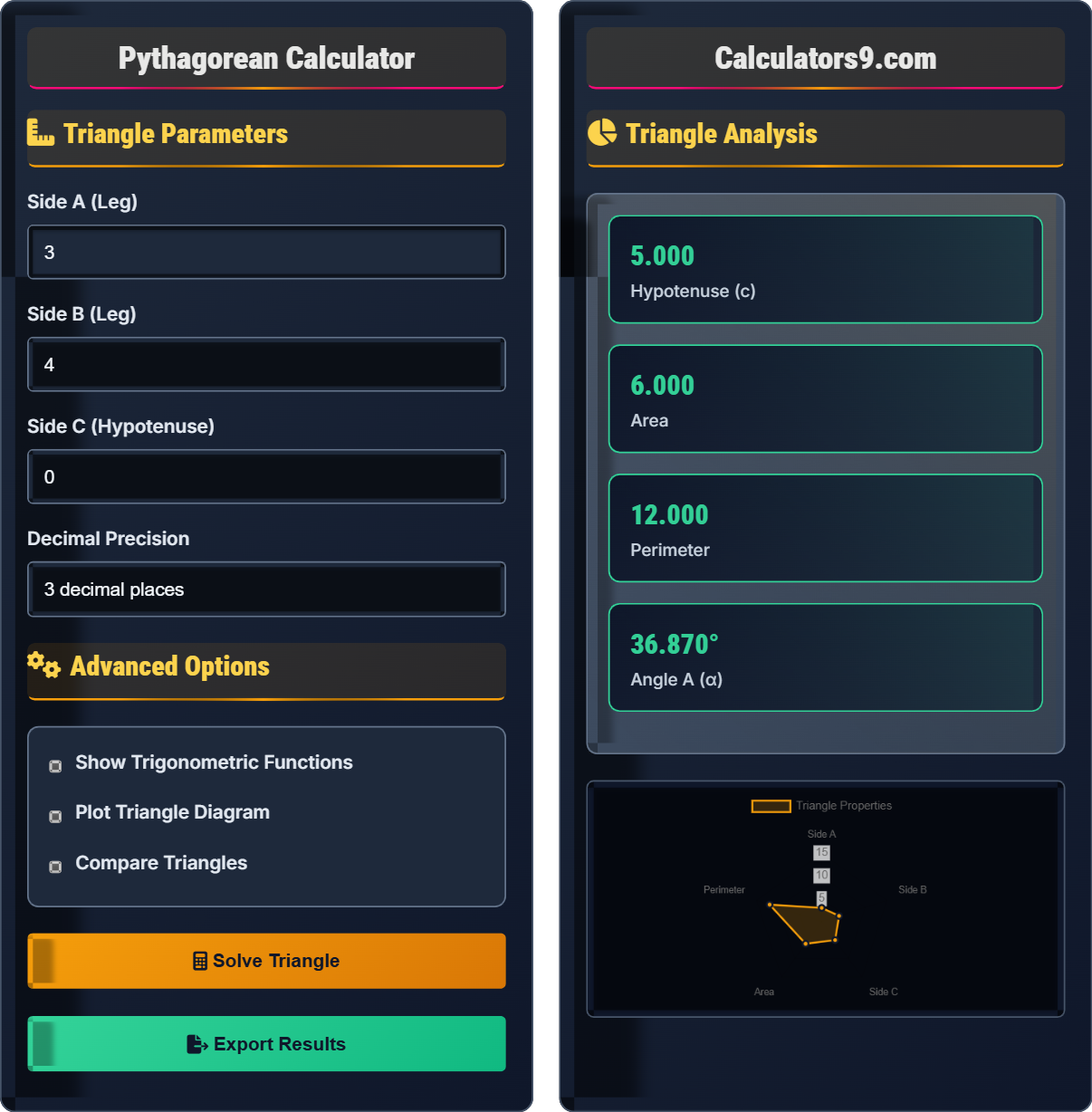
Triangle Parameters
Advanced Options
Triangle Analysis
| Property | Value | Formula |
|---|---|---|
| Side A | 3.000 | Given |
| Side B | 4.000 | Given |
| Side C (Hypotenuse) | 5.000 | √(a² + b²) |
| Area | 6.000 | (a × b) / 2 |
| Perimeter | 12.000 | a + b + c |
| Height to Hypotenuse | 2.400 | (a × b) / c |
| Function | Angle A | Angle B |
|---|---|---|
| Sine | 0.600 | 0.800 |
| Cosine | 0.800 | 0.600 |
| Tangent | 0.750 | 1.333 |
| Angle (degrees) | 36.870° | 53.130° |
| Angle (radians) | 0.644 rad | 0.927 rad |
Comprehensive Pythagorean Theorem Guide
The Pythagorean Theorem is one of the fundamental theorems in Euclidean geometry. It states that in a right triangle, the square of the hypotenuse (the side opposite the right angle) is equal to the sum of the squares of the other two sides (legs). This relationship has been known for over 2,500 years and is attributed to the ancient Greek mathematician Pythagoras, though evidence suggests it was known earlier.
The standard formula is:
Where:
- c = length of hypotenuse (longest side)
- a, b = lengths of the other two sides (legs)
- All sides must be measured in the same units
Pythagorean triples are sets of three positive integers (a, b, c) that satisfy the equation a² + b² = c². Common examples include:
- 3-4-5: The simplest and most well-known triple
- 5-12-13: Another common triple
- 8-15-17: A larger example
- 7-24-25: Also valid
These triples are useful for creating right triangles with integer side lengths, which simplifies calculations.
- Converse: If a² + b² = c², then the triangle is a right triangle
- Acute Triangle: If a² + b² > c², then the triangle is acute
- Obtuse Triangle: If a² + b² < c², then the triangle is obtuse
- 3D Version: For rectangular prisms: d² = l² + w² + h²
Pythagorean Theorem Learning Quiz
In a right triangle, if one leg is 6 units and the other leg is 8 units, what is the length of the hypotenuse?
The answer is B) 10 units. Using the Pythagorean theorem: c² = a² + b²
Step 1: c² = 6² + 8²
Step 2: c² = 36 + 64 = 100
Step 3: c = √100 = 10
Therefore, the hypotenuse is 10 units long.
This is a classic 6-8-10 Pythagorean triple, which is a scaled version of the 3-4-5 triple. The Pythagorean theorem is fundamental in geometry and is used to find the missing side of a right triangle when two sides are known. It's important to remember that this only applies to right triangles.
Hypotenuse: The longest side of a right triangle, opposite the right angle
Legs: The two shorter sides of a right triangle
Pythagorean Triple: Three integers that satisfy the Pythagorean equation
• Only applies to right triangles
• Hypotenuse is always the longest side
• Use the formula: c² = a² + b²
• Memorize common Pythagorean triples (3-4-5, 5-12-13)
• Always identify the hypotenuse first
• Check your answer by plugging back into the formula
• Using the wrong side as the hypotenuse
• Forgetting to take the square root
• Applying to non-right triangles
A right triangle has a hypotenuse of 13 units and one leg of 5 units. Find the length of the other leg. Show your work.
Using the Pythagorean theorem: c² = a² + b²
Step 1: Identify known values: c = 13, a = 5, find b
Step 2: Rearrange formula: b² = c² - a²
Step 3: Substitute: b² = 13² - 5² = 169 - 25 = 144
Step 4: Calculate: b = √144 = 12
Therefore, the other leg is 12 units long.
This problem requires rearranging the Pythagorean theorem to solve for a missing leg. When the hypotenuse and one leg are known, subtract the square of the known leg from the square of the hypotenuse, then take the square root. This is another Pythagorean triple: 5-12-13.
Rearranging Equations: Isolating the unknown variable
Square Root: The number that multiplies by itself to give the original number
Right Triangle: A triangle with one 90° angle
• When solving for a leg: b² = c² - a²
• When solving for hypotenuse: c² = a² + b²
• Always take the positive square root for lengths
• Remember: hypotenuse is always the largest side
• Use algebra to isolate the unknown
• Check: 5² + 12² = 25 + 144 = 169 = 13²
• Subtracting the wrong way (a² - c² instead of c² - a²)
• Forgetting to take the square root
• Using negative square root
A ladder is placed against a wall. The base of the ladder is 5 feet from the wall, and the top of the ladder reaches 12 feet up the wall. How long is the ladder?
The ladder, wall, and ground form a right triangle where the ladder is the hypotenuse.
Step 1: Identify the legs: a = 5 feet (distance from wall), b = 12 feet (height on wall)
Step 2: Apply Pythagorean theorem: c² = a² + b²
Step 3: Calculate: c² = 5² + 12² = 25 + 144 = 169
Step 4: Find hypotenuse: c = √169 = 13
Therefore, the ladder is 13 feet long.
This word problem demonstrates a common real-world application of the Pythagorean theorem. The key is recognizing that the situation forms a right triangle. The ladder acts as the hypotenuse, the distance from the wall is one leg, and the height up the wall is the other leg. This is the classic 5-12-13 Pythagorean triple.
Right Triangle Formation: Wall perpendicular to ground
Practical Application: Real-world problem solving
Pythagorean Triple: Integer solution to the equation
• Identify the right angle in the problem
• Determine which sides are the legs and hypotenuse
• Apply the formula correctly
• Draw a diagram to visualize the problem
• Label known sides and identify the unknown
• Verify the triangle is right-angled
• Misidentifying the hypotenuse
• Not recognizing the right triangle formation
• Forgetting to check if the answer is reasonable
What is the distance from one corner of a rectangular box measuring 3 units by 4 units by 5 units to the opposite corner (through the interior of the box)?
For a rectangular prism, the 3D diagonal is calculated using: d² = l² + w² + h²
Step 1: Identify dimensions: l = 3, w = 4, h = 5
Step 2: Apply 3D Pythagorean theorem: d² = 3² + 4² + 5²
Step 3: Calculate: d² = 9 + 16 + 25 = 50
Step 4: Find diagonal: d = √50 = √(25×2) = 5√2 ≈ 7.071
Therefore, the diagonal distance is approximately 7.071 units.
This problem extends the Pythagorean theorem to three dimensions. First, find the diagonal of the base using the 2D theorem, then use that diagonal and the height to find the 3D diagonal. Alternatively, the direct formula d² = l² + w² + h² gives the same result. This concept is important in 3D geometry and vector mathematics.
3D Diagonal: Line connecting opposite vertices in 3D shape
Rectangular Prism: 3D shape with rectangular faces
Extended Pythagorean: Theorem applied to 3D space
• 3D diagonal: d² = l² + w² + h²
• Apply 2D theorem twice for step-by-step approach
• All dimensions must be perpendicular
• Think of it as applying the theorem in 3 dimensions
• Can be done in one step or two steps
• Works for any rectangular 3D shape
• Only using 2D Pythagorean theorem
• Forgetting the height component
• Not simplifying radical expressions
Which of the following sets of side lengths forms a right triangle?
The answer is B) 5, 12, 13. To check if a triangle is a right triangle, verify if a² + b² = c² where c is the longest side.
Option A: 4² + 5² = 16 + 25 = 41 ≠ 36 = 6² (not right)
Option B: 5² + 12² = 25 + 144 = 169 = 13² (right triangle)
Option C: 6² + 8² = 36 + 64 = 100 ≠ 121 = 11² (not right)
Option D: 7² + 9² = 49 + 81 = 130 ≠ 144 = 12² (not right)
Only option B satisfies the Pythagorean theorem.
This question tests the converse of the Pythagorean theorem. If the sides of a triangle satisfy a² + b² = c², then the triangle is a right triangle. This is useful for verifying if a triangle is right-angled when you only know the side lengths. The 5-12-13 triple is another common Pythagorean triple to memorize.
Converse: If a² + b² = c², then triangle is right
Verification: Checking if condition is met
Pythagorean Triple: Three integers satisfying the equation
• Always use longest side as potential hypotenuse
• Check: sum of squares of shorter sides = square of longest
• If true, it's a right triangle
• Order sides from smallest to largest first
• Check if it's a known Pythagorean triple
• Verify by plugging values into formula
• Not identifying the longest side as potential hypotenuse
• Squaring the wrong values
• Arithmetic errors in calculations
Pythagorean Theorem Fundamentals
c² = a² + b² (where c is the hypotenuse)
For hypotenuse: c = √(a² + b²)
For leg: a = √(c² - b²) or b = √(c² - a²)
- Only applies to right triangles
- Hypotenuse is always the longest side
- Works in any unit system
- Converse can verify right triangles
Advanced Applications
Diagonal of rectangular prism: d² = l² + w² + h²
- Identify coordinates: (x₁, y₁) and (x₂, y₂)
- Apply: d = √[(x₂-x₁)² + (y₂-y₁)²]
- Recognize as Pythagorean theorem in coordinate form
- Extends to 3D: d = √[(x₂-x₁)² + (y₂-y₁)² + (z₂-z₁)²]
- Ensure triangle is right-angled before applying
- Verify your answer by substituting back
- Common triples: 3-4-5, 5-12-13, 8-15-17
- Memorize multiples of common triples
FAQ
Q: How do I know if a triangle is a right triangle?
A: There are several ways to determine if a triangle is a right triangle:
Using Side Lengths:
- Apply the converse of the Pythagorean theorem
- If a² + b² = c² (where c is the longest side), then it's a right triangle
- Example: Sides 6, 8, 10 → 6² + 8² = 36 + 64 = 100 = 10² → Right triangle
Using Angles:
- Measure one angle with a protractor
- If it measures 90°, it's a right triangle
- Or if two angles sum to 90°, the third must be 90°
Using Properties:
- Look for a small square in the angle corner (notation for 90°)
- Check if the triangle is labeled as right
The Pythagorean theorem test is the most reliable method when only side lengths are known.
Q: Can the Pythagorean theorem be used for non-right triangles?
A: No, the Pythagorean theorem only applies to right triangles. For non-right triangles, you would use:
Law of Cosines: c² = a² + b² - 2ab cos(C)
This formula generalizes the Pythagorean theorem for any triangle. When angle C is 90°, cos(90°) = 0, and the formula reduces to c² = a² + b².
Law of Sines: a/sin(A) = b/sin(B) = c/sin(C)
This is useful for finding missing sides or angles when you know some combination of sides and angles.
Classification Using Pythagorean Variation:
- If a² + b² > c², the triangle is acute
- If a² + b² < c², the triangle is obtuse
- If a² + b² = c², the triangle is right
These variations help classify triangles but don't solve for missing sides in non-right triangles.