Function Domain Finder
Advanced mathematical tool • Domain analysis
Domain Restrictions & Rules:
Show the calculatorRational Functions: Denominator ≠ 0
Radical Functions: Even roots: radicand ≥ 0
Logarithmic Functions: Argument > 0
Trigonometric Functions: tan(x), sec(x): x ≠ π/2 + nπ
Domain Analysis Process:
- Identify function type and restrictions
- Solve for values that make function undefined
- Express solution in interval notation
- Combine restrictions using set operations
Common Restrictions: Division by zero, negative even roots, non-positive logarithm arguments, undefined trigonometric values.
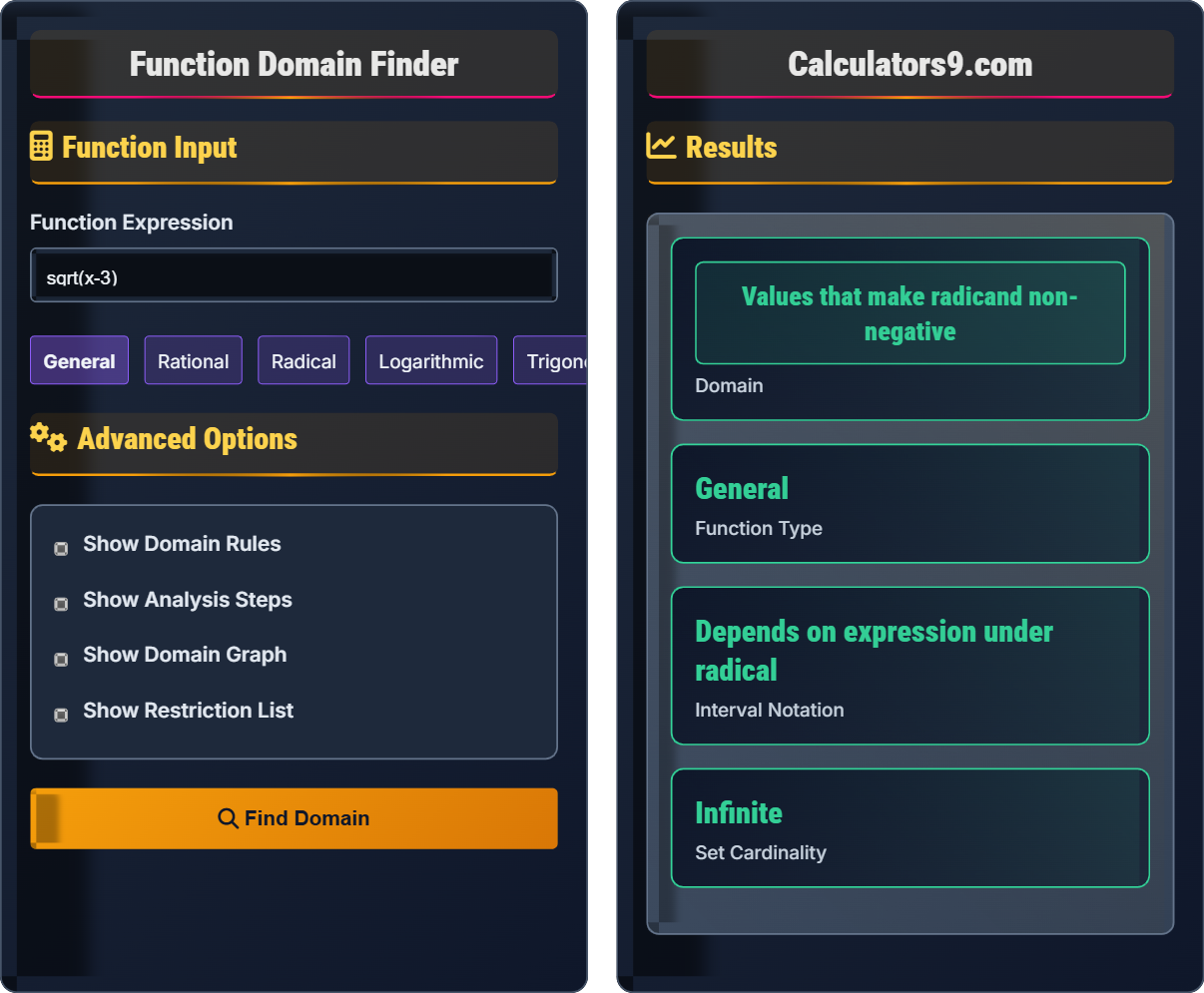
Function Input
Advanced Options
Results
Domain Analysis Fundamentals
The domain of a function is the set of all possible input values (x-values) for which the function is defined and produces a real output. Finding the domain involves identifying all values of x that do not make the function undefined or result in complex numbers when only real outputs are desired.
-
1Identify Function Type: Determine if rational, radical, logarithmic, etc.
-
2Find Restrictions: Identify values that make function undefined
-
3Solve Inequalities: Set up and solve conditions for validity
-
4Express Domain: Write in interval notation or set builder notation
-
5Verify: Test values in and outside the domain
- Denominators cannot equal zero
- Even roots require non-negative radicands
- Logarithms require positive arguments
- Trigonometric functions have specific restrictions
Function-Specific Restrictions
Different function types have specific domain restrictions. Understanding these patterns helps quickly identify the domain of complex functions.
- Rational Functions: Exclude values that make denominator zero
- Radical Functions: Even roots: radicand ≥ 0; Odd roots: all real numbers
- Logarithmic Functions: Argument must be positive
- Exponential Functions: Generally all real numbers
- Trigonometric Functions: tan(x), sec(x) undefined at π/2 + nπ
- Intersection of all individual restrictions
- Combine with AND operation
- Consider both algebraic and contextual constraints
- Verify endpoints for interval notation
Function Domain Learning Quiz
What is the domain of the function f(x) = 1/(x² - 4)?
The answer is D) x ≠ ±2. For rational functions, the denominator cannot equal zero. Setting x² - 4 = 0, we get x² = 4, so x = ±2. Therefore, the function is undefined at x = 2 and x = -2. The domain is all real numbers except x = 2 and x = -2, written as x ∈ ℝ, x ≠ ±2 or in interval notation as (-∞, -2) ∪ (-2, 2) ∪ (2, ∞).
This problem demonstrates the fundamental rule for rational functions: the denominator cannot be zero. We solve the equation denominator = 0 to find the excluded values. The key insight is that x² - 4 is a difference of squares, which factors as (x+2)(x-2), revealing both x = 2 and x = -2 as problematic values.
Rational Function: Function that can be expressed as the quotient of two polynomials
Domain Restriction: Values that make the function undefined
Interval Notation: Way to represent sets of numbers using intervals
• For rational functions: denominator ≠ 0
• Factor denominators completely
• Consider all factors that could be zero
• Always factor the denominator first
• Set each factor equal to zero
• Check for repeated factors
• Only finding one root of a quadratic denominator
• Forgetting to factor completely
• Not considering both positive and negative roots
Find the domain of the function f(x) = √(2x - 6) and express it in interval notation.
Step 1: Identify the restriction
For the square root function √(2x - 6), the expression under the radical (the radicand) must be non-negative.
Step 2: Set up the inequality
2x - 6 ≥ 0
Step 3: Solve the inequality
2x - 6 ≥ 0
2x ≥ 6
x ≥ 3
Step 4: Express in interval notation
The domain is all real numbers greater than or equal to 3: [3, ∞)
Step 5: Verify
At x = 3: √(2(3) - 6) = √0 = 0
At x = 4: √(2(4) - 6) = √2 ≈ 1.41 ✓
At x = 2: √(2(2) - 6) = √(-2) → undefined ✗
Therefore, the domain is [3, ∞).
This problem demonstrates the rule for even roots: the radicand must be non-negative (≥ 0). For odd roots like cube roots, the domain is all real numbers since odd roots are defined for negative numbers. The key is to set up the appropriate inequality and solve it systematically.
Radicand: Expression under the radical symbol
Even Root: Square root, fourth root, etc. (requires non-negative radicand)
Odd Root: Cube root, fifth root, etc. (defined for all real numbers)
• Even roots: radicand ≥ 0
• Odd roots: radicand can be any real number
• Always solve the inequality systematically
• Remember: even roots have non-negative radicands
• Check endpoints of intervals
• Use test values to verify
• Confusing even and odd root restrictions
• Forgetting to include the equality in ≥ inequalities
• Not solving the inequality correctly
A function is defined as f(x) = ln(x + 2)/(x² - 1). Identify all domain restrictions and express the domain in interval notation.
Step 1: Identify restrictions from each part
For the logarithm ln(x + 2): x + 2 > 0, so x > -2
For the denominator x² - 1: x² - 1 ≠ 0, so x² ≠ 1, which means x ≠ ±1
Step 2: Combine restrictions
We need x > -2 AND x ≠ ±1
Since -1 and +1 are both greater than -2, we exclude these points from the interval (-2, ∞)
Step 3: Express in interval notation
The domain is: (-2, -1) ∪ (-1, 1) ∪ (1, ∞)
Step 4: Verify
At x = 0: ln(2)/(-1) = -ln(2) ✓
At x = -1.5: ln(0.5)/(2.25-1) = ln(0.5)/1.25 ✓
At x = -2: ln(0) → undefined ✗
At x = 1: ln(3)/0 → undefined ✗
Therefore, the domain is (-2, -1) ∪ (-1, 1) ∪ (1, ∞).
This problem combines multiple types of restrictions. When a function has multiple parts, we must consider all restrictions simultaneously using the logical AND operation. The domain is the intersection of all individual domains. We start with the most basic restriction and then remove points that violate other restrictions.
Composite Restrictions: Multiple conditions that must all be satisfied
Intersection of Sets: Values that satisfy all conditions
Domain Union: When multiple separate intervals form the domain
• Combine restrictions using intersection (AND)
• Address each function component separately
• Express final answer as union of intervals if needed
• List all restrictions separately first
• Combine using intersection principles
• Draw a number line to visualize intervals
• Forgetting one of the restrictions
• Not properly combining multiple restrictions
• Misordering intervals in notation
Find the domain of f(x) = tan(x) + sec(x). Explain why these values are excluded.
Step 1: Identify restrictions for tan(x)
tan(x) = sin(x)/cos(x), so cos(x) ≠ 0
cos(x) = 0 when x = π/2 + nπ for integer n
Step 2: Identify restrictions for sec(x)
sec(x) = 1/cos(x), so cos(x) ≠ 0
This is the same restriction as for tan(x)
Step 3: Combine restrictions
Both functions are undefined when cos(x) = 0
This occurs at x = π/2 + nπ for any integer n
Step 4: Express domain
The domain is all real numbers except x = π/2 + nπ where n is any integer
In interval notation, this would be: ∪(n∈ℤ) (π/2 + (n-1)π, π/2 + nπ)
Step 5: Explanation
These values are excluded because both tan(x) and sec(x) involve division by cos(x), and division by zero is undefined. At x = π/2 + nπ, cos(x) = 0, making both functions undefined.
Therefore, the domain excludes x = π/2 + nπ for all integers n.
This problem demonstrates domain restrictions for trigonometric functions. Both tan(x) and sec(x) have the same restriction (cos(x) ≠ 0) because sec(x) = 1/cos(x) and tan(x) = sin(x)/cos(x). The key insight is recognizing that both functions fail when cos(x) = 0, which occurs at regular intervals.
Trigonometric Function: Function involving sine, cosine, tangent, etc.
Periodic Restriction: Restrictions that occur at regular intervals
Integer Multiples: Values of the form nπ where n is an integer
• tan(x) and sec(x) undefined when cos(x) = 0
• cot(x) and csc(x) undefined when sin(x) = 0
• Consider the fundamental period of trigonometric functions
• Remember which trig functions have which restrictions
• Use the fundamental period to express general solutions
• Visualize on the unit circle if needed
• Confusing which trig functions have which restrictions
• Forgetting to include all integer multiples
• Not recognizing that tan and sec share restrictions
Which of the following represents the domain of f(x) = √(x - 1)/(x - 3)?
The answer is C) [1, 3) ∪ (3, ∞). For this function, we have two restrictions: 1) The radicand x - 1 ≥ 0, which gives x ≥ 1, and 2) The denominator x - 3 ≠ 0, which gives x ≠ 3. Combining these restrictions: x must be greater than or equal to 1 AND x cannot equal 3. This means the domain includes [1, 3) and (3, ∞), which is written as [1, 3) ∪ (3, ∞). The square bracket at 1 indicates x = 1 is included (since √0 = 0 is defined), and the parentheses around 3 indicate x = 3 is excluded (since division by zero is undefined).
This problem combines two different types of restrictions: a radical restriction (non-negative radicand) and a rational function restriction (non-zero denominator). The key is to find the intersection of both conditions. Since x = 1 is allowed by the radical (giving √0 = 0) but x = 3 is not allowed by the denominator, we include 1 but exclude 3 in our domain.
Intersection of Conditions: Values satisfying all restrictions simultaneously
Bracket Notation: [ ] includes endpoint, ( ) excludes endpoint
Union of Intervals: Multiple intervals forming the complete domain
• Combine restrictions using intersection (AND)
• Use brackets for included endpoints
• Use parentheses for excluded endpoints
• Address each restriction separately first
• Then find the intersection of all conditions
• Be careful with inequality types (≥ vs >)
• Forgetting to exclude values that make denominator zero
• Including endpoints that should be excluded
• Not properly combining multiple restrictions
FAQ
Q: Why do we need to consider the domain of a function? Isn't it just all real numbers?
A: The domain is not always all real numbers! We need to consider the domain because certain operations are undefined in the real number system:
Division by zero: In f(x) = 1/x, x cannot be 0
Negative even roots: In f(x) = √x, x cannot be negative
Non-positive logarithms: In f(x) = ln(x), x must be positive
Undefined trig functions: In f(x) = tan(x), x cannot be π/2 + nπ
Understanding the domain is crucial because it tells us where the function exists and can be evaluated. Without considering the domain, we might try to evaluate a function at points where it's undefined, leading to mathematical errors.
Q: How do I find the domain when a function has multiple restrictions?
A: When a function has multiple restrictions, you find the domain by taking the intersection of all individual domains (the values that satisfy ALL conditions simultaneously).
Process:
1. Identify each restriction separately
2. Find the domain for each restriction
3. Take the intersection (AND operation) of all domains
4. Express the final domain in interval notation
Example: For f(x) = √(x-1)/(x-3):
• √(x-1) requires x ≥ 1
• (x-3) in denominator requires x ≠ 3
• Combined: x ≥ 1 AND x ≠ 3, which is [1, 3) ∪ (3, ∞)