Limit Calculator
Evaluate mathematical limits • 2026 edition
$$\lim_{x \to a} f(x) = L$$
The limit of a function f(x) as x approaches a value a is L if f(x) gets arbitrarily close to L as x gets closer to a.
Formally: For every ε > 0, there exists a δ > 0 such that if 0 < |x - a| < δ, then |f(x) - L| < ε.
Common Indeterminate Forms:
- 0/0 (Indeterminate quotient)
- ∞/∞ (Indeterminate quotient)
- 0·∞ (Indeterminate product)
- ∞ - ∞ (Indeterminate difference)
- 1^∞ (Indeterminate power)
- 0^0 (Indeterminate power)
- ∞^0 (Indeterminate power)
Key Limit Properties:
- Sum Rule: lim[f(x) + g(x)] = lim f(x) + lim g(x)
- Difference Rule: lim[f(x) - g(x)] = lim f(x) - lim g(x)
- Product Rule: lim[f(x) · g(x)] = lim f(x) · lim g(x)
- Quotient Rule: lim[f(x)/g(x)] = lim f(x) / lim g(x) (if lim g(x) ≠ 0)
Function Input
Advanced Options
Results
Comprehensive Limit Guide
A limit describes the value that a function approaches as the input approaches some value. It's fundamental to calculus and mathematical analysis. The notation limx→a f(x) = L means "the limit of f(x) as x approaches a equals L".
Basic limit properties help simplify complex expressions:
- Sum Rule: lim[f(x) + g(x)] = lim f(x) + lim g(x)
- Difference Rule: lim[f(x) - g(x)] = lim f(x) - lim g(x)
- Product Rule: lim[f(x) · g(x)] = lim f(x) · lim g(x)
- Quotient Rule: lim[f(x)/g(x)] = lim f(x) / lim g(x) (if lim g(x) ≠ 0)
- Power Rule: lim[f(x)n] = [lim f(x)]n
When direct substitution yields an undefined expression, we have an indeterminate form:
- 0/0: Factor or use L'Hôpital's rule
- ∞/∞: Divide by highest power or use L'Hôpital's rule
- 0·∞: Convert to 0/0 or ∞/∞ form
- ∞ - ∞: Combine fractions or rationalize
- 1^∞: Use logarithmic approach
- 0^0: Use logarithmic approach
- ∞^0: Use logarithmic approach
- Check Both Sides: For piecewise functions, verify left and right limits match
- Graphical Approach: Visualize the function behavior near the limit point
- Numerical Verification: Substitute values increasingly close to the limit point
- Algebraic Manipulation: Simplify the expression before evaluating the limit
- Special Limits: Memorize common limits like limx→0 sin(x)/x = 1
Limit Fundamentals
Formal definition: limx→a f(x) = L means for every ε > 0, there exists δ > 0 such that 0 < |x-a| < δ implies |f(x)-L| < ε.
Try plugging the limit point into the function. If f(a) is defined and finite, then limx→a f(x) = f(a).
- Polynomial functions are continuous everywhere
- Rational functions are continuous except where denominator is zero
- Composition of continuous functions is continuous
Advanced Techniques
If limx→a f(x)/g(x) is of the form 0/0 or ∞/∞, then limx→a f(x)/g(x) = limx→a f'(x)/g'(x).
- Factor numerator and denominator
- Cancel common factors
- Evaluate the simplified expression
- limx→0 sin(x)/x = 1
- limx→0 (1-cos(x))/x = 0
- limx→∞ (1+1/x)x = e
Limit Learning Quiz
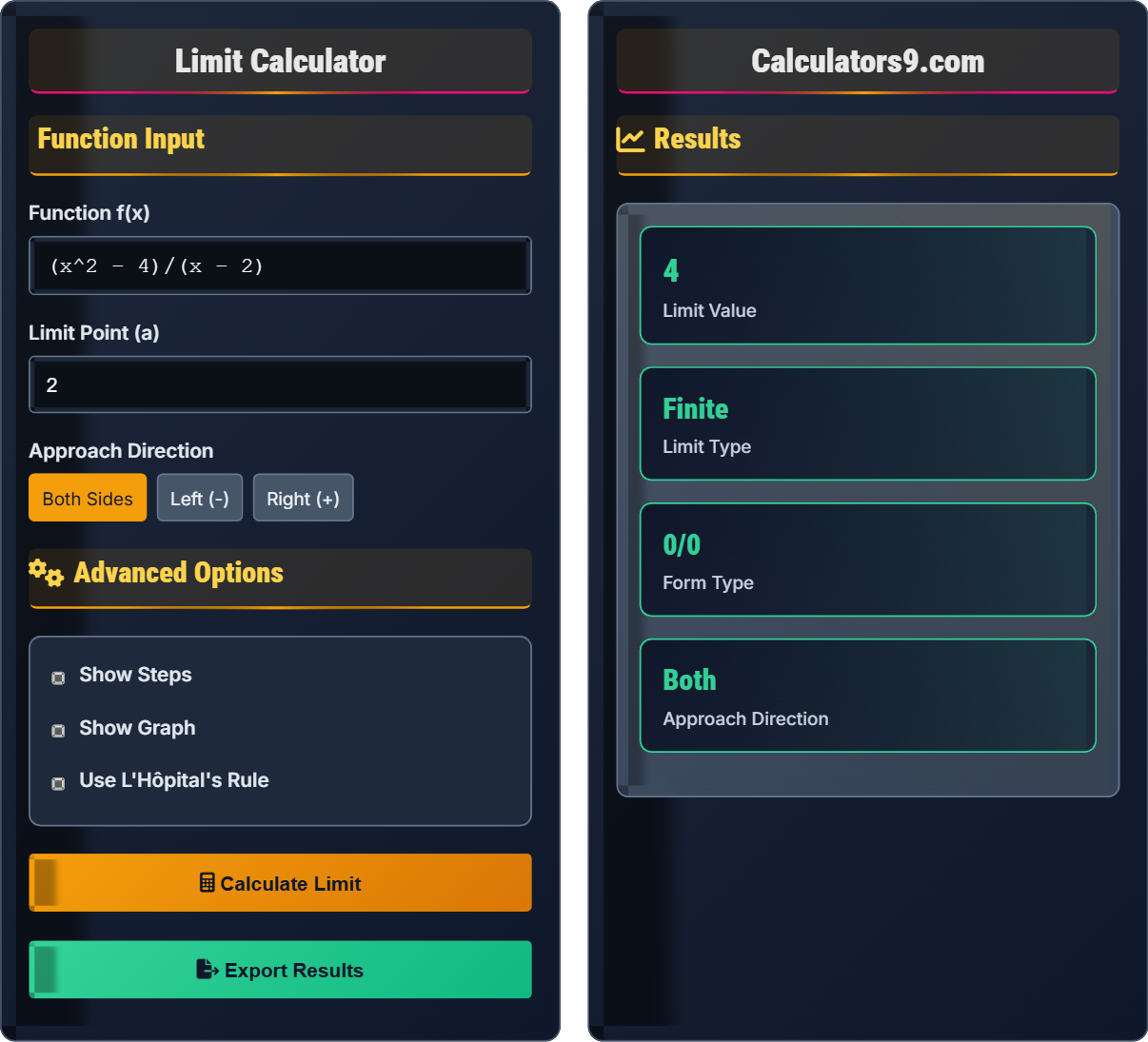
Find the limit of f(x) = (x² - 4)/(x - 2) as x approaches 2. Show all steps and explain the technique used.
Step 1: Direct substitution gives us (2² - 4)/(2 - 2) = (4 - 4)/(0) = 0/0, which is an indeterminate form.
Step 2: Factor the numerator: x² - 4 = (x + 2)(x - 2).
Step 3: Rewrite the function: f(x) = [(x + 2)(x - 2)]/(x - 2).
Step 4: Cancel the common factor (x - 2): f(x) = x + 2 for x ≠ 2.
Step 5: Now evaluate the limit: limx→2(x + 2) = 2 + 2 = 4.
Therefore, limx→2(x² - 4)/(x - 2) = 4.
This problem demonstrates the factoring technique for resolving indeterminate forms. When we encounter 0/0, it indicates that both numerator and denominator have a common factor that causes the indeterminacy. By factoring and simplifying, we remove the discontinuity and can evaluate the limit directly.
The key insight is that even though the original function is undefined at x = 2, the limit still exists because we're interested in the behavior of the function as x approaches 2, not the value at x = 2.
Indeterminate Form: An expression like 0/0 that doesn't provide enough information to determine the limit directly
Factoring Technique: A method to simplify rational expressions by canceling common factors
Removable Discontinuity: A point where a function is undefined but the limit exists
• Always try direct substitution first
• When you get 0/0, factor and cancel common terms
• The limit exists even if the function is undefined at that point
• Remember that a² - b² = (a+b)(a-b) for difference of squares
• Look for common factors when dealing with polynomial quotients
• The factored form reveals the behavior near the problematic point
• Forgetting to cancel common factors after factoring
• Assuming the limit doesn't exist just because the function is undefined at that point
• Trying to divide by zero instead of simplifying first
A company's profit function is given by P(x) = (x³ - 8)/(x - 2) thousand dollars, where x represents the number of thousands of units produced. What is the limiting profit as production approaches 2000 units? Interpret the result.
We need to find limx→2 P(x) = limx→2 (x³ - 8)/(x - 2).
Step 1: Direct substitution gives (2³ - 8)/(2 - 2) = (8 - 8)/0 = 0/0, an indeterminate form.
Step 2: Factor the numerator using the difference of cubes formula: x³ - 8 = x³ - 2³ = (x - 2)(x² + 2x + 4).
Step 3: Rewrite: P(x) = [(x - 2)(x² + 2x + 4)]/(x - 2).
Step 4: Cancel the common factor (x - 2): P(x) = x² + 2x + 4 for x ≠ 2.
Step 5: Evaluate the limit: limx→2(x² + 2x + 4) = 2² + 2(2) + 4 = 4 + 4 + 4 = 12.
Therefore, the limiting profit as production approaches 2000 units is $12,000.
This word problem demonstrates how limits model real-world situations where direct evaluation might be impossible due to mathematical constraints. The function P(x) appears undefined at x = 2 (2000 units), but the limit tells us what the profit approaches as production gets very close to this level.
In practical terms, this means that as production nears 2000 units, the profit approaches $12,000, even if the exact profit at exactly 2000 units might be difficult to calculate directly due to the original form of the equation.
Difference of Cubes: a³ - b³ = (a - b)(a² + ab + b²)
Real-World Limit: A limit that models actual phenomena where direct evaluation isn't possible
Practical Interpretation: Translating mathematical results into meaningful real-world terms
• Apply algebraic techniques to resolve indeterminate forms
• Use the difference of cubes formula when applicable
• Always interpret results in context of the problem
• Memorize special factoring formulas: difference of squares, sum/difference of cubes
• Always consider the practical meaning of your mathematical results
• Check that your answer makes sense in the context of the problem
• Not recognizing when to apply special factoring formulas
• Failing to interpret the result in the context of the problem
• Confusing the limit value with the function value at that point
FAQ
Q: When should I use L'Hôpital's Rule instead of factoring for limits?
A: Use L'Hôpital's Rule specifically when you encounter indeterminate forms of 0/0 or ∞/∞ after direct substitution. The rule states that if limx→a f(x)/g(x) is of the form 0/0 or ∞/∞, then:
$$\lim_{x \to a} \frac{f(x)}{g(x)} = \lim_{x \to a} \frac{f'(x)}{g'(x)}$$
For example, consider limx→0 sin(x)/x. Direct substitution gives 0/0, so we apply L'Hôpital's Rule:
$$\lim_{x \to 0} \frac{\sin(x)}{x} = \lim_{x \to 0} \frac{\cos(x)}{1} = \cos(0) = 1$$
On the other hand, use factoring when you have polynomial expressions that result in 0/0, as in limx→2 (x² - 4)/(x - 2). Here, factoring is simpler: (x² - 4) = (x+2)(x-2), so the limit becomes limx→2 (x+2) = 4.
L'Hôpital's Rule is particularly useful for transcendental functions (trigonometric, exponential, logarithmic) where factoring isn't possible.
Q: What's the difference between a limit existing and a function being continuous?
A: These are related but distinct concepts:
Limit Exists: limx→a f(x) = L means f(x) approaches the value L as x approaches a, regardless of whether f(a) is defined or what its value is.
Function Continuous at a: Three conditions must be met:
- f(a) is defined
- limx→a f(x) exists
- limx→a f(x) = f(a)
Consider f(x) = (x² - 4)/(x - 2). We found limx→2 f(x) = 4, so the limit exists. However, f(2) is undefined (division by zero), so the function is not continuous at x = 2. This is called a removable discontinuity.
A function is continuous at a point if and only if the limit exists and equals the function value at that point. Continuity is stronger than just having a limit.