Linear Equation Finder
Find equations from points • Slope calculation • Graph visualization
Linear Equation Forms:
Show the calculatorSlope-Intercept Form: \( y = mx + b \)
Point-Slope Form: \( y - y_1 = m(x - x_1) \)
Standard Form: \( Ax + By = C \)
Slope Formula: \( m = \frac{y_2 - y_1}{x_2 - x_1} \)
Where \( m \) is the slope and \( b \) is the y-intercept.
Example: Given points (2, 3) and (4, 7), find the linear equation.
Step 1: Calculate slope: \( m = \frac{7 - 3}{4 - 2} = \frac{4}{2} = 2 \)
Step 2: Use point-slope form with (2, 3): \( y - 3 = 2(x - 2) \)
Step 3: Simplify: \( y - 3 = 2x - 4 \), so \( y = 2x - 1 \)
The equation is \( y = 2x - 1 \) with slope 2 and y-intercept -1.
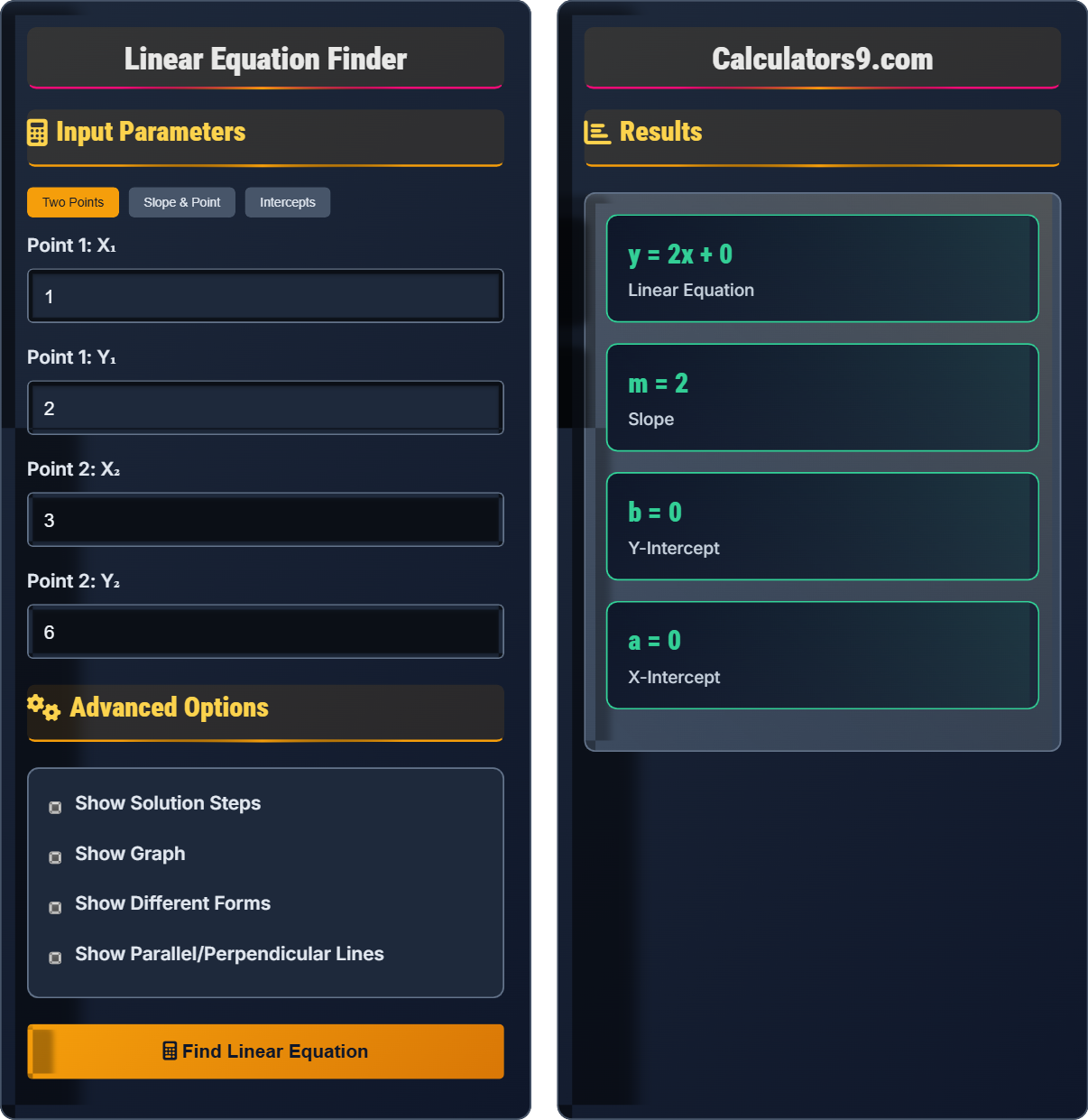
Input Parameters
Advanced Options
Results
Comprehensive Linear Equation Guide
A linear equation is an algebraic equation in which each term has an exponent of one, and the graph of the equation is a straight line. The most common form is the slope-intercept form: \( y = mx + b \), where \( m \) is the slope and \( b \) is the y-intercept. Linear equations represent relationships where the rate of change is constant.
Linear equations can be expressed in multiple forms:
Each form has specific advantages depending on the known information.
The slope of a line measures its steepness and direction:
Linear equations can be found using different sets of information:
- Two Points: Calculate slope, then use point-slope form
- Slope and Point: Directly use point-slope form
- Intercepts: Use intercept form then convert
- Graph: Identify slope and y-intercept visually
- Economics: Cost and revenue functions
- Physics: Position vs time for uniform motion
- Business: Break-even analysis
- Science: Linear relationships between variables
Linear Fundamentals
\( y = mx + b \) where m is slope and b is y-intercept.
\( m = \frac{y_2 - y_1}{x_2 - x_1} \)
Where (x₁, y₁) and (x₂, y₂) are two points.
- Exponent of variables is 1
- Graph is always a straight line
- Slope is constant throughout
Analysis Methods
X-intercept: where y=0, Y-intercept: where x=0.
- Parallel lines: same slope
- Perpendicular lines: slopes are negative reciprocals
- If m₁·m₂ = -1, lines are perpendicular
- Vertical lines have undefined slope
- Horizontal lines have zero slope
- Steeper lines have greater |slope|
Linear Equation Learning Quiz
What is the slope of the line passing through the points (2, 3) and (5, 9)?
Using the slope formula: m = (y₂ - y₁)/(x₂ - x₁)
Given points: (x₁, y₁) = (2, 3) and (x₂, y₂) = (5, 9)
m = (9 - 3)/(5 - 2) = 6/3 = 2
The slope is 2, so the answer is A) 2.
The slope of a line measures its steepness and direction. It represents the rate of change of y with respect to x. The slope formula m = (y₂ - y₁)/(x₂ - x₁) calculates the change in y divided by the change in x between two points. A positive slope indicates an upward trend from left to right, while a negative slope indicates a downward trend.
Slope: The measure of steepness of a line
Rate of Change: How much y changes for a unit change in x
Rise over Run: Vertical change divided by horizontal change
• Slope = (change in y)/(change in x)
• Order matters: subtract consistently (y₂-y₁)/(x₂-x₁)
• Any two points on the line give the same slope
• Remember: rise over run
• Use consistent order for both coordinates
• Visualize: positive slope goes up, negative goes down
• Mixing up the order of coordinates
• Forgetting to keep signs when subtracting negatives
• Dividing x-change by y-change instead of y/x
Find the equation of the line that passes through the point (3, 5) and has a slope of -2. Express your answer in slope-intercept form.
Given: Point (3, 5) and slope m = -2
Step 1: Use point-slope form: y - y₁ = m(x - x₁)
y - 5 = -2(x - 3)
Step 2: Distribute the slope: y - 5 = -2x + 6
Step 3: Add 5 to both sides: y = -2x + 6 + 5
Step 4: Simplify: y = -2x + 11
The equation in slope-intercept form is y = -2x + 11.
When given a point and a slope, the point-slope form is the most direct way to find the equation. The formula y - y₁ = m(x - x₁) uses the given slope and coordinates. After substituting the known values, we simplify to get the slope-intercept form y = mx + b, which clearly shows the slope and y-intercept.
Point-Slope Form: y - y₁ = m(x - x₁)
Slope-Intercept Form: y = mx + b
Y-Intercept: The point where the line crosses the y-axis
• Point-slope form requires one point and slope
• Distribute the slope carefully
• Isolate y to get slope-intercept form
• Substitute values carefully to avoid sign errors
• Always verify by plugging the original point back
• Double-check the arithmetic when distributing
• Forgetting to distribute the negative slope correctly
• Making sign errors when substituting coordinates
• Forgetting to isolate y at the end
A company's monthly profit is linearly related to the number of units sold. When 100 units are sold, the profit is $2000. When 300 units are sold, the profit is $6000. Find the linear equation that models profit P as a function of units sold x.
We have two points: (100, 2000) and (300, 6000)
Step 1: Find the slope (rate of change of profit per unit sold)
m = (6000 - 2000)/(300 - 100) = 4000/200 = 20
Step 2: Use point-slope form with (100, 2000)
P - 2000 = 20(x - 100)
Step 3: Simplify to slope-intercept form
P - 2000 = 20x - 2000
P = 20x
The linear equation is P = 20x, meaning profit increases by $20 for each unit sold.
Many real-world situations exhibit linear relationships. In this example, profit changes at a constant rate with respect to units sold. The slope represents the marginal profit per unit ($20/unit). The y-intercept would represent profit when no units are sold, which in this case is $0, indicating no fixed costs or baseline profit.
Linear Relationship: Variables change at a constant rate
Rate of Change: How one quantity changes with respect to another
Marginal Value: Change in output per unit change in input
• Extract coordinate pairs from word problems
• Slope represents the rate of change
• Y-intercept represents the initial value
• Identify independent and dependent variables
• Look for keywords like "rate," "per," or "for each"
• Verify your equation with the given data points
• Reversing the coordinates when forming ordered pairs
• Misinterpreting which variable is dependent vs independent
• Not checking if the equation fits the original data
Find the equation of the line that passes through the point (2, 3) and is: a) parallel to the line y = 4x - 1, and b) perpendicular to the line y = 4x - 1.
Original line: y = 4x - 1, so the slope is m = 4.
Part a) Parallel line:
Parallel lines have the same slope, so our new line also has slope m = 4.
Using point-slope form with point (2, 3):
y - 3 = 4(x - 2)
y - 3 = 4x - 8
y = 4x - 5
Part b) Perpendicular line:
Perpendicular lines have slopes that are negative reciprocals.
If original slope is 4, then perpendicular slope is -1/4.
Using point-slope form with point (2, 3) and slope -1/4:
y - 3 = -1/4(x - 2)
y - 3 = -1/4x + 1/2
y = -1/4x + 1/2 + 3
y = -1/4x + 7/2
Parallel line: y = 4x - 5
Perpendicular line: y = -1/4x + 7/2
Parallel lines never intersect and have identical slopes. Perpendicular lines intersect at right angles, and their slopes are negative reciprocals of each other. If one line has slope m, a perpendicular line has slope -1/m. This relationship comes from the geometric property that perpendicular lines form 90° angles.
Parallel Lines: Lines with the same slope that never meet
Perpendicular Lines: Lines that intersect at 90° angles
Negative Reciprocal: If m ≠ 0, then -1/m is its negative reciprocal
• Parallel: same slope (m₁ = m₂)
• Perpendicular: m₁ · m₂ = -1
• Negative reciprocal: flip and change sign
• For perpendicular: flip the fraction and change sign
• Always verify: multiply slopes to check if product is -1
• Remember: horizontal ⊥ vertical (undefined ⊥ 0)
• Forgetting to take the negative reciprocal for perpendicular lines
• Confusing the operations for parallel vs perpendicular
• Making arithmetic errors with fractions
What are the x-intercept and y-intercept of the line 3x + 4y = 12?
To find x-intercept: set y = 0 and solve for x
3x + 4(0) = 12
3x = 12
x = 4
So x-intercept is 4 (at point (4, 0))
To find y-intercept: set x = 0 and solve for y
3(0) + 4y = 12
4y = 12
y = 3
So y-intercept is 3 (at point (0, 3))
The answer is A) x-int: 4, y-int: 3.
The x-intercept is the point where the line crosses the x-axis (where y = 0). The y-intercept is the point where the line crosses the y-axis (where x = 0). To find intercepts from standard form Ax + By = C, we substitute 0 for the other variable and solve. These intercepts are useful for graphing linear equations.
X-Intercept: Point where line crosses x-axis (y=0)
Y-Intercept: Point where line crosses y-axis (x=0)
Intercept Form: x/a + y/b = 1, where a and b are intercepts
• X-intercept: substitute y = 0, solve for x
• Y-intercept: substitute x = 0, solve for y
• Intercepts help in graphing and understanding linear functions
• Remember: x-intercept has y = 0
• Remember: y-intercept has x = 0
• Plot both intercepts to easily graph the line
• Confusing which variable to set to zero for each intercept
• Forgetting to solve for the remaining variable
• Mixing up x and y intercept values
FAQ
Q: How do I know if two lines are parallel or perpendicular just by looking at their equations?
A: To determine if lines are parallel or perpendicular, compare their slopes when in slope-intercept form \( y = mx + b \).
Parallel lines: Have the same slope. For example, \( y = 2x + 3 \) and \( y = 2x - 5 \) are parallel because both have slope \( m = 2 \).
Perpendicular lines: Have slopes that are negative reciprocals of each other. If one line has slope \( m_1 \), a perpendicular line has slope \( m_2 = -\frac{1}{m_1} \). For example, \( y = 3x + 1 \) and \( y = -\frac{1}{3}x + 4 \) are perpendicular because \( 3 \times -\frac{1}{3} = -1 \).
Q: What's the difference between slope-intercept form and standard form of linear equations?
A: The main differences are:
Slope-intercept form: \( y = mx + b \)
- Immediately shows slope (m) and y-intercept (b)
- Ideal for graphing and understanding line characteristics
- Directly expresses y in terms of x
Standard form: \( Ax + By = C \)
- All variables on one side, constants on the other
- Preferred for solving systems of equations
- Requires manipulation to find slope and intercepts
Both forms represent the same line but serve different purposes.