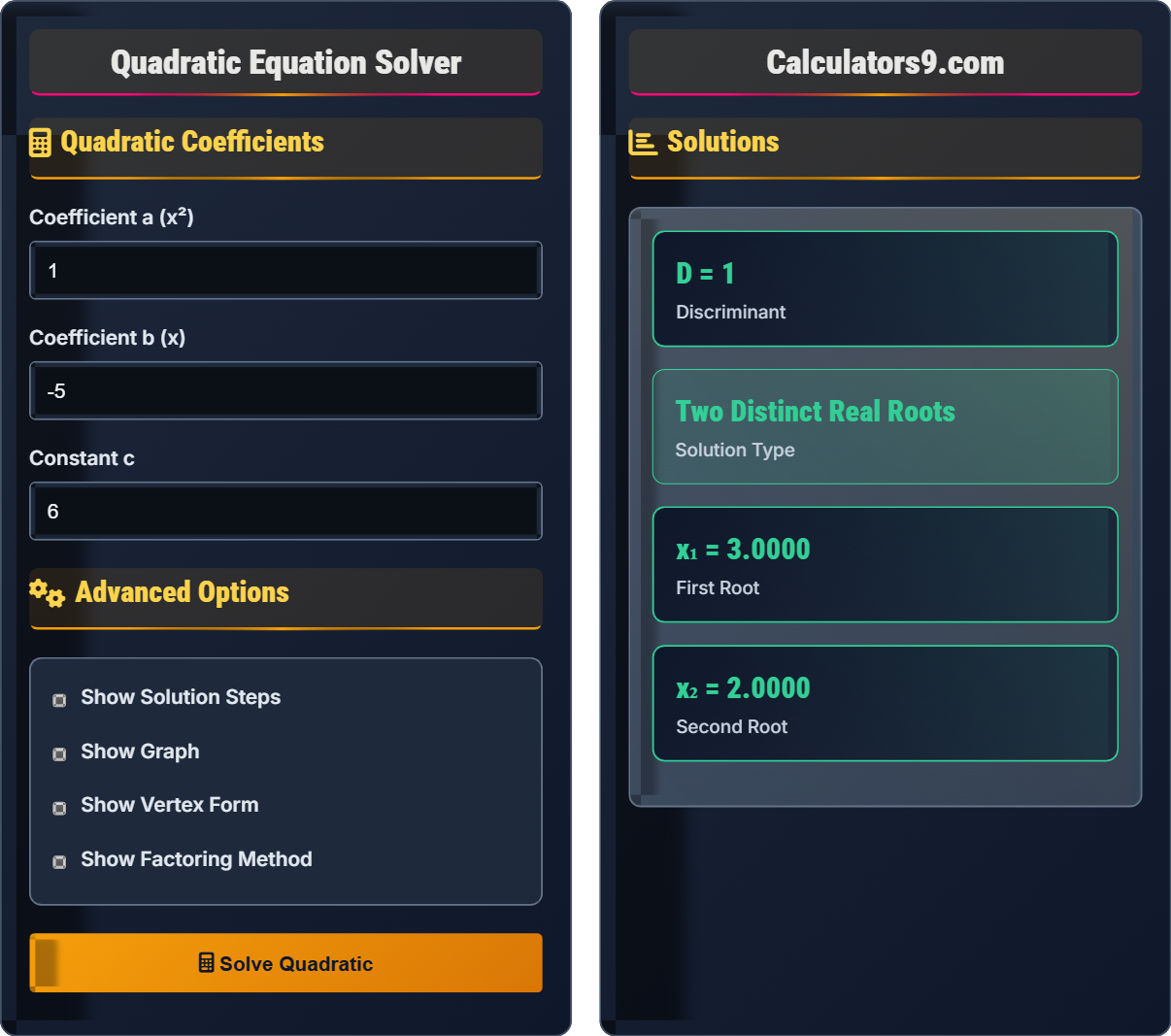
Quadratic Equation Solver
Step-by-step solutions • Discriminant analysis • Graph visualization
Quadratic Formula:
Show the calculator\( x = \frac{-b \pm \sqrt{b^2 - 4ac}}{2a} \)
Where \( ax^2 + bx + c = 0 \) is the standard form of a quadratic equation.
The discriminant \( D = b^2 - 4ac \) determines the nature of roots:
- If \( D > 0 \): Two distinct real roots
- If \( D = 0 \): One repeated real root
- If \( D < 0 \): Two complex conjugate roots
Example: For \( 2x^2 - 4x - 6 = 0 \), we have \( a = 2 \), \( b = -4 \), \( c = -6 \).
Discriminant: \( D = (-4)^2 - 4(2)(-6) = 16 + 48 = 64 \)
Since \( D > 0 \), we have two real roots:
\( x = \frac{4 \pm \sqrt{64}}{4} = \frac{4 \pm 8}{4} \)
So \( x_1 = 3 \) and \( x_2 = -1 \)
Quadratic Coefficients
Advanced Options
Solutions
Comprehensive Quadratic Guide
A quadratic equation is a polynomial equation of degree 2, written in the standard form: \( ax^2 + bx + c = 0 \), where \( a \neq 0 \). The graph of a quadratic function is a parabola, which opens upward if \( a > 0 \) and downward if \( a < 0 \). Quadratic equations model many real-world phenomena including projectile motion, optimization problems, and geometric applications.
The quadratic formula provides the solutions to any quadratic equation:
This formula is derived by completing the square on the general quadratic equation and works for all quadratic equations regardless of whether the solutions are real or complex.
The discriminant \( D = b^2 - 4ac \) determines the nature of the roots:
The vertex form of a quadratic equation is \( y = a(x - h)^2 + k \), where \( (h, k) \) is the vertex of the parabola. This form makes it easy to identify the vertex and axis of symmetry. Converting from standard to vertex form involves completing the square.
- Quadratic Formula: Universal method that works for all quadratics
- Factoring: Efficient when the quadratic factors nicely
- Completing the Square: Useful for finding vertex form
- Graphing: Visual approach to find approximate solutions
Quadratic Fundamentals
\( ax^2 + bx + c = 0 \) where \( a \neq 0 \).
\( x = \frac{-b \pm \sqrt{b^2 - 4ac}}{2a} \)
Where a, b, c are coefficients from standard form.
- Coefficient a cannot be zero
- Discriminant determines solution nature
- Parabola is symmetric about vertex
Analysis Methods
\( D = b^2 - 4ac \) determines root nature.
- h = -b/(2a) (x-coordinate of vertex)
- k = f(h) (y-coordinate of vertex)
- Vertex: (h, k)
- Positive a: opens upward
- Negative a: opens downward
- Larger |a|: narrower parabola
Quadratic Learning Quiz
For the quadratic equation \( 3x^2 - 6x + 3 = 0 \), what is the discriminant and what does it indicate about the roots?
For the equation \( 3x^2 - 6x + 3 = 0 \), we have a = 3, b = -6, c = 3.
Discriminant: D = b² - 4ac = (-6)² - 4(3)(3) = 36 - 36 = 0
When D = 0, the equation has exactly one repeated real root.
The answer is A) D = 0, one repeated real root.
The discriminant is a critical concept in quadratic equations as it tells us the nature of the roots without having to solve the equation completely. It's calculated using the formula D = b² - 4ac, where a, b, and c are the coefficients from the standard form ax² + bx + c = 0. The discriminant represents the value under the square root in the quadratic formula, which directly affects the type of solutions we get.
Discriminant: The expression b² - 4ac in the quadratic formula
Repeated Root: A root that occurs twice, also called a double root
Standard Form: Ax² + Bx + C = 0 format of a quadratic equation
• D > 0: Two distinct real roots
• D = 0: One repeated real root
• D < 0: Two complex conjugate roots
• Remember: D = b² - 4ac
• Think of D as telling you about the "discrimination" of roots
• Positive discriminant means "different" roots
• Forgetting to include negative signs in coefficient values
• Misidentifying coefficients from the equation
• Confusing the discriminant with other parts of the quadratic formula
Convert the quadratic function \( f(x) = x^2 - 4x + 1 \) to vertex form by completing the square. What is the vertex of the parabola?
Starting with f(x) = x² - 4x + 1
Step 1: Group x terms: f(x) = (x² - 4x) + 1
Step 2: Complete the square inside parentheses
Take half of coefficient of x: -4/2 = -2
Square it: (-2)² = 4
Add and subtract 4 inside parentheses: f(x) = (x² - 4x + 4 - 4) + 1
Step 3: Factor perfect square trinomial: f(x) = (x - 2)² - 4 + 1
Step 4: Simplify: f(x) = (x - 2)² - 3
Vertex form: f(x) = (x - 2)² + (-3)
Vertex: (h, k) = (2, -3)
Completing the square is a technique that transforms a quadratic from standard form to vertex form. The vertex form f(x) = a(x - h)² + k immediately reveals the vertex (h, k) of the parabola. The process involves taking the coefficient of x, dividing by 2, squaring it, and then adding and subtracting that value to create a perfect square trinomial that can be factored.
Vertex Form: f(x) = a(x - h)² + k where (h, k) is the vertex
Perfect Square Trinomial: A trinomial that factors to a binomial squared
Vertex: The highest or lowest point on a parabola
• Take coefficient of x, divide by 2, then square
• Always add AND subtract the squared value
• The vertex is at (h, k) in vertex form
• Remember: "half and square" for completing the square
• Keep track of signs carefully
• Check your work by expanding back to standard form
• Forgetting to add AND subtract the same value
• Incorrectly calculating half of the coefficient
• Getting the wrong sign for the vertex coordinates
A ball is thrown upward with an initial velocity of 32 ft/s from a height of 6 feet. The height of the ball after t seconds is given by the equation h(t) = -16t² + 32t + 6. When does the ball reach its maximum height, and what is that height?
The height function h(t) = -16t² + 32t + 6 is a quadratic equation representing a parabola that opens downward (since the coefficient of t² is negative).
Step 1: Find the time at which maximum height occurs (vertex of parabola)
Time at vertex: t = -b/(2a) = -32/(2×(-16)) = -32/(-32) = 1 second
Step 2: Find the maximum height by substituting t = 1 into the equation
h(1) = -16(1)² + 32(1) + 6 = -16 + 32 + 6 = 22 feet
The ball reaches its maximum height of 22 feet after 1 second.
Projectile motion follows a parabolic path described by a quadratic function. The general form is h(t) = -16t² + v₀t + h₀ (in feet) or h(t) = -4.9t² + v₀t + h₀ (in meters), where v₀ is the initial velocity and h₀ is the initial height. Since the coefficient of t² is negative, the parabola opens downward, and the vertex represents the maximum height of the projectile.
Projectile Motion: Motion under gravity with parabolic trajectory
Initial Velocity: Starting speed of the object
Vertex of Parabola: Highest or lowest point of the curve
• Time at max height: t = -b/(2a)
• Gravity causes negative coefficient for t² term
• Maximum height occurs at the vertex
• Remember: -16 for feet, -4.9 for meters
• Always substitute back to find the actual maximum value
• Draw a diagram to visualize the problem
• Forgetting the negative sign in the quadratic coefficient
• Using the wrong formula for time at maximum height
• Not substituting back to find the maximum value
Solve the quadratic equation \( 2x^2 - 7x - 15 = 0 \) using both factoring and the quadratic formula. Which method is more efficient for this equation?
Method 1: Factoring
We need two numbers that multiply to (2)(-15) = -30 and add to -7
Those numbers are -10 and 3
2x² - 10x + 3x - 15 = 0
2x(x - 5) + 3(x - 5) = 0
(2x + 3)(x - 5) = 0
So 2x + 3 = 0 or x - 5 = 0
Therefore x = -3/2 or x = 5
Method 2: Quadratic Formula
a = 2, b = -7, c = -15
x = (7 ± √((-7)² - 4(2)(-15)))/(2×2)
x = (7 ± √(49 + 120))/4
x = (7 ± √169)/4
x = (7 ± 13)/4
So x = (7+13)/4 = 5 or x = (7-13)/4 = -3/2
For this equation, factoring was more efficient since the numbers worked out nicely.
Both factoring and the quadratic formula will yield the same solutions, but efficiency varies depending on the equation. Factoring is faster when the quadratic factors neatly, but the quadratic formula works for all cases. The quadratic formula is particularly useful when the discriminant is not a perfect square or when the coefficients are large or complex.
Factoring: Expressing as a product of binomials
Quadratic Formula: Universal solution method
Efficiency: How quickly a method yields the solution
• Factoring requires finding two numbers that multiply to ac and add to b
• Quadratic formula works for all quadratics
• Try factoring first for simpler equations
• Look for factorable quadratics first
• Use the discriminant to predict factoring success
• If discriminant isn't a perfect square, use formula
• Forgetting to consider the leading coefficient when factoring
• Making arithmetic errors in the quadratic formula
• Not checking that solutions satisfy the original equation
What are the solutions to the equation \( x^2 + 4x + 5 = 0 \)?
For the equation x² + 4x + 5 = 0, we have a = 1, b = 4, c = 5.
Using the quadratic formula: x = (-4 ± √(16 - 20))/2
x = (-4 ± √(-4))/2
x = (-4 ± 2i)/2
x = -2 ± i
The answer is A) x = -2 ± i.
When the discriminant is negative, the quadratic equation has complex solutions involving the imaginary unit i, where i = √(-1). The solutions come in conjugate pairs: if one solution is a + bi, the other is a - bi. This occurs when the parabola represented by the quadratic function doesn't intersect the x-axis.
Complex Number: A number of the form a + bi
Imaginary Unit: i = √(-1)
Conjugate Pair: Complex numbers of the form a±bi
• D < 0 results in complex solutions
• Complex solutions come in conjugate pairs
• √(-n) = i√n for positive real numbers
• Remember: √(-1) = i
• Simplify √(negative number) first
• Keep real and imaginary parts separate
• Forgetting that √(-n) involves the imaginary unit
• Incorrectly simplifying expressions with i
• Not recognizing when discriminant is negative
FAQ
Q: Why does the discriminant determine the nature of roots in quadratic equations?
A: The discriminant appears under the square root in the quadratic formula: \( x = \frac{-b \pm \sqrt{b^2 - 4ac}}{2a} \).
Since we're taking the square root of the discriminant, its value determines the type of solutions:
- Positive discriminant: We take the square root of a positive number, giving two different real solutions
- Zero discriminant: We take the square root of zero, giving one repeated solution
- Negative discriminant: We take the square root of a negative number, giving complex solutions
Geometrically, the discriminant relates to how the parabola intersects the x-axis. A positive discriminant means the parabola crosses the x-axis at two points, zero means it touches at one point, and negative means it doesn't intersect at all.
Q: When should I use completing the square vs the quadratic formula?
A: The choice depends on your goal:
- Use the quadratic formula: When you simply need the roots of the equation. It's universal and straightforward.
- Use completing the square: When you need the vertex form of the quadratic, or when working with conic sections.
For the equation \( ax^2 + bx + c = 0 \):
Quadratic formula directly gives: \( x = \frac{-b \pm \sqrt{b^2 - 4ac}}{2a} \)
Completing the square transforms it to: \( a(x - h)^2 + k = 0 \) where the vertex is at \( (h, k) \).
Completing the square is also useful for deriving the quadratic formula itself.