Rational Expression Simplifier
Advanced mathematical tool • Algebraic fractions
Rational Expression Simplification:
Show the calculator$$\frac{P(x)}{Q(x)} = \frac{\text{Numerator Polynomial}}{\text{Denominator Polynomial}}$$
Where P(x) and Q(x) are polynomials with Q(x) ≠ 0.
Simplification Process:
- Factor both numerator and denominator completely
- Cancel common factors
- Identify domain restrictions (values that make denominator zero)
- Express in lowest terms
Common Factoring Techniques: Greatest Common Factor (GCF), difference of squares, perfect square trinomials, sum/difference of cubes, grouping.
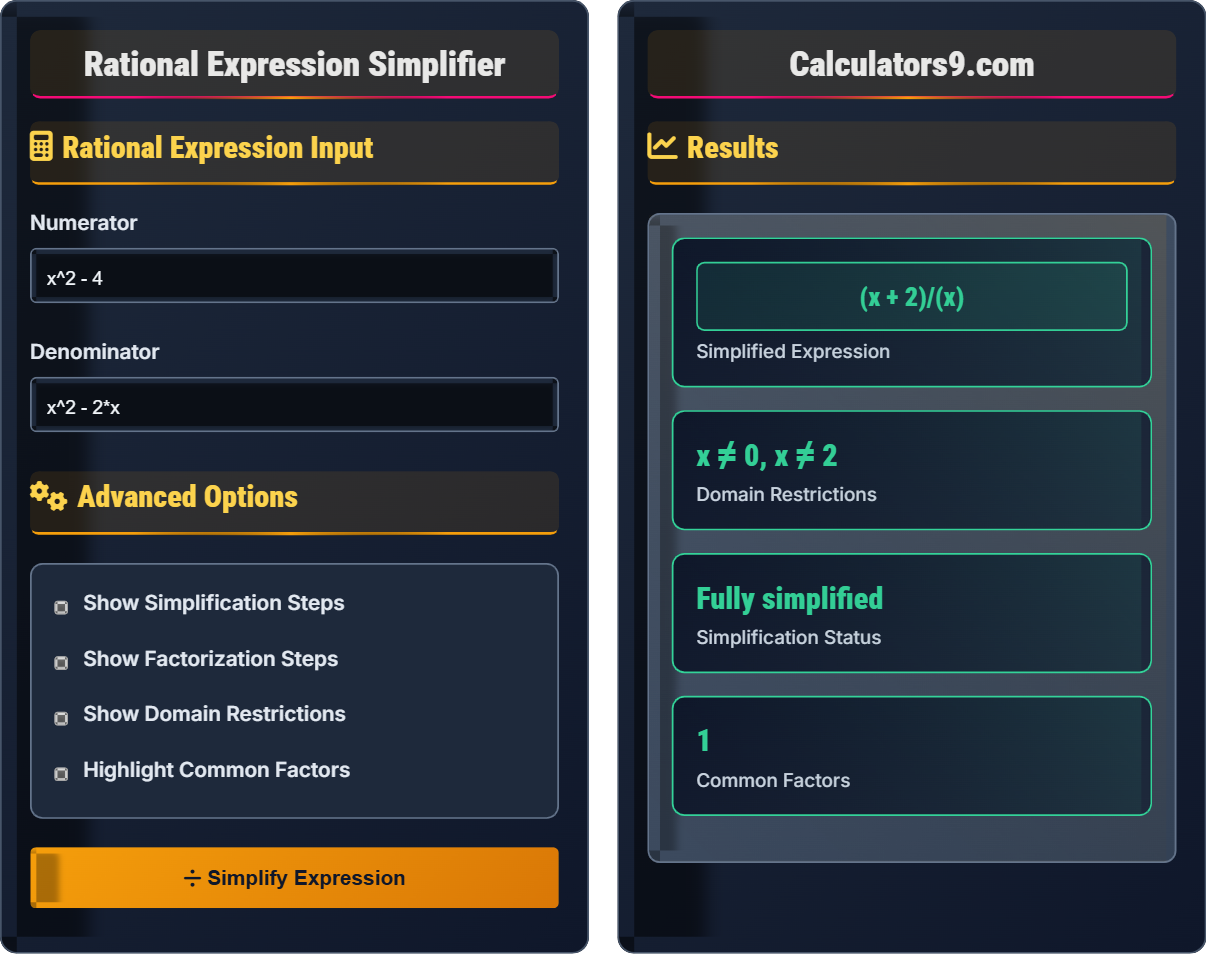
Rational Expression Input
Advanced Options
Results
Rational Expression Fundamentals
A rational expression is a fraction where both the numerator and denominator are polynomials. It has the form P(x)/Q(x) where P(x) and Q(x) are polynomials and Q(x) ≠ 0. Like numerical fractions, rational expressions can be simplified by canceling common factors in the numerator and denominator.
-
1Factor Completely: Factor both numerator and denominator completely
-
2Identify Common Factors: Find factors that appear in both numerator and denominator
-
3Cancel Common Factors: Divide out common factors
-
4State Restrictions: Identify values that make denominator zero
-
5Express in Lowest Terms: Write the simplified form
- Never cancel terms that are added or subtracted
- Only cancel common factors, not common terms
- Always state domain restrictions
- The denominator cannot equal zero
Factoring Techniques
Effective factoring is essential for simplifying rational expressions. Different polynomial forms require specific factoring techniques.
- Greatest Common Factor (GCF): Factor out common terms
- Difference of Squares: a² - b² = (a+b)(a-b)
- Perfect Square Trinomial: a² ± 2ab + b² = (a±b)²
- Sum/Difference of Cubes: a³ ± b³ = (a±b)(a²∓ab+b²)
- Trinomial Factoring: ax² + bx + c (find two numbers)
- Grouping: For polynomials with 4+ terms
- Always look for GCF first
- Check for special patterns (squares, cubes)
- Verify by expanding the factors
- Factor completely (until no further factoring is possible)
- Watch for hidden structures
Rational Expression Learning Quiz
Which factoring method should be used first to simplify the expression (x² - 9)/(x² - 6x + 9)?
The answer is B) Difference of squares and perfect square trinomial. Looking at the numerator x² - 9, we recognize this as a difference of squares: a² - b² = (a+b)(a-b), where a = x and b = 3. So x² - 9 = (x+3)(x-3). For the denominator x² - 6x + 9, we recognize this as a perfect square trinomial: a² - 2ab + b² = (a-b)², where a = x and b = 3. So x² - 6x + 9 = (x-3)². The expression becomes: (x+3)(x-3)/(x-3)², which simplifies to (x+3)/(x-3) after canceling one (x-3) factor.
This question tests pattern recognition skills essential for factoring. The key is to identify special polynomial forms quickly. Difference of squares (a² - b²) and perfect square trinomials (a² ± 2ab + b²) are among the most common patterns in rational expressions. Recognizing these patterns speeds up the simplification process significantly.
Difference of Squares: a² - b² = (a+b)(a-b)
Perfect Square Trinomial: a² ± 2ab + b² = (a±b)²
Rational Expression: Fraction with polynomials in numerator and denominator
• Always factor completely before simplifying
• Look for special patterns first
• Cancel only common factors, not terms
• Check for GCF before special patterns
• Remember: a² - b² always factors to (a+b)(a-b)
• Perfect square trinomials have three terms with middle coefficient = ±2ab
• Trying to factor expressions that can't be factored
• Not recognizing perfect square trinomials
• Forgetting to factor completely
Simplify the rational expression (x² - 5x + 6)/(x² - 4) and state any domain restrictions. Show your work.
Step 1: Factor the numerator x² - 5x + 6
We need two numbers that multiply to 6 and add to -5: -2 and -3
x² - 5x + 6 = (x - 2)(x - 3)
Step 2: Factor the denominator x² - 4
This is a difference of squares: x² - 4 = x² - 2² = (x + 2)(x - 2)
Step 3: Rewrite the expression with factored forms
(x² - 5x + 6)/(x² - 4) = [(x - 2)(x - 3)] / [(x + 2)(x - 2)]
Step 4: Cancel common factors
The factor (x - 2) appears in both numerator and denominator, so we can cancel it:
[(x - 2)(x - 3)] / [(x + 2)(x - 2)] = (x - 3)/(x + 2)
Step 5: State domain restrictions
Even though we canceled (x - 2), the original expression was undefined when x = 2 or x = -2
Domain restrictions: x ≠ 2 and x ≠ -2
Therefore, (x² - 5x + 6)/(x² - 4) = (x - 3)/(x + 2), where x ≠ ±2.
This problem demonstrates the complete process of rational expression simplification. It's crucial to remember that even after canceling factors, the domain restrictions from the original expression must be maintained. The cancellation only simplifies the expression but doesn't change where it's undefined.
Domain Restrictions: Values that make the denominator zero
Common Factor: Factor that appears in both numerator and denominatorLowest Terms: Rational expression with no common factors
• Always factor before simplifying
• Maintain original domain restrictions
• Only cancel common factors, never terms
• Factor each polynomial completely
• Write out all factors clearly
• Double-check that cancelled factors were identical
• Forgetting to factor completely
• Not maintaining domain restrictions
• Trying to cancel terms instead of factors
A rectangular garden has an area of (x² - 9) square feet and a length of (x + 3) feet. Find the width of the garden as a simplified rational expression. What are the domain restrictions in the context of this problem?
Step 1: Set up the relationship
Area = Length × Width, so Width = Area ÷ Length
Width = (x² - 9)/(x + 3)
Step 2: Factor the numerator
x² - 9 = x² - 3² = (x + 3)(x - 3) [difference of squares]
Step 3: Simplify the expression
Width = [(x + 3)(x - 3)]/(x + 3)
Cancel the common factor (x + 3):
Width = x - 3
Step 4: Determine domain restrictions
Original expression undefined when x + 3 = 0, so x = -3
Also, for physical dimensions, we need both length and width to be positive:
Length: x + 3 > 0 → x > -3
Width: x - 3 > 0 → x > 3
Step 5: Combine restrictions
For the garden to have positive dimensions: x > 3
Therefore, the width is (x - 3) feet, with domain restriction x > 3.
This application problem connects rational expressions to geometry. The key insight is recognizing that width equals area divided by length. The simplification process reveals that the rectangle has width (x - 3), which makes sense geometrically. The domain restrictions are important both mathematically (avoiding division by zero) and physically (positive dimensions).
Area: Product of length and width
Domain Restriction: Values that make the expression undefined
Physical Constraint: Real-world limitations on variable values
• Apply geometric formulas first
• Factor and simplify the resulting expression
• Consider both mathematical and physical constraints
• Always consider the real-world context for domain restrictions
• Draw diagrams to visualize geometric problems
• Check that your answer makes sense in context
• Forgetting to consider physical constraints
• Not maintaining mathematical domain restrictions
• Making errors in geometric relationships
The velocity of an object is given by the rational expression (t² - 4)/(t² - 5t + 6) meters per second, where t is time in seconds. Simplify this expression and identify when the velocity is undefined. Explain what this means physically.
Step 1: Factor the numerator t² - 4
t² - 4 = t² - 2² = (t + 2)(t - 2) [difference of squares]
Step 2: Factor the denominator t² - 5t + 6
We need two numbers that multiply to 6 and add to -5: -2 and -3
t² - 5t + 6 = (t - 2)(t - 3)
Step 3: Simplify the expression
(t² - 4)/(t² - 5t + 6) = [(t + 2)(t - 2)] / [(t - 2)(t - 3)]
Cancel the common factor (t - 2):
[(t + 2)(t - 2)] / [(t - 2)(t - 3)] = (t + 2)/(t - 3)
Step 4: Identify when velocity is undefined
Original expression undefined when denominator = 0:
t² - 5t + 6 = 0 → (t - 2)(t - 3) = 0 → t = 2 or t = 3
Step 5: Physical interpretation
At t = 2s and t = 3s, the velocity expression is undefined, which suggests a singularity in the mathematical model. Physically, this might represent:
- An instantaneous change in motion
- A limitation of the mathematical model
- A point where the object experiences infinite acceleration
Therefore, the simplified velocity is (t + 2)/(t - 3) m/s, undefined at t = 2s and t = 3s.
This physics application demonstrates how rational expressions model real phenomena. The simplification process reveals the underlying behavior of the system. The undefined points often correspond to critical moments in the physical system, highlighting the importance of understanding domain restrictions in applied contexts.
Velocity: Rate of change of displacement
Mathematical Singularity: Point where function is undefined
Domain Restriction: Values excluded from function domain
• Always factor before simplifying
• Identify all points where expression is undefined
• Interpret mathematical results in physical context
• Consider the physical meaning of undefined points
• Factor systematically to avoid missing terms
• Check that simplified form maintains physical relevance
• Missing domain restrictions after simplification
• Not interpreting results in physical context
• Making factoring errors
After simplifying the expression (x³ - 8)/(x² - 4x + 4), which of the following is true?
The answer is A) The simplified form is (x² + 2x + 4)/(x - 2) with domain x ≠ 2. For the numerator x³ - 8, this is a difference of cubes: a³ - b³ = (a - b)(a² + ab + b²), where a = x and b = 2. So x³ - 8 = (x - 2)(x² + 2x + 4). For the denominator x² - 4x + 4, this is a perfect square trinomial: x² - 4x + 4 = (x - 2)². The expression becomes: [(x - 2)(x² + 2x + 4)] / (x - 2)². After canceling one (x - 2) factor: (x² + 2x + 4)/(x - 2). The original expression is undefined when (x - 2)² = 0, which means x = 2.
This problem combines multiple factoring techniques: difference of cubes for the numerator and perfect square trinomial for the denominator. Recognizing these patterns is essential for advanced rational expression simplification. The sum of squares (x² + 2x + 4) in the numerator cannot be factored further over the real numbers, so the expression is fully simplified.
Difference of Cubes: a³ - b³ = (a - b)(a² + ab + b²)
Perfect Square Trinomial: a² - 2ab + b² = (a - b)²
Irreducible Polynomial: Cannot be factored further over reals
• Know special factoring formulas (cubes, squares)
• Factor completely before simplifying
• Maintain domain restrictions from original expression
• Remember the pattern: a³ - b³ = (a-b)(a²+ab+b²)
• Check that factored forms multiply back to original
• Always consider whether further factoring is possible
• Forgetting the middle term in difference of cubes
• Not recognizing perfect square trinomials
• Cancelling incorrectly when multiple factors exist
FAQ
Q: Why can't I cancel terms that are added or subtracted in rational expressions?
A: You can only cancel factors, not terms. A factor is something that is multiplied, while a term is something that is added or subtracted.
For example, in the expression (x + 2)/(x + 3), you cannot cancel the x's because they are terms being added, not factors being multiplied.
However, in (x(x + 2))/(x(x + 3)), you can cancel the x's because x is a factor in both numerator and denominator.
Think of it this way: (2 + 3)/(2 + 4) = 5/6, but if you could cancel the 2's, you'd get 3/4, which is not equal to 5/6. This demonstrates why cancelling terms doesn't work.
Always factor completely first, then cancel only the common factors.
Q: What's the significance of domain restrictions in rational expressions?
A: Domain restrictions are crucial for several reasons:
Mathematical Validity: Division by zero is undefined, so we must exclude values that make the denominator zero.
Function Behavior: Domain restrictions often correspond to vertical asymptotes or holes in the graph of the rational function.
Real-world Applications: In applied contexts, domain restrictions might represent physically impossible values or conditions.
Continuity: Understanding domain restrictions helps determine where the function is continuous.
Even after simplification: You must maintain the original domain restrictions. For example, (x²-4)/(x-2) simplifies to x+2, but the domain still excludes x=2 because the original expression was undefined there.