Series Sum Estimator
Advanced mathematical tool • Infinite & finite series
Series Formulas:
Show the calculatorArithmetic Series: \(S_n = \frac{n}{2}[2a_1 + (n-1)d]\)
Geometric Series (finite): \(S_n = a_1 \frac{1-r^n}{1-r}\)
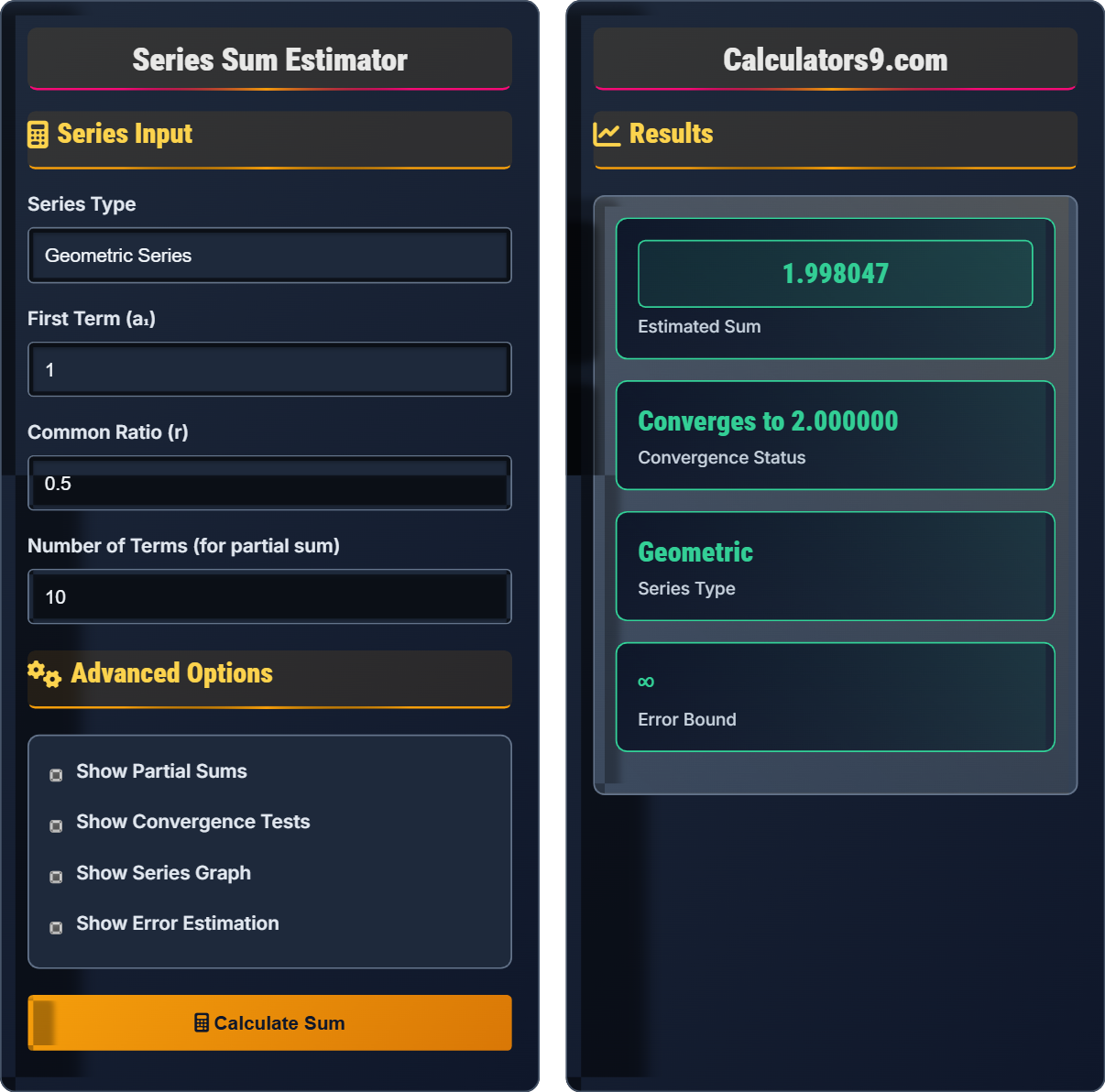
Geometric Series (infinite): \(S_\infty = \frac{a_1}{1-r}\) (when |r| < 1)
Harmonic Series: \(H_n = \sum_{k=1}^{n} \frac{1}{k}\) (divergent)
P-Series: \(\sum_{n=1}^{\infty} \frac{1}{n^p}\) (converges if p > 1)
Series convergence is determined by various tests: Ratio Test, Root Test, Comparison Test, Integral Test, etc. For alternating series, Leibniz's test applies if terms decrease monotonically to zero.
Series Input
Advanced Options
Results
Series Sum Fundamentals
A series is the sum of the terms of a sequence. Given a sequence {aₙ}, the corresponding series is denoted as ∑aₙ. Series can be finite (sum of n terms) or infinite (sum of infinitely many terms). The study of series is fundamental in calculus, analysis, and many applications in science and engineering.
-
1Finite Series: Sum of a fixed number of terms
-
2Infinite Series: Sum of infinitely many terms
-
3Convergent: Partial sums approach a finite limit
-
4Divergent: Partial sums don't approach a limit
-
5Conditionally Convergent: Converges but not absolutely
- If lim(n→∞) aₙ ≠ 0, then ∑aₙ diverges
- Geometric series converges if |r| < 1
- P-series converges if p > 1
- Integral test: ∫f(x)dx and ∑f(n) have same convergence
Convergence Tests
Several tests help determine whether a series converges or diverges. The choice of test depends on the form of the series. Understanding these tests is crucial for analyzing series behavior.
- nth Term Test: If lim aₙ ≠ 0, series diverges
- Geometric Series Test: ∑arⁿ converges if |r| < 1
- p-Series Test: ∑1/nᵖ converges if p > 1
- Ratio Test: L = lim |aₙ₊₁/aₙ|; converges if L < 1
- Root Test: L = lim ᵐ√|aₙ|; converges if L < 1
- Use nth term test first (if lim ≠ 0, diverges)
- Look for geometric patterns
- Check for p-series form
- Try ratio test for factorials/exponentials
- Use comparison tests for similar series
Series Sum Learning Quiz
Which test is most appropriate for determining the convergence of the series ∑(n!)/(2ⁿ)?
The answer is B) Ratio Test. The series ∑(n!)/(2ⁿ) contains both a factorial (n!) and an exponential (2ⁿ) term. The Ratio Test is particularly effective for series involving factorials, exponentials, or powers because it simplifies the ratio aₙ₊₁/aₙ. For this series:
L = lim(n→∞) |aₙ₊₁/aₙ| = lim(n→∞) |((n+1)!/2ⁿ⁺¹) / (n!/2ⁿ)|
= lim(n→∞) |(n+1)!/n! × 2ⁿ/2ⁿ⁺¹| = lim(n→∞) |(n+1) × 1/2| = lim(n→∞) (n+1)/2 = ∞
Since L = ∞ > 1, the series diverges by the Ratio Test.
The Ratio Test is ideal for series containing factorials, exponentials, or powers because these terms often cancel nicely in the ratio. When you see n! in a series, immediately consider the Ratio Test. The test works by comparing the growth rate of consecutive terms. If the ratio approaches a value greater than 1, the terms are growing, and the series diverges.
Ratio Test: For series ∑aₙ, if L = lim |aₙ₊₁/aₙ|, then: converges if L < 1, diverges if L > 1
Factorial: n! = n × (n-1) × ... × 2 × 1
Convergence: Partial sums approach a finite limit
• Use Ratio Test for factorials, exponentials, powers
• If L = 1, the test is inconclusive
• Always try nth term test first
• Factorials suggest Ratio Test
• Exponentials often work well with Ratio Test
• Remember to take absolute values
• Forgetting to take absolute values in Ratio Test
• Not simplifying the ratio properly
• Confusing convergence with the value of the sum
Find the sum of the infinite geometric series: 3 + 3/4 + 3/16 + 3/64 + ... Show your work.
Step 1: Identify the first term and common ratio
First term: a₁ = 3
Common ratio: r = (3/4)/3 = 1/4
We can verify: (3/16)/(3/4) = (3/16) × (4/3) = 1/4
Step 2: Check for convergence
Since |r| = |1/4| = 1/4 < 1, the series converges
Step 3: Apply the formula for infinite geometric series
S∞ = a₁/(1-r) = 3/(1-1/4) = 3/(3/4) = 3 × 4/3 = 4
Step 4: Verify with partial sums
S₁ = 3
S₂ = 3 + 3/4 = 15/4 = 3.75
S₃ = 3 + 3/4 + 3/16 = 48/16 + 12/16 + 3/16 = 63/16 ≈ 3.9375
As we add more terms, the partial sums approach 4.
Therefore, the sum of the series is 4.
This example demonstrates the power of the geometric series formula. The key insight is recognizing the pattern: each term is the previous term multiplied by the common ratio. For infinite geometric series with |r| < 1, the formula S∞ = a₁/(1-r) gives the exact sum. This is remarkable because we're adding infinitely many terms but getting a finite result!
Geometric Series: Series where each term is previous term times constant
Common Ratio: The constant multiplier between consecutive terms
Infinite Series: Sum of infinitely many terms
• Geometric series converges if |r| < 1
• S∞ = a₁/(1-r) for convergent geometric series
• Always verify that |r| < 1 before applying formula
• Look for multiplication pattern to identify geometric series
• Calculate r = second term ÷ first term
• Check that |r| < 1 for convergence
• Forgetting to check convergence condition |r| < 1
• Misidentifying the first term or common ratio
• Applying formula to divergent series
Analyze the convergence of the p-series ∑(1/n^(3/2)). Does it converge or diverge? If it converges, what can you say about its sum compared to ∑(1/n²)?
Step 1: Identify the p-series
The series ∑(1/n^(3/2)) is a p-series with p = 3/2 = 1.5
Step 2: Apply the p-series test
A p-series ∑(1/nᵖ) converges if and only if p > 1
Since p = 1.5 > 1, the series converges
Step 3: Compare with ∑(1/n²)
The series ∑(1/n²) is a p-series with p = 2
Both series converge since both p-values are greater than 1
Step 4: Analyze relative convergence
For n ≥ 1: n^(3/2) < n², so 1/n^(3/2) > 1/n²
This means each term in ∑(1/n^(3/2)) is larger than the corresponding term in ∑(1/n²)
However, both series still converge. The series ∑(1/n²) converges "faster" because its terms approach zero more rapidly.
Therefore, ∑(1/n^(3/2)) converges, and its sum is greater than the sum of ∑(1/n²).
This problem illustrates the p-series test and comparative analysis. The p-series test is elegant in its simplicity: if p > 1, the series converges; if p ≤ 1, it diverges. The boundary case p = 1 (the harmonic series) is divergent. This shows how sensitive convergence is to the rate at which terms approach zero.
P-Series: Series of the form ∑(1/nᵖ) where p is constant
Convergence: Partial sums approach a finite limitHarmonic Series: Special case of p-series with p=1
• P-series ∑(1/nᵖ) converges iff p > 1
• Harmonic series (p=1) diverges
• Larger p means faster convergence
• Remember: p > 1 means convergence
• The harmonic series ∑(1/n) diverges
• Compare rates of convergence using term-by-term comparison
• Confusing p-series test condition (p > 1 for convergence)
• Forgetting that p = 1 is the divergent harmonic series
• Misunderstanding the relationship between p-value and convergence speed
Zeno's paradox suggests that to travel a distance, one must first travel half the distance, then half of the remaining distance, and so on infinitely. Model this as a geometric series and calculate the total distance traveled. How does this resolve Zeno's paradox?
Step 1: Model the distances as a series
Starting with a total distance of 1 unit, the distances covered are:
1/2 + 1/4 + 1/8 + 1/16 + ... = ∑(1/2)ⁿ from n=1 to ∞
Step 2: Identify the geometric series parameters
First term: a₁ = 1/2
Common ratio: r = 1/2
Step 3: Check for convergence
Since |r| = 1/2 < 1, the series converges
Step 4: Calculate the sum
S∞ = a₁/(1-r) = (1/2)/(1-1/2) = (1/2)/(1/2) = 1
Step 5: Interpret the result
The sum of the infinite series is exactly 1, which means the total distance is covered despite having infinitely many steps. This resolves Zeno's paradox by showing that an infinite sum of decreasing terms can equal a finite value.
Therefore, the total distance traveled is 1 unit, resolving Zeno's paradox mathematically.
This historical problem beautifully demonstrates the practical importance of infinite series. Zeno's paradox puzzled philosophers for centuries until the development of calculus and series theory provided the mathematical tools to understand how infinite processes can have finite outcomes. The resolution relies on the fact that the terms decrease rapidly enough that their sum remains finite.
Zeno's Paradox: Ancient paradox about motion and infinite division
Convergent Series: Series whose partial sums approach a finite limit
Geometric Series: Series where each term is previous term times constant
• Infinite series can have finite sums
• Rapidly decreasing terms allow convergence
• Geometric series model many real-world phenomena
• Look for geometric patterns in real-world situations
• Understand that infinity doesn't always mean divergence
• Connect mathematical concepts to philosophical problems
• Assuming infinite processes always lead to infinite results
• Not recognizing geometric series in word problems
• Forgetting that mathematical models approximate reality
Which of the following statements about the series ∑(1/n) and ∑(1/n²) is TRUE?
The answer is C) ∑(1/n) diverges and ∑(1/n²) converges. The series ∑(1/n) is the harmonic series, which is a p-series with p = 1. According to the p-series test, this diverges since p ≤ 1. On the other hand, ∑(1/n²) is a p-series with p = 2. Since p = 2 > 1, this series converges. This is a classic example demonstrating that the boundary between convergence and divergence occurs at p = 1 for p-series. Even though 1/n² approaches zero faster than 1/n, this small difference in the rate of approach to zero makes the crucial difference between divergence and convergence.
This comparison highlights the critical nature of convergence. The harmonic series ∑(1/n) is one of the most important examples in analysis - it's the "boundary case" for p-series. Even though its terms approach zero, they don't approach zero fast enough for the series to converge. The series ∑(1/n²), however, has terms that approach zero sufficiently rapidly for convergence. This demonstrates that convergence depends critically on the rate at which terms approach zero.
Harmonic Series: ∑(1/n), a p-series with p=1 that diverges
P-Series Test: ∑(1/nᵖ) converges iff p > 1
Boundary Case: The point where behavior changes (p=1)
• Harmonic series ∑(1/n) diverges
• ∑(1/n²) converges (p > 1)
• Rate of approach to zero determines convergence
• Remember: harmonic series diverges
• P-series with p > 1 converges
• The boundary between convergence/divergence is p = 1
• Thinking harmonic series converges
• Confusing the boundary condition for p-series
• Not recognizing that slower decay can cause divergence
FAQ
Q: How do I choose which convergence test to use for a given series?
A: Here's a systematic approach to selecting the right convergence test:
1. nth Term Test: Always check first. If lim(n→∞) aₙ ≠ 0, the series diverges. If the limit is 0, the test is inconclusive.
2. Recognizable Forms: Check if it's a geometric series (∑arⁿ) or p-series (∑1/nᵖ). These have simple convergence criteria.
3. Factorials or Exponentials: Use the Ratio Test: L = lim |aₙ₊₁/aₙ|. Converges if L < 1, diverges if L > 1.
4. nth Powers: Use the Root Test: L = lim ᵐ√|aₙ|. Converges if L < 1, diverges if L > 1.
5. Positive Terms: Consider Comparison Test or Limit Comparison Test. Compare with a known series.
6. Integrable Function: If aₙ = f(n) where f is positive, continuous, and decreasing, use the Integral Test.
7. Alternating Series: If terms alternate in sign, use the Alternating Series Test.
Start with the simplest tests and progress to more complex ones as needed.
Q: What's the difference between conditional and absolute convergence?
A: This distinction is crucial for series with both positive and negative terms:
Absolute Convergence: A series ∑aₙ converges absolutely if ∑|aₙ| converges. This is stronger than ordinary convergence.
Conditional Convergence: A series ∑aₙ converges conditionally if ∑aₙ converges but ∑|aₙ| diverges.
Key Property: If a series converges absolutely, then it converges. However, a series can converge without converging absolutely (conditional convergence).
Example of Conditional Convergence: The alternating harmonic series ∑(-1)ⁿ⁺¹/n = 1 - 1/2 + 1/3 - 1/4 + ... converges to ln(2), but ∑|(-1)ⁿ⁺¹/n| = ∑1/n (harmonic series) diverges.
Practical Significance: Absolutely convergent series can be rearranged in any order without changing the sum. Conditionally convergent series can be rearranged to converge to any value or even diverge (Riemann Rearrangement Theorem).