Slope Intercept Form Calculator
y = mx + b solver • 2026 edition
$$y = mx + b$$
The slope-intercept form of a linear equation expresses a line where m is the slope and b is the y-intercept.
Components:
- y = dependent variable (output)
- x = independent variable (input)
- m = slope (rise/run = Δy/Δx)
- b = y-intercept (where line crosses y-axis)
Calculating Slope from Two Points:
Given points (x₁, y₁) and (x₂, y₂): $$m = \frac{y_2 - y_1}{x_2 - x_1}$$
Calculating Y-Intercept:
Using point-slope form: $$b = y - mx$$
Examples:
- y = 2x + 3 (slope = 2, y-intercept = 3)
- y = -0.5x + 1 (slope = -0.5, y-intercept = 1)
- y = 4 (slope = 0, y-intercept = 4)
Input Options
Advanced Options
Results
Comprehensive Linear Equations Guide
The slope-intercept form of a linear equation is written as y = mx + b, where m is the slope and b is the y-intercept. This form is particularly useful because it immediately provides key characteristics of the line: its steepness (slope) and where it crosses the y-axis (y-intercept).
Methods for determining slope and y-intercept:
- From Two Points: Calculate slope using m = (y₂-y₁)/(x₂-x₁), then find b using b = y - mx
- From Standard Form: Convert Ax + By = C to slope-intercept form by solving for y
- From Graph: Determine rise over run for slope, and read y-value where line crosses y-axis
- From Context: Identify rate of change (slope) and starting value (y-intercept) in word problems
Certain linear equations have unique characteristics:
- Horizontal Lines: y = b (slope = 0)
- Vertical Lines: x = a (undefined slope)
- Positive Slope: Line rises from left to right
- Negative Slope: Line falls from left to right
- Zero Slope: Horizontal line with no steepness
- Undefined Slope: Vertical line with infinite steepness
- Rate Problems: Slope represents rate of change (e.g., distance/time)
- Cost Analysis: Y-intercept is fixed cost, slope is variable cost
- Physics: Position vs time graphs with velocity as slope
- Economics: Supply/demand curves with price elasticity
- Data Modeling: Linear regression and trend analysis
Linear Equation Fundamentals
Slope measures the steepness of a line and is calculated as rise over run: m = (y₂-y₁)/(x₂-x₁).
Set x = 0 in the equation y = mx + b, which gives y = b. The y-intercept is the point (0, b).
- Parallel lines have equal slopes
- Perpendicular lines have slopes that are negative reciprocals
- Positive slope indicates upward trend
- Negative slope indicates downward trend
Advanced Concepts
Parallel lines: Same slope, different y-intercepts. Perpendicular lines: Product of slopes equals -1.
- Set y = 0 in the equation y = mx + b
- Solve for x: 0 = mx + b → x = -b/m
- X-intercept is the point (-b/m, 0)
- Lines with same slope are parallel
- Lines with slopes m₁ and m₂ are perpendicular if m₁·m₂ = -1
- Horizontal lines are perpendicular to vertical lines
Linear Equations Learning Quiz
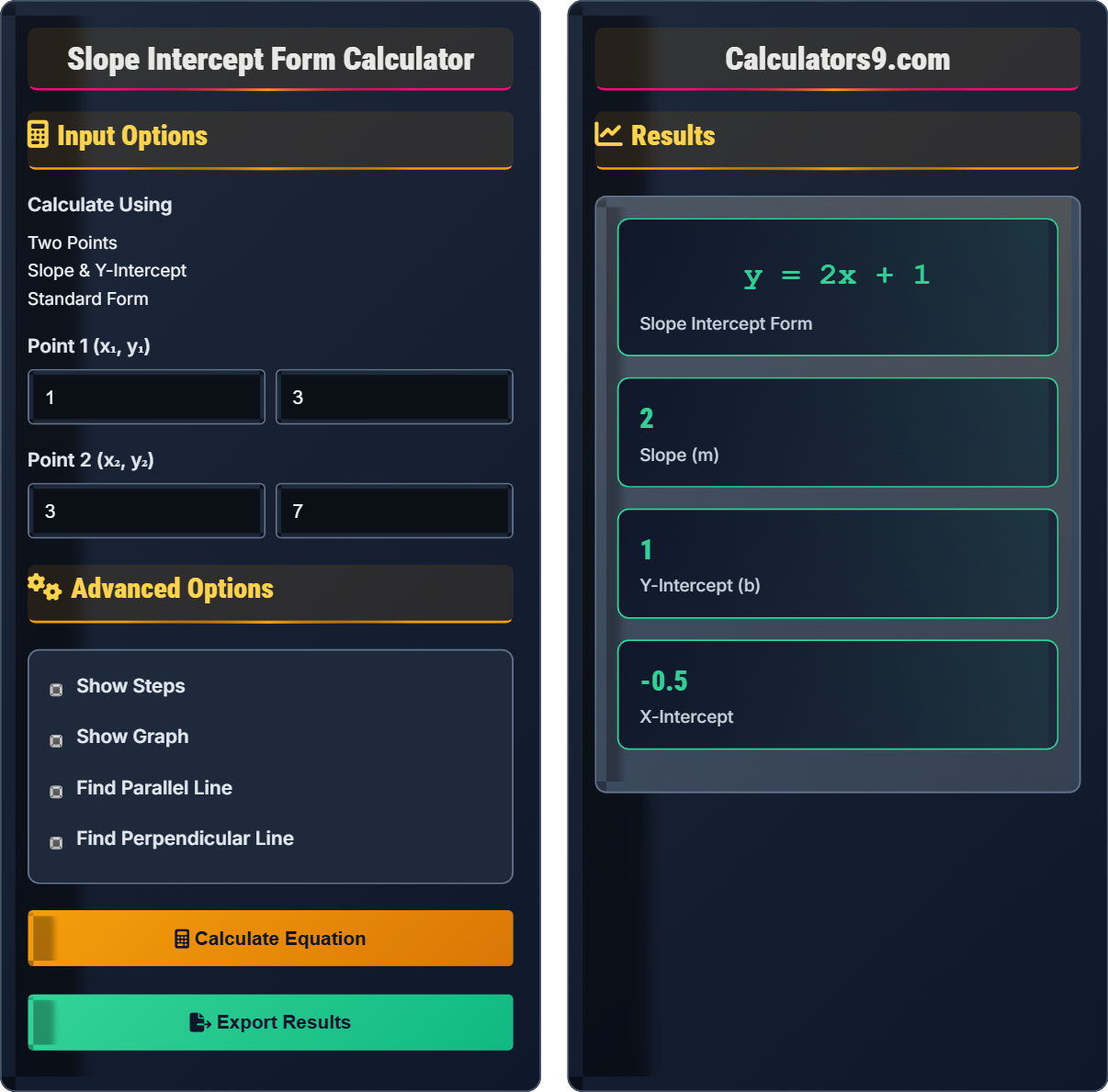
Find the equation of the line passing through points (2, 5) and (4, 9) in slope-intercept form. Show all steps.
Step 1: Calculate the slope using the formula m = (y₂-y₁)/(x₂-x₁).
m = (9-5)/(4-2) = 4/2 = 2
Step 2: Use the point-slope form with one of the points, say (2, 5): y - y₁ = m(x - x₁).
y - 5 = 2(x - 2)
Step 3: Distribute the slope: y - 5 = 2x - 4.
Step 4: Add 5 to both sides to isolate y: y = 2x - 4 + 5.
Step 5: Simplify: y = 2x + 1.
Therefore, the equation in slope-intercept form is y = 2x + 1.
This problem demonstrates the systematic approach to finding a linear equation from two points. First, we calculate the slope, which represents the rate of change between the points. Then we use the point-slope form to create an equation that passes through one of the points with the calculated slope. Finally, we rearrange to get the slope-intercept form, which clearly shows the slope and y-intercept.
The order of operations is crucial: calculate slope first, then substitute into the point-slope form, and finally solve for y.
Slope: The rate of change of y with respect to x, calculated as rise over run
Point-Slope Form: y - y₁ = m(x - x₁), where m is slope and (x₁,y₁) is a point on the line
Slope-Intercept Form: y = mx + b, where m is slope and b is y-intercept
• Always calculate slope first when given two points
• Either point can be used in point-slope form
• The final result should be in the form y = mx + b
• Double-check your arithmetic when calculating slope
• Verify your final equation by substituting both original points
• The slope tells you how much y changes for each unit increase in x
• Mixing up x and y coordinates when calculating slope
• Forgetting to distribute the slope when converting from point-slope form
• Arithmetic errors when solving for y
A company charges a $50 setup fee plus $20 per hour for a service. Write a linear equation that represents the total cost C as a function of hours h. What is the slope and y-intercept? Interpret their meanings.
The total cost consists of a fixed setup fee plus a variable hourly rate:
C = 20h + 50
This is in slope-intercept form y = mx + b, where:
- Slope (m) = 20
- Y-intercept (b) = 50
Interpretation:
Slope = 20 means the cost increases by $20 for each additional hour of service.
Y-intercept = 50 means the initial cost is $50 even if no hours of service are provided (the setup fee).
This word problem demonstrates how linear equations model real-world scenarios with a fixed component and a variable component. The y-intercept represents the fixed cost that exists regardless of usage, while the slope represents the rate at which the cost changes with respect to the independent variable (hours).
In business applications, the y-intercept often represents fixed costs, startup fees, or initial values, while the slope represents marginal costs, rates, or rates of change.
Fixed Cost: A cost that does not change with the level of activity (y-intercept)
Variable Cost: A cost that changes proportionally with the level of activity (slope × quantity)
Rate of Change: How much the dependent variable changes per unit change in the independent variable (slope)
• In word problems, identify the fixed amount (y-intercept) and rate of change (slope)
• The independent variable is usually the input that affects the outcome
• The dependent variable is the outcome that depends on the input
• Look for keywords like "fixed," "initial," or "starting" for the y-intercept
• Look for rates, per-unit costs, or hourly/daily rates for the slope
• Always verify that your equation makes sense in the context of the problem
• Reversing the roles of slope and y-intercept
• Forgetting to include fixed costs in the y-intercept
• Misidentifying which quantity is dependent vs independent
FAQ
Q: How do I know if two lines are parallel or perpendicular using their equations?
A: To determine the relationship between two lines, first convert both equations to slope-intercept form (y = mx + b) to identify their slopes:
Parallel Lines: Two lines are parallel if and only if their slopes are equal AND their y-intercepts are different.
Example: y = 2x + 3 and y = 2x - 5 are parallel because both have slope m = 2 but different y-intercepts.
Perpendicular Lines: Two lines are perpendicular if and only if the product of their slopes equals -1.
Example: y = 2x + 3 and y = -½x + 1 are perpendicular because 2 × (-½) = -1.
Special cases:
- Horizontal lines (slope = 0) are perpendicular to vertical lines (undefined slope)
- If one line has slope m, a perpendicular line has slope -1/m
Remember: if slopes are equal and y-intercepts are also equal, the lines are identical, not parallel.
Q: What's the significance of slope in real-world applications?
A: The slope has significant meaning across various disciplines as it represents the rate of change:
Economics: In demand curves, slope indicates price elasticity. In cost functions, it represents marginal cost (cost per additional unit).
Physics: On a position vs. time graph, slope represents velocity. On a velocity vs. time graph, slope represents acceleration.
Business: In revenue models, slope represents the rate of income per unit sold. In growth models, it represents the rate of change in market share.
Statistics: In regression analysis, the slope coefficient indicates how much the dependent variable changes for each unit increase in the independent variable.
Mathematically, if y = mx + b, then for every 1-unit increase in x, y changes by m units. The sign of the slope indicates direction (positive = increasing, negative = decreasing) and the magnitude indicates steepness of change.