System of Equations Solver
Solve 2x2 & 3x3 systems • Multiple methods • Graph visualization
System of Linear Equations:
Show the calculatorGeneral Form (2x2):
\( a_1x + b_1y = c_1 \)
\( a_2x + b_2y = c_2 \)
Matrix Form: \( AX = B \)
\( \begin{bmatrix} a_1 & b_1 \\ a_2 & b_2 \end{bmatrix} \begin{bmatrix} x \\ y \end{bmatrix} = \begin{bmatrix} c_1 \\ c_2 \end{bmatrix} \)
Solution Types:
- Unique Solution: Lines intersect at one point
- Infinitely Many Solutions: Lines are identical
- No Solution: Lines are parallel
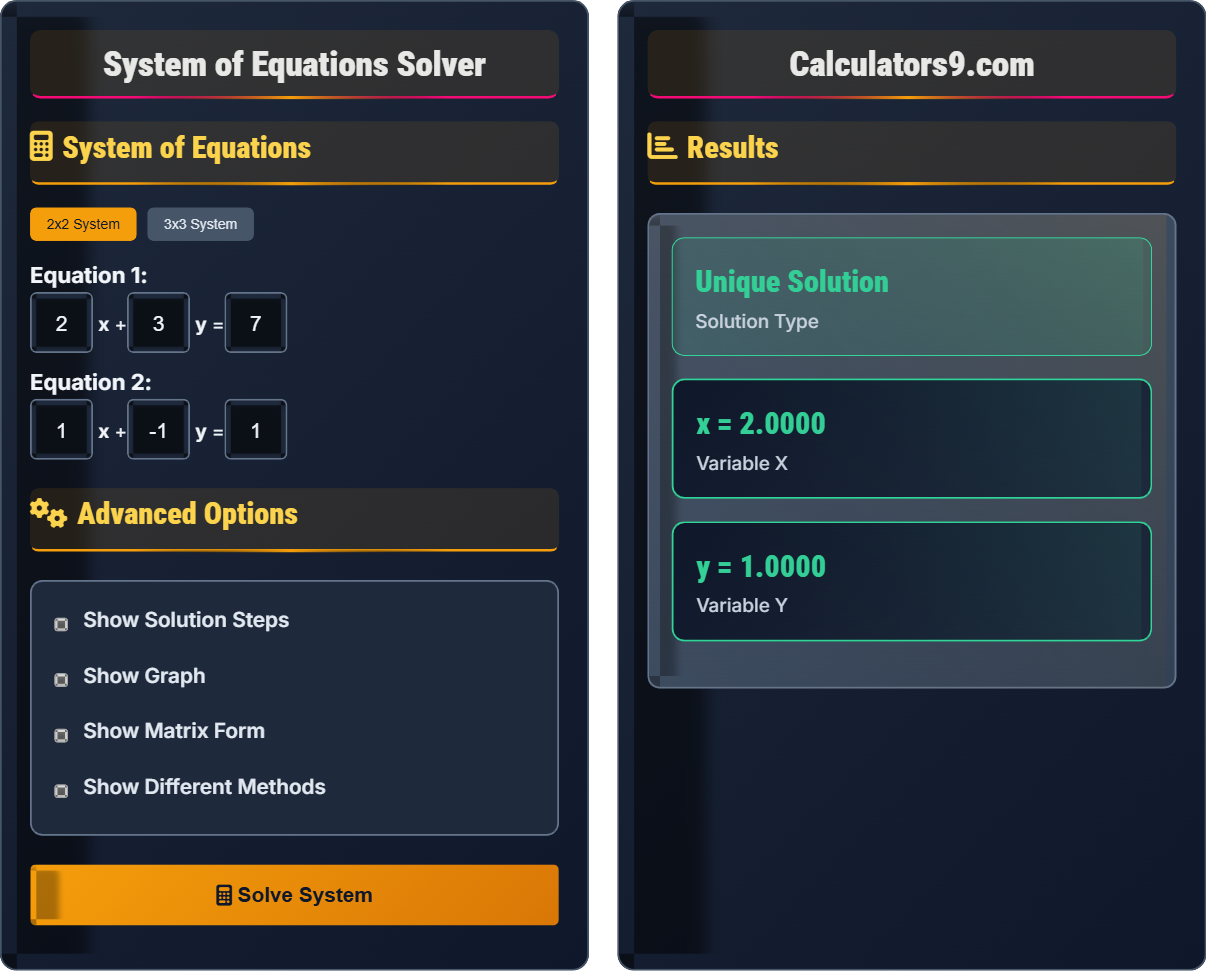
Example: Solve the system:
\( 2x + 3y = 7 \)
\( x - y = 1 \)
From equation 2: \( x = y + 1 \)
Substitute into equation 1: \( 2(y + 1) + 3y = 7 \)
\( 2y + 2 + 3y = 7 \)
\( 5y = 5 \)
\( y = 1 \)
Then: \( x = 1 + 1 = 2 \)
Solution: \( x = 2, y = 1 \)
System of Equations
Equation 1:
Equation 2:
Equation 1:
Equation 2:
Equation 3:
Advanced Options
Results
Comprehensive System of Equations Guide
A system of equations consists of two or more equations with the same variables that are solved simultaneously. The solution to the system is the set of values that satisfies all equations in the system. For linear systems, solutions correspond to intersection points of the represented lines or planes.
Systems of equations can be solved using various methods:
A system of linear equations can have three possible outcomes:
- Unique Solution: Lines intersect at exactly one point (consistent and independent)
- Infinitely Many Solutions: Lines are identical (consistent and dependent)
- No Solution: Lines are parallel (inconsistent)
A system of linear equations can be represented in matrix form:
Where A is the coefficient matrix, X is the variable matrix, and B is the constant matrix. For a 2x2 system:
- Economics: Supply and demand equilibrium
- Engineering: Circuit analysis and structural systems
- Physics: Force and motion problems
- Chemistry: Balancing chemical equations
System Fundamentals
Set of equations with common variables to be solved together.
\( AX = B \) where A is coefficient matrix, X is variable matrix, B is constant matrix.
- All equations must be satisfied simultaneously
- Same number of equations as unknowns for unique solution
- Consistent systems have at least one solution
Analysis Methods
System has solution (consistent) or no solution (inconsistent).
- Substitution: Express one variable in terms of others
- Elimination: Add/subtract equations to remove variables
- Matrix: Use determinant and inverse matrix methods
- Graphical: Find intersection points
- More equations than unknowns: overdetermined
- Fewer equations than unknowns: underdetermined
- Exact same number: potentially unique solution
System of Equations Learning Quiz
Consider the system of equations: 2x + 3y = 6 and 4x + 6y = 12. What type of solution does this system have?
Looking at the system: 2x + 3y = 6 and 4x + 6y = 12
Notice that the second equation is exactly twice the first equation:
2(2x + 3y) = 2(6) → 4x + 6y = 12
Since both equations represent the same line, there are infinitely many solutions.
The answer is B) Infinitely many solutions.
When one equation in a system is a scalar multiple of another, the equations represent the same line. This means every point on the line is a solution to both equations, resulting in infinitely many solutions. The system is called "dependent" or "consistent." Graphically, the lines coincide perfectly.
Consistent System: Has at least one solution
Dependent System: Has infinitely many solutions
Independent System: Has exactly one solution
• If one equation is a multiple of another → infinitely many solutions
• If equations are multiples but constants differ → no solution
• If equations are independent → unique solution
• Check if one equation is a multiple of another
• Look for proportional coefficients
• Graph both equations to visualize the relationship
• Not recognizing when equations are multiples of each other
• Confusing dependent systems with inconsistent systems
• Failing to check if constants also scale proportionally
Solve the system using the substitution method: x + 2y = 5 and 3x - y = 1. Show your work.
Given system: x + 2y = 5 ... (1) and 3x - y = 1 ... (2)
Step 1: Solve equation (1) for x: x = 5 - 2y
Step 2: Substitute this expression for x into equation (2):
3(5 - 2y) - y = 1
15 - 6y - y = 1
15 - 7y = 1
-7y = 1 - 15
-7y = -14
y = 2
Step 3: Substitute y = 2 back into x = 5 - 2y:
x = 5 - 2(2) = 5 - 4 = 1
Step 4: Verify by substituting into both original equations:
Equation (1): 1 + 2(2) = 1 + 4 = 5 ✓
Equation (2): 3(1) - 2 = 3 - 2 = 1 ✓
The solution is x = 1, y = 2.
The substitution method involves solving one equation for one variable, then substituting that expression into the other equation. This eliminates one variable, allowing us to solve for the remaining variable. The substitution method is particularly effective when one equation has a variable with a coefficient of 1 or -1.
Substitution Method: Solve one equation for a variable and substitute
Verification: Check solution in both original equations
Isolation: Expressing one variable in terms of others
• Solve for a variable with coefficient 1 or -1 when possible
• Substitute the entire expression, not just the variable
• Always verify the solution in both original equations
• Choose the easiest equation to solve first
• Keep expressions organized to avoid sign errors
• Always check your solution to catch mistakes
• Forgetting to substitute the entire expression (signs)
• Making arithmetic errors during substitution
• Not verifying the solution in both equations
A store sells two types of candy: chocolate bars for $3 each and gummy bears for $2 each. On Monday, the store sold 20 items for a total of $50. How many chocolate bars and how many gummy bears were sold?
Let x = number of chocolate bars, y = number of gummy bears
From the problem, we get two equations:
Equation 1 (total items): x + y = 20
Equation 2 (total cost): 3x + 2y = 50
Step 1: From equation 1, solve for y: y = 20 - x
Step 2: Substitute into equation 2: 3x + 2(20 - x) = 50
3x + 40 - 2x = 50
x + 40 = 50
x = 10
Step 3: Find y: y = 20 - 10 = 10
Step 4: Verify: 10 + 10 = 20 ✓ and 3(10) + 2(10) = 30 + 20 = 50 ✓
The store sold 10 chocolate bars and 10 gummy bears.
Word problems involving systems of equations require identifying two distinct relationships. In this case, we had a relationship for the total number of items and another for the total cost. Setting up the system correctly is crucial - define variables clearly and translate the verbal relationships into mathematical equations.
Word Problem: Mathematical problem stated in narrative form
Variable Definition: Assign symbols to unknown quantities
Relationship Translation: Convert verbal statements to equations
• Define variables clearly at the beginning
• Look for two distinct relationships in the problem
• Always verify the solution in the context of the problem
• Identify keywords like "total," "sum," "difference," "product"
• Organize information in a table or list
• Check if the solution makes sense in the real-world context
• Misidentifying the relationships in the problem
• Assigning variables incorrectly
• Not checking if the solution is reasonable
Solve the system using the elimination method: 2x + 5y = 16 and 3x - 2y = 1. Show your work and explain when elimination is preferred over substitution.
Given system: 2x + 5y = 16 ... (1) and 3x - 2y = 1 ... (2)
Step 1: To eliminate x, multiply equation (1) by 3 and equation (2) by 2:
3(2x + 5y) = 3(16) → 6x + 15y = 48 ... (3)
2(3x - 2y) = 2(1) → 6x - 4y = 2 ... (4)
Step 2: Subtract equation (4) from equation (3):
(6x + 15y) - (6x - 4y) = 48 - 2
6x + 15y - 6x + 4y = 46
19y = 46
y = 46/19 ≈ 2.42
Step 3: Substitute y = 46/19 into equation (1):
2x + 5(46/19) = 16
2x + 230/19 = 16
2x = 16 - 230/19 = (304 - 230)/19 = 74/19
x = 37/19 ≈ 1.95
Elimination is preferred when:
- No variable has a coefficient of 1 or -1 (making substitution messy)
- Coefficients can be easily manipulated to cancel out a variable
- Working with larger systems where elimination is more systematic
The elimination method works by adding or subtracting equations to eliminate one variable. This is done by multiplying equations by appropriate constants so that when added, one variable cancels out. The elimination method is particularly useful when coefficients are not 1 or -1, as it avoids dealing with complex fractions that can occur with substitution.
Elimination Method: Add/subtract equations to eliminate variables
Scalar Multiplication: Multiply equation by constant to align coefficients
Systematic Approach: Structured method for solving systems
• Multiply entire equation by the same constant
• Add or subtract equations to eliminate a variable
• Always verify the final solution
• Look for coefficients that are easy to match
• Use LCM to find multipliers efficiently
• Keep track of signs when adding/subtracting
• Forgetting to multiply the entire equation including the constant
• Sign errors when adding or subtracting equations
• Arithmetic errors with fractions
What is the correct matrix representation of the system: 4x - 2y = 10 and x + 3y = 5?
For the system 4x - 2y = 10 and x + 3y = 5, we arrange it in matrix form AX = B.
The coefficient matrix A contains the coefficients of x and y in order:
Row 1: coefficients from 4x - 2y = 10 → [4, -2]
Row 2: coefficients from x + 3y = 5 → [1, 3]
The variable matrix X contains the variables: [x, y]ᵀ
The constant matrix B contains the constants: [10, 5]ᵀ
Therefore: \( \begin{bmatrix} 4 & -2 \\ 1 & 3 \end{bmatrix} \begin{bmatrix} x \\ y \end{bmatrix} = \begin{bmatrix} 10 \\ 5 \end{bmatrix} \)
The answer is A.
The matrix form of a system of linear equations arranges coefficients, variables, and constants into matrices. The coefficient matrix has rows corresponding to equations and columns corresponding to variables in order. The constant matrix has values from the right side of each equation. This form allows for systematic solution using matrix operations.
Coefficient Matrix: Contains coefficients of variables
Variable Matrix: Contains the unknown variables
Constant Matrix: Contains the constants on the right side
• Arrange coefficients by equation (rows) and variable (columns)
• Maintain the same order of variables in all equations
• Constants go in separate column matrix
• Write equations in standard form first
• Pay attention to signs of coefficients
• Verify by expanding the matrix multiplication
• Mixing up rows and columns in the coefficient matrix
• Forgetting to include negative signs in coefficients
• Placing constants in the coefficient matrix
FAQ
Q: How do I know which method (substitution or elimination) to use for solving a system of equations?
A: The choice depends on the structure of the equations:
Use substitution when: One equation has a variable with coefficient 1 or -1, making it easy to isolate. For example, in the system \( x + 2y = 5 \) and \( 3x - y = 1 \), the first equation makes it easy to express \( x = 5 - 2y \).
Use elimination when: The coefficients of one variable are the same or opposites, or can be made the same with simple multiplication. For example, in the system \( 2x + 3y = 7 \) and \( 4x - 3y = 5 \), adding the equations directly eliminates \( y \).
Both methods will give the same solution, but one might be computationally easier than the other.
Q: What does it mean when a system of equations has no solution or infinitely many solutions?
A: These cases relate to the geometric interpretation of the system:
No solution (inconsistent system): The equations represent parallel lines that never intersect. For example, \( x + y = 3 \) and \( x + y = 5 \) are parallel lines with the same slope but different y-intercepts.
Infinitely many solutions (dependent system): The equations represent the same line. For example, \( 2x + 3y = 6 \) and \( 4x + 6y = 12 \) are the same line written differently (the second is 2 times the first).
When solving algebraically, no solution results in a contradiction (like 0 = 5), while infinitely many solutions result in an identity (like 0 = 0).