Vertex Form Converter
Parabola calculator • 2026 edition
$$f(x) = a(x - h)^2 + k$$
The vertex form of a quadratic function directly shows the vertex (h, k) of the parabola and the parameter 'a' which determines direction and width.
Components:
- a = coefficient that determines direction and width
- h = x-coordinate of vertex (horizontal shift)
- k = y-coordinate of vertex (vertical shift)
Converting Standard to Vertex Form:
Starting with f(x) = ax² + bx + c, complete the square:
$$f(x) = a\left(x + \frac{b}{2a}\right)^2 + \left(c - \frac{b^2}{4a}\right)$$
Where h = -b/(2a) and k = c - b²/(4a).
Converting Vertex to Standard Form:
Expand f(x) = a(x - h)² + k to get f(x) = ax² - 2ahx + (ah² + k).
Examples:
- f(x) = 2(x - 3)² + 1 (vertex at (3, 1), opens up)
- f(x) = -(x + 2)² + 5 (vertex at (-2, 5), opens down)
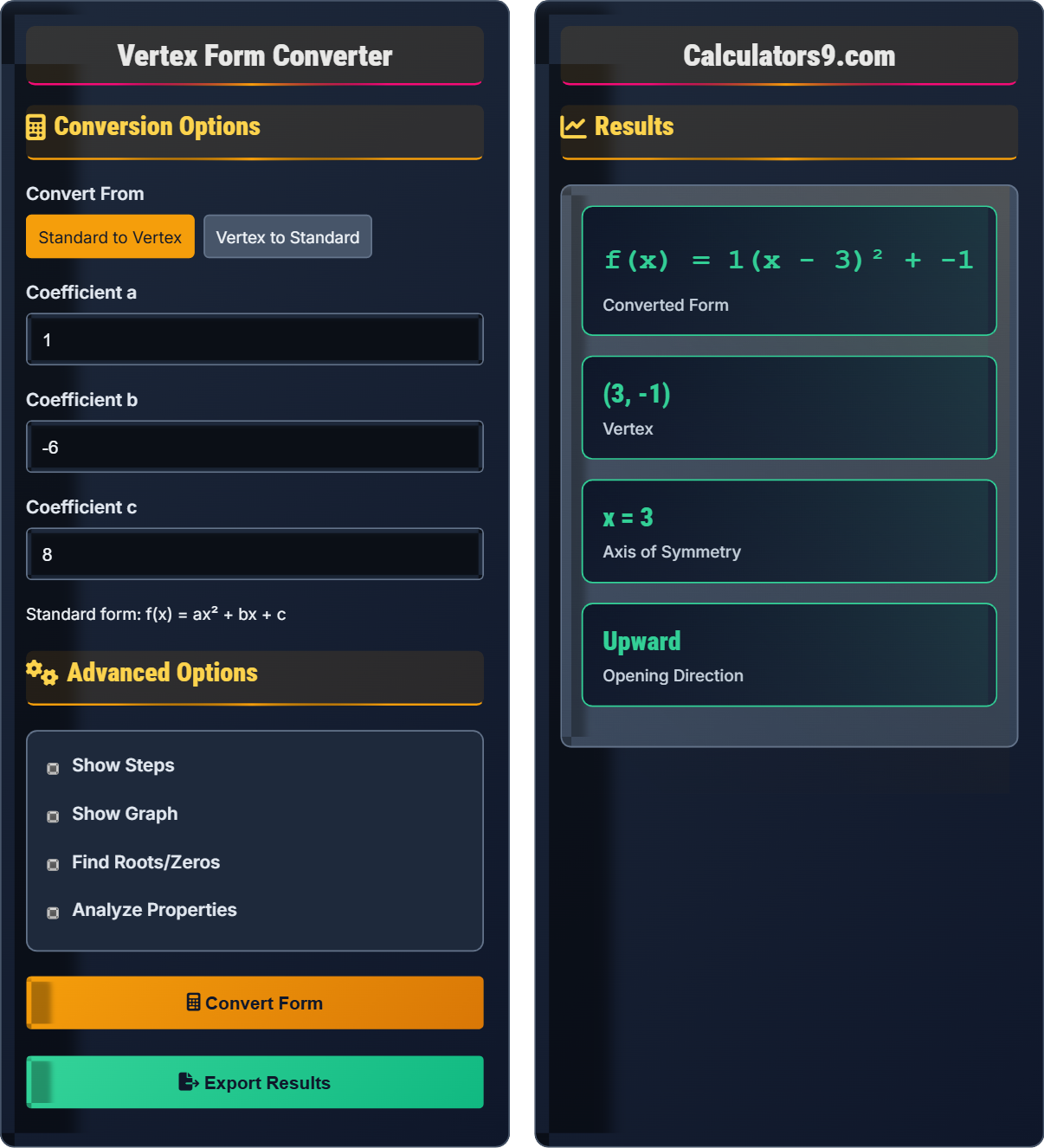
Conversion Options
Standard form: f(x) = ax² + bx + c
Advanced Options
Results
Comprehensive Quadratic Functions Guide
The vertex form of a quadratic function is written as f(x) = a(x - h)² + k, where (h, k) is the vertex of the parabola and 'a' determines the direction and width of the parabola. This form is particularly useful because it immediately provides the vertex coordinates and the axis of symmetry.
Methods for converting between standard and vertex forms:
- Standard to Vertex: Complete the square by factoring out 'a', adding and subtracting (b/2a)² inside the parentheses
- Vertex to Standard: Expand the squared binomial and combine like terms
- Using Formulas: h = -b/(2a) and k = f(h) for converting standard to vertex
Key features determined from vertex form:
- Vertex: (h, k) - the maximum or minimum point
- Axis of Symmetry: x = h - vertical line through vertex
- Direction: Upward if a > 0, downward if a < 0
- Width: Narrower if |a| > 1, wider if |a| < 1
- Y-Intercept: f(0) = ah² + k
- Projectile Motion: Trajectory follows parabolic path
- Optimization: Finding maximum profit or minimum cost
- Physics: Parabolic reflectors, satellite dishes
- Economics: Revenue and cost functions
- Engineering: Bridge design, arch structures
Quadratic Fundamentals
The vertex is the highest or lowest point on a parabola, located at (h, k) in vertex form f(x) = a(x - h)² + k.
For f(x) = ax² + bx + c, vertex is at x = -b/(2a), then substitute to find y-coordinate.
- If a > 0, parabola opens upward (minimum at vertex)
- If a < 0, parabola opens downward (maximum at vertex)
- Axis of symmetry is x = h
- The vertex represents optimal value in applications
Advanced Concepts
A technique to convert standard form to vertex form by creating a perfect square trinomial.
- Set f(x) = 0
- Solve: a(x - h)² + k = 0
- (x - h)² = -k/a
- x = h ± √(-k/a) (if discriminant ≥ 0)
- If k/a > 0 and a > 0: no real roots
- If k/a = 0: one real root (at vertex)
- If k/a < 0: two real roots
Quadratic Functions Learning Quiz
Convert the quadratic function f(x) = 2x² - 8x + 5 to vertex form by completing the square. Show all steps and identify the vertex.
Step 1: Factor out the leading coefficient from first two terms: f(x) = 2(x² - 4x) + 5
Step 2: Complete the square inside parentheses. Take half of coefficient of x: (-4/2) = -2. Square it: (-2)² = 4.
Step 3: Add and subtract this square inside parentheses: f(x) = 2(x² - 4x + 4 - 4) + 5
Step 4: Group perfect square trinomial: f(x) = 2((x² - 4x + 4) - 4) + 5
Step 5: Factor the trinomial: f(x) = 2((x - 2)² - 4) + 5
Step 6: Distribute the 2: f(x) = 2(x - 2)² - 8 + 5
Step 7: Combine constants: f(x) = 2(x - 2)² - 3
Therefore, the vertex form is f(x) = 2(x - 2)² - 3, with vertex at (2, -3).
This problem demonstrates the completing the square technique, which transforms a quadratic from standard form to vertex form. The key insight is that we create a perfect square trinomial by adding and subtracting the same value, which doesn't change the function but allows us to factor into a squared binomial. The process isolates the squared term, revealing the vertex coordinates directly from the vertex form.
Completing the square is essential because it provides the vertex coordinates without memorizing formulas.
Perfect Square Trinomial: A trinomial that factors into a squared binomial, like x² - 4x + 4 = (x - 2)²
Completing the Square: Adding and subtracting the square of half the linear coefficient to create a perfect square trinomial
Vertex Form: f(x) = a(x - h)² + k, where (h, k) is the vertex
• Always factor out the leading coefficient before completing the square
• Take half of the linear coefficient, then square it
• Add and subtract the same value to maintain equality
• Remember the pattern: (x - h)² means vertex is at x = h
• The sign of h is opposite to what appears in the binomial
• Check your work by expanding back to standard form
• Forgetting to factor out the leading coefficient
• Incorrectly calculating half of the linear coefficient
• Forgetting to multiply by the leading coefficient when distributing
A ball is thrown upward with an initial velocity of 64 ft/sec from a height of 6 feet. Its height after t seconds is modeled by h(t) = -16t² + 64t + 6. Find the maximum height and when it occurs. At what time does the ball hit the ground?
This is a quadratic function modeling projectile motion. To find the maximum height, we need to find the vertex of the parabola.
For h(t) = -16t² + 64t + 6, we have a = -16, b = 64, c = 6.
Time at maximum height: t = -b/(2a) = -64/(2×(-16)) = -64/(-32) = 2 seconds
Maximum height: h(2) = -16(2)² + 64(2) + 6 = -64 + 128 + 6 = 70 feet
Time when ball hits ground: Set h(t) = 0 and solve:
-16t² + 64t + 6 = 0
Using quadratic formula: t = (-64 ± √(64² - 4(-16)(6))) / (2(-16))
t = (-64 ± √(4096 + 384)) / (-32) = (-64 ± √4480) / (-32)
t = (-64 ± 66.93) / (-32)
t ≈ 4.09 seconds (taking positive solution)
Therefore, the ball reaches maximum height of 70 feet after 2 seconds, and hits the ground after about 4.09 seconds.
This application problem connects quadratic functions to physics. The negative coefficient of the squared term indicates the parabola opens downward, representing the ball's trajectory under gravity. The vertex gives the maximum height since the parabola opens downward. The zeros of the function represent when the ball is at ground level.
Understanding the physical meaning of the mathematical results is crucial in applied problems.
Projectile Motion: Motion under constant gravitational acceleration, following a parabolic path
Vertex in Physics: The point of maximum height in projectile motion
Roots in Physics: Times when the object is at ground level
• In projectile motion, the coefficient of t² is always negative (due to gravity)
• Time cannot be negative in physics applications
• The vertex represents maximum height when the coefficient of t² is negative
• Always check that your answers make physical sense
• Time values should be positive in motion problems
• The vertex formula t = -b/(2a) works for any quadratic function
• Forgetting to consider only positive time solutions in physics problems
• Misapplying the vertex formula
• Arithmetic errors when using the quadratic formula
FAQ
Q: Why is vertex form useful compared to standard form for analyzing parabolas?
A: Vertex form f(x) = a(x - h)² + k is extremely useful because it directly reveals key characteristics of the parabola:
Vertex Coordinates: The vertex is immediately visible at (h, k).
Axis of Symmetry: The line x = h is the axis of symmetry.
Direction and Width: The coefficient 'a' indicates whether the parabola opens up (a > 0) or down (a < 0), and how wide or narrow it is.
Transformation Information: The values h and k show horizontal and vertical shifts from the parent function f(x) = x².
In contrast, standard form f(x) = ax² + bx + c requires calculation to find the vertex using h = -b/(2a) and k = f(h). Vertex form makes analysis immediate and intuitive.
For optimization problems, vertex form instantly shows the maximum or minimum value of the function.
Q: How do I find the focus and directrix of a parabola from vertex form?
A: For a parabola in vertex form f(x) = a(x - h)² + k, the focus and directrix can be found as follows:
First, rewrite the equation in the form (x - h)² = 4p(y - k), where p is the focal length.
Starting with f(x) = a(x - h)² + k:
- y = a(x - h)² + k
- y - k = a(x - h)²
- (1/a)(y - k) = (x - h)²
- (x - h)² = (1/a)(y - k)
Comparing to (x - h)² = 4p(y - k), we have 4p = 1/a, so p = 1/(4a).
Focus: Located at (h, k + p) = (h, k + 1/(4a))
Directrix: The horizontal line y = k - p = k - 1/(4a)
For example, if f(x) = 2(x - 3)² + 1, then a = 2, h = 3, k = 1. So p = 1/(4×2) = 1/8. Focus is at (3, 1 + 1/8) = (3, 9/8), and directrix is y = 1 - 1/8 = 7/8.