Avogadro's Number Converter
Atomic analysis • 2026 chemistry
Avogadro's Number Formula:
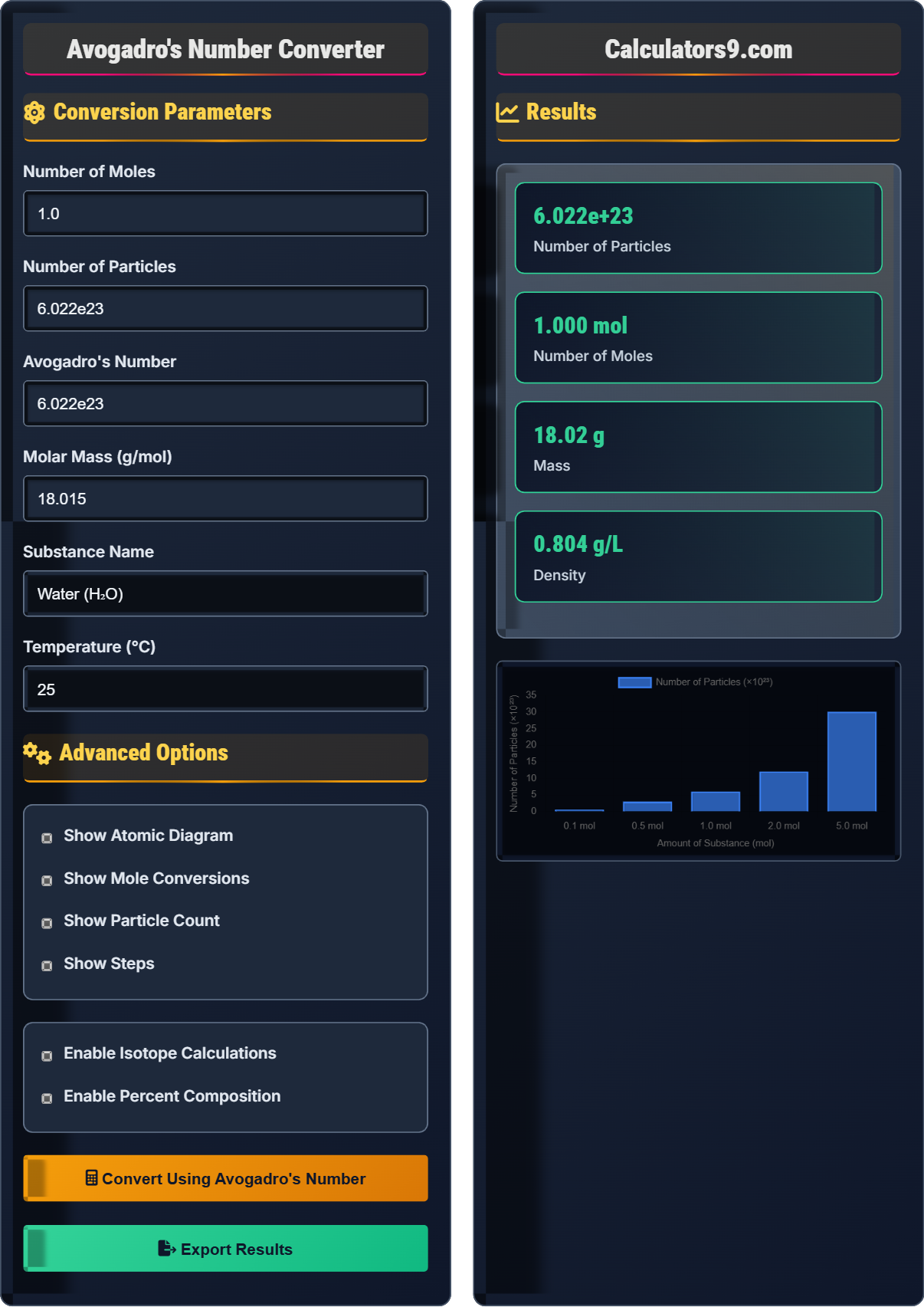
Show the calculator\( N = n \times N_A \)
Where:
- \( N \) = number of particles (atoms, molecules, ions)
- \( n \) = number of moles
- \( N_A \) = Avogadro's number = 6.022 × 10²³ particles/mol
This fundamental constant relates the macroscopic amount of substance (moles) to the microscopic count of particles (atoms, molecules, ions). Avogadro's number is the bridge between the atomic scale and measurable quantities in the laboratory. One mole of any substance contains exactly 6.022 × 10²³ particles, regardless of the type of particle.
Derived forms:
- \( n = \frac{N}{N_A} \) (moles from particles)
- \( N_A = \frac{N}{n} \) (definition of Avogadro's number)
- \( \text{mass} = n \times \text{molar mass} \) (connection to grams)
Conversion Parameters
Advanced Options
Results
| Conversion | Value | Units |
|---|
| Particle Type | Count | Scientific Notation |
|---|
| Mass Parameter | Value | Units |
|---|
Comprehensive Avogadro's Number Guide
Avogadro's number (N_A = 6.022 × 10²³) is the number of elementary entities (atoms, molecules, ions, electrons) in one mole of a substance. Named after Italian scientist Amedeo Avogadro, it provides the connection between macroscopic measurements and microscopic reality. This fundamental constant allows chemists to count particles by weighing them.
The fundamental relationship is:
Where:
- \(N\) = number of particles
- \(n\) = number of moles
- \(N_A\) = Avogadro's number (6.022 × 10²³)
Avogadro's number connects to other fundamental concepts:
Where m is mass and M is molar mass.
- Significant Figures: Match precision of measurements
- Scientific Notation: Essential for large numbers
- Unit Conversions: Always check units cancel properly
- Real vs Ideal: Assumes perfect counting
Avogadro's Number Fundamentals
Number of particles in one mole of substance (6.022×10²³).
\(N = n \times N_A\)
Where N=particles, n=moles, N_A=Avogadro's number.
- Constant for all substances
- Connects macro and micro
- Essential for stoichiometry
Applications
Essential for all chemical calculations involving amounts of substances.
- Reaction stoichiometry
- Concentration calculations
- Gas law applications
- Biochemical pathways
- Scientific notation essential
- Unit cancellation critical
- Significant figures matter
- Connects to other constants
Avogadro's Number Learning Quiz
How many molecules are in 0.50 moles of water?
The answer is A) 3.011 × 10²³. Using the formula N = n × N_A: N = 0.50 mol × 6.022 × 10²³ particles/mol = 3.011 × 10²³ molecules. This demonstrates that the number of particles is directly proportional to the number of moles.
This calculation shows the direct proportionality between moles and particles. Since Avogadro's number is the conversion factor, multiplying moles by N_A gives the number of particles. For 0.50 mol, we expect half of Avogadro's number of particles.
Avogadro's Number: 6.022 × 10²³ particles/mol
Mole: Amount of substance containing N_A particles
Proportional: N ∝ n (when N_A is constant)
• N = n × N_A
• Direct proportionality
• Always use scientific notation for large numbers
• Remember: 1 mol = 6.022×10²³ particles
• Use dimensional analysis
• Check exponent arithmetic
• Forgetting to multiply by Avogadro's number
• Arithmetic errors with exponents
• Not using scientific notation properly
Calculate how many moles are in 2.4 × 10²⁴ atoms of carbon. Show your work.
Using the formula n = N/N_A:
Given:
- N = 2.4 × 10²⁴ atoms
- N_A = 6.022 × 10²³ atoms/mol
Step 1: Apply the formula: n = N/N_A
Step 2: Substitute values: n = (2.4 × 10²⁴) / (6.022 × 10²³)
Step 3: Calculate: n = (2.4/6.022) × (10²⁴/10²³) = 0.398 × 10¹ = 3.98 mol
Therefore, there are approximately 4.0 moles of carbon atoms.
This demonstrates the inverse relationship. When converting from particles to moles, we divide by Avogadro's number. The division of powers of 10: (10²⁴)/(10²³) = 10¹. The result makes sense because we have about 4 times more particles than Avogadro's number.
Inverse Relationship: n = N/N_A (divide to go from particles to moles)
Division of Powers: 10ᵃ/10ᵇ = 10^(a-b)
Dimensional Analysis: Units cancel to give moles
• n = N/N_A (to find moles)
• N = n × N_A (to find particles)
• Use proper scientific notation
• Remember: particles → moles (divide by N_A)
• moles → particles (multiply by N_A)
• Check if answer is reasonable
• Dividing instead of multiplying (or vice versa)
• Arithmetic errors with exponents
• Forgetting to convert to scientific notation
A sample of glucose (C₆H₁₂O₆) contains 1.80 × 10²⁴ molecules. How many moles of glucose does this represent? How many carbon atoms are in this sample?
Step 1: Calculate moles of glucose
n = N/N_A = (1.80 × 10²⁴) / (6.022 × 10²³) = 2.99 mol ≈ 3.0 mol
Step 2: Calculate carbon atoms
Each glucose molecule has 6 carbon atoms
Total carbon atoms = 1.80 × 10²⁴ molecules × 6 atoms/molecule = 1.08 × 10²⁵ carbon atoms
Step 3: Alternative calculation using moles
Carbon atoms = 3.0 mol × 6 mol C/mol glucose × 6.022 × 10²³ atoms/mol = 1.08 × 10²⁵ carbon atoms
Therefore: 3.0 moles of glucose contain 1.08 × 10²⁵ carbon atoms.
This problem combines mole calculations with molecular structure. First, convert molecules to moles. Then, use the molecular formula to determine the number of specific atoms. The two approaches (direct counting vs. using moles) should give the same result.
Molecular Formula: Shows atoms per molecule (C₆H₁₂O₆)
Atomic Count: Atoms per molecule
Stoichiometric Ratio: 6 C atoms per glucose molecule
• Use molecular formula for atomic ratios
• Apply Avogadro's number consistently
• Multiple approaches should give same result
• Count atoms in molecular formula
• Use both direct and mole methods to verify
• Check units cancel properly
• Forgetting molecular composition
• Not accounting for multiple atoms
• Arithmetic errors with large numbers
A balloon contains 0.250 moles of helium gas at STP. Calculate the number of helium atoms, the volume of the gas, and the mass of the gas. (At STP: 1 mol gas = 22.4 L, He molar mass = 4.003 g/mol)
Step 1: Calculate number of helium atoms
N = n × N_A = 0.250 mol × 6.022 × 10²³ atoms/mol = 1.51 × 10²³ atoms
Step 2: Calculate volume at STP
V = n × (22.4 L/mol) = 0.250 mol × 22.4 L/mol = 5.60 L
Step 3: Calculate mass
m = n × M = 0.250 mol × 4.003 g/mol = 1.00 g
Therefore: 1.51 × 10²³ atoms, 5.60 L volume, 1.00 g mass.
This integrates Avogadro's number with other fundamental relationships. The mole serves as a bridge connecting particle count, volume (at STP), and mass. This demonstrates how the mole connects different measurable quantities in chemistry.
STP: Standard Temperature and Pressure (0°C, 1 atm)
Molar Volume: 22.4 L/mol at STP for ideal gases
Bridge Concept: Mole connects different measurable quantities
• 1 mol gas = 22.4 L at STP
• n = m/M (moles = mass/molar mass)
• N = n × N_A (particles)
• Mole is the universal connector
• Remember STP conditions
• Use molar volume for gas calculations
• Forgetting STP conditions
• Not using molar volume properly
• Confusing different conversion factors
Which statement about Avogadro's number is TRUE?
The answer is B) It represents the number of atoms in 12 g of carbon-12. Avogadro's number is defined as the number of atoms in exactly 12 grams of carbon-12 isotope. This definition makes it a universal constant that applies to all substances. The number was named after Avogadro but was determined by later scientists. It is a fundamental physical constant that never changes.
Historically, Avogadro proposed that equal volumes of gases at the same temperature and pressure contain equal numbers of molecules. The actual number (Avogadro's number) was determined later through various experimental methods and is now defined based on carbon-12. This provides a precise, universal standard.
Carbon-12: Stable isotope used as mass standard
Universal Constant: Same for all substances
Fundamental Constant: Does not change with conditions
• Universal constant (6.022×10²³)
• Defined by carbon-12
• Independent of conditions
• Remember definition: atoms in 12g C-12
• Universal for all substances
• Fundamental physical constant
• Thinking Avogadro discovered the number
• Believing it changes with conditions
• Thinking it's element-specific
FAQ
Q: How is Avogadro's number determined experimentally?
A: Avogadro's number has been determined through several experimental methods:
X-ray Crystallography: Measuring the spacing of atoms in crystals like silicon to determine how many atoms are in a given volume.
Electrolysis: Measuring the charge required to deposit a known mass of metal, using Faraday's constant.
Oil Drop Experiment: Millikan's oil drop experiment determined the charge of an electron, which relates to Avogadro's number.
Modern Definition: As of 2019, Avogadro's number is defined as exactly 6.02214076 × 10²³, based on the redefinition of the mole in terms of this exact number.
Q: How is Avogadro's number used in biological systems and biochemistry?
A: Avogadro's number is essential in biological systems:
Enzyme Kinetics: Determining turnover numbers (molecules processed per enzyme per second).
Metabolic Pathways: Calculating flux rates through biochemical pathways.
Drug Dosing: Converting between molar concentrations and molecular amounts.
Cellular Processes: Understanding the number of molecules involved in cellular signaling.
For example, if a cell contains 1 μM of a signaling molecule, that equals 6.022 × 10¹⁴ molecules per liter, or about 600,000 molecules per typical cell volume.