Concentration Calculator
Solution analysis • 2026 chemistry
Concentration Formulas:
Show the calculator\( \text{Molarity (M)} = \frac{\text{moles of solute}}{\text{liters of solution}} \)
\( \text{Molality (m)} = \frac{\text{moles of solute}}{\text{kilograms of solvent}} \)
\( \text{Normality (N)} = \text{Molarity} \times \text{equivalents per mole} \)
\( \text{Mass Percent} = \frac{\text{mass of solute}}{\text{mass of solution}} \times 100\% \)
These fundamental formulas express different ways to quantify the amount of solute in a solution. Molarity is the most common in laboratory settings, while molality is temperature-independent. Normality accounts for reactive equivalents in acid-base reactions.
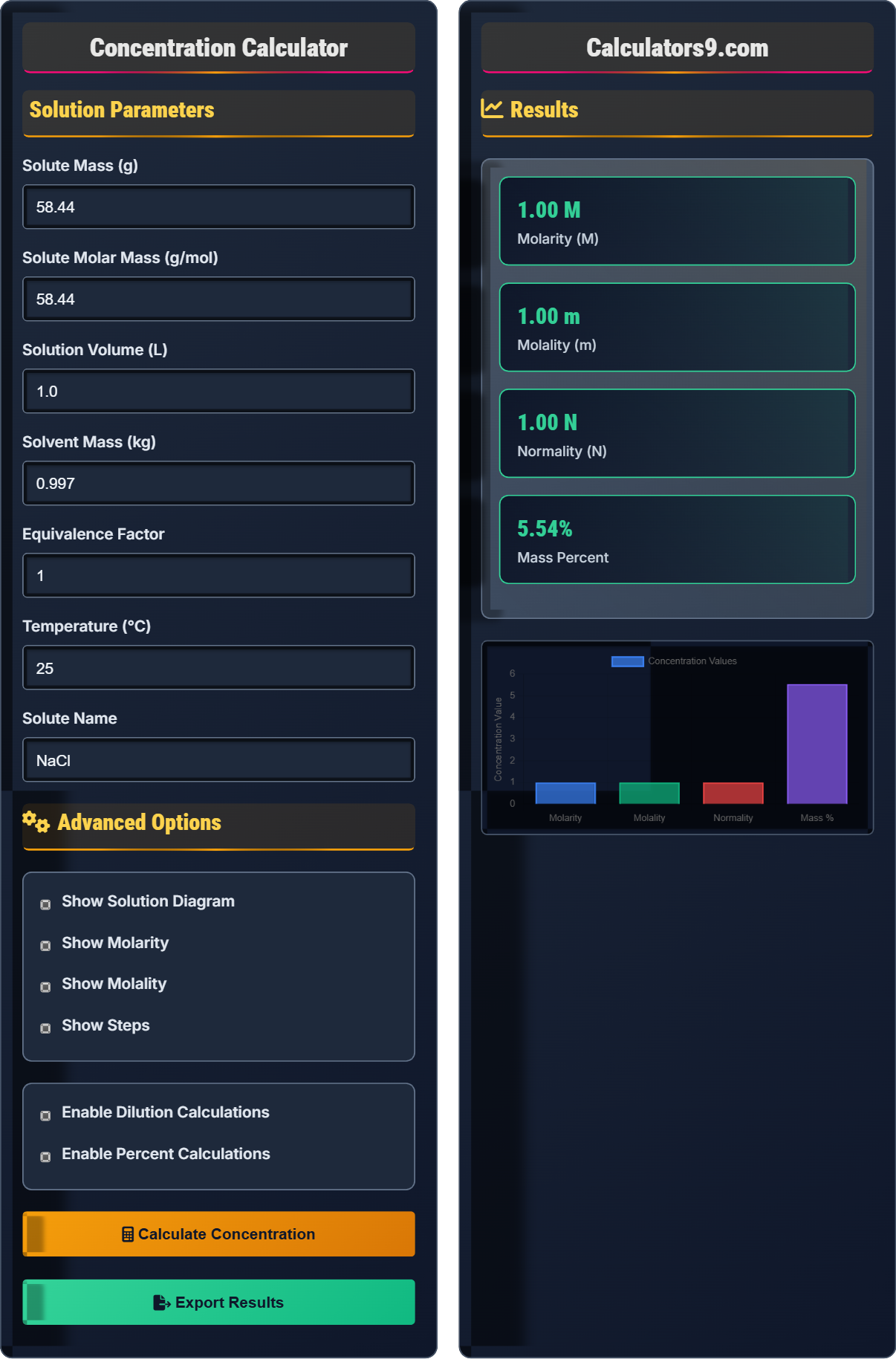
Example: For 58.44 g of NaCl (1.00 mol) dissolved in 1.00 L of solution:
Molarity = 1.00 mol / 1.00 L = 1.00 M
If the solvent mass is 0.997 kg, Molality = 1.00 mol / 0.997 kg = 1.00 m
Therefore, the solution has a molarity of 1.00 M.
Solution Parameters
Advanced Options
Results
| Concentration Type | Value | Units |
|---|
| Amount Type | Value | Units |
|---|
| Mass Component | Value | Units |
|---|
Comprehensive Concentration Guide
Concentration is a measure of the amount of solute dissolved in a given amount of solvent or solution. It quantifies the relative proportion of solute to solvent and is expressed in various units depending on the application. Different concentration units serve specific purposes in chemistry and biology.
The main concentration expressions are:
Where:
- \(M\) = Molarity (mol/L)
- \(m\) = Molality (mol/kg)
- \(N\) = Normality (equivalents/L)
- \(n\) = moles of solute
- \(V\) = liters of solution
- \(kg_{solvent}\) = kilograms of solvent
- \(f_{eq}\) = equivalence factor
Key differences between concentration units:
Molarity is temperature-dependent, while molality is not.
- Temperature Effects: Molarity changes with temperature
- Significant Figures: Match precision of measurements
- Unit Selection: Choose based on application needs
- Equivalents: Consider reaction stoichiometry for normality
Concentration Fundamentals
Amount of solute per amount of solution or solvent.
\(M = \frac{n}{V}\)
Where M=molarity, n=moles, V=volume.
- Temperature dependent
- Uses solution volume
- Standard in labs
Applications
Titration, dilution, and standard solution preparation.
- Titration analysis
- Standard solutions
- Reaction stoichiometry
- Quality control
- Temperature affects molarity
- Molality is temperature independent
- Choose units carefully
- Consider solute-solvent interactions
Concentration Learning Quiz
What is the molarity of a solution prepared by dissolving 117 g of NaCl (molar mass = 58.44 g/mol) in enough water to make 2.00 L of solution?
The answer is B) 1.00 M. First, calculate moles of NaCl: n = mass/molar mass = 117 g / 58.44 g/mol = 2.00 mol. Then, calculate molarity: M = n/V = 2.00 mol / 2.00 L = 1.00 M. This represents the number of moles of solute per liter of solution.
This demonstrates the two-step process for calculating molarity: first convert mass to moles using molar mass, then divide moles by solution volume. The key is to distinguish between solution volume and solvent volume.
Molarity: Moles of solute per liter of solution
Solution Volume: Total volume of solute + solvent
Molar Mass: Mass of one mole of substance
• M = n/V (molarity = moles/volume)
• Use solution volume, not solvent volume
• Convert mass to moles first
• Always convert mass to moles first
• Volume must be in liters
• Check units cancel properly
• Using solvent mass instead of solution volume
• Forgetting to convert mass to moles
• Using wrong volume units
Calculate the molality of a solution prepared by dissolving 74.1 g of Ca(OH)₂ (molar mass = 74.1 g/mol) in 500 g of water.
Step 1: Calculate moles of Ca(OH)₂
n = mass/molar mass = 74.1 g / 74.1 g/mol = 1.00 mol
Step 2: Convert solvent mass to kg
Mass of solvent = 500 g = 0.500 kg
Step 3: Calculate molality
m = n/kg_solvent = 1.00 mol / 0.500 kg = 2.00 m
Therefore, the molality is 2.00 m.
Molality differs from molarity because it uses solvent mass instead of solution volume. This makes molality temperature-independent, which is important for colligative properties. The calculation requires converting mass to moles and mass to kg.
Molality: Moles of solute per kg of solvent
Temperature Independent: Does not change with temperature
Colligative Properties: Properties that depend on particle number
• m = n/kg_solvent
• Uses solvent mass (not solution mass)
• Temperature independent
• Always convert mass to kg for molality
• Remember: molality ≠ molarity
• Use for boiling/freezing point calculations
• Using solution mass instead of solvent mass
• Forgetting to convert to kg
• Confusing molality with molarity
How many milliliters of 6.0 M HCl are needed to prepare 500 mL of 0.50 M HCl solution? What is the dilution factor?
Step 1: Apply dilution formula: M₁V₁ = M₂V₂
Given: M₁ = 6.0 M, M₂ = 0.50 M, V₂ = 500 mL
Step 2: Solve for V₁
V₁ = (M₂V₂)/M₁ = (0.50 M × 500 mL)/6.0 M = 250/6.0 = 41.7 mL
Step 3: Calculate dilution factor
Dilution factor = V₂/V₁ = 500 mL / 41.7 mL = 12.0
Therefore, 41.7 mL of 6.0 M HCl is needed, and the dilution factor is 12.0.
Dilution calculations preserve the number of moles of solute. The dilution factor represents how much the solution is diluted. A dilution factor of 12.0 means the original solution was diluted 12-fold.
Dilution Formula: M₁V₁ = M₂V₂ (moles conserved)
Dilution Factor: V₂/V₁ (how much diluted)
Constant Moles: n₁ = n₂ in dilution
• M₁V₁ = M₂V₂ (dilution law)
• Moles of solute remain constant
• Volume units must match
• Concentrated volume is always smaller
• Check that dilution makes sense
• Verify units cancel properly
• Mixing up initial and final values
• Forgetting that moles stay constant
• Unit conversion errors
Calculate the normality of a 0.25 M H₂SO₄ solution. How many equivalents of H⁺ does sulfuric acid provide per mole?
Step 1: Determine equivalence factor for H₂SO₄
H₂SO₄ is a diprotic acid that can donate 2 H⁺ ions per molecule
Therefore, equivalence factor = 2 equivalents per mole
Step 2: Calculate normality
N = M × equivalence factor = 0.25 M × 2 = 0.50 N
Step 3: Verify the relationship
Each mole of H₂SO₄ provides 2 moles of H⁺ ions (2 equivalents)
Therefore, the normality is 0.50 N.
Normality accounts for the reactive capacity of acids and bases. Sulfuric acid (H₂SO₄) is diprotic, meaning it can donate two protons (H⁺) per molecule, so its normality is twice its molarity. This is important in acid-base titrations.
Normality: Equivalents per liter of solution
Equivalence Factor: Reactive units per mole
Diprotic Acid: Can donate 2 protons per molecule
• N = M × equivalence factor
• H₂SO₄: 2 equivalents per mole
• HCl: 1 equivalent per mole
• Count ionizable hydrogens for acids
• Count hydroxide groups for bases
• Use for titration calculations
• Forgetting to count all ionizable hydrogens
• Assuming 1:1 equivalence for all acids
• Confusing with molarity calculations
Which concentration unit is temperature-independent?
The answer is B) Molality (m). Molality is defined as moles of solute per kilogram of solvent. Since it uses mass (kg) rather than volume (L), it is not affected by temperature changes. Molarity, normality, and mass percent that involve volume are temperature-dependent because volume changes with temperature.
This highlights the key difference between concentration units. Molarity uses solution volume which expands with temperature, while molality uses solvent mass which is unaffected by temperature. This makes molality important for colligative properties calculations.
Temperature Independent: Does not change with temperature
Colligative Properties: Properties depending on particle number
Volume Expansion: Liquids expand with temperature
• Mass does not change with temperature
• Volume changes with temperature
• Use molality for temperature-sensitive applications
• Mass-based units are temperature independent
• Volume-based units are temperature dependent
• Use molality for boiling/Freezing point
• Thinking all concentration units are temperature independent
• Using molarity for colligative properties
• Not considering volume expansion
FAQ
Q: What is the difference between molarity and molality, and when should each be used?
A: The key differences are:
Molarity (M): Moles of solute per liter of solution
\(M = \frac{\text{moles of solute}}{\text{liters of solution}}\)
Molality (m): Moles of solute per kilogram of solvent
\(m = \frac{\text{moles of solute}}{\text{kilograms of solvent}}\)
When to use:
- Molarity: Most laboratory applications, titrations, reactions in solution
- Molality: Colligative properties (boiling point elevation, freezing point depression), thermodynamic calculations
Molarity changes with temperature because solution volume expands/contracts, while molality remains constant.
Q: How is concentration important in biological systems and cellular processes?
A: Concentration is fundamental to biological systems:
Osmosis: Cell membrane permeability depends on concentration gradients across membranes.
Enzyme Activity: Michaelis-Menten kinetics describes how reaction rate depends on substrate concentration.
Neurotransmission: Action potentials depend on Na⁺ and K⁺ concentration gradients.
Drug Dosing: Therapeutic concentrations must be maintained for efficacy without toxicity.
For example, blood glucose concentration is tightly regulated at ~5 mM, and deviations cause diabetes complications. The Nernst equation relates ion concentration gradients to membrane potential.