Half-Life Decay Calculator
Nuclear analysis • 2026 chemistry
Radioactive Decay Formula:
Show the calculator\( N(t) = N_0 e^{-\lambda t} \)
Where:
- \( N(t) \) = remaining nuclei at time t
- \( N_0 \) = initial number of nuclei
- \( \lambda \) = decay constant
- \( t \) = time elapsed
This exponential decay model describes how radioactive nuclei decrease over time. The half-life (t₁/₂) is related to the decay constant by: t₁/₂ = ln(2)/λ. The decay constant represents the probability per unit time that a nucleus will decay. This law applies to all radioactive decay processes.
Alternative forms:
- \( N(t) = N_0 (1/2)^{t/t_{1/2}} \)
- \( A(t) = A_0 e^{-\lambda t} \) (activity decay)
- \( A(t) = A_0 (1/2)^{t/t_{1/2}} \) (activity form)
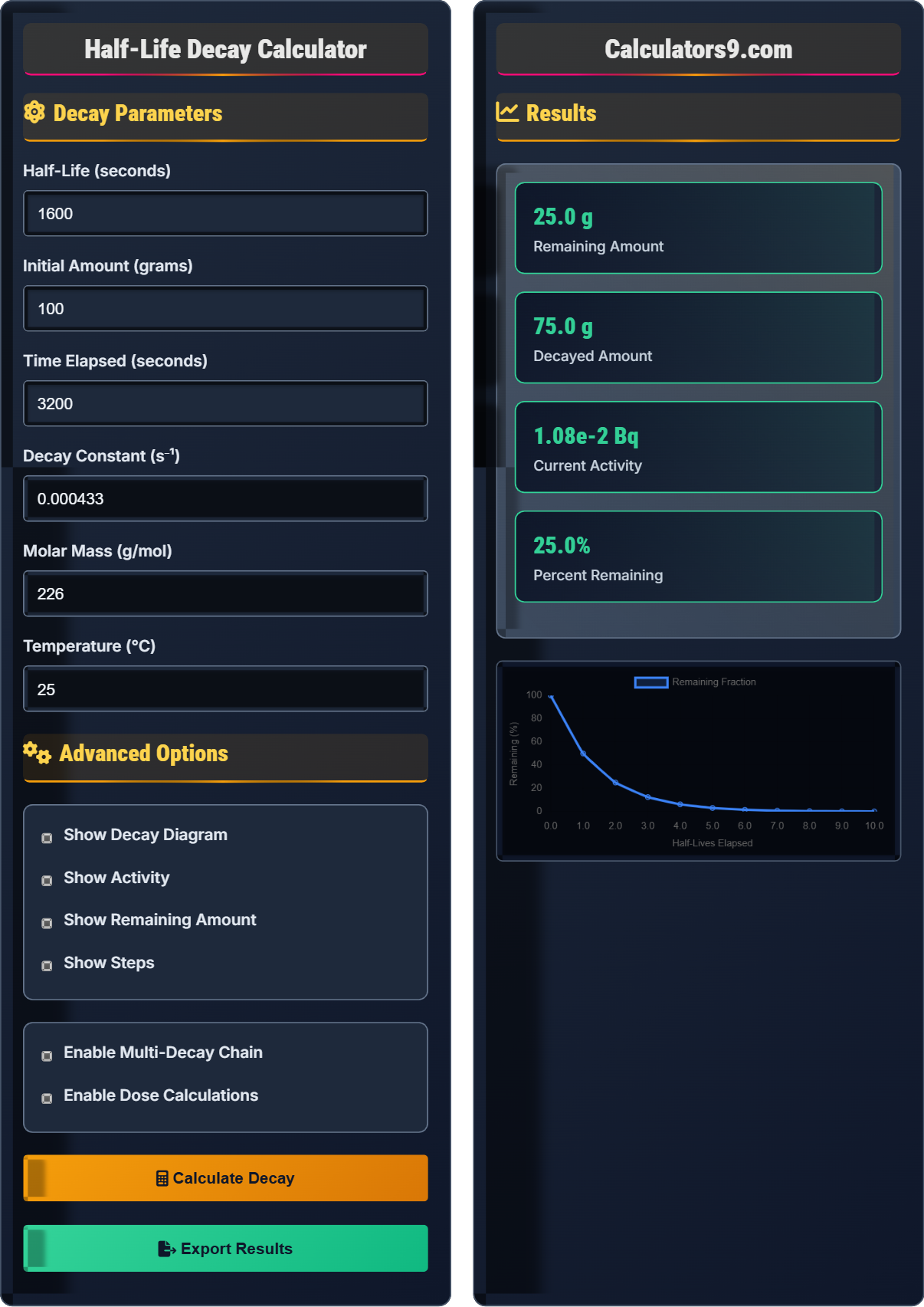
Decay Parameters
Advanced Options
Results
| Parameter | Value | Units |
|---|
| Activity Type | Value | Units |
|---|
| Time Parameter | Value | Units |
|---|
Comprehensive Half-Life Guide
Radioactive decay is the spontaneous transformation of an unstable atomic nucleus into a more stable configuration, accompanied by the emission of radiation. The half-life is the time required for half of the radioactive nuclei in a sample to decay. This process follows first-order kinetics and is characterized by the decay constant (λ).
The fundamental equation is:
Where:
- \(N(t)\) = remaining nuclei at time t
- \(N_0\) = initial number of nuclei
- \(\lambda\) = decay constant
- \(t\) = time elapsed
Half-life connects to other nuclear concepts:
Where A is activity and τ is mean lifetime.
- Temperature Independence: Half-life is not affected by temperature
- Pressure Independence: Pressure does not affect nuclear decay rates
- Chemical Environment: Decay rates are independent of chemical state
- Statistical Nature: Large samples required for predictable behavior
Decay Fundamentals
Spontaneous nuclear transformation with radiation emission.
\(N(t) = N_0 e^{-\lambda t}\)
Where N=remaining nuclei, N₀=initial, λ=decay constant, t=time.
- Exponential decay
- Half-life constant
- Independent of conditions
Applications
Medical imaging and therapy rely on controlled radioactive decay.
- Carbon dating
- Medical imaging
- Cancer therapy
- Industrial gauging
- Temperature independent
- Statistical in nature
- Requires safety measures
- Storage of radioactive waste
Half-Life Learning Quiz
After 3 half-lives, what fraction of the original radioactive material remains?
The answer is C) 1/8. After each half-life, the amount is halved. After 3 half-lives: 1/2 × 1/2 × 1/2 = 1/8. The general formula is (1/2)ⁿ where n is the number of half-lives elapsed. After 3 half-lives, 1/8 of the original material remains.
This demonstrates the exponential nature of radioactive decay. Each half-life reduces the remaining amount by half, so after n half-lives, the remaining fraction is (1/2)ⁿ. This is why radioactive materials become safer over time.
Half-Life: Time for half of nuclei to decay
Exponential Decay: Decreasing by constant proportions
Radioactive Decay: Spontaneous nuclear transformation
• Remaining fraction = (1/2)ⁿ
• Each half-life halves the remaining amount
• Exponential decay is predictable
• After n half-lives, remaining = (1/2)ⁿ
• After 1: 1/2 remains
• After 2: 1/4 remains
• Thinking decay is linear instead of exponential
• Forgetting to raise (1/2) to the power of n
• Confusing remaining with decayed amount
Carbon-14 has a half-life of 5730 years. If you start with 100 grams of C-14, how much remains after 11,460 years?
Step 1: Calculate number of half-lives elapsed
Number of half-lives = Time elapsed / Half-life = 11,460 years / 5,730 years = 2
Step 2: Calculate remaining amount using (1/2)ⁿ
Remaining fraction = (1/2)² = 1/4
Remaining amount = Initial amount × Remaining fraction = 100 g × 1/4 = 25 g
Therefore, 25 grams of C-14 remain after 11,460 years.
This demonstrates how to calculate remaining amounts using the number of half-lives. Since 11,460 years is exactly 2 half-lives of C-14, the amount decreases by 1/2 twice: 100 → 50 → 25 grams.
Carbon-14: Radioactive isotope used in dating
Archaeological Dating: Uses C-14 decay for age determination
Half-Life Calculation: Time elapsed / Half-life = number of half-lives
• Calculate number of half-lives first
• Use (1/2)ⁿ for remaining fraction
• Multiply by initial amount
• Number of half-lives = time/half-life
• (1/2)ⁿ gives remaining fraction
• Always check if time is exact multiple
• Forgetting to calculate number of half-lives
• Using linear instead of exponential decay
• Confusing half-life with total time
A medical isotope of iodine-131 has a half-life of 8.02 days. If a patient receives 20 μg of I-131 for thyroid treatment, how much will remain after 24.06 days? How many half-lives have passed?
Step 1: Calculate number of half-lives elapsed
Number of half-lives = 24.06 days / 8.02 days = 3
Step 2: Calculate remaining amount
Remaining fraction = (1/2)³ = 1/8
Remaining amount = 20 μg × 1/8 = 2.5 μg
Step 3: Calculate percent remaining
Percent remaining = (2.5 μg / 20 μg) × 100% = 12.5%
Therefore, after 24.06 days (3 half-lives), 2.5 μg of I-131 remains (12.5% of original).
This medical application shows how half-life affects drug efficacy. Iodine-131 is used in thyroid treatments because it concentrates in the thyroid and its 8-day half-life provides sufficient time for treatment while ensuring rapid clearance.
Iodine-131: Radioisotope used in thyroid treatments
Medical Isotope: Radioactive material for diagnosis/therapy
Thyroid Treatment: Uses selective uptake of radioiodine
• Medical isotopes have controlled half-lives
• Longer half-life = longer duration
• Calculate half-lives first
• Use (1/2)ⁿ for remaining fraction
• Consider medical safety requirements
• Not considering medical implications
• Forgetting to calculate number of half-lives
• Confusing remaining with decayed amount
An archaeological sample contains 12.5% of the carbon-14 found in living organisms. Given that C-14 has a half-life of 5730 years, calculate the approximate age of the sample.
Step 1: Express remaining fraction as a power of 1/2
12.5% = 0.125 = 1/8 = (1/2)³
Step 2: Determine number of half-lives
Since (1/2)ⁿ = (1/2)³, then n = 3 half-lives
Step 3: Calculate age
Age = Number of half-lives × Half-life = 3 × 5730 years = 17,190 years
Therefore, the sample is approximately 17,190 years old.
This demonstrates reverse calculation - finding age from remaining percentage. By expressing the remaining percentage as a power of (1/2), we can determine how many half-lives have passed, then multiply by the half-life to get the age.
Carbon Dating: Uses C-14 decay for age determination
Archaeological Dating: Determines age of ancient materials
Living Organisms: Maintain equilibrium with atmospheric C-14
• Age = (number of half-lives) × (half-life)
• Convert percentage to fraction first
• Express fraction as power of (1/2)
• Express percentage as decimal
• Convert to power of (1/2)
• Multiply by half-life
• Forgetting to convert percentage to fraction
• Not expressing as power of (1/2)
• Confusing time units
Which statement about the decay constant (λ) is CORRECT?
The answer is C) It has units of inverse time. The decay constant λ has units of time⁻¹ (e.g., s⁻¹, yr⁻¹) and represents the probability per unit time that a nucleus will decay. The relationship between half-life and decay constant is: t₁/₂ = ln(2)/λ. The decay constant is characteristic of each isotope and does not change with time.
The decay constant represents the probability of decay per unit time. A larger decay constant means a shorter half-life (faster decay). The relationship t₁/₂ = ln(2)/λ shows that decay constant and half-life are inversely related.
Decay Constant: Probability of decay per unit time
Probability: Chance of decay in given time interval
Inverse Relationship: λ and t₁/₂ are inversely related
• λ has units of time⁻¹
• t₁/₂ = ln(2)/λ
• λ is constant for each isotope
• λ = ln(2)/t₁/₂
• Larger λ = faster decay
• λ is intrinsic property
• Thinking λ has units of time
• Confusing λ with t₁/₂
• Believing λ changes with time
FAQ
Q: How does temperature affect radioactive decay rates?
A: Temperature has no effect on radioactive decay rates. The half-life is determined by the nuclear binding energy and quantum mechanical tunneling probabilities, which are not influenced by temperature. This is because nuclear forces operate on a much smaller scale than atomic forces that are affected by thermal energy.
Mathematically: \( N(t) = N_0 e^{-\lambda t} \)
The decay constant λ is independent of temperature. This temperature independence is what makes radiometric dating reliable across geological time scales with varying climate conditions.
Q: How is radioactive decay used in biological research and medicine?
A: Radioactive decay has numerous biological applications:
Medical Imaging: PET scans use isotopes like F-18 (t₁/₂ = 110 min) and SPECT uses Tc-99m (t₁/₂ = 6 hours)
Cancer Therapy: I-131 for thyroid cancer (t₁/₂ = 8 days), targeted alpha therapy
Research Tracers: C-14 and H-3 labeling for metabolic studies
Diagnostic Tests: Bone scans with Tc-99m, cardiac perfusion studies
The key is matching the half-life to the application: short-lived for imaging (minimizes exposure), medium half-life for therapy (delivers dose over time).