Ideal Gas Law Calculator
Gas analysis • 2026 chemistry
Ideal Gas Law Formula:
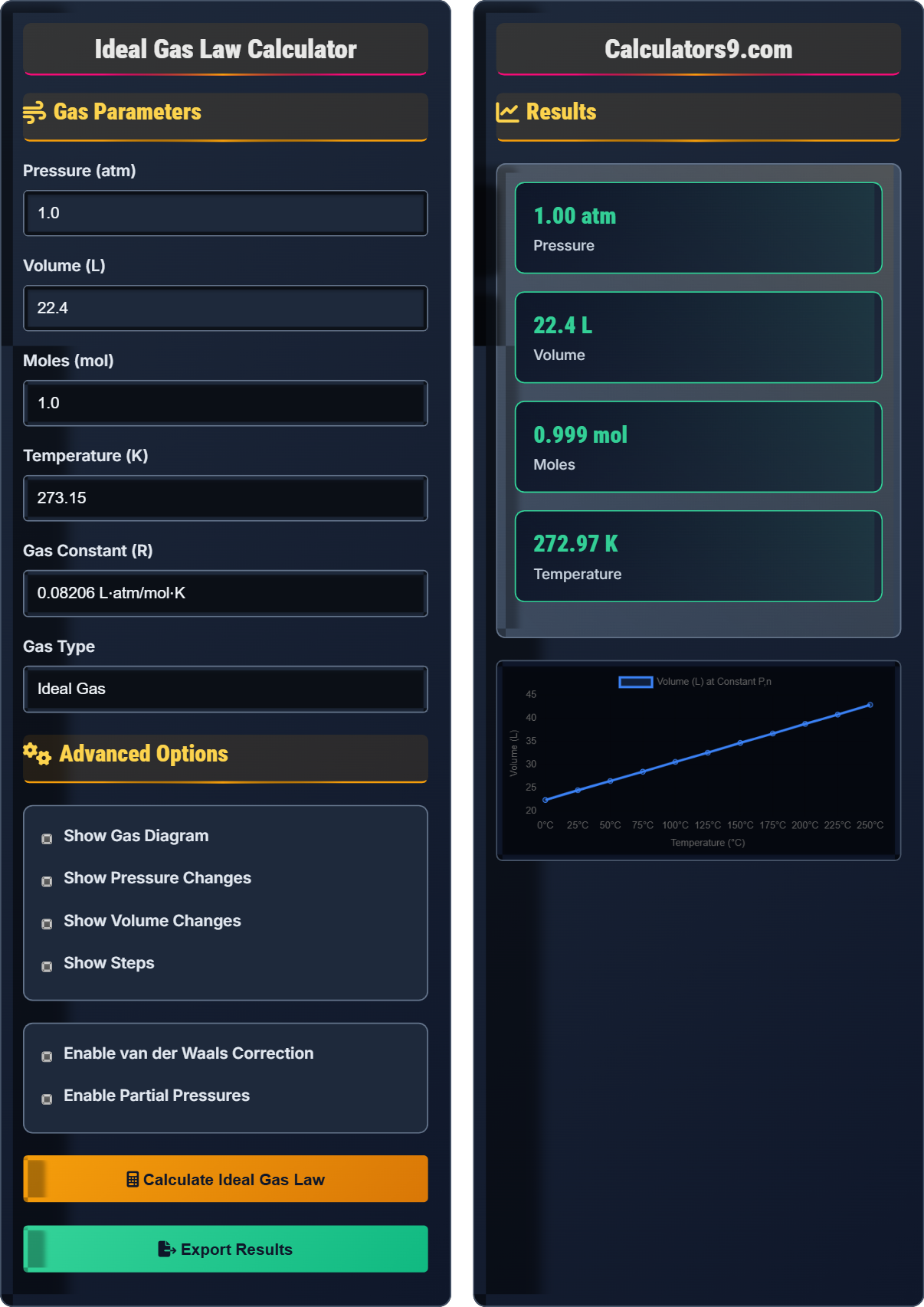
Show the calculator\( PV = nRT \)
Where:
- \( P \) = pressure (atm)
- \( V \) = volume (L)
- \( n \) = number of moles (mol)
- \( R \) = ideal gas constant (0.08206 L⋅atm/mol⋅K)
- \( T \) = temperature (K)
This fundamental equation describes the behavior of an ideal gas, relating pressure, volume, temperature, and amount of substance. The ideal gas law assumes that gas particles have no volume and no intermolecular forces. While real gases deviate from ideal behavior at high pressures and low temperatures, the ideal gas law provides excellent approximations under most conditions.
Derived forms:
- \( P = \frac{nRT}{V} \) (pressure form)
- \( V = \frac{nRT}{P} \) (volume form)
- \( n = \frac{PV}{RT} \) (moles form)
- \( T = \frac{PV}{nR} \) (temperature form)
Gas Parameters
Advanced Options
Results
| Parameter | Value | Units |
|---|
| Relationship | Expression | Value |
|---|
| Derived Property | Value | Units |
|---|
Comprehensive Ideal Gas Law Guide
The ideal gas law combines Boyle's law, Charles's law, and Avogadro's law into a single equation: PV = nRT. It describes the behavior of an ideal gas, where particles are assumed to have no volume and no intermolecular attractions. The law provides excellent approximations for real gases under moderate conditions of temperature and pressure.
The fundamental equation is:
Where:
- \(P\) = pressure (atm, Pa, mmHg)
- \(V\) = volume (L, m³)
- \(n\) = number of moles (mol)
- \(R\) = gas constant (0.08206 L⋅atm/mol⋅K)
- \(T\) = absolute temperature (K)
The ideal gas constant R has different values depending on the units used:
- Temperature: Must be in Kelvin (K = °C + 273.15)
- Pressure: Use consistent units throughout
- Real Gases: Deviate from ideal behavior at high pressure and low temperature
- Limitations: Becomes inaccurate near condensation points
Gas Law Fundamentals
Relationship between pressure, volume, temperature, and moles of gas.
\(PV = nRT\)
Where P=pressure, V=volume, n=moles, R=gas constant, T=temperature.
- Temperature in Kelvin
- Consistent units required
- Applies to ideal gases
Applications
Chemical reactions involving gases use ideal gas law for calculations.
- Reaction stoichiometry
- Atmospheric modeling
- Engine design
- Respiratory physiology
- Real gases deviate at extremes
- Temperature affects behavior
- Pressure-volume relationship
- Avogadro's law component
Ideal Gas Law Learning Quiz
According to the ideal gas law, what happens to the volume of a gas when the temperature is doubled while pressure and number of moles remain constant?
The answer is C) Volume doubles. From PV = nRT, when P and n are constant, V/T = constant (Charles's law). If T doubles, then V must also double to maintain the equality. This demonstrates the direct proportionality between volume and temperature at constant pressure.
This is Charles's law, a special case of the ideal gas law. When pressure and moles are held constant, volume and temperature are directly proportional. As temperature increases, gas particles move faster and push the container walls outward, increasing volume.
Charles's Law: V/T = constant at constant P and n
Direct Proportionality: V ∝ T
Constant Pressure: Isobaric process
• V/T = constant (Charles's law)
• Direct relationship: V ∝ T
• Temperature must be in Kelvin
• Always convert to Kelvin
• Hold other variables constant
• Direct relationships: ↑T → ↑V
• Using Celsius instead of Kelvin
• Forgetting to hold other variables constant
• Confusing direct and inverse relationships
Calculate the pressure of 2.00 moles of gas in a 10.0 L container at 300 K. (R = 0.08206 L⋅atm/mol⋅K)
Using the ideal gas law: PV = nRT
Given:
- n = 2.00 mol
- V = 10.0 L
- T = 300 K
- R = 0.08206 L⋅atm/mol⋅K
Step 1: Rearrange to solve for pressure: P = nRT/V
Step 2: Substitute values: P = (2.00 mol × 0.08206 L⋅atm/mol⋅K × 300 K) / 10.0 L
Step 3: Calculate: P = (49.236 L⋅atm) / 10.0 L = 4.92 atm
Therefore, the pressure is 4.92 atm.
This demonstrates solving for pressure when volume, moles, and temperature are known. The key is to rearrange the ideal gas law to isolate the unknown variable, then substitute the known values with proper units.
Gas Constant: R = 0.08206 L⋅atm/mol⋅K
Isolated Variable: P in this case
Unit Consistency: All units must match R
• Rearrange equation to isolate unknown
• Match units to gas constant
• Use Kelvin for temperature
• Write equation with unknown isolated
• Substitute values with units
• Check units cancel properly
• Forgetting to rearrange the equation
• Using wrong temperature scale
• Mismatching units with gas constant
During inhalation, the lung volume increases from 2.0 L to 3.0 L while maintaining a constant temperature of 310 K and pressure of 1.0 atm. How many additional moles of air are inhaled? (R = 0.08206 L⋅atm/mol⋅K)
Step 1: Calculate initial moles using PV = nRT
n_initial = PV/RT = (1.0 atm × 2.0 L) / (0.08206 L⋅atm/mol⋅K × 310 K) = 2.0 / 25.44 = 0.0786 mol
Step 2: Calculate final moles
n_final = PV/RT = (1.0 atm × 3.0 L) / (0.08206 L⋅atm/mol⋅K × 310 K) = 3.0 / 25.44 = 0.118 mol
Step 3: Calculate additional moles inhaled
Additional moles = n_final - n_initial = 0.118 - 0.0786 = 0.0394 mol
Therefore, 0.039 mol of additional air are inhaled.
This demonstrates how the ideal gas law applies to respiratory physiology. As the diaphragm contracts and lung volume increases, more air (moles) enters to maintain constant pressure and temperature. This is how breathing works at the molecular level.
Respiratory Physiology: Gas exchange in lungs
Diaphragm Contraction: Increases lung volume
Constant Conditions: Pressure and temperature maintained
• Breathing involves pressure-volume relationships
• Constant temperature assumption
• Atmospheric pressure is maintained
• Apply gas law to initial and final states
• Calculate difference in moles
• Consider biological applications
• Forgetting to calculate both initial and final states
• Not considering biological context
• Incorrect unit conversions
A mixture of gases contains 0.21 mol of O₂ and 0.78 mol of N₂ in a 5.0 L container at 298 K. Calculate the total pressure and the partial pressure of each gas.
Step 1: Calculate total moles of gas
n_total = n_O₂ + n_N₂ = 0.21 + 0.78 = 0.99 mol
Step 2: Calculate total pressure using ideal gas law
P_total = nRT/V = (0.99 mol × 0.08206 L⋅atm/mol⋅K × 298 K) / 5.0 L = 24.26 / 5.0 = 4.85 atm
Step 3: Calculate mole fractions
X_O₂ = n_O₂/n_total = 0.21/0.99 = 0.212
X_N₂ = n_N₂/n_total = 0.78/0.99 = 0.788
Step 4: Calculate partial pressures using Dalton's law
P_O₂ = X_O₂ × P_total = 0.212 × 4.85 = 1.03 atm
P_N₂ = X_N₂ × P_total = 0.788 × 4.85 = 3.82 atm
Therefore: P_total = 4.85 atm, P_O₂ = 1.03 atm, P_N₂ = 3.82 atm.
This combines the ideal gas law with Dalton's law of partial pressures. Each gas in a mixture behaves independently as if it occupied the entire volume alone. The partial pressure is proportional to the mole fraction of each component.
Gas Mixture: Multiple gases in same container
Partial Pressure: Pressure each gas would exert alone
Dalton's Law: P_total = P₁ + P₂ + ...
• Each gas behaves independently
• P_i = X_i × P_total
• Total moles = sum of individual moles
• Calculate total moles first
• Find mole fractions
• Apply Dalton's law
• Forgetting to sum individual moles
• Confusing mole fraction with partial pressure
• Not applying Dalton's law correctly
Which of the following statements about the gas constant R is CORRECT?
The answer is C) It has different values depending on the units chosen. The gas constant R is universal (the same for all gases) but its numerical value depends on the units used. Common values include: R = 0.08206 L⋅atm/mol⋅K, R = 8.314 J/mol⋅K, and R = 62.36 L⋅mmHg/mol⋅K. The constant itself is universal, but its expression varies with unit system.
The gas constant R is a fundamental physical constant that relates energy to temperature for one mole of gas. While the physical quantity is universal, its numerical value changes based on the units of pressure, volume, and energy being used in the calculation.
Universal Constant: Same for all gases
Unit Dependent: Numerical value changes with units
Fundamental Constant: Relates energy to temperature
• R is universal for all gases
• Value depends on units used
• Must match units in calculation
• Match R units to other variables
• R = 0.08206 when using L, atm, mol, K
• R = 8.314 when using SI units
• Using wrong R value for units
• Thinking R changes with gas type
• Forgetting to check unit consistency
FAQ
Q: When does the ideal gas law become inaccurate and what corrections are used?
A: The ideal gas law becomes inaccurate under these conditions:
High Pressure: Gas molecules are forced close together, making molecular volume significant and intermolecular forces important.
Low Temperature: Molecules move slowly, allowing intermolecular attractions to dominate.
Heavy Molecules: Larger molecules have stronger van der Waals forces.
The van der Waals equation provides corrections:
\( \left(P + \frac{an^2}{V^2}\right)(V - nb) = nRT \)
Where 'a' accounts for intermolecular attractions and 'b' accounts for molecular volume. The ideal gas law works well for small, non-polar molecules at moderate conditions.
Q: How is the ideal gas law applied in biological systems and respiratory physiology?
A: The ideal gas law is fundamental to respiratory physiology:
Gas Exchange: PV = nRT explains how pressure gradients drive O₂ and CO₂ exchange in alveoli.
Boyle's Law (P₁V₁ = P₂V₂): Describes how diaphragm contraction changes lung volume and pressure to facilitate breathing.
Partial Pressures: Dalton's law combined with ideal gas law explains gas solubility in blood.
Altitude Effects: Lower atmospheric pressure at altitude affects O₂ availability using gas law relationships.
For example, at sea level (P = 1 atm), the partial pressure of O₂ is 0.21 atm, but at high altitude where P = 0.8 atm, PO₂ drops to 0.17 atm, reducing oxygen availability.