Molar Mass Calculator
Molecular analysis • 2026 chemistry
Molar Mass Formula:
Show the calculator\( M = \sum (n_i \times m_i) \)
Where:
- \( M \) = molar mass (g/mol)
- \( n_i \) = number of atoms of element i
- \( m_i \) = atomic mass of element i (g/mol)
This fundamental formula calculates the mass of one mole of a chemical compound by summing the atomic masses of all constituent atoms. Avogadro's number (6.022×10²³) defines the number of particles in one mole. The molar mass is numerically equal to the formula weight in atomic mass units.
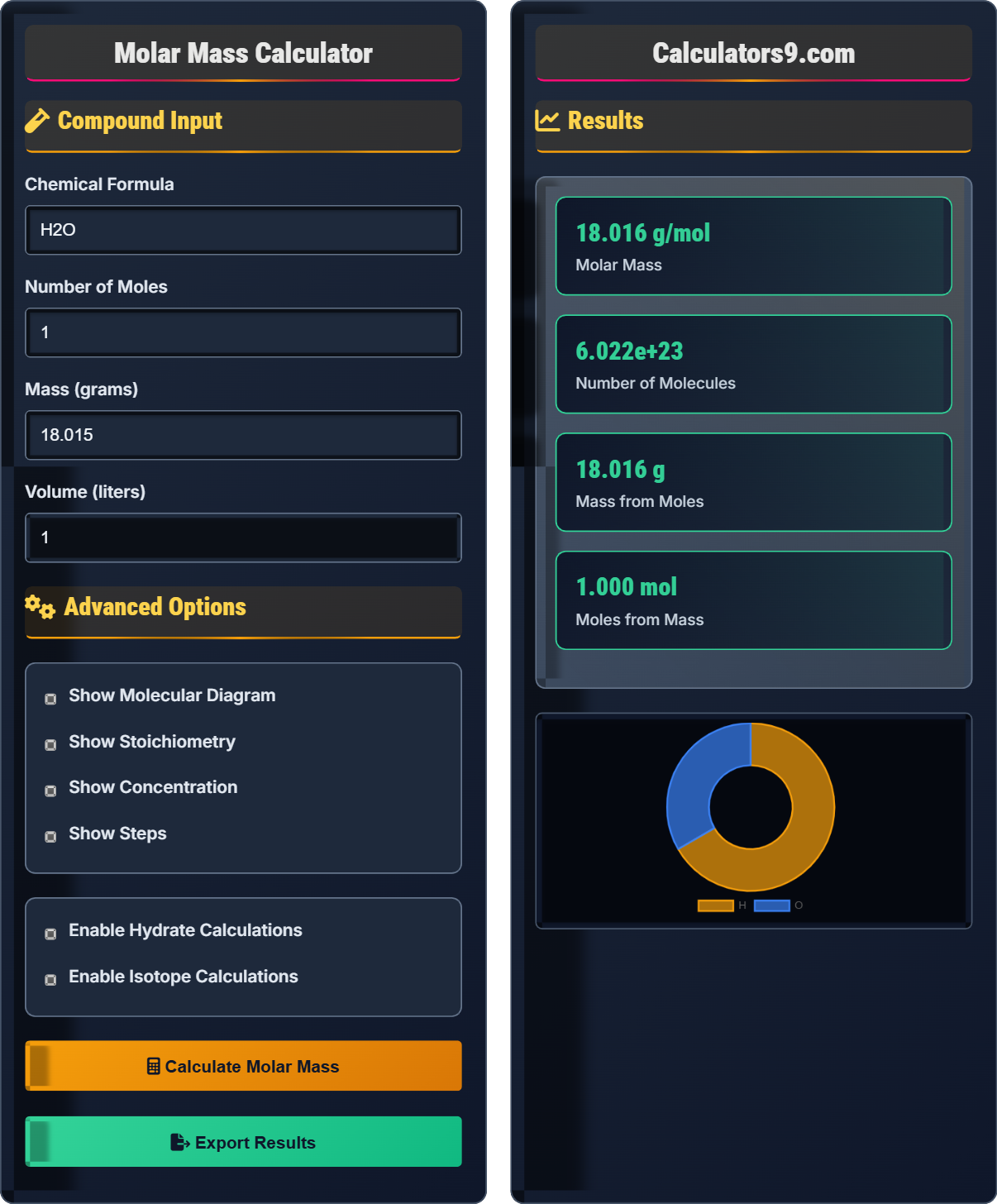
Example: Water (H₂O) has 2 hydrogen atoms and 1 oxygen atom:
\( M_{H_2O} = (2 \times 1.008) + (1 \times 15.999) = 2.016 + 15.999 = 18.015 \) g/mol
Thus, one mole of water has a mass of approximately 18.015 g.
Compound Input
Advanced Options
Results
| Component | Atomic Mass (g/mol) | Count | Contribution (g/mol) |
|---|
| Quantity | Value | Units |
|---|
| Element | Mass Percent | Atomic Percent |
|---|
Comprehensive Molar Mass Guide
Molar mass is the mass of one mole of a substance, expressed in grams per mole (g/mol). It represents the mass of 6.022×10²³ (Avogadro's number) particles of that substance. For elements, molar mass is numerically equal to the atomic mass in atomic mass units (amu). For compounds, it's the sum of the molar masses of all atoms in the molecular formula.
The calculation is:
Where:
- \(M\) = molar mass (g/mol)
- \(n_i\) = number of atoms of element i
- \(m_i\) = atomic mass of element i (g/mol)
Molar mass connects to other fundamental concepts:
Where n is moles, m is mass, N is number of particles, and N_A is Avogadro's number.
- Significant Figures: Match precision of experimental data
- Hydrates: Include water molecules in molar mass calculations
- Isotopes: Natural abundance affects average atomic masses
- Ion Charges: Don't affect molar mass calculations
Molar Mass Fundamentals
Mass of one mole of a substance (g/mol).
\(M = \sum (n_i \times m_i)\)
Where M=molar mass, n=count, m=atomic mass.
- Sum of atomic masses
- Equals formula weight
- Connects mass and moles
Applications
Stoichiometry and reaction balancing rely on molar mass.
- Solution preparation
- Reaction stoichiometry
- Empirical formulas
- Gas law calculations
- Match significant figures
- Include water in hydrates
- Consider isotopic abundances
- Account for ion charges
Molar Mass Learning Quiz
What is the molar mass of carbon dioxide (CO₂)? (Atomic masses: C = 12.01 g/mol, O = 16.00 g/mol)
The answer is B) 44.01 g/mol. Carbon dioxide has 1 carbon atom and 2 oxygen atoms. Using the molar mass formula: M = (1 × 12.01) + (2 × 16.00) = 12.01 + 32.00 = 44.01 g/mol. This represents the mass of 6.022×10²³ CO₂ molecules.
This calculation demonstrates the systematic approach to finding molar masses. Count the number of each type of atom in the formula, multiply by the atomic mass of each element, and sum all contributions. The subscript in CO₂ indicates 2 oxygen atoms, not 1.
Molar Mass: Mass of one mole of substance (g/mol)
Atomic Mass: Average mass of atoms of an element
Avogadro's Number: 6.022×10²³ particles per mole
• Count atoms correctly from chemical formula
• Multiply by correct atomic mass
• Sum all contributions
• Write out formula with atom counts
• Use periodic table for atomic masses
• Check subscripts carefully
• Forgetting to count all atoms
• Using wrong atomic mass values
• Misreading subscripts
Calculate the molar mass of glucose (C₆H₁₂O₆). (Atomic masses: C = 12.01 g/mol, H = 1.008 g/mol, O = 16.00 g/mol)
Glucose contains 6 carbon atoms, 12 hydrogen atoms, and 6 oxygen atoms.
Step 1: Calculate carbon contribution: 6 × 12.01 = 72.06 g/mol
Step 2: Calculate hydrogen contribution: 12 × 1.008 = 12.096 g/mol
Step 3: Calculate oxygen contribution: 6 × 16.00 = 96.00 g/mol
Step 4: Sum all contributions: 72.06 + 12.096 + 96.00 = 180.156 g/mol
Therefore, the molar mass of glucose is approximately 180.16 g/mol.
This example shows how to systematically break down complex molecules. Organize the calculation by element to avoid missing atoms. Glucose is a key biological molecule with an exact molar mass that's important in biochemistry.
Simple Sugar: Monosaccharide like glucose
Carbohydrate: Compounds with C, H, O in 1:2:1 ratio
Biological Fuel: Glucose provides energy in cells
• Count atoms for each element separately
• Use correct atomic masses
• Round appropriately for final answer
• Group by element: C₆, H₁₂, O₆
• Multiply first, then add
• Check total atom count
• Miscounting hydrogen atoms
• Forgetting to multiply by subscripts
• Adding before multiplying
If you have 90.08 g of glucose (C₆H₁₂O₆, molar mass = 180.16 g/mol), how many moles of glucose do you have? How many glucose molecules is this?
Step 1: Calculate moles using n = m/M
n = 90.08 g ÷ 180.16 g/mol = 0.500 mol
Step 2: Calculate number of molecules using N = n × N_A
N = 0.500 mol × 6.022×10²³ molecules/mol = 3.011×10²³ molecules
Therefore, you have 0.500 moles of glucose, which equals 3.011×10²³ glucose molecules.
This demonstrates the connection between mass, moles, and number of particles. The molar mass serves as a conversion factor between mass and moles. Avogadro's number converts between moles and particles. This is fundamental to stoichiometry.
Stoichiometry: Quantitative relationships in reactions
Mole Concept: Amount of substance containing N_A particles
Conversion Factor: Molar mass relates mass to moles
• n = m/M (moles = mass/molar mass)
• N = n × N_A (particles = moles × Avogadro's number)
• Use dimensional analysis
• Always check units cancel correctly
• Estimate reasonableness of answers
• Memorize Avogadro's number
• Dividing mass by moles instead of molar mass
• Forgetting Avogadro's number
• Incorrect unit conversions
Copper(II) sulfate pentahydrate has the formula CuSO₄·5H₂O. Calculate its molar mass, including the water of hydration. (Atomic masses: Cu = 63.55 g/mol, S = 32.07 g/mol, O = 16.00 g/mol, H = 1.008 g/mol)
Step 1: Calculate CuSO₄ contribution
Cu: 1 × 63.55 = 63.55 g/mol
S: 1 × 32.07 = 32.07 g/mol
O: 4 × 16.00 = 64.00 g/mol
Subtotal: 63.55 + 32.07 + 64.00 = 159.62 g/mol
Step 2: Calculate 5H₂O contribution
H₂O: (2 × 1.008) + (1 × 16.00) = 18.016 g/mol
5H₂O: 5 × 18.016 = 90.08 g/mol
Step 3: Calculate total molar mass
Total: 159.62 + 90.08 = 249.70 g/mol
Therefore, the molar mass of CuSO₄·5H₂O is 249.70 g/mol.
Hydrates contain water molecules in their crystal structure. The dot (·) separates the main compound from water molecules. Both contribute to the total molar mass. This is important in analytical chemistry when weighing hydrated salts.
Hydrate: Compound with water molecules in crystal lattice
Water of Hydration: Water molecules bound in crystalline structure
Dehydration: Removing water molecules from hydrate
• Include water in molar mass calculations
• Count water molecules separately
• Dot (·) means "and"
• Treat water as separate molecule
• Multiply water count by H₂O molar mass
• Add to main compound mass
• Forgetting water molecules
• Counting water atoms individually
• Misinterpreting the dot notation
What is the mass percent of oxygen in water (H₂O)? (Atomic masses: H = 1.008 g/mol, O = 16.00 g/mol)
The answer is B) 88.81%. First, calculate the molar mass of H₂O: M = (2 × 1.008) + (1 × 16.00) = 18.016 g/mol. The mass of oxygen in one mole of water is 16.00 g. Mass percent of oxygen = (mass of oxygen / total molar mass) × 100% = (16.00 / 18.016) × 100% = 88.81%.
This demonstrates mass percent composition, which is important for determining empirical formulas. Oxygen makes up the majority of water's mass despite hydrogen having more atoms. This is because oxygen atoms are much heavier than hydrogen atoms.
Mass Percent: (mass of element / total mass) × 100%
Composition: Relative amounts of elements in compound
Empirical Formula: Simplest whole-number ratio of atoms
• Mass % = (element mass / total mass) × 100%
• All mass percents sum to 100%
• Use molar masses for calculations
• Calculate total molar mass first
• Check that percents sum to ~100%
• Heavier atoms contribute more to mass
• Forgetting to multiply by 100%
• Using atomic numbers instead of masses
• Counting atoms instead of masses
FAQ
Q: How do isotopes affect molar mass calculations and why do we use average atomic masses?
A: Isotopes affect molar mass because they have different numbers of neutrons, resulting in different atomic masses. The average atomic mass shown on the periodic table is calculated using the natural abundance of each isotope:
\( \text{Average atomic mass} = \sum (\text{isotope mass} \times \text{natural abundance}) \)
For example, chlorine has two main isotopes: Cl-35 (75.77% abundance, 34.969 amu) and Cl-37 (24.23% abundance, 36.966 amu).
Calculated average: (0.7577 × 34.969) + (0.2423 × 36.966) = 35.45 amu
We use average atomic masses because samples contain the natural mix of isotopes, and this provides the most accurate molar mass for real-world calculations.
Q: How is molar mass used in biological applications, particularly in biochemistry?
A: Molar mass is crucial in biochemistry for numerous applications:
- Protein Analysis: Determining concentration from absorbance using Beer-Lambert law
- Enzyme Kinetics: Calculating turnover numbers and catalytic efficiency
- Drug Development: Dosing calculations and pharmacokinetics
- Metabolic Studies: Calculating flux rates through pathways
- PCR & DNA Analysis: Primer design and concentration calculations
For example, when preparing a 1 mM solution of insulin (molar mass ≈ 5808 g/mol), you would need 5.808 mg per liter. Accurate molar mass is essential for reproducible biochemical experiments.