pH Scale Estimator
Acidity analysis • 2026 chemistry
pH Formula:
Show the calculator\( \text{pH} = -\log[H^+] \)
Where:
- \( \text{pH} \) = potential of hydrogen
- \( [H^+] \) = hydrogen ion concentration (M)
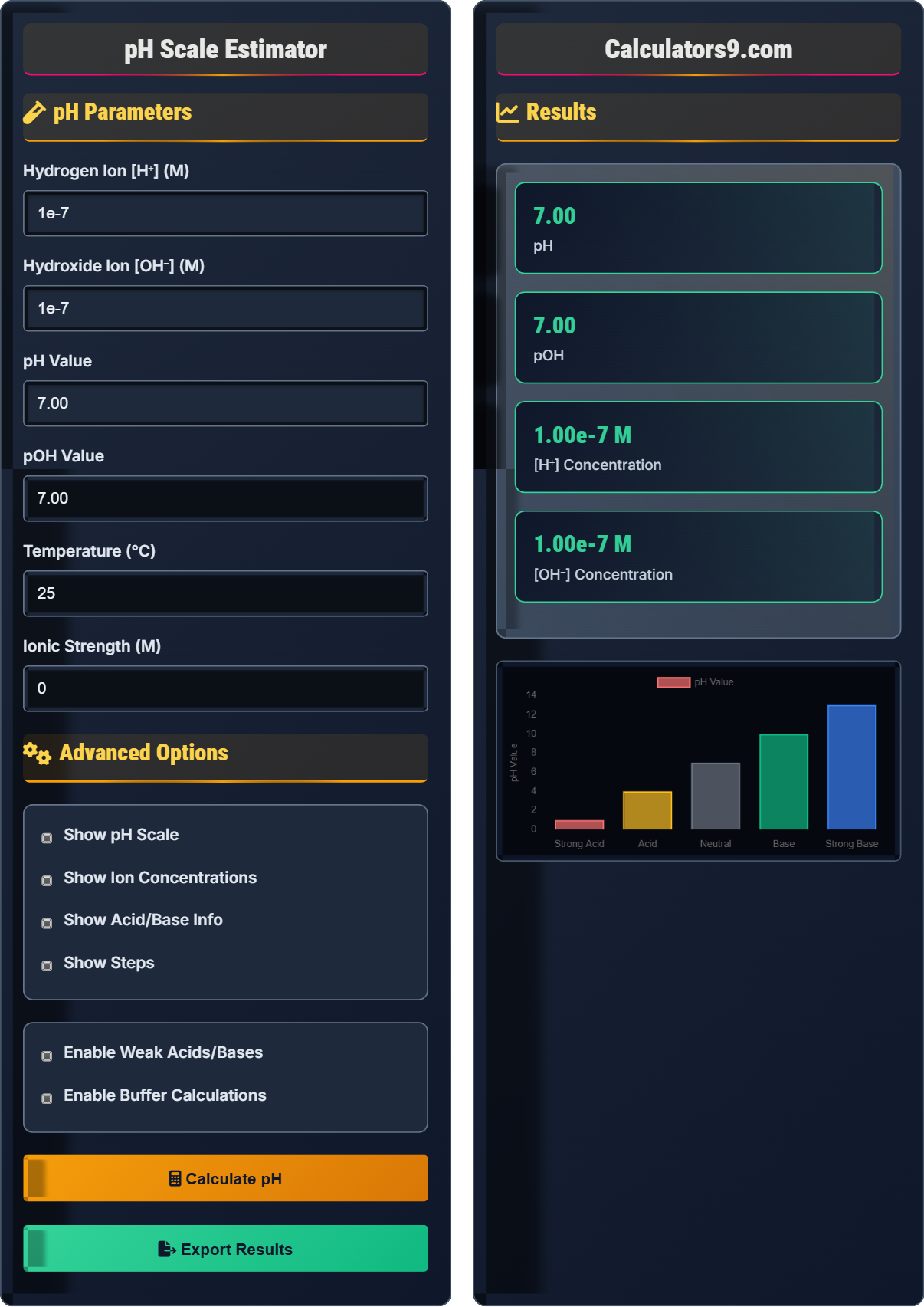
This logarithmic scale measures the acidity or basicity of a solution. pH values range from 0 (most acidic) to 14 (most basic), with 7 being neutral. The relationship between pH and pOH is: pH + pOH = 14. The scale is logarithmic, meaning each unit change represents a tenfold change in hydrogen ion concentration.
Examples:
- pH 1: [H⁺] = 1.0 × 10⁻¹ M (very acidic)
- pH 4: [H⁺] = 1.0 × 10⁻⁴ M (acidic)
- pH 7: [H⁺] = 1.0 × 10⁻⁷ M (neutral)
- pH 10: [H⁺] = 1.0 × 10⁻¹⁰ M (basic)
- pH 14: [H⁺] = 1.0 × 10⁻¹⁴ M (very basic)
pH Parameters
Advanced Options
Results
| Measurement | Value | Range |
|---|
| Ion | Concentration (M) | Scientific Notation |
|---|
| Property | Value | Significance |
|---|
Comprehensive pH Guide
pH is a measure of the acidity or basicity of an aqueous solution. The term "pH" stands for "potential of hydrogen." It measures the concentration of hydrogen ions (H⁺) in a solution on a logarithmic scale from 0 to 14. The pH scale is logarithmic, meaning each unit change represents a tenfold change in hydrogen ion concentration.
The fundamental equation is:
And the relationship between pH and pOH is:
Where [H⁺] is the hydrogen ion concentration in moles per liter (M).
The pH scale ranges from 0 to 14:
- Acidic: pH < 7 (higher [H⁺], lower [OH⁻])
- Neutral: pH = 7 ([H⁺] = [OH⁻] = 10⁻⁷ M)
- Basic: pH > 7 (lower [H⁺], higher [OH⁻])
- Temperature Effects: K_w changes with temperature
- Activity Coefficients: Ionic strength affects actual pH
- Buffer Solutions: Resist pH changes
- Weak Acids/Bases: Partial dissociation affects pH
pH Fundamentals
Measure of acidity/basicity on logarithmic scale 0-14.
\(\text{pH} = -\log[H^+]\)
Where [H⁺]=hydrogen ion concentration.
- Logarithmic scale
- Neutral pH = 7
- pH + pOH = 14
Applications
Blood pH, enzyme activity, and cellular processes depend on pH.
- Water treatment
- Food preservation
- Medical diagnostics
- Chemical processes
- Temperature affects pH
- Buffer systems maintain pH
- Weak acids have complex pH
- Activity coefficients matter
pH Learning Quiz
What is the pH of a solution with [H⁺] = 1.0 × 10⁻⁴ M?
The answer is A) 4.0. Using the pH formula: pH = -log[H⁺] = -log(1.0 × 10⁻⁴) = -(-4) = 4.0. The logarithm of 10⁻⁴ is -4, and the negative of that is 4.0. This represents an acidic solution.
When the hydrogen ion concentration is expressed in scientific notation with a negative exponent, the pH value is simply the positive value of that exponent. This is because the negative logarithm cancels the negative exponent. For 10⁻ⁿ, the pH is n.
pH: Negative logarithm of hydrogen ion concentration
Acidic: pH < 7
Logarithmic Scale: Each unit represents 10-fold change
• pH = -log[H⁺]
• Higher [H⁺] = lower pH
• Lower [H⁺] = higher pH
• For 10⁻ⁿ, pH = n
• Invert the exponent sign
• Remember: low pH = acidic
• Forgetting the negative sign in the formula
• Getting the inverse relationship wrong
• Confusing with pOH calculations
Calculate the pH of a solution with [H⁺] = 2.5 × 10⁻⁶ M. Show your work.
Using the pH formula: pH = -log[H⁺]
Given: [H⁺] = 2.5 × 10⁻⁶ M
Step 1: Apply the formula: pH = -log(2.5 × 10⁻⁶)
Step 2: Use logarithm properties: pH = -[log(2.5) + log(10⁻⁶)]
Step 3: Calculate: pH = -[log(2.5) + (-6)] = -[0.398 - 6] = -(-5.602) = 5.60
Therefore, the pH is approximately 5.60.
When the coefficient is not 1, we must use the logarithm properties: log(ab) = log(a) + log(b). For 2.5 × 10⁻⁶, we calculate log(2.5) + log(10⁻⁶) = 0.398 + (-6) = -5.602, then take the negative to get 5.60.
Logarithm Properties: log(ab) = log(a) + log(b)
Scientific Notation: Expressing numbers as a × 10ⁿ
Negative Logarithm: -log(x) inverts the sign
• Always use negative logarithm
• Break down scientific notation
• Apply logarithm properties correctly
• For a × 10⁻ⁿ, pH ≈ n - log(a)
• Use calculator for log(2.5)
• Verify answer is reasonable
• Forgetting to apply the negative sign
• Not using logarithm properties
• Misapplying the formula
A solution has a pH of 3.5. Calculate the pOH, [H⁺], and [OH⁻] of the solution. Is this solution acidic, basic, or neutral?
Step 1: Calculate pOH using pH + pOH = 14
pOH = 14 - pH = 14 - 3.5 = 10.5
Step 2: Calculate [H⁺] using pH = -log[H⁺]
[H⁺] = 10⁻ᵖᴴ = 10⁻³·⁵ = 3.16 × 10⁻⁴ M
Step 3: Calculate [OH⁻] using pOH = -log[OH⁻]
[OH⁻] = 10⁻ᵖᴼᴴ = 10⁻¹⁰·⁵ = 3.16 × 10⁻¹¹ M
Step 4: Determine acidity
Since pH = 3.5 < 7, the solution is acidic.
Therefore: pH = 3.5, pOH = 10.5, [H⁺] = 3.16 × 10⁻⁴ M, [OH⁻] = 3.16 × 10⁻¹¹ M, and the solution is acidic.
This demonstrates the relationship between pH and pOH. In any aqueous solution at 25°C, pH + pOH = 14. The hydrogen and hydroxide ion concentrations are related by Kw = [H⁺][OH⁻] = 10⁻¹⁴.
Autoionization: H₂O ⇌ H⁺ + OH⁻
Ion Product: Kw = [H⁺][OH⁻] = 10⁻¹⁴
Relationship: pH + pOH = 14
• pH + pOH = 14 at 25°C
• [H⁺] = 10⁻ᵖᴴ
• [OH⁻] = 10⁻ᵖᴼᴴ
• Use pH + pOH = 14 for quick conversions
• Remember: acidic pH < 7
• Always check ion product: [H⁺][OH⁻] = 10⁻¹⁴
• Forgetting pH + pOH = 14
• Confusing the exponents
• Not verifying the ion product
A buffer solution contains 0.1 M acetic acid (CH₃COOH) and 0.1 M sodium acetate (CH₃COONa). The Ka of acetic acid is 1.8 × 10⁻⁵. Calculate the pH of this buffer using the Henderson-Hasselbalch equation: pH = pKa + log([A⁻]/[HA]).
Step 1: Calculate pKa from Ka
pKa = -log(Ka) = -log(1.8 × 10⁻⁵) = 4.74
Step 2: Identify concentrations
[A⁻] = [acetate] = 0.1 M (from sodium acetate)
[HA] = [acetic acid] = 0.1 M
Step 3: Apply Henderson-Hasselbalch equation
pH = pKa + log([A⁻]/[HA]) = 4.74 + log(0.1/0.1) = 4.74 + log(1) = 4.74 + 0 = 4.74
Therefore, the pH of the buffer is 4.74.
Buffers resist pH changes by maintaining an equilibrium between a weak acid and its conjugate base. The Henderson-Hasselbalch equation simplifies pH calculations for buffer systems. When [A⁻] = [HA], the pH equals the pKa.
Buffer: Solution that resists pH changes
Conjugate Pair: HA and A⁻ in equilibrium
Henderson-Hasselbalch: pH = pKa + log([base]/[acid])
• pKa = -log(Ka)
• Buffer works best when pH ≈ pKa
• pH = pKa when [A⁻] = [HA]
• Buffer capacity highest near pKa
• Equal concentrations give pH = pKa
• Use for biological pH control
• Confusing pKa and Ka
• Using wrong concentrations
• Forgetting to calculate pKa
Which of the following statements about pH is CORRECT?
The answer is B) A solution with pH 3 is 100 times more acidic than pH 5. Since pH is logarithmic, the difference of 2 pH units represents a 10² = 100-fold difference in [H⁺]. pH 3 has [H⁺] = 10⁻³ M, while pH 5 has [H⁺] = 10⁻⁵ M. The ratio is 10⁻³/10⁻⁵ = 10² = 100.
The logarithmic nature of pH means that each unit change represents a tenfold change in hydrogen ion concentration. This exponential relationship is crucial for understanding the scale's sensitivity.
Logarithmic Scale: Each unit = 10-fold change
Acidity: Higher [H⁺] = lower pH
Temperature Dependence: Kw changes with temperature
• Lower pH = higher [H⁺] = more acidic
• Each pH unit = 10-fold [H⁺] change
• Neutral pH depends on temperature
• pH difference of n units = 10ⁿ difference in [H⁺]
• Remember: acidic < 7 < basic
• Always consider temperature effects
• Thinking pH and [H⁺] are directly proportional
• Forgetting the logarithmic nature
• Assuming neutral pH is always 7
FAQ
Q: How does temperature affect pH measurements and calculations?
A: Temperature significantly affects pH because the ion product of water (K_w) changes with temperature:
\( K_w = [H^+][OH^-] \)
At 25°C: K_w = 1.0 × 10⁻¹⁴ (neutral pH = 7.00)
At 50°C: K_w = 5.5 × 10⁻¹⁴ (neutral pH = 6.63)
At 0°C: K_w = 1.2 × 10⁻¹⁵ (neutral pH = 7.47)
Additionally, the dissociation constants (Ka/Kb) of acids and bases also vary with temperature, affecting the pH of solutions. This is why pH electrodes are temperature-compensated, and why pH values should specify the measurement temperature.
Q: Why is pH so important in biological systems and what are typical physiological pH values?
A: pH is critical in biological systems because:
- Enzyme Activity: Most enzymes have optimal pH ranges (e.g., pepsin at pH 2, trypsin at pH 8)
- Protein Structure: pH affects charge distribution and protein folding
- Membrane Transport: Many transporters depend on H⁺ gradients
- Cellular Processes: pH regulates metabolism and signaling
Typical physiological pH values:
- Blood: 7.35-7.45
- Stomach: 1.5-2.0
- Intestines: 7.0-8.5
- Lysosomes: 4.5-5.0
- Cell cytoplasm: 7.0-7.4
Even small deviations from optimal pH can severely impact biological function.