Solution Dilution Calculator
Concentration analysis • 2026 chemistry
Dilution Formula:
Show the calculator\( C_1V_1 = C_2V_2 \)
Where:
- \( C_1 \) = initial concentration (M)
- \( V_1 \) = initial volume (L)
- \( C_2 \) = final concentration (M)
- \( V_2 \) = final volume (L)
This fundamental equation expresses the conservation of moles in dilution processes. The number of moles of solute remains constant before and after dilution. The product of concentration and volume (C×V) represents moles of solute, which remains unchanged during dilution. This law is essential for preparing solutions of desired concentrations.
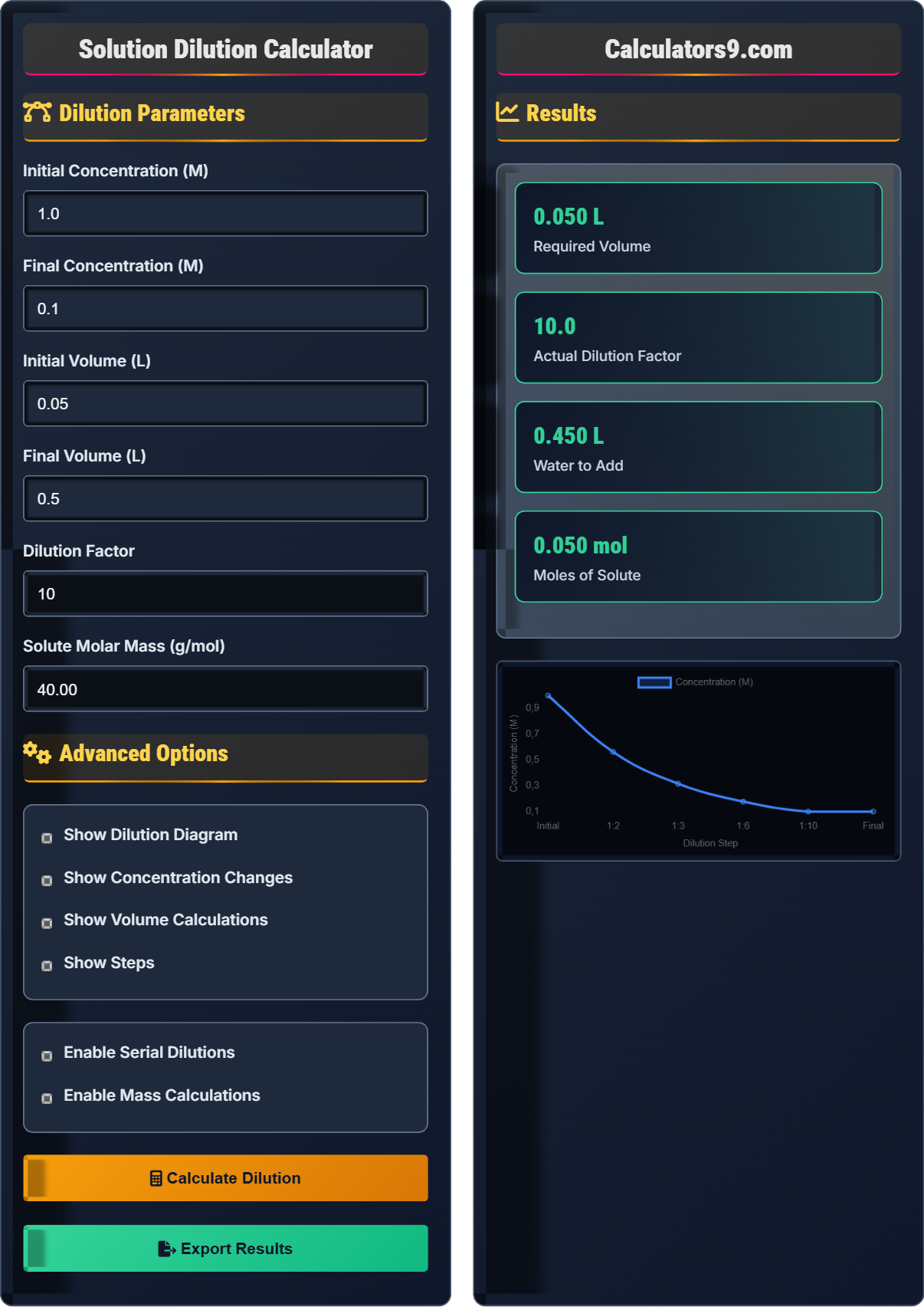
Example: To prepare 500 mL of 0.1 M NaOH from 1.0 M stock solution:
\( C_1V_1 = C_2V_2 \)
\( 1.0 \times V_1 = 0.1 \times 0.5 \)
\( V_1 = 0.05 \) L = 50 mL
Therefore, 50 mL of 1.0 M stock solution diluted to 500 mL gives 0.1 M solution.
Dilution Parameters
Advanced Options
Results
| Solution | Concentration (M) | Volume (L) | Moles |
|---|
| Measurement | Value | Units |
|---|
| Amount Type | Value | Units |
|---|
Comprehensive Solution Dilution Guide
Solution dilution is the process of reducing the concentration of a solute in a solution by adding more solvent (usually water). The dilution formula C₁V₁ = C₂V₂ expresses the conservation of moles during this process. The number of moles of solute remains constant, but the total volume increases, resulting in a lower concentration.
The fundamental equation is:
Where:
- \(C_1\) = initial concentration (M)
- \(V_1\) = initial volume (L)
- \(C_2\) = final concentration (M)
- \(V_2\) = final volume (L)
Dilution connects to other concentration measures:
Where M is molarity, n is moles, and V is volume.
- Significant Figures: Match precision of measurements
- Temperature: Volume changes with temperature
- Accuracy: Use proper volumetric glassware
- Safety: Add acid to water, not vice versa
Dilution Fundamentals
Reducing concentration by adding more solvent while keeping moles constant.
\(C_1V_1 = C_2V_2\)
Where C=concentration, V=volume.
- Moles remain constant
- Volume increases
- Concentration decreases
Applications
Standard solutions, serial dilutions, and titrations require dilution.
- Preparing standard solutions
- Serial dilutions
- Sample preparation
- Calibration curves
- Use proper glassware
- Match significant figures
- Consider temperature effects
- Follow safety protocols
Dilution Learning Quiz
What volume of 2.0 M NaOH is needed to prepare 250 mL of 0.4 M NaOH?
The answer is A) 50 mL. Using the dilution formula C₁V₁ = C₂V₂: 2.0 × V₁ = 0.4 × 0.250. Solving for V₁: V₁ = (0.4 × 0.250) / 2.0 = 0.100 / 2.0 = 0.050 L = 50 mL. Therefore, 50 mL of 2.0 M NaOH is needed to prepare 250 mL of 0.4 M NaOH.
This demonstrates the direct application of the dilution formula. The more concentrated solution requires a smaller volume to provide the same number of moles as the dilute solution. The key insight is that moles of solute remain constant during dilution.
Dilution: Reducing concentration by adding solvent
Conservation of Moles: n₁ = n₂ during dilutionMolarity: Moles per liter of solution (M)
• C₁V₁ = C₂V₂ always
• Moles remain constant
• Volume units must match
• Always identify known and unknown values
• Check units are consistent
• Verify answer makes sense
• Mixing up C₁ and C₂
• Forgetting to convert mL to L
• Not maintaining moles constant
You have 100 mL of 0.5 M HCl. Calculate the final concentration if you dilute it to 500 mL.
Using the dilution formula: C₁V₁ = C₂V₂
Given:
- C₁ = 0.5 M
- V₁ = 100 mL = 0.100 L
- V₂ = 500 mL = 0.500 L
- C₂ = ?
Step 1: Apply dilution formula: 0.5 × 0.100 = C₂ × 0.500
Step 2: Calculate: 0.050 = C₂ × 0.500
Step 3: Solve for C₂: C₂ = 0.050 / 0.500 = 0.10 M
Therefore, the final concentration is 0.10 M.
This shows how volume increases lead to concentration decreases. The solution is diluted 5-fold (500/100 = 5), so the concentration decreases by a factor of 5 (0.5/0.1 = 5). This inverse relationship is fundamental to dilution calculations.
Dilution Factor: Ratio of final to initial volume
Concentration: Amount of solute per volume of solution
Inverse Relationship: Volume and concentration are inversely related
• Volume and concentration are inversely related
• Moles stay the same
• Dilution factor = V₂/V₁
• Dilution factor = V₂/V₁
• Final conc = Initial conc / dilution factor
• Check that volume increases and concentration decreases
• Getting the inverse relationship wrong
• Forgetting to convert units
• Mixing up initial and final values
A scientist performs a serial dilution by taking 10 mL of a 1.0 M solution and diluting it to 100 mL. Then, 10 mL of this dilution is further diluted to 100 mL. What is the final concentration?
Step 1: First dilution (C₁V₁ = C₂V₂)
1.0 × 0.010 = C₂ × 0.100
C₂ = (1.0 × 0.010) / 0.100 = 0.10 M
Step 2: Second dilution (using 0.10 M solution)
0.10 × 0.010 = C₂ × 0.100
C₂ = (0.10 × 0.010) / 0.100 = 0.010 M
Step 3: Overall dilution factor
Overall factor = 1.0 M / 0.010 M = 100
Therefore, the final concentration is 0.010 M (a 100-fold dilution).
Each dilution step multiplies the total dilution factor. In this case, each 1:10 dilution contributes to a total 1:100 dilution. Serial dilutions are commonly used in laboratories to achieve very low concentrations.
Serial Dilution: Sequential dilution steps
Dilution Factor: Total dilution achieved
Cumulative Effect: Each step multiplies the dilution
• Each dilution step is independent
• Total dilution = product of individual factors
• Apply dilution formula to each step
• Track each dilution step separately
• Multiply dilution factors for total dilution
• Verify final concentration is reasonable
• Forgetting to apply dilution to each step
• Adding instead of multiplying dilution factors
• Not tracking intermediate concentrations
How many grams of NaCl (molar mass = 58.44 g/mol) are needed to prepare 250 mL of a 0.2 M solution? If this solution is then diluted to 1.0 L, what is the new molarity and mass of NaCl in the final solution?
Step 1: Calculate moles needed for 0.2 M solution
Moles = M × V = 0.2 mol/L × 0.250 L = 0.050 mol
Step 2: Calculate mass of NaCl needed
Mass = moles × molar mass = 0.050 mol × 58.44 g/mol = 2.92 g
Step 3: Calculate final molarity after dilution
Using C₁V₁ = C₂V₂: 0.2 × 0.250 = C₂ × 1.0
C₂ = (0.2 × 0.250) / 1.0 = 0.05 M
Step 4: Mass of NaCl remains constant
Mass in final solution = 2.92 g (same as initial)
Therefore, 2.92 g of NaCl are needed, final molarity is 0.05 M, and mass remains 2.92 g.
This problem connects molarity to mass and shows that dilution affects concentration but not the total amount of solute. The mass of solute remains constant during dilution, only the concentration changes as volume increases.
Molarity: Moles of solute per liter of solution
Mass Conservation: Solute mass remains constant during dilution
Concentration: Intensive property affected by dilution
• Moles of solute remain constant
• Mass of solute remains constant
• Concentration changes with volume
• Use M = n/V to connect molarity and moles
• Use n = mass/molar mass to connect moles and mass
• Remember: mass doesn't change during dilution
• Thinking mass changes during dilution
• Forgetting to convert volume units
• Confusing concentration with total amount
Which of the following represents the dilution factor when 5 mL of solution is diluted to 100 mL?
The answer is C) 20. The dilution factor is calculated as: Dilution Factor = V₂/V₁ = 100 mL / 5 mL = 20. Alternatively, it can be calculated as C₁/C₂, since C₁V₁ = C₂V₂ implies C₁/C₂ = V₂/V₁. The dilution factor represents how much the solution has been diluted.
The dilution factor tells us how many times more dilute the final solution is compared to the original. A dilution factor of 20 means the final concentration is 1/20th of the original concentration. This concept is important in laboratory work for expressing dilution levels.
Dilution Factor: V₂/V₁ or C₁/C₂
Concentration Reduction: Inverse of dilution factor
Volume Increase: Equal to dilution factor
• Dilution Factor = V₂/V₁
• Dilution Factor = C₁/C₂
• Final conc = Initial conc / dilution factor
• DF = final vol / initial vol
• DF = initial conc / final conc
• Higher DF = more dilute solution
• Calculating DF as V₁/V₂ instead of V₂/V₁
• Confusing dilution factor with concentration
• Forgetting that DF is dimensionless
FAQ
Q: What is the difference between dilution and concentration, and how do they relate mathematically?
A: Dilution and concentration are opposite processes:
Dilution: Adding solvent to decrease concentration (C₁V₁ = C₂V₂ where V₂ > V₁)
Concentration: Removing solvent (or adding more solute) to increase concentration
For dilution: \( C_1V_1 = C_2V_2 \) (moles remain constant, volume increases)
For concentration: \( C_1V_1 = C_2V_2 \) (moles remain constant, volume decreases)
The key difference is the direction of volume change. In both cases, the number of moles of solute remains constant, but the concentration changes inversely with volume.
Q: How is dilution used in biological applications, particularly in cell culture and microbiology?
A: Dilution is fundamental in biological applications:
- Cell Culture: Diluting media, drugs, or growth factors to appropriate concentrations
- Plate Counts: Serial dilutions to obtain countable colonies (typically 30-300 CFU)
- ELISA/Assays: Preparing standard curves and sample dilutions
- Antibiotic Testing: Creating concentration gradients for sensitivity tests
- PCR/qPCR: Diluting templates to optimal concentrations
For example, in bacterial counting, a 10⁻⁶ dilution might be plated to obtain 50 colonies, indicating the original culture had 50 × 10⁶ = 5 × 10⁷ CFU/mL.