Stoichiometry Balance Calculator
Reaction analysis • 2026 chemistry
Stoichiometry Formula:
Show the calculator\( aA + bB \rightarrow cC + dD \)
Where:
- \( a, b, c, d \) = stoichiometric coefficients
- \( A, B \) = reactants
- \( C, D \) = products
This fundamental principle of chemistry states that chemical reactions proceed according to fixed ratios of reactants and products. The law of conservation of mass requires that atoms are neither created nor destroyed in chemical reactions. Stoichiometric coefficients balance the equation so that the number of atoms of each element is equal on both sides.
Example: Combustion of methane:
\( CH_4 + 2O_2 \rightarrow CO_2 + 2H_2O \)
This balanced equation shows that 1 mole of methane reacts with 2 moles of oxygen to produce 1 mole of carbon dioxide and 2 moles of water.
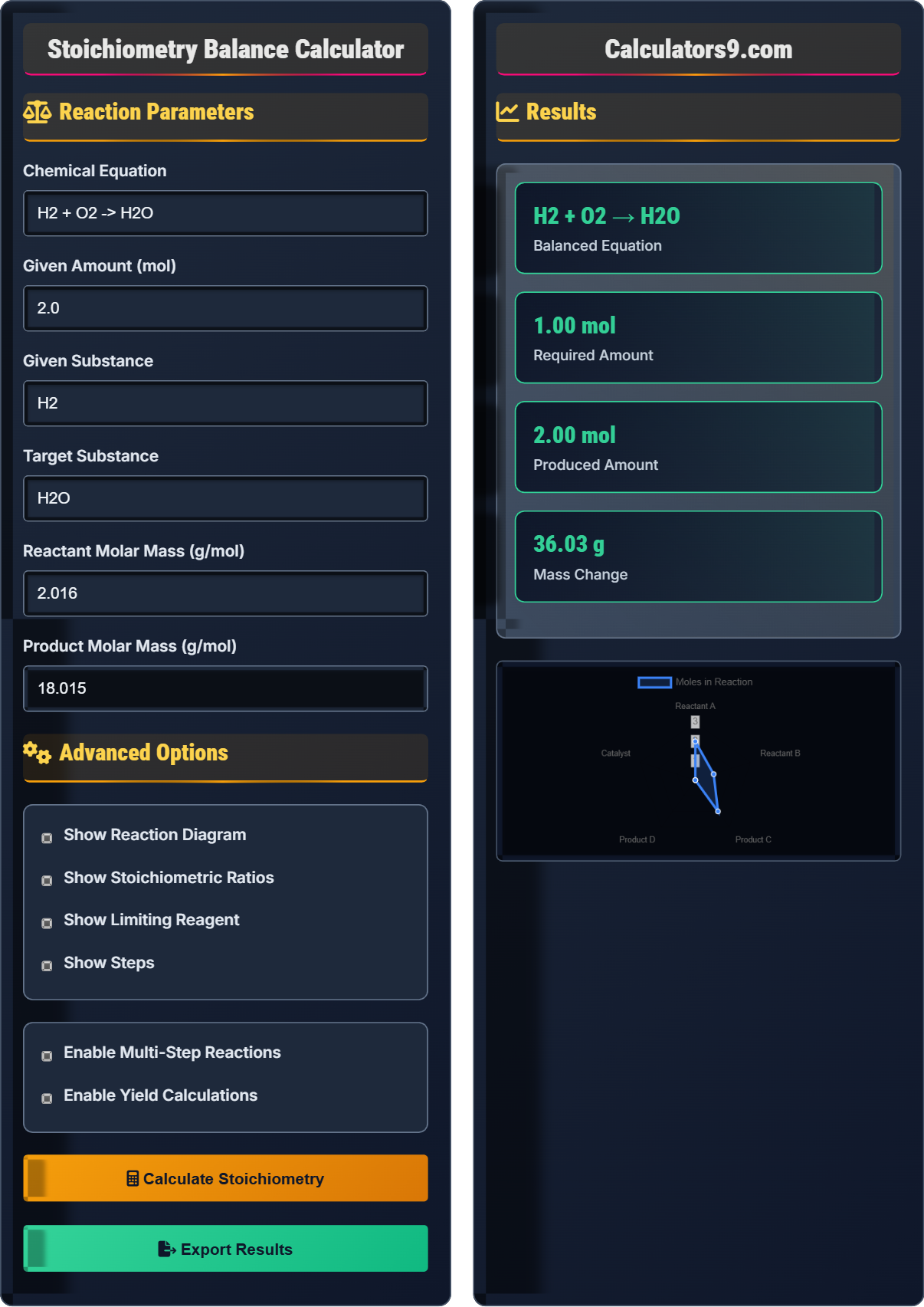
Reaction Parameters
Advanced Options
Results
| Substance | Coefficient | Mole Ratio | Mass Ratio |
|---|
| Substance | Moles | Mass (g) |
|---|
| Component | Mass (g) | Percent |
|---|
Comprehensive Stoichiometry Guide
Stoichiometry is the quantitative relationship between reactants and products in a chemical reaction. It is based on the law of conservation of mass, which states that matter cannot be created or destroyed in a chemical reaction. The coefficients in a balanced chemical equation represent the relative amounts of substances involved.
The fundamental principle is:
Where a, b, c, and d are stoichiometric coefficients that balance the equation.
The limiting reagent is the reactant that is completely consumed first, limiting the amount of product formed:
- Conservation of Mass: Total mass remains constant
- Conservation of Atoms: Atom count balanced on both sides
- Significant Figures: Match precision of measurements
- State of Matter: Affects volume calculations
Stoichiometry Fundamentals
Quantitative relationship between reactants and products.
\(aA + bB \rightarrow cC + dD\)
Where coefficients represent mole ratios.
- Mass conservation
- Atom conservation
- Balanced equations
Applications
Reaction prediction, yield calculations, and limiting reagent identification.
- Reaction prediction
- Yield calculations
- Limiting reagent identification
- Industrial scaling
- Conservation laws apply
- Significant figures matter
- State affects volume
- Percent yield important
Stoichiometry Learning Quiz
In the balanced equation 2H₂ + O₂ → 2H₂O, how many moles of H₂O are produced from 3 moles of H₂?
The answer is B) 3 moles. From the balanced equation, the mole ratio of H₂ to H₂O is 2:2, which simplifies to 1:1. Therefore, 3 moles of H₂ will produce 3 moles of H₂O. The stoichiometric coefficients provide the conversion factor between reactants and products.
This demonstrates the direct proportionality between reactants and products in a balanced equation. The coefficients act as conversion factors. For every 2 moles of H₂ consumed, exactly 2 moles of H₂O are produced, maintaining a 1:1 ratio.
Stoichiometric Coefficient: Numbers that balance the equation
Mole Ratio: Proportion between substances in reaction
Conservation of Mass: Matter is neither created nor destroyed
• Coefficients provide mole ratios
• Balanced equations are essential
• Mass is conserved
• Write mole ratios from coefficients
• Set up dimensional analysis
• Check that equation is balanced
• Using subscripts instead of coefficients
• Forgetting to balance the equation
• Not maintaining mole ratios
Calculate how many grams of water are produced when 10.0 g of hydrogen gas (H₂) reacts completely with excess oxygen. (Atomic masses: H = 1.008 g/mol, O = 16.00 g/mol)
Step 1: Write the balanced equation: 2H₂ + O₂ → 2H₂O
Step 2: Calculate molar mass of H₂: 2 × 1.008 = 2.016 g/mol
Step 3: Convert grams to moles of H₂: 10.0 g ÷ 2.016 g/mol = 4.96 mol
Step 4: Use mole ratio to find moles of H₂O: 4.96 mol H₂ × (2 mol H₂O/2 mol H₂) = 4.96 mol H₂O
Step 5: Calculate molar mass of H₂O: 2(1.008) + 16.00 = 18.016 g/mol
Step 6: Convert moles to grams of H₂O: 4.96 mol × 18.016 g/mol = 89.4 g
Therefore, 89.4 g of water are produced.
This problem demonstrates the three-step process: mass → moles → moles → mass. The mole ratio from the balanced equation connects the reactant to the product. Dimensional analysis ensures units cancel properly.
Molar Mass: Mass of one mole of substance
Dimensional Analysis: Method of unit cancellation
Excess Reactant: Present in more than needed
• Balance equation first
• Convert to moles using molar mass
• Use mole ratios from coefficients
• Always balance the equation first
• Use dimensional analysis for conversions
• Check units cancel correctly
• Forgetting to balance the equation
• Using incorrect molar masses
• Not using mole ratios correctly
In the reaction 2Al + 3Cl₂ → 2AlCl₃, if you start with 5.00 g Al and 10.0 g Cl₂, which is the limiting reagent and how much AlCl₃ can be produced? (Atomic masses: Al = 26.98 g/mol, Cl = 35.45 g/mol)
Step 1: Calculate molar masses
Al: 26.98 g/mol, Cl₂: 2(35.45) = 70.90 g/mol, AlCl₃: 26.98 + 3(35.45) = 133.33 g/mol
Step 2: Convert to moles
Al: 5.00 g ÷ 26.98 g/mol = 0.185 mol
Cl₂: 10.0 g ÷ 70.90 g/mol = 0.141 mol
Step 3: Determine limiting reagent using mole ratios
For Al: 0.185 mol ÷ 2 = 0.0925
For Cl₂: 0.141 mol ÷ 3 = 0.0470
Cl₂ is limiting since 0.0470 < 0.0925
Step 4: Calculate AlCl₃ produced using limiting reagent
0.141 mol Cl₂ × (2 mol AlCl₃/3 mol Cl₂) = 0.0940 mol AlCl₃
0.0940 mol × 133.33 g/mol = 12.5 g AlCl₃
Therefore, Cl₂ is the limiting reagent and 12.5 g of AlCl₃ can be produced.
To find the limiting reagent, divide moles of each reactant by its coefficient in the balanced equation. The smallest result identifies the limiting reagent. This method compares the actual mole ratio to the required mole ratio.
Limiting Reagent: Reactant that runs out first
Excess Reagent: Reactant left over after reaction
Theoretical Yield: Maximum product possible
• Divide moles by coefficient to find limiting reagent
• Use limiting reagent to calculate product
• Excess reagent remains after reaction
• Divide moles by coefficient for each reactant
• Smallest result = limiting reagent
• Always use limiting reagent for product calculations
• Using the wrong reactant to calculate product
• Not dividing by coefficients properly
• Confusing limiting with excess reagent
When 25.0 g of CaCO₃ decomposes according to CaCO₃ → CaO + CO₂, 12.5 g of CaO is actually obtained. Calculate the theoretical yield, actual yield, and percent yield. (Atomic masses: Ca = 40.08 g/mol, C = 12.01 g/mol, O = 16.00 g/mol)
Step 1: Calculate molar masses
CaCO₃: 40.08 + 12.01 + 3(16.00) = 100.09 g/mol
CaO: 40.08 + 16.00 = 56.08 g/mol
Step 2: Convert to moles of CaCO₃
25.0 g ÷ 100.09 g/mol = 0.250 mol
Step 3: Calculate theoretical yield of CaO
From equation: 1 mol CaCO₃ → 1 mol CaO
0.250 mol CaCO₃ → 0.250 mol CaO
0.250 mol × 56.08 g/mol = 14.0 g CaO (theoretical yield)
Step 4: Calculate percent yield
% yield = (actual yield/theoretical yield) × 100%
% yield = (12.5 g/14.0 g) × 100% = 89.3%
Therefore: theoretical yield = 14.0 g, actual yield = 12.5 g, percent yield = 89.3%
Percent yield compares actual laboratory results to theoretical predictions. Factors like incomplete reactions, side reactions, and handling losses contribute to yields less than 100%. The theoretical yield is calculated using stoichiometry.
Theoretical Yield: Maximum possible product
Actual Yield: Amount obtained experimentally
Percent Yield: (actual/theoretical) × 100%
• Theoretical yield comes from stoichiometry
• Actual yield comes from experiment
• Percent yield is always ≤ 100%
• Theoretical yield is calculated, not measured
• Actual yield is measured in lab
• Percent yield shows reaction efficiency
• Confusing theoretical with actual yield
• Using wrong values in percent yield formula
• Forgetting to multiply by 100%
Which of the following is NOT conserved in a chemical reaction?
The answer is C) Number of molecules. The law of conservation of mass states that mass and the number of atoms are conserved in chemical reactions. Charge is also conserved. However, the number of molecules can change during a reaction. For example, in 2H₂ + O₂ → 2H₂O, 3 molecules become 2 molecules.
This highlights the difference between microscopic and macroscopic conservation. While atoms are rearranged into new molecules, the total number of each type of atom remains constant. The number of molecules changes because atoms combine differently.
Conservation of Mass: Mass remains constant
Conservation of Atoms: Atom count unchanged
Molecular Rearrangement: Atoms form new molecules
• Atoms are conserved
• Mass is conserved
• Molecules may change
• Count atoms, not molecules
• Balance equations by adjusting coefficients
• Remember: atoms rearrange, don't disappear
• Thinking molecule count is conserved
• Confusing atoms with molecules
• Not distinguishing between conservation laws
FAQ
Q: How do you balance complex chemical equations systematically?
A: Here's a systematic approach for balancing complex equations:
1. Identify Elements: List all elements in the equation
2. Start with Complex Species: Balance polyatomic ions or elements that appear in only one reactant and one product
3. Balance Metals First: If present, balance metal atoms first
4. Balance Non-Metals: Balance non-metal atoms
5. Balance Oxygen: Balance O atoms (usually last)
6. Balance Hydrogen: Balance H atoms (usually last)
7. Check Charge Balance: For ionic equations, ensure total charge is balanced
For example, to balance: Fe₂O₃ + CO → Fe + CO₂
Start with Fe: 2Fe₂O₃ → 4Fe
Then C: 3CO → 3CO₂
Finally balance O: Fe₂O₃ + 3CO → 2Fe + 3CO₂
Q: How is stoichiometry applied in biological systems and metabolic pathways?
A: Stoichiometry is fundamental in biological systems:
Cellular Respiration: C₆H₁₂O₆ + 6O₂ → 6CO₂ + 6H₂O + ATP
This shows that 1 glucose molecule requires 6 O₂ molecules.
Photosynthesis: 6CO₂ + 6H₂O → C₆H₁₂O₆ + 6O₂
Shows 6 CO₂ molecules needed to produce 1 glucose.
Enzyme Kinetics: Understanding substrate-product ratios
Metabolic Flux Analysis: Quantifying pathway utilization
Drug Metabolism: Calculating therapeutic doses based on reaction stoichiometry
For example, knowing that 1 mol of glucose produces ~30-32 mol of ATP helps understand cellular energy efficiency.