Titration Curve Simulator
Acid-base analysis • 2026 chemistry
Titration Curve Formula:
Show the calculator\( \text{pH} = -\log[H^+] \)
For strong acid-strong base titration:
Before equivalence: \( \text{pH} = -\log\left(\frac{\text{moles H}^+}{\text{total volume}}\right) \)
At equivalence: \( \text{pH} = 7.0 \)
After equivalence: \( \text{pH} = 14 + \log\left(\frac{\text{moles OH}^-}{\text{total volume}}\right) \)
For weak acid-strong base titration, the Henderson-Hasselbalch equation is used in the buffer region: pH = pKa + log([A⁻]/[HA]). The equivalence point occurs at pH > 7. The steep rise near the equivalence point allows for precise endpoint detection.
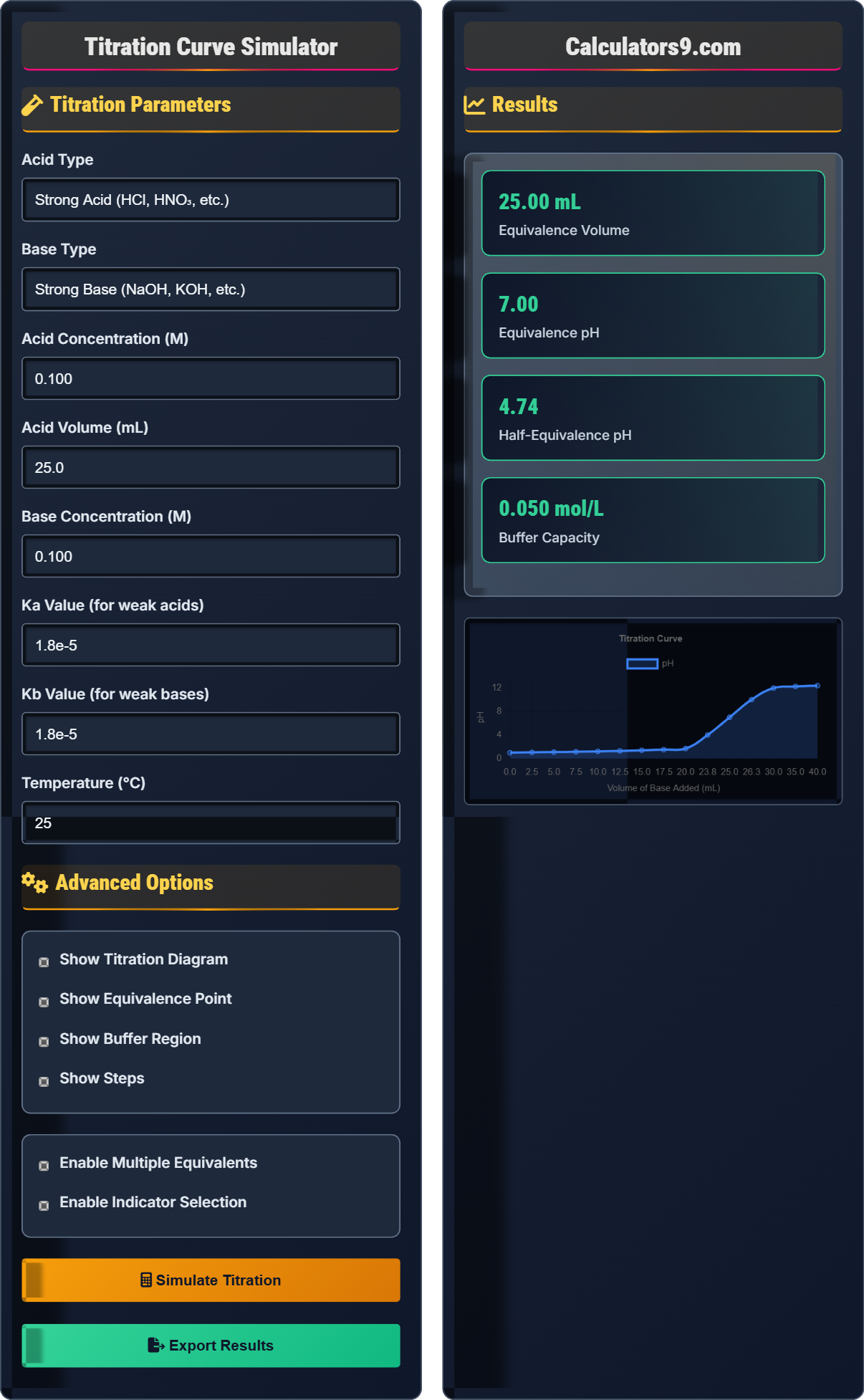
Example: For 25.0 mL of 0.100 M HCl titrated with 0.100 M NaOH:
At 12.5 mL NaOH added: [H⁺] = (2.50 - 1.25) mmol / 37.5 mL = 0.0333 M
pH = -log(0.0333) = 1.48
At equivalence (25.0 mL NaOH): pH = 7.00
Titration Parameters
Advanced Options
Results
| Volume (mL) | pH | Region |
|---|
| Volume Type | Value | Units |
|---|
| Equilibrium | Constant | Significance |
|---|
Comprehensive Titration Guide
A titration curve plots the pH of a solution as a function of the volume of titrant added. It reveals critical information about acid-base reactions, including equivalence points, buffer regions, and pKa values. The curve shape depends on the strength and concentration of the acid and base involved.
The curve has distinct regions:
For strong acid-strong base: pH = 7 at equivalence. For weak acid-strong base: pH > 7 at equivalence.
The equivalence point is where stoichiometric amounts of acid and base have reacted:
For polyprotic acids, multiple equivalence points occur.
- Temperature Effects: Kw changes with temperature
- Indicator Selection: Match to equivalence point pH
- Titration Speed: Slow near equivalence for accuracy
- Electrode Calibration: Ensure accurate pH measurements
Titration Fundamentals
pH vs. volume plot showing acid-base reaction progression.
\(C_aV_a = C_bV_b\)
Where C=concentration, V=volume, a=acid, b=base.
- Equivalence when moles acid = moles base
- Steep slope at equivalence point
- Buffer region around pKa
Applications
Quantitative analysis of acid/base concentrations and strengths.
- Concentration determination
- pKa/pKb measurement
- Buffer preparation
- Quality control
- Temperature affects Kw
- Indicator must match endpoint
- Slow titration near equivalence
- Electrode calibration critical
Titration Learning Quiz
For a strong acid-strong base titration, what is the pH at the equivalence point?
The answer is B) Equal to 7. At the equivalence point of a strong acid-strong base titration, the solution contains only salt (like NaCl) and water. Since neither the cation (Na⁺) nor the anion (Cl⁻) hydrolyzes significantly, the pH is neutral at 7.00 at 25°C.
This demonstrates that strong acids and strong bases completely neutralize each other, forming neutral salt and water. The conjugate base of a strong acid and the conjugate acid of a strong base are both very weak and do not affect the pH.
Equivalence Point: When moles of acid = moles of base
Neutral Salt: Salt that doesn't hydrolyze in water
Strong Acid/Base: Completely ionized in solution
• Strong acid + Strong base → pH = 7 at equivalence
• Weak acid + Strong base → pH > 7 at equivalence
• Strong acid + Weak base → pH < 7 at equivalence
• Remember: neutral salt = neutral pH
• Conjugate of strong = weak (no effect)
• Conjugate of weak = strong (affects pH)
• Thinking all titrations have pH = 7 at equivalence
• Forgetting about salt hydrolysis
• Confusing equivalence with endpoint
Calculate the volume of 0.100 M NaOH needed to reach the equivalence point when titrating 25.0 mL of 0.100 M HCl.
At equivalence: moles of acid = moles of base
Step 1: Calculate moles of HCl
moles_HCl = M × V = 0.100 M × 0.0250 L = 0.00250 mol
Step 2: Calculate volume of NaOH needed
moles_NaOH = moles_HCl = 0.00250 mol
V_NaOH = moles_NaOH / M_NaOH = 0.00250 mol / 0.100 M = 0.0250 L = 25.0 mL
Therefore, 25.0 mL of NaOH is needed to reach the equivalence point.
This demonstrates the 1:1 stoichiometry of HCl + NaOH → NaCl + H₂O. When both acid and base have the same concentration, equal volumes are needed for complete neutralization. The calculation relies on the mole relationship at equivalence.
Equivalence Point: When stoichiometric amounts react
Mole Relationship: Based on balanced equation
Stoichiometry: Molar ratios in chemical equation
• At equivalence: moles_acid = moles_base
• Use balanced equation for mole ratios
• Concentration = moles/volume
• Write balanced equation first
• Calculate moles before volumes
• Check that units cancel properly
• Forgetting to balance the equation
• Using wrong mole ratios
• Unit conversion errors
In the titration of 25.0 mL of 0.100 M acetic acid (Ka = 1.8 × 10⁻⁵) with 0.100 M NaOH, what is the pH after adding 12.5 mL of NaOH? (This is at the half-equivalence point.)
At the half-equivalence point, [HA] = [A⁻], so the Henderson-Hasselbalch equation simplifies:
pH = pKa + log([A⁻]/[HA]) = pKa + log(1) = pKa
Step 1: Calculate pKa
pKa = -log(Ka) = -log(1.8 × 10⁻⁵) = 4.74
Step 2: Apply Henderson-Hasselbalch
At half-equivalence: pH = pKa = 4.74
Therefore, the pH after adding 12.5 mL of NaOH is 4.74.
This demonstrates a special property of weak acid titrations: at the half-equivalence point, pH = pKa. This occurs because equal concentrations of weak acid and its conjugate base form an ideal buffer, where pH = pKa + log(1) = pKa.
Half-Equivalence Point: When 50% of acid is neutralized
Buffer Region: Where pH changes gradually
Henderson-Hasselbalch: pH = pKa + log([A⁻]/[HA])
• At half-equivalence: pH = pKa
• Buffer region: pH ≈ pKa ± 1
• Henderson-Hasselbalch applies to buffers
• Remember: half-equivalence → pH = pKa
• Use Henderson-Hasselbalch for buffers
• Buffer capacity greatest at pH = pKa
• Forgetting Henderson-Hasselbalch equation
• Not recognizing half-equivalence point
• Using wrong concentrations
For phosphoric acid (H₃PO₄), which has three pKa values: pKa₁ = 2.12, pKa₂ = 7.21, pKa₃ = 12.32, how many equivalence points would appear on a titration curve with NaOH? Describe the pH at each equivalence point.
Phosphoric acid is a triprotic acid with three ionizable hydrogens, so it will have three equivalence points:
Step 1: First equivalence point (H₃PO₄ → H₂PO₄⁻)
pH ≈ (pKa₁ + pKa₂)/2 = (2.12 + 7.21)/2 = 4.67
Step 2: Second equivalence point (H₂PO₄⁻ → HPO₄²⁻)
pH ≈ (pKa₂ + pKa₃)/2 = (7.21 + 12.32)/2 = 9.77
Step 3: Third equivalence point (HPO₄²⁻ → PO₄³⁻)
pH > 12.32 (basic, as PO₄³⁻ is a strong base)
Therefore, three equivalence points appear with pH values of approximately 4.67, 9.77, and >12.
Each ionizable hydrogen in a polyprotic acid creates an equivalence point. The pH at each equivalence point is roughly the average of adjacent pKa values. The third equivalence point for H₃PO₄ occurs at very high pH because PO₄³⁻ is a strong base that hydrolyzes extensively.
Polyprotic Acid: Acid with multiple ionizable hydrogens
Triprotic Acid: Has three ionizable hydrogens
Successive Ionization: Each H⁺ removed sequentially
• Number of equivalence points = number of ionizable H⁺
• pH at equivalence ≈ average of adjacent pKa values
• Each pKa represents a distinct ionization step
• Count ionizable hydrogens for equivalence points
• pH between pKa values at equivalence
• Very weak conjugate bases → high pH
• Counting total H atoms instead of ionizable H⁺
• Forgetting that each ionization is separate
• Assuming all equivalence points at pH = 7
Which indicator would be most appropriate for the titration of acetic acid with NaOH? (Acetic acid: Ka = 1.8 × 10⁻⁵, equivalence point pH ≈ 8.7)
The answer is C) Phenolphthalein (pH 8.2-10.0). For the titration of a weak acid with a strong base, the equivalence point occurs at pH > 7 (approximately 8.7 for acetic acid). Phenolphthalein changes color in the pH range 8.2-10.0, which encompasses the equivalence point pH of 8.7.
Indicator selection is critical for accurate titration results. The indicator's color change range should bracket the equivalence point pH. Methyl orange would change too early, bromothymol blue would change too early, and universal indicator is too broad.
Indicator: Substance that changes color at specific pH
Endpoint: Point where indicator changes color
Equivalence Point: Point of complete neutralization
• Indicator range should include equivalence pH
• Weak acid + Strong base → pH > 7 at equivalence
• Strong acid + Weak base → pH < 7 at equivalence
• Match indicator range to equivalence pH
• Weak acid + strong base → basic equivalence
• Strong acid + strong base → neutral equivalence
• Using indicator for wrong pH range
• Confusing endpoint with equivalence point
• Not considering acid/base strength
FAQ
Q: What is the difference between the endpoint and equivalence point in a titration?
A: The distinction is critical:
Equivalence Point: Theoretical point where stoichiometric amounts of acid and base have reacted. Calculated based on the reaction stoichiometry: moles of acid = moles of base.
Endpoint: Experimental point where the indicator changes color, signaling the completion of the titration.
The goal is to choose an indicator whose color change occurs as close as possible to the equivalence point. The closer the endpoint matches the equivalence point, the more accurate the titration result. The difference between them is called the titration error.
Q: How is titration used in biological and biochemical applications?
A: Titration has numerous biological applications:
Amino Acid Analysis: Determining amino acid content through acid-base titration.
Enzyme Kinetics: Monitoring pH changes during enzymatic reactions.
Protein Analysis: Determining isoelectric points and buffering capacity.
Food Analysis: Measuring acidity in foods and beverages.
Medical Diagnostics: Blood pH measurements and acid-base balance studies.
For example, the titration of amino acids exploits their amphoteric nature, allowing determination of pKa values and concentration in biological samples.