Angle Bisector Finder
Geometry tool • 2026 edition
$$\frac{AC}{AB} = \frac{CD}{DB}$$
The angle bisector theorem states that the angle bisector of a triangle divides the opposite side into segments proportional to the adjacent sides.
Components:
- AC and AB = sides adjacent to the angle being bisected
- CD and DB = segments of the opposite side
Coordinate Form:
For angle bisector of angle at point A with sides AB and AC:
$$\vec{u} = \frac{\vec{AB}}{|\vec{AB}|} + \frac{\vec{AC}}{|\vec{AC}|}$$
Point Form:
If D divides BC in ratio AB:AC, then:
$$D = \frac{AC \cdot B + AB \cdot C}{AC + AB}$$
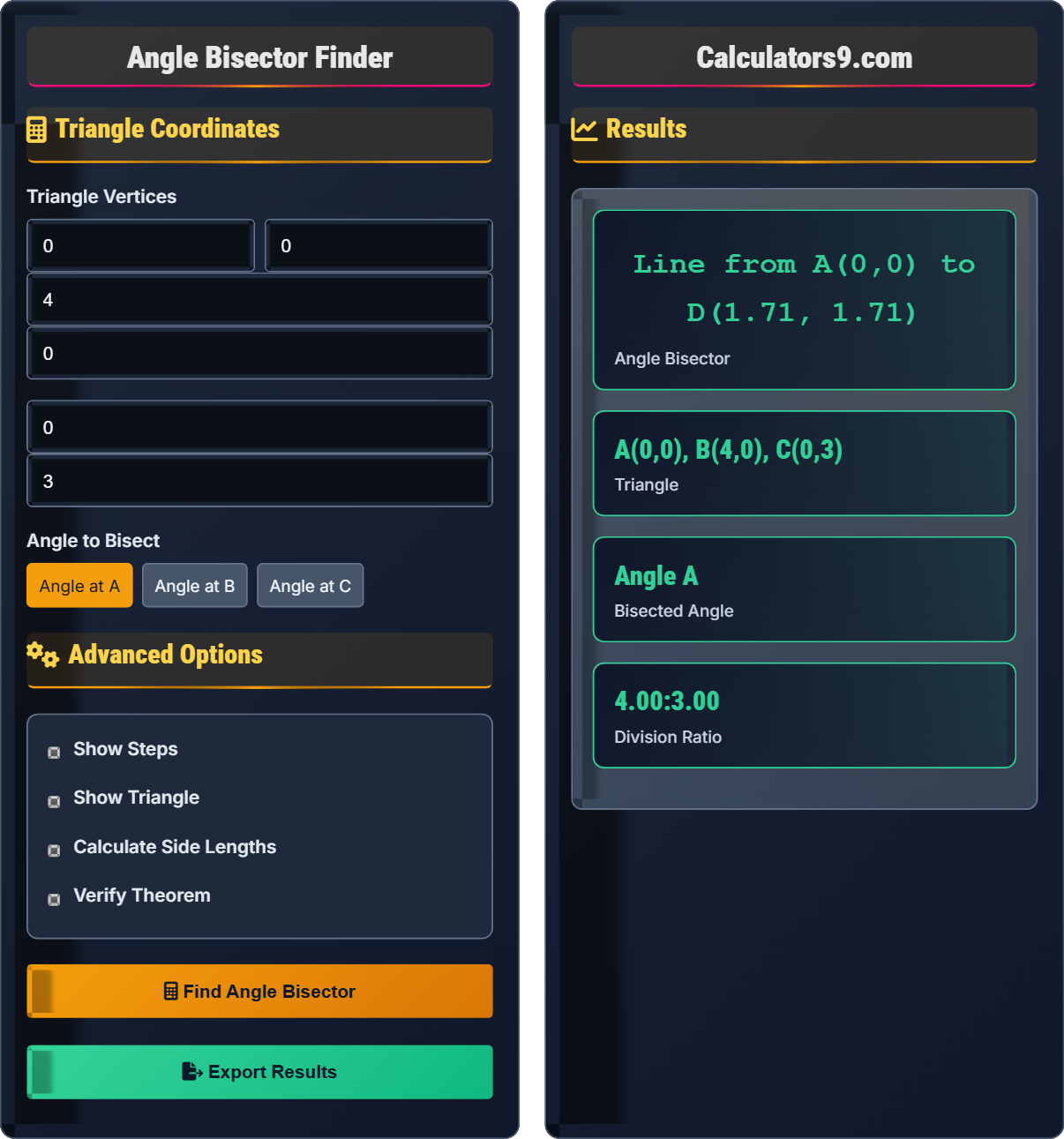
Example: For triangle ABC with A(0,0), B(4,0), C(0,3), the angle bisector at A divides BC in ratio AB:AC = 4:3.
Triangle Coordinates
Advanced Options
Results
Comprehensive Angle Bisector Guide
An angle bisector is a ray or line segment that divides an angle into two congruent angles. In a triangle, the angle bisector of an angle divides the opposite side into segments proportional to the adjacent sides.
The angle bisector theorem states that if AD is the angle bisector of angle A in triangle ABC, then:
- BD/DC = AB/AC (the ratio of the segments equals the ratio of the adjacent sides)
- Point D divides side BC in the ratio of the other two sides
- This relationship holds for any angle bisector in a triangle
Angle bisector calculations in special situations:
- Isosceles triangle: Bisector of vertex angle is also median and altitude
- Right triangle: Special relationships apply to angle bisectors
- Equilateral triangle: All angle bisectors are identical and concurrent
- Coordinate form: Vector addition of normalized adjacent sides
- Construction: Creating precise angles and divisions
- Engineering: Stress distribution in structural elements
- Computer Graphics: Lighting and rendering algorithms
- Navigation: Pathfinding and route optimization
- Art & Design: Symmetrical compositions and proportions
Angle Bisector Fundamentals
An angle bisector is a line or ray that divides an angle into two equal parts, creating two congruent angles.
Angle bisector theorem: In triangle ABC with angle bisector AD, BD/DC = AB/AC.
- Angle bisector divides angle into two equal parts
- Ratio of opposite segments equals ratio of adjacent sides
- Points on bisector are equidistant from angle sides
- Three angle bisectors meet at incenter (center of inscribed circle)
Advanced Concepts
The incenter is the point where all three angle bisectors of a triangle intersect; it's the center of the inscribed circle.
- Calculate side lengths using distance formula
- Apply ratio to find division point
- Use section formula to find coordinates
- Connect vertex to division point for bisector
- Angle bisector always lies inside the angle
- Any point on bisector is equidistant from angle sides
- Length of angle bisector can be calculated using specific formula
- Angle bisector never extends beyond the triangle
Angle Bisector Learning Quiz
Find the point where the angle bisector of angle A meets side BC in triangle ABC with vertices A(0,0), B(4,0), and C(0,3). Show all steps and explain the geometric reasoning behind the angle bisector theorem.
Step 1: Identify the triangle vertices: A(0,0), B(4,0), C(0,3)
Step 2: Calculate side lengths adjacent to angle A:
AB = √[(4-0)² + (0-0)²] = √16 = 4
AC = √[(0-0)² + (3-0)²] = √9 = 3
Step 3: Apply the angle bisector theorem:
The angle bisector divides BC in the ratio AB:AC = 4:3
Geometric Reasoning: The angle bisector theorem states that the angle bisector of an angle in a triangle divides the opposite side into segments proportional to the adjacent sides. This is because the bisector creates two smaller triangles that share a common angle and have equal angles at the vertex, making them similar in a specific way.
Step 4: Find point D that divides BC in ratio 4:3:
Using section formula: D = (mC + nB)/(m + n), where m:n = 4:3
D = (4C + 3B)/(4 + 3) = (4(0,3) + 3(4,0))/7 = ((0,12) + (12,0))/7 = (12,12)/7 = (12/7, 12/7)
Step 5: Simplify: D = (12/7, 12/7) ≈ (1.71, 1.71)
Therefore, the angle bisector of angle A meets side BC at point D(12/7, 12/7) or approximately (1.71, 1.71).
This problem demonstrates the powerful angle bisector theorem, which establishes a proportional relationship between segments created by an angle bisector. The theorem is fundamental in geometry because it connects the angular property (bisector) with linear properties (side lengths). Understanding this theorem helps solve complex geometric problems by converting angular relationships into proportional ones.
The theorem has practical applications in various fields.
Angle Bisector: A line that divides an angle into two equal parts
Angle Bisector Theorem: The bisector divides the opposite side proportionally to adjacent sidesSection Formula: Formula to find point dividing a line segment in given ratio
• The ratio is always adjacent side to adjacent side
• Apply section formula correctly with proper ratio
• The bisector always lies inside the triangle
• Remember: ratio is always adjacent sides, not opposite
• The angle bisector theorem applies to any triangle
• Check that your point lies on the correct side
• Confusing the ratio (using opposite instead of adjacent)
• Applying section formula incorrectly
• Forgetting to verify the point is on the correct side
A triangular plot of land has corners at A(0,0), B(10,0), and C(0,8). A developer wants to build a path from corner A that divides the angle at A equally, reaching the opposite side BC. Where will this path meet side BC? If the path costs $50 per unit length, what is the total cost of the path?
Step 1: Identify triangle vertices: A(0,0), B(10,0), C(0,8)
Step 2: Calculate adjacent side lengths:
AB = √[(10-0)² + (0-0)²] = √100 = 10
AC = √[(0-0)² + (8-0)²] = √64 = 8
Step 3: Apply angle bisector theorem:
The bisector divides BC in ratio AB:AC = 10:8 = 5:4
Step 4: Find point D that divides BC in ratio 5:4:
Using section formula: D = (mC + nB)/(m + n), where m:n = 5:4
D = (5C + 4B)/(5 + 4) = (5(0,8) + 4(10,0))/9 = ((0,40) + (40,0))/9 = (40,40)/9
D = (40/9, 40/9) ≈ (4.44, 4.44)
Step 5: Calculate path length from A to D:
Path length = √[(40/9 - 0)² + (40/9 - 0)²] = √[2×(40/9)²] = √[2×1600/81] = (40√2)/9 ≈ 6.29 units
Step 6: Calculate total cost:
Cost = 6.29 units × $50/unit = $314.50
Therefore, the path meets BC at approximately (4.44, 4.44) and costs $314.50.
This application problem connects angle bisector calculations to real-world scenarios. The key insight is that the angle bisector theorem provides a proportional relationship that can be used to find exact division points. The problem demonstrates how geometric theorems apply to practical situations like construction and land development, where precise angular divisions are necessary.
Mathematical concepts often have direct real-world applications.
Triangular Plot: Land area shaped as a triangle
Angle Division: Creating equal angles from a vertex
Proportional Relationship: Maintaining constant ratios
• Apply the angle bisector theorem consistently
• Calculate distances accurately using coordinate geometry
• Include unit conversions when needed
• Draw a diagram to visualize the problem
• Simplify ratios before applying formulas
• Verify that your answer makes practical sense
• Not simplifying the ratio correctly
• Calculating distances incorrectly
• Forgetting to calculate the final cost
FAQ
Q: What is the difference between an angle bisector and a perpendicular bisector?
A: These are different geometric constructions:
Angle Bisector:
- Divides an angle into two equal parts
- Passes through the vertex of the angle
- Creates two congruent angles
- Related to the angle bisector theorem
Perpendicular Bisector:
- Divides a line segment into two equal parts
- Perpendicular to the segment
- Does not necessarily pass through an angle vertex
- All points are equidistant from segment endpoints
Angle bisectors deal with angles, while perpendicular bisectors deal with line segments.
Q: How do the three angle bisectors of a triangle relate to each other?
A: The three angle bisectors of a triangle have a remarkable property:
Concurrency: All three angle bisectors intersect at a single point called the incenter.
Incenter Properties:
- Equidistant from all three sides of the triangle
- Center of the inscribed circle (incircle)
- Always lies inside the triangle
- Located at intersection of all three angle bisectors
This concurrency is one of the fundamental theorems of triangle geometry, along with the concurrency of medians (centroid), altitudes (orthocenter), and perpendicular bisectors (circumcenter).